The Drumbeat Nobody Warned Them About
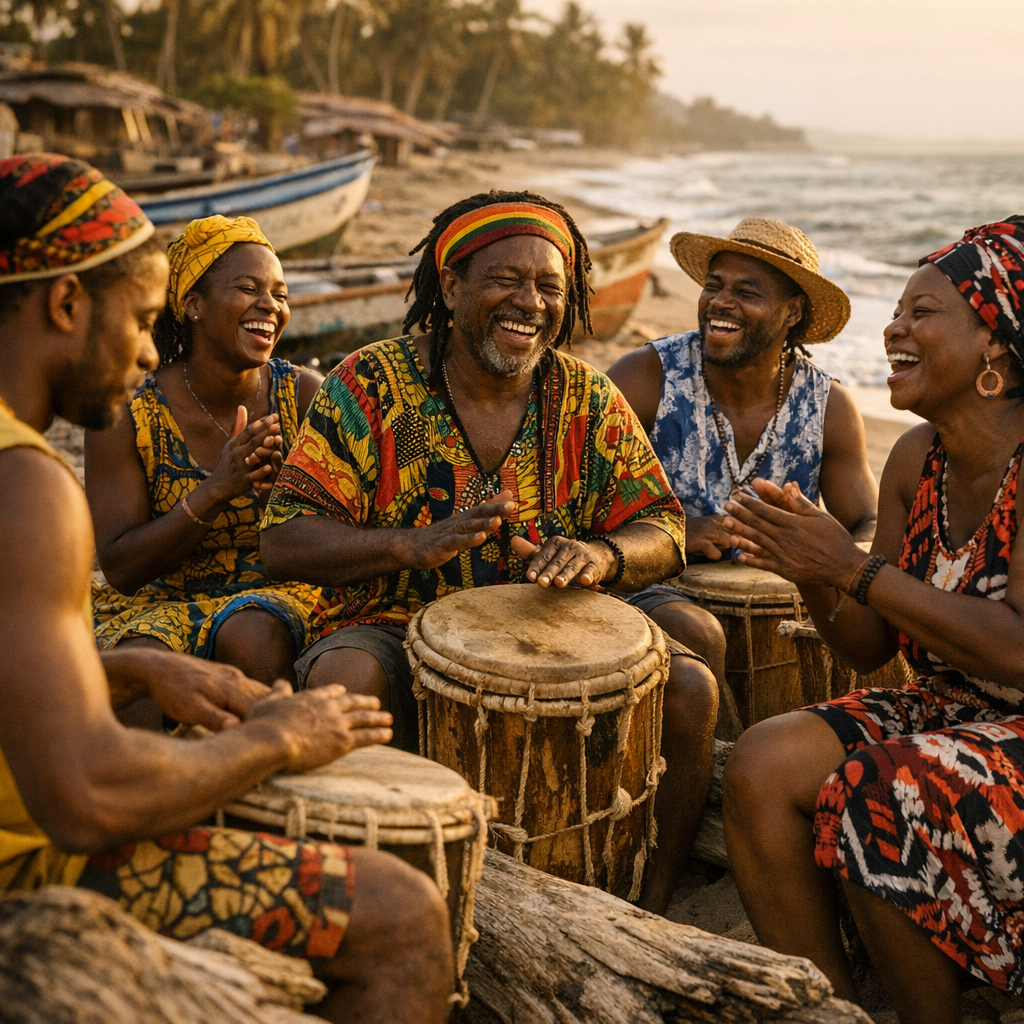
A group of Black travelers lands in Roatan expecting what the brochures promised: Maya ruins a short ferry ride away, some of the best reef diving in the Western Hemisphere, resort buffets and rum punch on white sand. Then, on a Friday evening in Punta Gorda, on the island’s north shore, they follow a sound they can’t place — a layered, hypnotic pulse of primero and segunda drums — and walk into a Garifuna settlement day celebration. Women in bright orange, yellow, and black turns and skirts move in the punta dance. Men beat drums carved from mahogany and mayflower wood, skinned with deer or peccary hide. Someone hands them a plate of hudut, mashed plantain in coconut fish soup. Nobody is speaking Spanish. They’re speaking a language that exists nowhere else on Earth.
Most visitors to Honduras never learn this story, and that is by design more than accident — it’s a story that was almost erased on purpose, twice. It begins not in Honduras at all, but on a small volcanic island more than a thousand miles away, and it ends with one of the only Afro-Indigenous nations in the Americas that never went through plantation slavery to become who they are.
A Shipwreck, an Island, and a New People
In the mid-1600s, the Lesser Antilles island of St. Vincent — never successfully colonized by Europeans and still held by Indigenous Island Caribs — became the unlikely birthplace of a new people. The most commonly cited origin involves two Spanish slave ships wrecked off St. Vincent around 1635, whose captive Africans swam or were rescued ashore. Other accounts point to earlier arrivals: Africans who escaped from British and French plantations on neighboring islands and found refuge among the Caribs, who controlled St. Vincent and were willing to shelter them. However they arrived, West and Central African survivors intermarried with the Indigenous Island Caribs already living there, and over generations a distinct culture emerged — the Garinagu, known in English as the Garifuna: Afro-Indigenous, with their own Arawakan-based language layered with African and French vocabulary, their own cuisine, their own cosmology, and their own name for themselves that predates any colonial label.
The British called them “Black Caribs” to distinguish them from the “Yellow Caribs” who had not intermarried with Africans — a racial sorting exercise that mattered enormously to colonial administrators trying to decide who could legally be enslaved and who, under existing treaties, could not. The Garifuna understood exactly what was at stake in that distinction, and for well over a century, they fought to stay free on the island their ancestors had built a life on.
The Second Carib War and the Order to Disappear
St. Vincent changed hands between Britain and France repeatedly through the 1700s, and the Garifuna played each side against the other to preserve their autonomy, at times allying with French planters and revolutionary forces against British expansion onto Carib-held land. Tensions boiled into open warfare in what’s known as the Second Carib War, beginning in March 1795, when Garifuna forces — bolstered by French Republican sympathizers — seized most of the island outside the British stronghold of Kingstown. For nearly two years they held their ground against British troops weakened by tropical disease and difficult terrain.
It didn’t last. In 1796, Britain captured neighboring St. Lucia and cut off French supply lines, and General Sir Ralph Abercromby landed reinforcements that finally broke Garifuna resistance. What followed was not simple military defeat — it was a deliberate campaign of removal. British forces rounded up thousands of Garifuna men, women, and children and interned them on the tiny nearby island of Balliceaux to await deportation. Conditions there were catastrophic: disease, starvation, and exposure killed close to half of those imprisoned before a ship ever left the harbor. Of roughly 4,300 Garifuna interned on Balliceaux, only about 2,000 survived to be loaded onto British vessels.
BTN previously told the Balliceaux side of this story in depth — St. Vincent’s Balliceaux: Ground Zero of the Garifuna Diaspora covers the exile’s origin point, the mass deaths on that island, and what a visit there looks like today. This piece picks up where that one ends — where the survivors landed, and what they built next.
April 12, 1797: Landfall at Roatan
On April 11 and 12, 1797, roughly 2,000 Garifuna survivors were put ashore on Roatan, an island off the Caribbean coast of Honduras that Britain controlled at the time and considered remote enough, and poor enough in resources, that a displaced population could be left there indefinitely without much British oversight. It was, in effect, a sentence — exile to a place the British assumed offered no future.
They were wrong. The Garifuna who landed at Port Royal and later settled at Punta Gorda on Roatan’s north coast did what their ancestors had done on St. Vincent: they adapted, they farmed, they fished, and they built community with striking speed. Within a few years, Garifuna families and small groups had begun moving off Roatan to the Honduran mainland and along the Central American coast, drawn by better farmland and fishing grounds. By the early 1800s, Garifuna settlements stretched along the Caribbean shoreline from Belize’s Stann Creek District down through Honduras’s northern coast and into Guatemala and Nicaragua — a diaspora born from a single, brutal act of colonial exile that the British almost certainly expected to end in the Garifuna’s disappearance rather than their multiplication.
Today, roughly 300,000 to 400,000 Garifuna people live across Honduras, Belize, Guatemala, and Nicaragua, with additional large communities in the United States — particularly New York City, New Orleans, and Los Angeles — making the Garifuna diaspora, in a very real sense, still expanding more than 225 years after that first landing at Roatan.
A Language and Culture Found Nowhere Else
What makes the Garifuna story distinct from most African diaspora narratives in the Americas is this: the Garifuna never passed through generations of chattel plantation slavery to become who they are. Their African ancestors were briefly enslaved aboard the ships that wrecked or from which they escaped, but the culture that formed on St. Vincent, and that the British exiled to Roatan, developed largely outside the plantation system, fused instead with Indigenous Caribbean life. That history produced something genuinely singular: a language classified as Arawakan at its grammatical core but layered with Carib, French, English, and African vocabulary, spoken by no other people on the planet. UNESCO recognized its importance in 2001, proclaiming Garifuna language, dance, and music a Masterpiece of the Oral and Intangible Heritage of Humanity — later formally inscribed in 2008 on UNESCO’s Representative List of the Intangible Cultural Heritage of Humanity.
Garifuna music runs through several distinct forms: punta, the courtship dance and rhythm most visitors encounter first, driven by call-and-response vocals and layered drumming; paranda, a slower guitar-and-drum style built for storytelling and social commentary; and hüngühüngü and other ceremonial rhythms tied to spiritual practice, including the dügü ancestor-veneration ceremony, a multi-day ritual still practiced today that connects living Garifuna to their ancestors through drumming, dance, and offerings. The 1980s and ’90s brought punta rock, an electrified evolution that turned the tradition into a regional pop phenomenon, and Belizean-Garifuna artist Andy Palacio’s 2007 album “Wátina,” recorded with the Garifuna Collective, brought international acclaim and helped push UNESCO’s recognition of the culture into wider global awareness before his death later that year.
Food carries the same distinctiveness. Hudut — mashed green and ripe plantain served with fish simmered in coconut milk — is the signature dish, alongside cassava bread (ereba), made from grated, pressed, and baked bitter cassava using techniques passed down through generations and processed to remove the root’s natural toxins, a skill historically held and taught by Garifuna women. Machuca, darasa (tamale-like cassava-and-plantain wraps), and hudutu variations appear across the diaspora, adapted slightly by country but recognizably the same culinary lineage everywhere Garifuna communities exist.
Land, Tourism, and an Unfinished Fight
It would be incomplete, and dishonest, to tell this story only as one of cultural triumph. Garifuna communities along Honduras’s north coast have spent decades in an ongoing struggle to hold onto ancestral coastal land as tourism development, private resort projects, and, in some areas, contested land titling have pushed into territory Garifuna families have occupied since the early 1800s. Communities in places like Tela Bay and along the Cayos Cochinos have organized, sometimes at real personal risk, to defend land rights recognized under Honduran law and international Indigenous rights frameworks but not always honored in practice. This tension — between tourism as an economic lifeline for Garifuna communities and tourism as a pressure that displaces the very people who make a place worth visiting — is real, ongoing, and worth understanding before you go. Travelers can help by choosing Garifuna-owned tour operators, guesthouses, and restaurants directly, so tourism dollars build community leverage rather than working against it.
What to See
Punta Gorda, Roatan (Honduras) — The oldest continuous Garifuna settlement in Honduras, founded by the original 1797 arrivals, Punta Gorda still holds an annual settlement day celebration every April 12th, commemorating the landing with drumming, dance, traditional dress, and community feasting that draws Garifuna visitors home from across the diaspora. It’s the single most direct place to stand where this story physically began in Honduras.
Dangriga and Hopkins, Belize — Dangriga is Belize’s Garifuna cultural capital, home to the Gulisi Garifuna Museum and the country’s largest Garifuna Settlement Day celebrations each November 19th, a national holiday. Hopkins Village, a smaller coastal settlement about 45 minutes south, offers a slower, closer-in cultural immersion — drumming lessons at the Lebeha Drumming Center, cassava bread demonstrations, and beachfront guesthouses run by Garifuna families.
La Ceiba and the North Coast, Honduras — Beyond Roatan, mainland Garifuna villages along Honduras’s Caribbean coast, including Sambo Creek and Corozal, offer community-based tourism experiences, often bookable directly through local cooperatives, that put money straight into the hands of the families hosting you.
Practical Notes for Visiting
Garifuna Settlement Day (November 19, primarily in Belize) and the Roatan Punta Gorda arrival commemoration (April 12) are the two biggest windows for experiencing the culture at full volume, but both are living community and religious observances first, tourist events second — attend as a respectful guest, ask before photographing ceremonies (especially anything connected to the dügü), and prioritize Garifuna-owned tour guides and homestays over larger non-Garifuna-operated resort excursions. Basic Garifuna greetings are appreciated but not expected; Spanish is widely spoken in Honduras and Guatemala, English and Belizean Kriol in Belize, alongside Garifuna itself.
Closing Reflection
The British exile order of 1797 was written as an ending. Nearly half the people it targeted never survived to see Roatan’s shore, dying of starvation and disease on Balliceaux before deportation even began. And yet the roughly 2,000 who did land at Port Royal and Punta Gorda that April did not fade into the footnote colonial administrators expected — they built villages, then a coastline of villages, then a language recognized by the United Nations as a treasure of human heritage, then a diaspora spanning four countries and thriving communities in the United States. Visiting Punta Gorda or Dangriga or Hopkins today means standing inside that refusal to disappear. Go for the drumming and the hudut, but leave knowing what it took, and who is still fighting, generation after generation, to make sure the story keeps being told on their own terms.