The Turnoff Most Itineraries Skip
Ask most people to picture Mexico and you’ll get agave fields, mariachi trumpets, the postcard colonial squares of Oaxaca City or San Miguel de Allende. Blackness rarely makes the mental image. So when a food-and-culture itinerary built around Oaxaca’s markets and mezcal palenques takes an unplanned turn south toward the Pacific coast, past Puerto Escondido and down Highway 200 into the Costa Chica, the shift is disorienting in the best way. Somewhere past Pinotepa Nacional, the landscape flattens into lagoon country, the heat turns wet and heavy, and the faces on the street start to look like a Georgia fish-fry or a Kingston market — not because of some coincidence, but because they’re the product of the same transatlantic system that built both.
By the time the road drops into Cuajinicuilapa, a dusty ranching-and-fishing town straddling the Guerrero–Oaxaca line, there’s no ambiguity left. This is a Black town. Not “Black-influenced,” not a curiosity buried in a footnote about Vicente Guerrero, Mexico’s only Afro-descendant president — a town where the majority of residents are visibly, unmistakably of African descent, where family names carry centuries of history, and where a national museum sits on the town square specifically to tell that story. It has looked this way for more than four hundred years. Mexico’s government only started counting it in 2015.
The Third Root: Four Centuries Hiding in Plain Sight
Starting in the 1500s, the Spanish crown funneled enslaved Africans into New Spain’s Pacific coast to work cattle ranches, sugar mills, and cotton fields — labor considered too brutal for an Indigenous population already being decimated by disease and forced labor. Unlike Veracruz, Mexico’s better-known Gulf Coast port of entry for enslaved Africans, the Costa Chica’s mountainous isolation meant those communities didn’t get absorbed as quickly into a broader mestizo identity. Some remained enslaved on coastal ranches for generations. Others escaped inland and formed cimarrón — maroon — settlements in the coastal lowlands and lagoon country, intermarrying with local Indigenous communities and building something new: an Afro-Indigenous identity distinct from both of its roots, and from the Spanish colonial one imposed on top of it.
For most of Mexican history, none of that fit the national story. Mexican identity was built around “mestizaje” — the officially sanctioned blending of Spanish and Indigenous heritage — and that framework simply had no category for a third strand. Afro-Mexicans weren’t hidden so much as written out of the picture by omission, generation after generation, in textbooks, in census forms, in the national mythology of who counted as Mexican.
The person most responsible for forcing that omission into the open was Luz María Martínez Montiel, Mexico’s first professionally trained Africanist, who spent four decades teaching African history at UNAM and built an entire academic field around a term she championed: la tercera raíz — “the third root.” Alongside the Spanish and Indigenous roots every Mexican schoolchild learns, Martínez Montiel argued, sits an African one, just as old, just as foundational, and far more erased. Her research, museum-building, and advocacy — which helped seed a federal “Third Root Program” in the early 2000s — laid the intellectual groundwork for everything that has followed: the 2015 survey, the 2019 constitutional reform, and the museum that now anchors Cuajinicuilapa’s town square. She didn’t live to see full recognition arrive, but the Costa Chica is, in a very direct sense, the place her life’s work was about.
Danza de los Diablos: Ancestors, Not Costumes
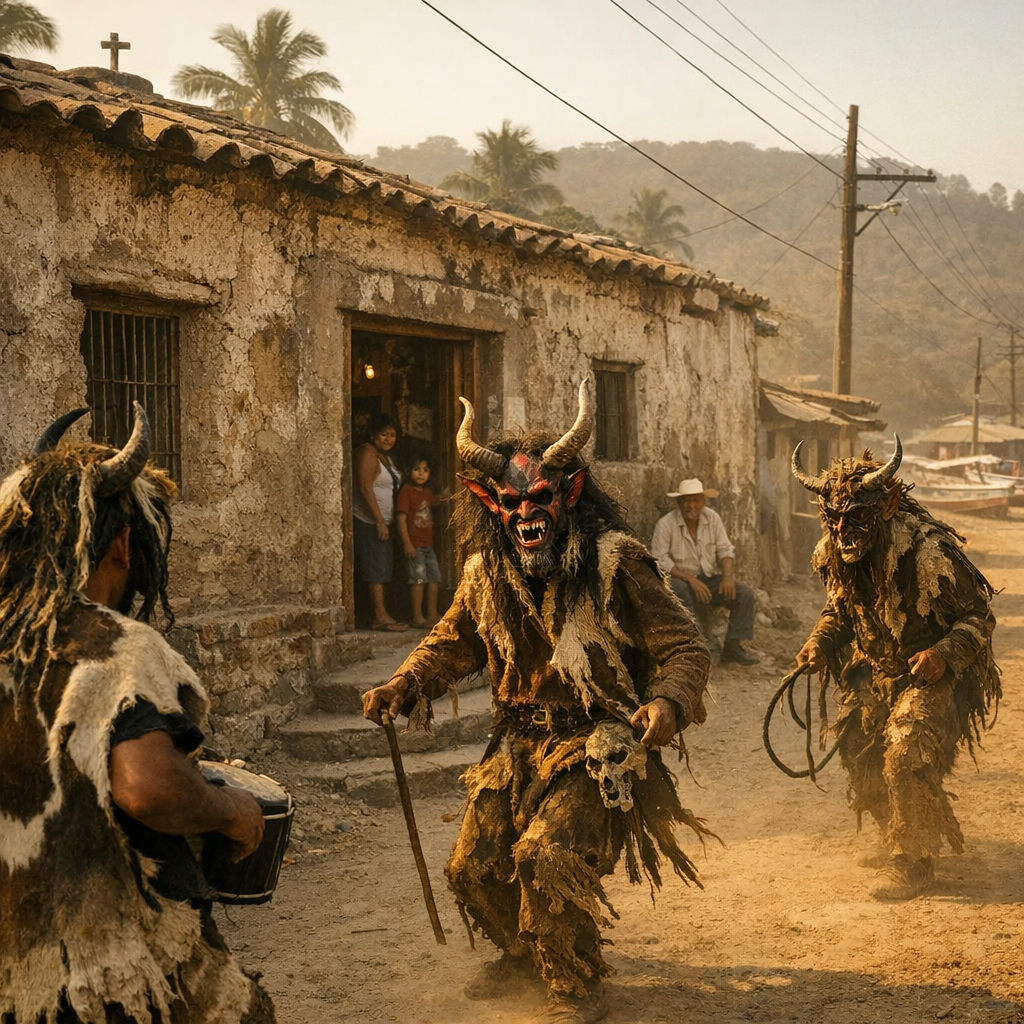
If you can time a visit around it, the clearest window into that inheritance is the Danza de los Diablos — the Dance of the Devils — traditionally performed around Día de los Muertos on November 1st and 2nd. Dancers wear elaborate carved wooden masks with exaggerated, fringed features and ragged, tattered costumes, moving in stamping, low-hunched formations behind a lead performer called the Diablo Mayor, who sets the choreography and pace for the group. The percussion is raw and specific to the region: a charrasca (a scraped instrument), an armadillo-shell bote drum, harmonica, and violin, driving a rhythm that has nothing in common with the mariachi sound most outsiders associate with Mexican music.
Scholars trace the dance’s roots to the colonial period — a coded ritual blending West and Central African spiritual practice with the Catholic Day of the Dead observance imposed on enslaved and colonized people alike. Some read the exaggerated devil imagery as satire aimed at enslavers themselves, a masked way of mocking the powerful while appearing to simply perform for them. Whatever its exact original intent, Mexican cultural authorities now formally recognize the dance as patrimonio afromexicano — Afro-Mexican heritage. Watching it unfold on a dirt street at dusk, torchlight catching the grain of hand-carved masks passed down through families, it plays less like a tourist spectacle and more like what it actually is: a community talking to its own ancestors in a language it never stopped speaking.
2015, 2019, 2020: A Recognition Story That Isn’t Finished
Here is the timeline worth knowing before you go, because it’s the actual news story underneath the travel story: for most of the twentieth century, Mexico’s national census had no way for anyone to identify as Afro-Mexican at all. That changed only recently, and only because Afro-Mexican organizers from communities like Cuajinicuilapa spent roughly two decades demanding it.
In 2015, Mexico’s National Institute of Statistics and Geography (INEGI) added a self-identification question to its intercensal survey for the first time: “Based on your culture, history, and traditions, do you consider yourself Black, meaning Afro-Mexican or Afro-descendant?” Around 1.2 million people answered yes — roughly 1.2% of the national population, concentrated most heavily in exactly the towns this story is about. It was the first time in the modern census era that Afro-Mexicans existed in Mexico’s official numbers at all.
Four years later, in 2019, the Mexican Senate voted unanimously — 122 to 0 — to amend the federal constitution to formally recognize Afro-Mexican people and communities as part of the nation’s pluricultural composition, a status Indigenous communities had already held for decades. It was a genuine milestone, and organizers celebrated it as one. It was also, by the organizers’ own account, nowhere near the end of the fight. “The national recognition is not going to change the way that Black people are seen in Mexico overnight,” activist Isaías Martínez Trani told reporters at the time. Fellow organizer Seynabou Diédhiou put it more bluntly: “It’s a recognition that’s written on paper, but now comes the part of bringing that into practice.” By the 2020 census, with an improved and more visible version of the same question, roughly 2.6 million people — about 2% of Mexico’s population — self-identified as Afro-descendant, with Guerrero and Oaxaca posting the country’s highest concentrations by far.
That “part of bringing it into practice” is still very much underway. A further constitutional reform in 2024 attempted to give Indigenous and Afro-Mexican communities formal legal personality and consultation rights over projects affecting their land — and was immediately met by scholars and organizers with the same caution as 2019: real on paper, unproven in practice, dependent on funding and enforcement mechanisms that don’t yet reliably exist. The people of the Costa Chica have been telling their own history for four centuries. The Mexican state has been listening, formally, for about ten years. Treat this as a story still being written, not a box that’s been checked.
An Honest Word on Safety
This needs to be said plainly rather than buried: Cuajinicuilapa sits just inside Guerrero, and Guerrero state currently carries the U.S. State Department’s most severe advisory, Level 4 — Do Not Travel, with no carve-out for tourist areas. The Oaxaca side of the Costa Chica — Pinotepa Nacional, El Ciruelo, and the coastal corridor along Highway 200 — sits under a considerably more moderate Level 2 advisory, similar to much of touristic coastal Mexico. Cuajinicuilapa itself is geographically distinct from Guerrero’s higher-risk interior “Tierra Caliente” region, but on paper, it is inside the Level 4 zone, and that deserves real weight in your planning rather than a footnote.
BTN covered the full, current breakdown of this — state-by-state advisory levels, how to check them before you book, and how to build a safe itinerary that still reaches the region’s Afro-Mexican culture even if Guerrero conditions are unfavorable — in our destination guide to Costa Chica. Read it before you finalize any trip that includes Cuajinicuilapa, and re-check the live advisory at travel.state.gov the week you travel, not the week you booked.
What to See: Museo Nacional de las Culturas Afromestizas
The anchor of any Cuajinicuilapa visit is the Museo Nacional de las Culturas Afromestizas, the only museum in Mexico dedicated specifically to Afro-Mexican history and culture. It sits on the town’s central square in a modest building that punches well above its size: exhibits trace the arrival of enslaved Africans on the Pacific coast, the formation of cimarrón communities, regional dress, craftwork, and the musical and dance traditions — including the masks used in the Danza de los Diablos — that have carried this identity across generations largely without outside institutional support. For a diaspora traveler, it functions as something close to what the W.E.B. Du Bois Center is to Accra: a place that finally names, in the community’s own words, a history the rest of the country spent centuries declining to see.
Planning the Visit
The practical gateway is Puerto Escondido International Airport (PXM) in Oaxaca, with connections from Mexico City. From there it’s roughly a two-to-two-and-a-half-hour drive southeast on Highway 200 to Pinotepa Nacional, the region’s largest town and most comfortable base, with El Ciruelo and its own distinctive artesa dance tradition a short trip further along the coast. Acapulco’s airport is technically closer to Cuajinicuilapa, but given Guerrero’s advisory status, most cautious travelers route through Oaxaca instead and treat the Cuajinicuilapa leg as a carefully planned day trip rather than an overnight stay — ideally with a local guide who works the region regularly and monitors current road conditions.
Target late October through early November if the Danza de los Diablos matters to your trip; the dry season, November through April, offers the most comfortable travel weather otherwise. Bring cash — card acceptance thins out fast once you leave Pinotepa Nacional and Puerto Escondido — and ask before you photograph. These are living communities keeping their own traditions alive on their own terms, not open-air exhibits performing for visitors.
Recognition, Not Novelty
It’s tempting to write this as a “you won’t believe there are Black people in Mexico” story. Don’t. The people of Cuajinicuilapa and the wider Costa Chica have never been surprised by their own existence — they’ve been fighting, for generations, against a national story that refused to make room for it, and against the colorism within Mexico’s own mestizo self-image that treated Afro-Mexican identity as something to be diluted rather than named. The surprise, if there is one, belongs entirely to outsiders who never bothered to look.
What changed in 2015 and 2019 wasn’t the existence of Afro-Mexican communities — it was the state finally agreeing, on paper, to count and name what had been true along this coastline since the 1500s. Activists who fought for that recognition are the first to say the fight isn’t over; representation on a census form and a line in the constitution don’t by themselves undo centuries of erasure or the discrimination that persists today. Visiting Cuajinicuilapa, standing in the Museo Nacional de las Culturas Afromestizas, watching a devil mask catch torchlight at dusk — these aren’t acts of discovering something hidden. They’re acts of showing up for a community that has been telling its own story all along, and finally has a little more room, hard-won and still incomplete, to tell it on the national stage.