The Elder on the Hillside
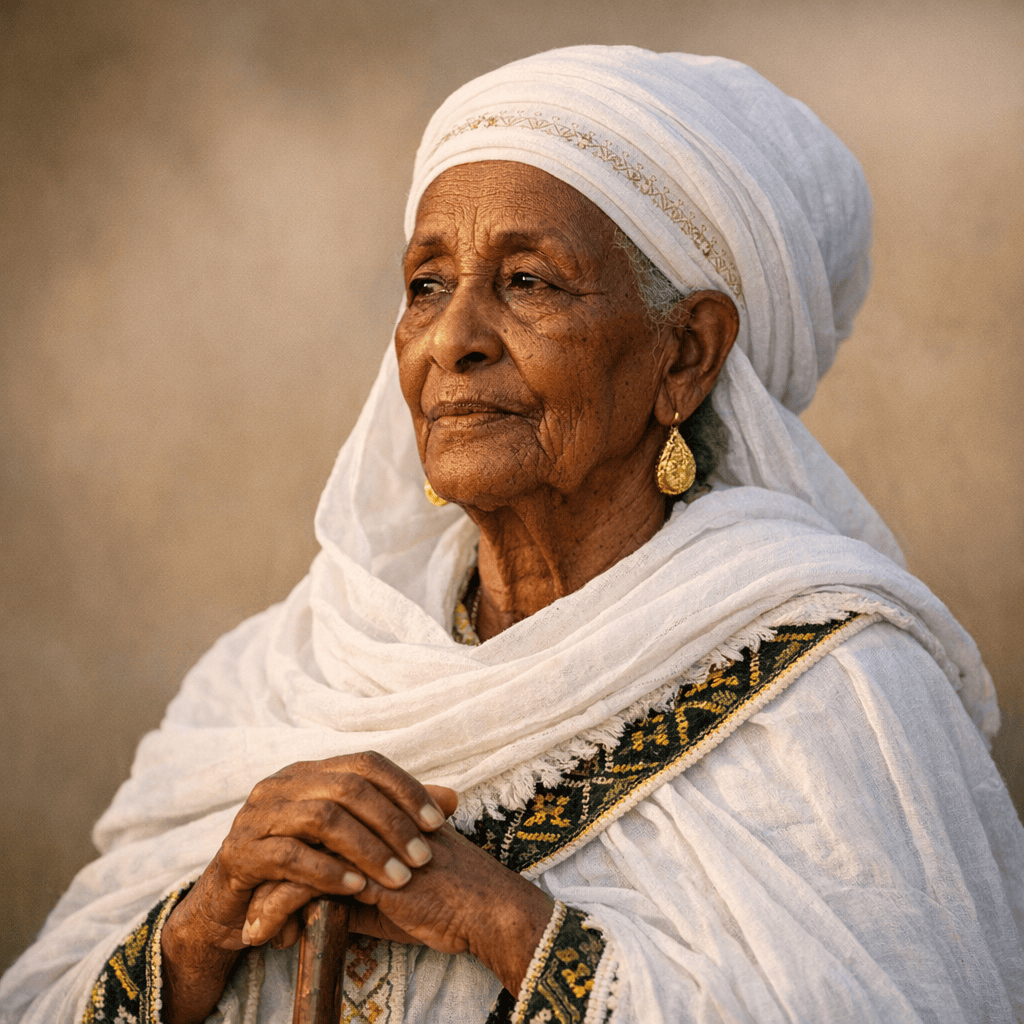
Aster is eighty-one years old, and she is telling me about a hill in Gondar that she has not seen in forty-one years, describing it the way other people describe a room they left mid-sentence. We are sitting on plastic chairs in a courtyard in Netanya, a few days before Sigd, and she is wrapped in a white netela shawl with the deep red-and-gold border that Beta Israel women wear for the holiday. Her granddaughter translates from Amharic when Aster’s Hebrew runs out, which is rarely, because after four decades in Israel her Hebrew is fluent and unhurried. “We used to climb the hill and face toward Jerusalem,” she tells me. “We had never seen it. We only knew which direction it was.” Then she points, without needing to think about it, toward the exact direction Jerusalem sits from where we’re sitting now, forty minutes down the coast. She has spent most of her life orienting herself toward a city she once could only imagine, and now lives an hour’s drive from.
I did not come to Israel to write about geopolitics, and I am not going to. This is not that story, and Aster made clear early in our conversation that it wasn’t the story she wanted to tell either. “People ask me about news,” she said, waving a hand. “I want to talk about who we are.” So do I. This is a story about a Black Jewish community that held onto an identity for well over a thousand years, walked through unimaginable danger to keep it, and is still, more than three decades after their rescue, working out what belonging costs and what it means.
A People Who Prayed Toward a City They’d Never Seen
Beta Israel — the House of Israel — is the name the community gave itself in the highlands of northern Ethiopia, where their oral tradition places their origins as far back as the era of the First Temple, with some traditions tracing their lineage to the Tribe of Dan. Outsiders in Ethiopia called them Falasha, a word meaning “exile” or “stranger” — a label imposed on them, not chosen by them, and one the community itself has largely rejected. For well over a millennium, cut off from Jerusalem and from the rabbinic Judaism practiced everywhere else in the world, Beta Israel developed its own religious tradition, Haymanot, built entirely on the Written Torah and led by priests called kessim rather than rabbis. Their calendar, their fasts, their laws of purity, their monastic orders — all of it grew in isolation, parallel to a Jewish world that, for most of that time, did not know they existed.
Aster grew up in that world before it changed. She remembers her grandmother keeping the fasts, remembers the kessim leading prayer, remembers a childhood where being Jewish and being Ethiopian were simply the same fact, undivided by any of the categories that would later get imposed on her from the outside — categories about race, about authenticity, about who counts. “In Ethiopia nobody asked me if I was really Jewish,” she says. “In Israel, for many years, people asked me that question.” It is a sentence she says without bitterness, mostly, but she says it more than once during our conversation, which tells me something about how much weight it still carries.
That question — whether Beta Israel was “really” Jewish according to Jewish law — persisted in the wider Jewish world for most of the twentieth century, until Israel’s Sephardic Chief Rabbi, Ovadia Yosef, issued a 1973 ruling recognizing Beta Israel’s Jewish status, tracing their lineage to the Tribe of Dan. Israel’s Ashkenazi Chief Rabbinate followed with its own ruling shortly after. In 1975, the Israeli government formally extended the Law of Return to the community — the law that grants Jews worldwide the right to Israeli citizenship. Recognition, on paper, had arrived. What came next was the far harder part: getting a community trapped inside a collapsing country actually home.
The Walk
By the early 1980s, Ethiopia was gripped by a civil war between the Marxist Derg government and rebel factions, compounded by a famine that would eventually kill hundreds of thousands of Ethiopians of every background. Beta Israel communities, already marginalized and living largely in poverty in the Gondar and Tigray regions, began walking — on foot, for two weeks to a month, across hostile terrain, toward refugee camps in Sudan, a country with no diplomatic relations with Israel and no particular reason to welcome them. Historians estimate that roughly 4,000 people died along that walk, from starvation, disease, and violence, before ever reaching a camp.
Aster was thirty-nine when she made that walk with her husband and three children, the youngest still an infant. I ask her what she remembers most, expecting an answer about fear or hunger. Instead she tells me about her feet. “I remember my feet more than I remember being afraid,” she says. “You stop being afraid after a while. Your feet don’t stop hurting.” Her youngest daughter, the infant, did not survive the journey. She tells me this the way she tells me most things — plainly, without performance, in a tone that has clearly had four decades to settle into something she can carry without it crushing her every time she speaks it aloud. I do not ask a follow-up question. Some silences are the most respectful thing you can offer.
Two Rescues, One Community
Those who survived the walk gathered in official and unofficial refugee camps inside Sudan, where Israel — working through secret diplomatic channels and with quiet cooperation from the United States — organized a covert airlift. Between November 1984 and January 1985, Operation Moses evacuated roughly 8,000 Ethiopian Jewish refugees from Sudan to Israel aboard a series of secret flights, most routed discreetly through Brussels to avoid drawing attention. The operation was so sensitive that it had to be halted abruptly in early January 1985 after news of it leaked to the press, stranding several hundred refugees who had reached Sudan but not yet been flown out — a gap later closed by a smaller U.S.-led follow-up airlift, Operation Joshua, that spring.
Aster was one of the roughly 8,000. She remembers being told to leave everything behind — no belongings, nothing that would slow the loading of the plane — and remembers not fully believing she was in Israel until the plane’s wheels touched the ground and the woman next to her began praying. “I did not cry on the airplane,” she says. “I cried when I saw the ground.”
Thousands more remained in Ethiopia, still hoping for a way out, and their moment came six years later under far more urgent circumstances. By May 1991, the Derg regime under Mengistu Haile Mariam was collapsing as rebel forces closed in on Addis Ababa. Israeli officials, with American diplomatic support that included a personal letter from President George H.W. Bush to the Ethiopian government, secured last-minute permission to evacuate the remaining community before the government fell. Over 36 uninterrupted hours on May 24 and 25, 1991, 34 aircraft — Israeli Air Force C-130 transports and El Al Boeing 747 jumbo jets with their seats stripped out to maximize capacity — carried 14,325 Ethiopian Jews from Addis Ababa to Israel in what became known as Operation Solomon. One 747 carried an estimated 1,088 passengers on a single flight, the most people ever transported on a commercial aircraft, including babies born mid-flight. By the time the last plane landed, Mengistu’s government had already fallen. It remains, relative to its timeframe, one of the largest airlifts in aviation history — a rescue completed in the narrow, closing window before it would have become impossible.
If you want the full ledger of that history — the fifteenth-century persecutions, the catastrophic 1888–1892 famine Ethiopians still call Kefu-qän, “the Bad Days,” and the detailed timeline of Operations Moses, Joshua, and Solomon — Black Travel Now has a companion piece, Following Beta Israel: Ethiopian Jewish Heritage in Israel, that lays it out in full, along with where the community lives today and the current State Department advisory picture for Israel. I’m not going to repeat that ground here. What I want to sit with instead is what happened after the plane landed — because arrival, it turns out, was not the end of the story. In a lot of ways, it was the beginning of a harder one.
What Rescue Doesn’t Solve
I ask Aster what surprised her most about life in Israel, and she doesn’t hesitate. “That being rescued and being accepted are not the same thing,” she says. She describes years of being steered toward lower-track schools regardless of her children’s ability, and a bureaucracy that, in the early years, quietly discarded blood donations from Ethiopian-Israeli donors over unfounded HIV concerns — a policy that became public in the 1990s and provoked outrage across the community. None of this, she’s careful to say, erases her gratitude for the rescue itself. Both things are true for her, held at once.
That friction has not stayed private, and it did not stay in the past. In 2015, video captured Israeli police beating an Ethiopian-Israeli soldier, Damas Pakada, in his IDF uniform — footage that sparked nationwide protests over police treatment of the community. In 2019, an off-duty police officer shot and killed nineteen-year-old Solomon Teka, an Ethiopian-Israeli teenager, under disputed circumstances — a killing that set off some of the largest Ethiopian-Israeli protests in the country’s history and drew comparisons, in Israeli and international press alike, to the Black Lives Matter movement in the United States. Ethiopian-Israeli households have also historically reported lower average incomes than the broader Jewish Israeli population, with educational attainment gaps that have narrowed but taken decades to close. Aster’s granddaughter, translating this part of the conversation, adds her own aside without being asked: “We are Israeli and we are still fighting to be seen as Israeli. Both things, every day.”
Alongside that friction, there has been real, hard-won progress. Addisu Massala became the first Ethiopian-Israeli elected to the Knesset in 1996. In 2020, Pnina Tamano-Shata — who arrived in Israel as a child during Operation Moses — was appointed Israel’s Minister of Aliyah and Integration, the first Ethiopian-born government minister in the country’s history, overseeing the very immigration system that once brought her own family home. Aster mentions this with visible pride. “A girl who walked to Sudan became a minister of the government,” she says. “I want young people to know both parts of that sentence.”
Sigd: Facing Jerusalem, Then Standing In It
The reason I’m sitting with Aster this week, and not some other week, is Sigd — a holiday unique to Beta Israel, observed on the 29th of the Ethiopian month of Marcheshvan, roughly fifty days after Yom Kippur. The word means “prostration,” and the holiday commemorates the giving of the Torah and the community’s covenant with God, historically observed by climbing a hilltop, fasting, and facing toward a Jerusalem that, for most of Beta Israel’s history in Ethiopia, no one in the community had ever actually seen. In July 2008, the Knesset voted to make Sigd an official Israeli state holiday — a formal, national acknowledgment that this specific, once-obscure hilltop ritual belongs to Israel’s calendar the same way Purim or Sukkot does.
Today Sigd is observed in person, on a promenade in Jerusalem with a direct view of the Old City, rather than on a distant hillside facing a direction. Aster has now celebrated it both ways — the version aimed at a horizon, and the version standing inside what that horizon pointed to — and she tells me the second version has never once stopped feeling astonishing to her, even after this many years. “Every year I still have the thought: I am standing where I used to only point,” she says. “I do not think that thought will ever become normal to me, and I do not want it to.”
A Companion, Not a Booking
If you want to sit with this history further before or after a trip of your own, skip the tour packages — there aren’t really any built for this story, and that’s appropriate, not a gap to be filled. Watch Live and Become (French title: Va, vis et deviens) instead. Directed by Radu Mihăileanu, the 2005 film follows a young Ethiopian Christian boy whose mother, in a refugee camp in Sudan, tells him to pass as Jewish so a grieving Beta Israel woman can carry him to Israel during Operation Moses — and then follows him for decades as he grows up carrying a secret identity inside a rescue that was, and wasn’t, meant for him. It won audience awards at Berlin and Vancouver and earned César nominations for Best Film and Best Director. It is not a documentary, but it understands something a documentary might miss: that rescue and identity don’t resolve as neatly as a headline suggests, and that the people who lived it are still, decades later, working out exactly what they were given and exactly what it cost.
What I Carried Away From the Courtyard
Before I leave, I ask Aster the question I’d been circling the whole conversation, the one about Blackness and Jewishness and whether she’d ever felt she had to choose between the categories other people kept trying to put her in. She thinks about it longer than she’s thought about anything else I’ve asked her. “I did not choose to be Black or Jewish,” she finally says. “Both were already true before I had an opinion about them. What I chose was to keep both, even when people made that difficult.” Then she straightens her netela, glances once in the direction of Jerusalem out of what looks like pure habit at this point, and tells me it’s time for her to start cooking for the holiday.
I think about that sentence the whole drive back down the coast. Beta Israel’s history isn’t a triumphant arc with the hard parts edited out, and it isn’t a tragedy with the joy edited out either. It’s a thousand years of an identity nobody outside the community was asked to validate, a walk that killed thousands who attempted it, two airlifts that pulled survivors out of collapsing countries with hours to spare, and a life on the other side that has included real discrimination alongside real belonging — sometimes in the same week, sometimes in the same sentence. Aster held all of that in one conversation, on plastic chairs, without once needing me to simplify it for her. That’s the whole story. I was just lucky enough to be sitting there when she told it.