A Culture Born of Isolation and Rice
Along the marshy barrier islands and tidal creeks stretching from around Georgetown, South Carolina down through Beaufort County and the Sea Islands, a Black American culture developed in near-total isolation for the better part of two hundred years — and in that isolation, preserved more of its direct West African inheritance than almost any other Black community in the United States. These are the Gullah people, and their story begins with a brutal economic calculation made by South Carolina’s rice planters in the 1700s.
Rice cultivation is not intuitive. It requires precise knowledge of tidal irrigation, seed selection, and field engineering that European colonists simply did not possess. South Carolina’s planters knew this, and so they specifically and deliberately sought enslaved people from West Africa’s “Rice Coast” — Sierra Leone, Senegambia, and the Windward Coast — where rice had been cultivated using sophisticated techniques for centuries. The enslaved Africans brought here didn’t just provide labor. They brought the entire technical knowledge system that built South Carolina’s rice economy into one of the wealthiest agricultural enterprises in colonial America, and Georgetown County became its epicenter.
The Sea Islands’ isolation — accessible only by boat well into the twentieth century, surrounded by marsh and mosquito-heavy lowland that planters themselves often avoided in summer — meant that the enslaved and later freed Black communities living there had far less day-to-day contact with white overseers and far more autonomy to maintain their own language, foodways, and spiritual practices than enslaved communities almost anywhere else in the American South. What survived is not a diluted memory of Africa. It is, in measurable, documentable ways, Africa itself, still being lived on American soil.
The Language: Not Broken English, But Its Own Tongue
For most of the twentieth century, outside linguists and even some educators dismissed Gullah as “broken English” — a deficient, uneducated dialect rather than what it actually is: a fully formed English-based creole language with its own consistent grammar, its own internal logic, and a vocabulary carrying direct loanwords from Kikongo, Kimbundu, Mende, Vai, and other West and Central African languages. Serious linguistic study over the past several decades has corrected this record. Gullah is a language in the same sense that Haitian Creole or Jamaican Patois is a language — not a corruption of English, but its own systematic creation, born from the specific circumstance of West and Central Africans from many different language backgrounds needing a shared tongue.
Words that have crossed from Gullah into mainstream American English — “goober” (peanut), “gumbo,” “juke” (as in jukebox), “yam,” and the name “Gullah” itself, which many linguists trace to either Angola or the Gola ethnic group of West Africa — are quiet, everyday evidence of how much of this culture has already shaped the country far beyond the Sea Islands, usually without credit.
Priscilla’s Homecoming: Tracing an Unbroken Line to Sierra Leone
In 1989, American anthropologist Joseph Opala organized a homecoming that few thought possible: he identified Bunce Island, a British slave castle in Sierra Leone, as the specific point of departure for a documented number of enslaved people sent directly to South Carolina and Georgia’s rice plantations. Gullah community leaders, including Penn Center’s Emory Campbell, traveled to Sierra Leone that year to walk the same rice fields their ancestors had been taken from — a reunion captured in the documentary “Family Across the Sea” and reciprocated the following year by a state visit from Sierra Leone’s president to South Carolina.
Opala’s research reached its most powerful proof point in 2005, when he traced an unbroken, fully documented 250-year paper trail connecting a Charleston-area woman named Thomalind Polite to a ten-year-old enslaved girl known only as “Priscilla,” taken from Sierra Leone to Charleston in 1756. Using ship manifests, plantation records, and estate documents across eight generations, Opala proved — not through DNA testing or oral tradition alone, but through an unbroken documentary chain — exactly which African village Priscilla’s family likely came from. Polite traveled to Sierra Leone that year in what became known as “Priscilla’s Homecoming,” one of the most thoroughly documented reconnections between an African American family and a specific African origin point in the entire history of the diaspora.
Penn Center and St. Helena Island: The Heart of Gullah Preservation
If there is one place to begin understanding Gullah history and culture in person, it is Penn Center on St. Helena Island, South Carolina. Founded in 1862 as one of the first schools in the country built specifically to educate formerly enslaved people — established while the Civil War was still being fought, in a part of the Sea Islands that fell under Union control early — Penn Center became a center of Gullah community life, education, and land ownership for over 150 years. Dr. Martin Luther King Jr. used Penn Center as a retreat and planning site for the Southern Christian Leadership Conference in the 1960s, drawn specifically to its history as a self-sustaining Black institution.
Today, Penn Center operates as a National Historic Landmark District with a museum, archives, and ongoing land-preservation and cultural programming run largely by Gullah community members and descendants themselves. It remains an active, living institution rather than a static historical site — hosting an annual Heritage Days celebration, community programs, and some of the most extensive Gullah oral history archives anywhere.
Daufuskie Island: A Community Still Living the Culture
Accessible only by boat, with no bridge connecting it to the mainland, Daufuskie Island off Hilton Head remains one of the most intact Gullah communities left in South Carolina — a place where author Pat Conroy taught school in the late 1960s (later fictionalized in “The Water Is Wide”) and where a small number of Gullah families, some tracing land ownership back to Reconstruction-era purchases, still live on inherited family land. Praise houses — small, historically significant community worship buildings that predate many formal churches on the island — remain part of Daufuskie’s spiritual landscape, alongside historic cemeteries and the restored Mary Fields School.
Daufuskie’s isolation, once purely a hardship, is now its greatest asset for cultural preservation — though it also means the island faces real, ongoing pressure from resort development on its edges, a tension present across nearly every Gullah community in the region.
Sweetgrass Baskets: An Unbroken West African Craft
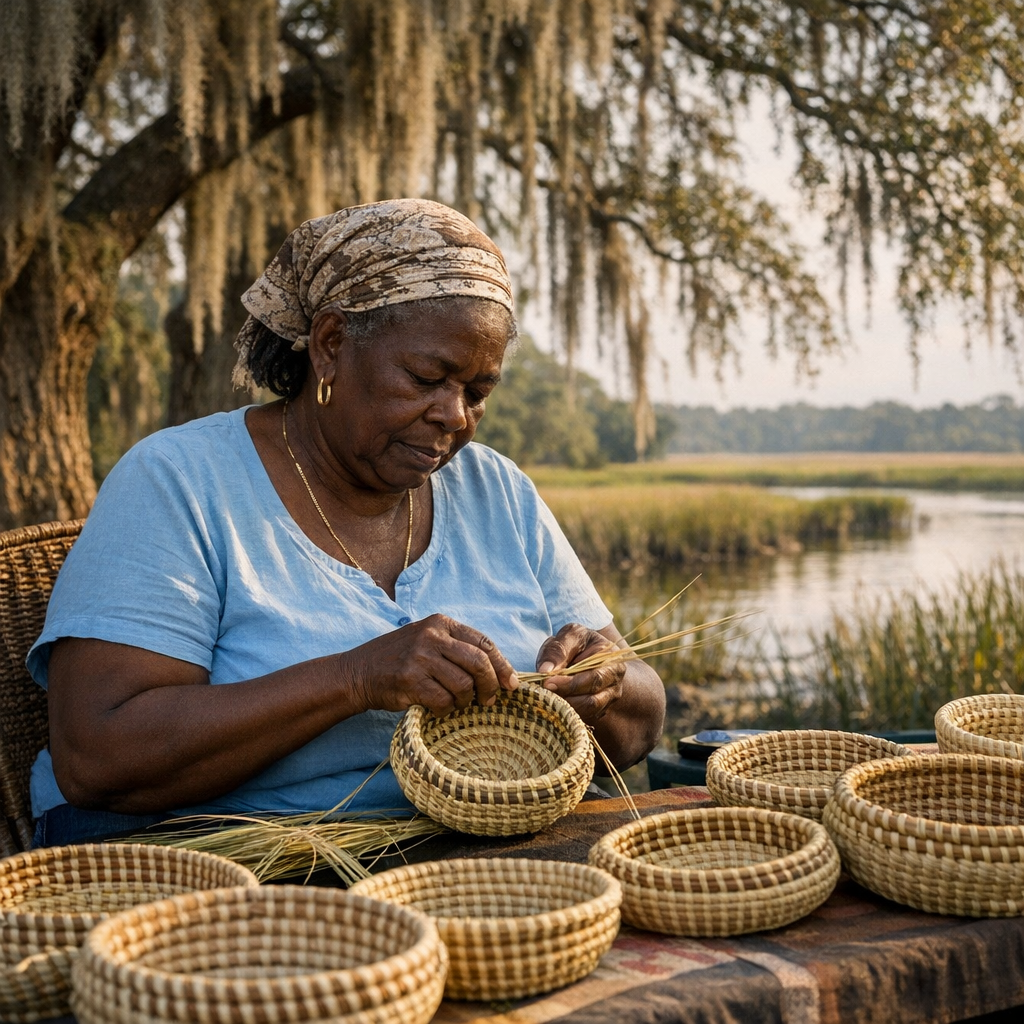
Charleston’s sweetgrass basket-weaving tradition, most visibly practiced today at stands along Highway 17 in Mount Pleasant and inside the historic Charleston City Market, is a direct, unbroken technical inheritance from West African coiled-basket weaving traditions brought by enslaved people who used the earliest versions of these baskets as agricultural tools for winnowing rice. The craft has been passed down matrilineally for generations and is now recognized as one of the oldest surviving African art forms in the Americas. Buying a sweetgrass basket directly from a Gullah weaver — rather than a mass-produced import sold as a souvenir — is one of the most direct ways a traveler can put money straight into the hands of a culture-bearer continuing this specific 300-year-old craft.
A Living Culture Under Pressure
BTN would be doing this story a disservice by presenting Gullah culture only as history. It is a living, present-tense community facing real, active pressure: coastal resort and golf-course development across Hilton Head, Kiawah, and the broader Sea Islands has steadily eroded Gullah-owned land through rising property taxes, heirs’ property complications (where land inherited without a will becomes vulnerable to forced sale), and direct buyout pressure from developers. Land that Gullah families have held since Reconstruction is disappearing acre by acre, even as the culture itself draws growing tourist and academic interest. Supporting Gullah-owned businesses, tours, and cultural sites directly is one of the few concrete ways visitors can help counter that pressure rather than simply consume the culture as a backdrop.
How to Visit Respectfully
Book Gullah history tours and Penn Center visits through Gullah-owned and -operated tour companies rather than generic regional tour operators — Gullah Tours in Charleston and the Gullah Heritage Trail Tours on Hilton Head are both Black, Gullah-family-owned operations that put your money directly into the community telling its own story. Approach praise houses, cemeteries, and any active religious sites with the same respect you’d extend to any place of worship, and always ask before photographing residents or private homes on islands like Daufuskie, where tourism has increased significantly in recent years.
Where to Stay & Eat
Beaufort, South Carolina — a walkable, historic small city roughly 20 minutes from St. Helena Island and Penn Center — offers a range of boutique inns and hotels and makes an excellent base for exploring the Lowcountry Gullah sites. Charleston, an hour north, offers the widest range of accommodations along with its historic City Market. For food, seek out Gullah-owned restaurants specifically: Gullah Grub on St. Helena Island (owned by the Cooler family, who also run Gullah cultural tours) and the Foolish Frog on Daufuskie Island both serve Lowcountry Gullah cooking — red rice, shrimp and grits, okra soup, and Frogmore stew — prepared by the community whose ancestors created these dishes, not a themed imitation of them.
BTN Insider Tips
Book Penn Center’s Heritage Days if your dates allow. Held annually in November, it’s the single richest concentrated dose of living Gullah culture — music, food, craft demonstrations, and community storytelling — available to visitors anywhere in the region.
Buy your sweetgrass basket directly from the weaver, not a gift shop. Ask about the weaver’s family history with the craft; most are proud to share it, and the conversation is often as valuable as the basket itself.
Getting to Daufuskie Island requires a ferry from Hilton Head or Bluffton — there is no bridge and no car access, which is precisely what has helped preserve it. Book a guided island tour rather than assuming you can explore independently once you land.
Learn a few Gullah words before you go — “binyah” (been here, meaning a longtime local) and “cumyah” (come here, meaning a newcomer) are common enough that recognizing them shows a level of respect and preparation most visitors never bother with.
Why This Story Matters Now
The Gullah story is proof, in a way few other American stories can claim with this much documentary specificity, that the connection between African Americans and Africa was never fully severed — not by the Middle Passage, not by centuries of enslavement, not by two hundred years of separation. Thomalind Polite’s 2005 homecoming to Sierra Leone wasn’t a symbolic gesture or an act of faith. It was proven, on paper, ship manifest to ship manifest, generation to generation. That kind of unbroken evidence is rare in the African American historical record, and the Gullah Sea Islands are one of the very few places in the country where you can stand inside it — in the rice fields, in the praise houses, in the language still spoken at Sunday dinner tables from St. Helena to Daufuskie.