A Name From a River, A Culture From the Rice Fields
Drive the Georgia coast south from Savannah toward the Florida line and you’ll hear a name that South Carolina’s Sea Islands mostly don’t use for themselves: Geechee. The name most likely traces to the Ogeechee River, which runs through the Georgia Lowcountry where enslaved West Africans — brought here for the same reason as their counterparts in South Carolina, their deep technical knowledge of rice cultivation — built plantation economies and, after emancipation, their own independent communities on land no one else wanted.
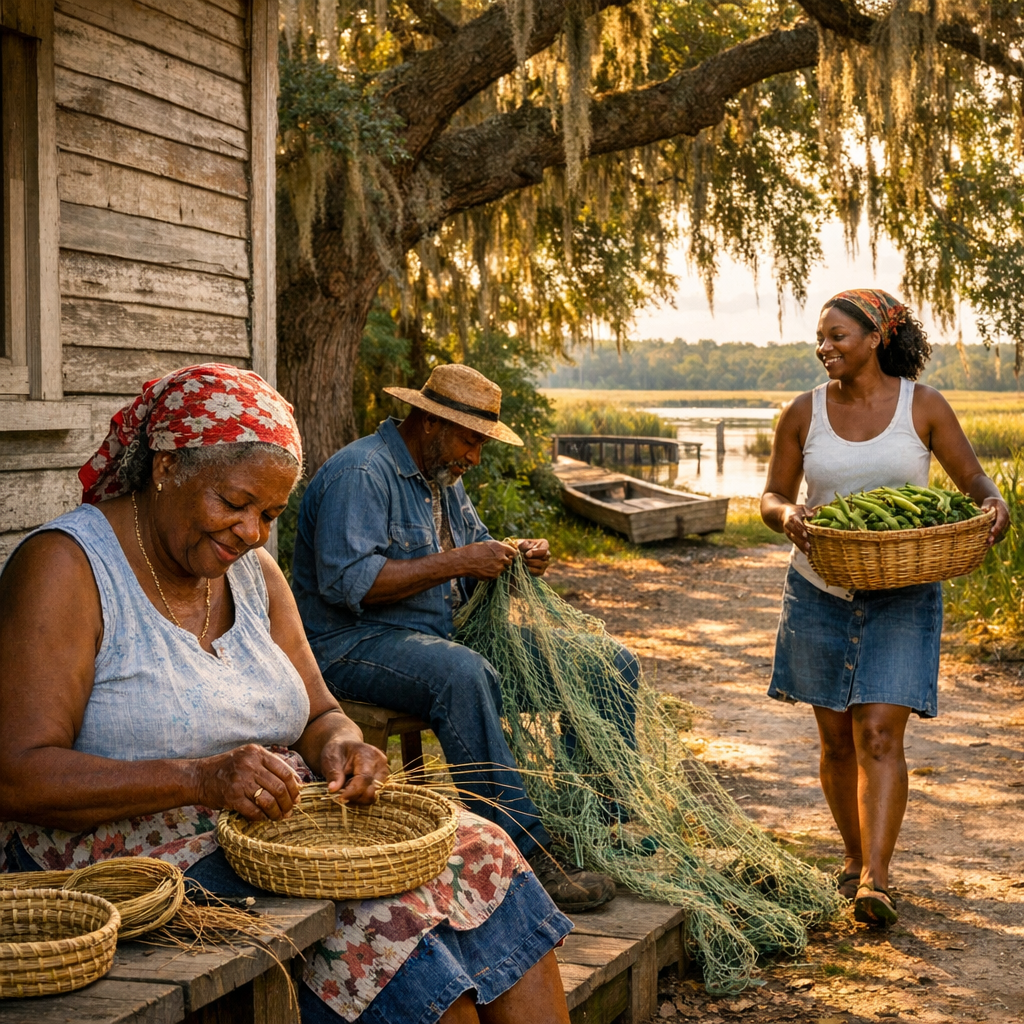
Geechee and Gullah are, in the most accurate telling, one culture wearing two regional names. Both groups descend from enslaved West and Central Africans brought specifically for rice-growing expertise to the isolated barrier islands and tidal marshlands of the Southeast coast. Both preserved an English-based creole language full of direct African loanwords. Both built independent, self-sufficient communities in places white landowners considered undesirable — malarial, hard to farm at scale, cut off from the mainland. The regional distinction is largely geographic: Gullah usually describes the culture in South Carolina and the northernmost Georgia coast, while Geechee describes the same culture as it continues south through coastal Georgia and into northern Florida. Some families and communities have always used one term over the other based purely on which side of an old county line their ancestors happened to land on — not because the culture itself is meaningfully different.
Gullah and Geechee: One Culture, Two Names
BTN wants to be precise here rather than repeat a common misconception: there is no hard cultural line separating “Gullah” from “Geechee” the way there might be between, say, Jamaican and Haitian culture. Congress itself formally recognized this in 2006 by establishing the Gullah Geechee Cultural Heritage Corridor — a single federally designated heritage corridor stretching from Pender County, North Carolina down through South Carolina and Georgia to St. Augustine, Florida, treating the culture as one continuous inheritance rather than two separate ones. An estimated 200,000 Gullah Geechee people live within this corridor today.
What does genuinely distinguish the Georgia coast is its specific set of communities, islands, and recent history — most urgently, the extraordinary fight that just played out on Sapelo Island, one of the last places in Georgia where the Geechee community has held onto its own land, its own governance, and its own daily life without being absorbed into resort development.
Sapelo Island and Hog Hammock: The Last Intact Geechee Community
Sapelo Island, accessible only by ferry from Meridian, Georgia, is home to Hogg Hummock (also spelled Hog Hammock), a community founded by formerly enslaved people who purchased land on the island after emancipation and have lived there, generation after generation, ever since. At its peak, Hogg Hummock was home to several hundred residents. Today, largely because of decades of rising property taxes, land pressure, and the same heirs’-property vulnerabilities that threaten Gullah Geechee land across the entire corridor, that number has fallen to somewhere between 30 and 50 full-time residents — one of the smallest, most fragile concentrations of intact Gullah Geechee culture left anywhere.
The island itself is mostly owned by the state of Georgia as a wildlife management area and marine research reserve, with Hogg Hummock representing a small, privately held pocket of land within it — a geography that has made the community simultaneously protected from large-scale commercial development and acutely vulnerable to any single policy change affecting that small footprint of private land.
2026 Update: The Referendum That Saved Hogg Hummock
This is the most important and most current chapter of the Sapelo Island story, and it’s a genuinely rare good-news update in a history more often defined by loss. In 2023, McIntosh County commissioners quietly passed a zoning change that would have doubled the maximum size of homes allowed in Hogg Hummock — a change residents immediately recognized as an invitation to outside buyers and large-scale construction that would drive up property values, and with them, property taxes, pricing longtime Geechee families off land their families have held since Reconstruction. Residents organized a petition for a referendum to repeal the zoning change; the county initially blocked the vote from happening at all, prompting residents to take their fight all the way to the Georgia Supreme Court.
In 2025, the Georgia Supreme Court ruled in the residents’ favor, clearing the way for the long-delayed referendum. On January 21, 2026, McIntosh County voters went to the polls and decisively rejected the zoning change — over 85% of the roughly 1,500 residents who voted cast their ballot to repeal it, a landslide result after nearly three years and more than half a million dollars in county legal fees spent fighting a community of a few dozen residents. Community organizer Rhonikki Williams put it plainly after the vote: residents across the county stood with Hogg Hummock to protect it, and others like it, from displacement.
The Next Threat: Property Taxes
BTN would be doing readers a disservice by presenting this as a story with a clean, finished ending. Even after the referendum victory, Hogg Hummock’s Board of Assessors has proposed significant property tax reassessments — with some property valuations potentially rising tenfold over three years starting in 2026 — a shift that could accomplish through the tax code exactly what the rejected zoning change would have accomplished through development. The zoning fight was won. The underlying economic pressure on this land has not gone away, and residents and preservation advocates are continuing to organize around it as of this writing. This is a live, ongoing story, not a settled one — worth checking current status before you visit, and worth supporting directly if you believe, as BTN does, that this specific 160-year-old community deserves to still exist in 2030 and beyond.
Geechee Kunda and the Mainland Georgia Coast
For travelers who can’t make the ferry crossing to Sapelo Island, or who want deeper context before they go, Geechee Kunda in Riceboro, Georgia — a cultural center and museum founded by Geechee culture-bearer Jim Bacote — offers an accessible, mainland introduction to Geechee history, foodways, and oral tradition through guided tours and exhibits built specifically around this coastal Georgia identity. The nearby town of Darien, one of the oldest planned towns in Georgia and a historic hub of the coastal timber and shrimping industries that many Geechee families worked in for generations, is also worth a stop for its own layered Black maritime history.
Who This Story Is For
Diaspora travelers with roots anywhere along the Georgia or South Carolina coast, anyone who has ever heard a family member described as “Geechee” and wanted the real history behind the word, and travelers who want to understand one of the most direct, least-diluted living links between African American culture and specific West African origins anywhere in the country. It’s also, urgently, a story for anyone who cares about land justice: Hogg Hummock’s fight is a live example of a Black community successfully organizing to protect itself, in real time, in 2026.
How to Visit Respectfully
Book your Sapelo Island ferry and any Hogg Hummock tour through the Sapelo Island Visitors Center or a community-affiliated guide rather than arranging independent access — the island’s ferry schedule is limited, controlled by the state, and visiting without a plan can mean stranding yourself or missing the small window of organized tours that actually support the community. Approach Hogg Hummock the same way you would Africatown or any other living descendant community: this is someone’s home and an active fight for survival, not a historical attraction frozen in the past. Spend your money at Geechee-owned businesses and tours specifically, and if you want to support the community beyond your visit, look for the current preservation and legal-defense organizations residents themselves have pointed to during the zoning fight.
Where to Stay & Eat
Darien and Brunswick on the mainland offer the most practical bases for a Sapelo Island day trip, with a range of budget to mid-range accommodations and easy ferry access. For food, look for Lowcountry Boil and shrimp dishes sourced from the Georgia coast’s historically Black-worked shrimping fleets, still docked in towns like Darien and Brunswick — a direct culinary and economic through-line from the same maritime economy Geechee families have worked for generations.
BTN Insider Tips
Check the ferry schedule and book well ahead. Sapelo Island’s ferry runs on a limited schedule controlled by the state, and same-day walk-up access is not reliable, especially in peak season.
Follow the property tax story before you go. Given how recent and unresolved this fight is, checking current news on Hogg Hummock’s tax assessment status will give you a much richer, more current understanding of what the community is dealing with right now.
Visit Geechee Kunda in Riceboro if the Sapelo ferry doesn’t fit your schedule. It’s a genuinely worthwhile mainland alternative that doesn’t require ferry logistics.
Use “Geechee” and “Gullah” with equal respect, not as competing or hierarchical terms. Both are correct names for a shared culture, and which one a person uses for themselves usually just reflects their family’s specific stretch of coastline.
Why This Story Matters Now
Hogg Hummock is not a museum piece, and its story isn’t finished. It’s a few dozen families on a small barrier island who just spent three years and won a fight most outside observers assumed they’d lose, against a county government willing to spend half a million dollars to change the rules under them. That victory matters enormously, and it’s also fragile — the same pressure that showed up as a zoning ordinance in 2023 has already resurfaced as a tax assessment in 2026. Visiting, learning the real history behind the word Geechee, and spending money directly with the community are small but genuinely meaningful ways to stand with a community that has already proven, twice now, that it intends to still be there.