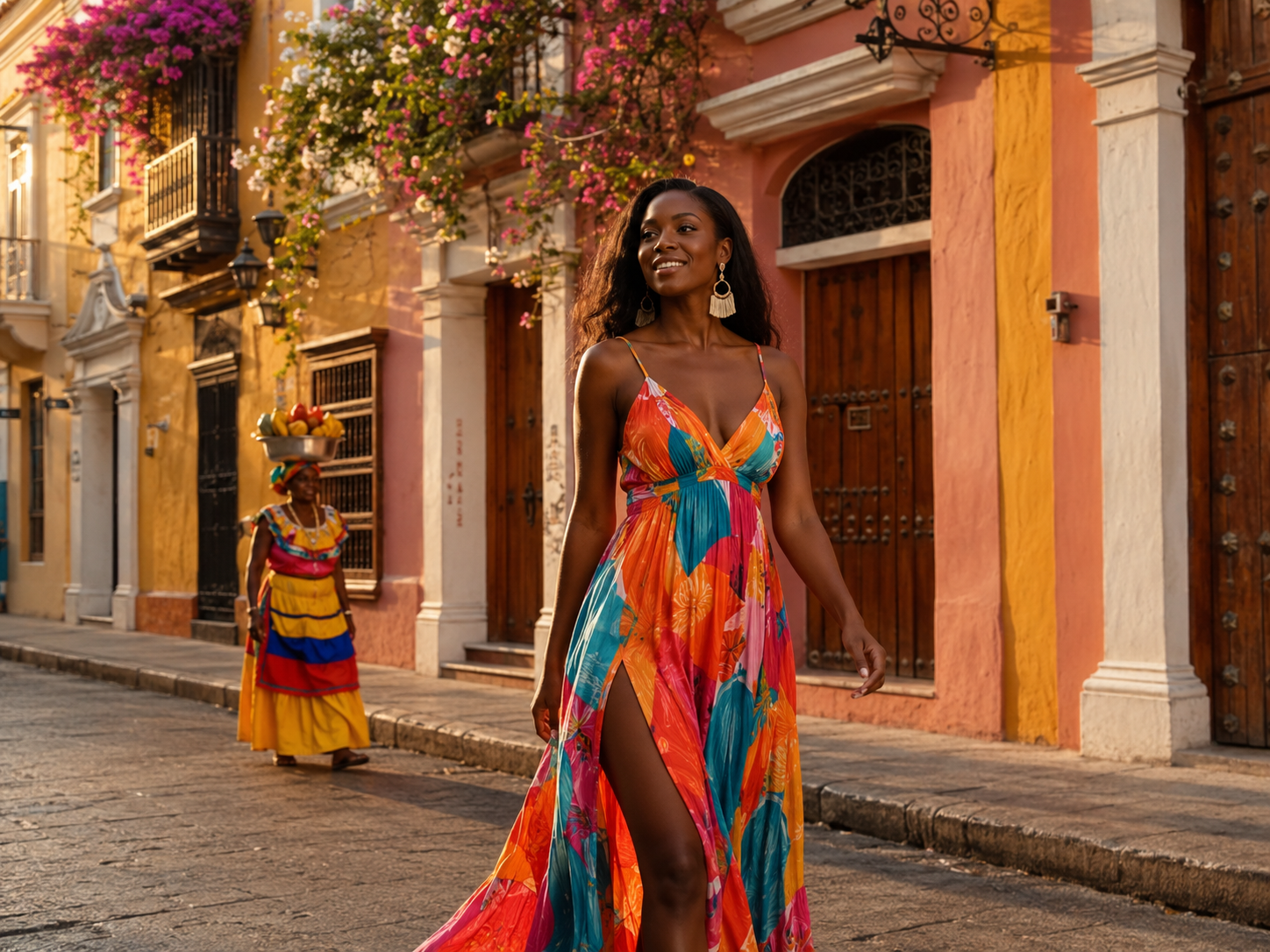
The plane touched down and the first thing I felt was the heat pressing against the window like a hand. Not the dry, brittle heat of a departure lounge, but something thick and alive — the kind of humidity that arrives with a smell of salt and diesel and ripe mango. I stepped onto the tarmac in Cartagena and my curls collapsed instantly. A woman ahead of me in a mango-colored dress laughed at her own hair doing the same thing, caught my eye, and said, “Bienvenida, mi amor.” I hadn’t said a word. She just knew I was arriving alone, and she decided, right there, to welcome me anyway.
I had come to Colombia on my own — no group tour, no travel partner, no safety net of a familiar face — and I would be lying if I said I wasn’t nervous. Solo travel as a Black woman carries a particular weight. You are asked, constantly, to calculate: Is this safe? Am I welcome? Will I be seen, and how? What I did not expect, what no guidebook quite prepared me for, was how quickly Cartagena would answer those questions. Within an hour of landing, before I had even found my hotel, the city had already begun making its case that I belonged.
Arriving Alone and Learning to Breathe
My taxi from the airport rattled through neighborhoods that tourists rarely photograph — auto shops, fruit stands, kids playing soccer barefoot in the dusk — before the old city rose up ahead, honey-gold and floodlit. I had booked a small guesthouse in Getsemaní, the once-working-class barrio just outside the walls, and I recommend it to any solo traveler over the polished hotels inside the Ciudad Amurallada. It is cheaper, it is realer, and it is full of people actually living their lives rather than performing them for cruise-ship day-trippers.
That first night I made myself do the hardest thing about solo travel: I went out to eat alone. I sat at a plastic table on a corner and ordered an arepa de huevo — a fried cornmeal pocket with a whole egg cooked inside it, crisp and golden and gloriously bad for me. It cost about a dollar. I ate it watching a group of teenagers practice a champeta dance routine under a streetlight, hips loose, laughing every time someone missed a step. Nobody looked at me strangely. Nobody looked at me at all, and after a lifetime of being looked at, that anonymity felt like a kind of grace.
I came to Cartagena braced for the loneliness of solo travel. Instead the city kept handing me small proofs that I was not, in any way that mattered, alone.
The Walled City and the Beautiful Chaos of Getsemaní
You cannot talk about Cartagena without talking about the Ciudad Amurallada, the walled old city, and you should not skip it just because it is famous. Go in the early morning, before the heat and the crowds, and walk the ramparts as the light turns the bougainvillea electric. The balconies drip with flowers. The plazas are cobblestoned and cool under the ceiba trees. It is genuinely one of the most beautiful colonial cities in the Americas, and it is also, I want to be honest, built on the bones of the transatlantic slave trade. Cartagena was one of the largest slave ports in the Spanish empire. Walking those gorgeous streets as a Black woman, I felt the doubleness of it in my chest — the beauty and the horror braided together, impossible to separate.
Getsemaní, just outside the walls, is where my heart actually lived. This is the barrio of street art, and I mean murals that stop you mid-stride — giant portraits of Afro-Colombian women with crowns of fruit, painted words about resistance, walls turned into love letters to the neighborhood. Every evening the whole district migrates to Plaza de la Trinidad, the square in front of the old church. Vendors sell cold beer and skewers of grilled meat; kids kick soccer balls; old men play dominoes; travelers and locals share the church steps as if they were bleachers. I went back three nights in a row. By the third, the woman selling arepas remembered my order and waved off my money for the extra one she slipped me.
A Note on Where to Stay
If you want quiet and polish, stay inside the walls. If you want life, stay in Getsemaní — but book a place on a street with foot traffic and ask your host about the walk home at night. I never felt unsafe there, but I am a planner, and planning is what lets me relax.
Afro-Colombian Roots and the Town That Freed Itself
The most important day of my trip was the day I left Cartagena entirely. About an hour inland sits San Basilio de Palenque, and if you take one thing from this piece, let it be this name. Palenque was founded by Benkos Biohó, a formerly enslaved African man who escaped and led others to freedom in the mountains, and in the 17th century the Spanish crown was forced to recognize it as free. It is celebrated as the first free Black town in the Americas — a place where Africans liberated themselves and built a society that has survived, unbroken, for four centuries.
I hired a driver and a local guide (do not attempt this one alone or without a guide who speaks the language and the customs), and I spent the day in a town that speaks its own creole language, Palenquero, a tongue that carries Kikongo and Kimbundu words straight from Central Africa. I heard drumming that I recognized in my body before my mind caught up. I watched women braid intricate maps into each other’s hair — hairstyles that, I learned, were once used to encode escape routes for the enslaved. I sat with an elder who told me, through my guide, that the whole town understands itself as living proof that freedom was always possible.
In Palenque I understood that I had not come to Colombia to visit Black history. I had come to stand inside a Black present that never stopped resisting.
Go with respect. This is not a theme park; it is a living community that has every reason to be wary of outsiders. Pay your guide fairly, buy the sweets the women sell, ask permission before you photograph anyone, and listen more than you speak. It was the most moving day I have spent anywhere in the world.
The Palenqueras and the Food That Told the Truth
Back in the city, you will see them everywhere in the postcards: the palenqueras, Afro-Colombian women in ruffled dresses of yellow, blue, and red, balancing enormous bowls of fruit on their heads. They are descendants of Palenque, and their presence in Cartagena is not decoration — it is history walking the streets. Yes, they will charge you for a photo, and yes, you should pay it and pay it gladly. I bought a plate of sliced mango, papaya, and watermelon dusted with salt and lime from a woman named Nubia, and we talked for twenty minutes about her daughters while the fruit dripped down my wrist.
The food in Cartagena deserves its own pilgrimage. I ate ceviche so fresh it tasted like the sea had just given it up. I ate posta negra, a slow-braised beef in a dark, sweet-savory sauce that is the city on a plate. But the real education happened at Bazurto market — the vast, sprawling, gloriously overwhelming local market that most tourists are warned away from. I went with a guide (again: get a guide for Bazurto, both for navigation and for the deeper reason that you will actually understand what you are eating), and I ate the best meal of my trip standing at a stall, elbow to elbow with fishmongers, eating rice with coconut and fried fish off a paper plate. Champeta music blasted from somewhere. A man insisted I try his soup. I have never felt more alive.
The People and the Feeling of Belonging
I have traveled to a lot of places where I was the only Black face in the room, where I felt like a curiosity or an intruder. Cartagena was the opposite. Colombia has one of the largest Afro-descendant populations in Latin America, and on the Caribbean coast, Blackness is simply the texture of everyday life. The woman selling coffee, the men mending nets, the DJ, the police officer, the toddlers, the grandmothers — I saw myself reflected back constantly, and it did something to my nervous system that I am still trying to describe.
People called me reina — queen — and mi amor, and while I know these are common Colombian endearments thrown at everyone, they still landed softly. I learned enough Spanish to be dangerous and delightful: gracias, por favor, ¿cuánto cuesta?, estoy sola pero estoy bien — I am alone but I am fine. That last phrase became a small anthem. A little Spanish goes a very long way here; download an offline translator, but learn your greetings by heart, because the warmth you get back is worth ten times the effort.
Solo Safety, Honestly, as a Black Woman
Let me be straight with you, because I hate travel writing that pretends the world is frictionless. Cartagena is a warm city, but it is a city, and solo female travelers should move with intention. Here is what actually worked for me.
I used registered taxis and ride apps rather than hailing cars off the street, especially at night. I kept my phone and jewelry low-key and left the flashy stuff at home. I told my guesthouse host my plans each day, and I shared my live location with my sister back home. I dressed for the heat but read the room in more conservative or residential areas. I got firm and practiced with the persistent street vendors on the beach — a friendly-but-final “no, gracias” and steady walking works wonders. I avoided isolated stretches of beach alone and did not walk unfamiliar streets after dark. I trusted my gut every single time it spoke, and it never steered me wrong.
The catcalling exists, as it does most places, but I found it milder than in some cities I have loved. What I want you to hear is this: none of these precautions stole my joy. They are simply the cost of admission, and the admission bought me one of the freest weeks of my life. Do not let fear-peddlers keep you home. Prepare, then go.
Day Tripping to the Rosario Islands
When the heat of the city becomes too much, the sea is right there. I took a boat out to the Rosario Islands, an archipelago about an hour offshore where the Caribbean turns the impossible turquoise of a screensaver. Book a reputable tour rather than the cheapest dock hustle — the difference is a calm day versus a chaotic one — and choose an island day pass with lunch included. I swam in water so clear I could count my toes, ate fried fish and coconut rice under a palm shelter, and floated on my back in the warm salt, looking up at nothing, feeling my shoulders finally drop all the way down.
A word to the wise: some of the island touts are aggressive, and the “free” boat rides are never free. Agree on every price before you step onto anything that floats. But once you are out there, in that blue, the whole apparatus of getting there melts away.
What I Carry Home
On my last night I went back to Plaza de la Trinidad. The champeta was playing, the beer was cold, the arepa woman waved. I sat on the church steps where I had sat my first night — a different woman than the one who arrived, though only a week had passed. I thought about how I had come here bracing for a certain loneliness, the specific solitude of being a Black woman moving alone through an unknown place, and how the city had simply refused to let me feel it.
Cartagena did not make me feel welcome the way a resort makes you feel welcome, with scripts and lanyards. It made me feel recognized. In the palenqueras’ faces and Nubia’s daughters, in the freedom-town four centuries strong, in the drummers and the dancers and the woman in the mango dress who claimed me before I said a word — I saw a reflection of myself carried across an ocean, planted in Caribbean soil, and flourishing. That is a rare and holy thing to find as a traveler: not a place that tolerates you, but a place that already, somehow, contains you.
I traveled solo to Cartagena as a Black woman, and I left understanding something I will carry for the rest of my life. Belonging is not always something you have to earn or explain. Sometimes it is waiting for you, generations deep, in a city you have never been — and all you have to do is be brave enough to arrive alone, and let it find you.