A Sleepy Port With a Loud Secret
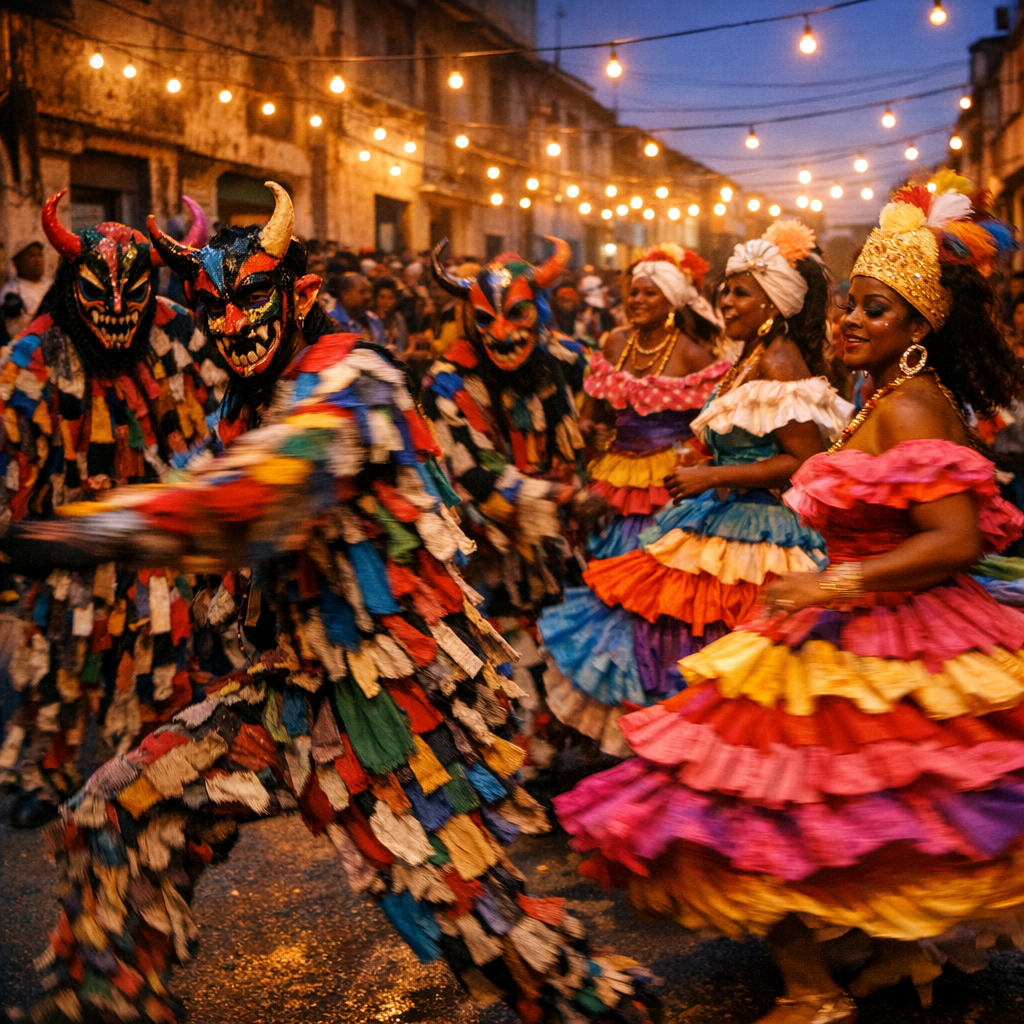
You could drive through Portobelo on an ordinary afternoon and mistake it for just another faded Caribbean fishing town — crumbling Spanish fort walls half-swallowed by jungle, pelicans working the harbor, a handful of dive shops catering to travelers headed out to the reefs. Then, on the right weekend every other year, the town changes completely. Drums start up somewhere near the old customs house. A procession turns the corner: women in towering, colorful headdresses and ruffled dresses that seem to unfold like flowers, moving in a slow, hip-driven dance with bare feet planted hard into the earth. Behind them come the devils — dozens of them, in patchwork rags and grotesque painted masks, cracking whips theatrically and chasing screaming, delighted children through the crowd. A queen holds court on a wooden throne. Somewhere, someone dressed as an angel is trying, dramatically and unsuccessfully, to capture a devil twice her size.
A traveler who stumbles into this without context might read it as chaos, or spectacle, or even something uncomfortable — face paint and mockery and a lot of noise. They would be missing the point entirely. What’s actually happening in the streets of Portobelo is one of the most sophisticated acts of cultural memory anywhere in the Americas: a centuries-old community of self-liberated Africans reenacting, in front of the whole town, exactly how they got free — and making their former captors the punchline.
The Gold, the Chains, and the Cimarrones Who Ran
Portobelo was not always sleepy. In the sixteenth and seventeenth centuries it was one of the most important — and most brutal — ports in the entire Spanish empire. Silver and gold plundered from Andean mines in present-day Peru and Bolivia moved overland across the isthmus and out through Portobelo’s harbor, bound for Spain. Guarding, hauling, and building the infrastructure for that theft required enormous amounts of forced labor, and the Spanish crown supplied it through the transatlantic slave trade, bringing thousands of kidnapped West and Central Africans to Panama’s Caribbean coast.
Not all of them stayed enslaved. From the earliest years of Spanish colonization, Africans in Panama escaped into the surrounding forests and mountains, forming their own free, self-governing communities. The Spanish called them cimarrones — a word originally used for domesticated cattle that had gone wild, repurposed as a slur for people who refused to stay captured. The cimarrones wore it as fact instead of insult: they had, indeed, gone wild and free, and they had no intention of going back.
Their freedom wasn’t just an escape — it was a strategic alliance. Cimarron communities partnered with English privateers, most famously Sir Francis Drake, who needed local knowledge of the terrain and a common enemy in Spain. Cimarron fighters guided English raiders through jungle paths to ambush Spanish mule trains loaded with stolen silver, sabotaging the very trade route that had enslaved them in the first place. It is one of history’s sharper ironies: some of the gold and silver Spain lost to English piracy along this coast was lost with the direct help of the people Spain had enslaved to move it. Out of these alliances and this resistance, a free Afro-Panamanian population took root along the coast near Portobelo and Nombre de Dios — and they began calling themselves, and their culture, Congo.
What the Diablos y Congos Performance Actually Means
What survives today as the Festival de Diablos y Congos is not folklore performed for tourists — it’s a ritual reenactment that Congo communities have maintained among themselves, generation after generation, since the colonial period. The performance runs on Congo culture’s own internal calendar, staged most intensely in the weeks after Carnival, and it tells one continuous story: capture, bondage, escape, and triumphant freedom.
The cast follows a set structure passed down through Congo communities. A Queen — often called Merced — rules the Congo nation alongside a King, Juan de Dioso, and a royal court of princes and princesses. Opposing them are the Diablos, led by a Major Devil, representing the enslavers and colonial authority itself. Spanish colonizers had used the Christian devil as a tool of control, teaching enslaved Africans that resistance was literally satanic. Congo culture flipped that weapon around entirely: in the Congo telling, the devil is the enslaver, grotesque and cruel, and it’s the Congos — the formerly enslaved — who are righteous, clever, and ultimately victorious, capturing and symbolically subduing the devil by the performance’s end.
The details of the performance are dense with encoded meaning. Congo men and women speak “en congo” during the festival — a stylized, often inverted way of talking where performers say close to the opposite of what they mean, or twist grammar and pronunciation deliberately. This wasn’t invented for the show; it echoes the real linguistic strategies enslaved Africans used to communicate freely, coded and confusing, right under the noses of slave traders and overseers who thought they understood the language being spoken around them. Congo women’s ruffled, colorful dresses evoke Panama’s traditional pollera, personalized with found objects and worn with meaning. Men playing Congos wear old clothing turned inside out, decorated with trinkets and dolls — a nod to how enslaved ancestors, given nothing, made adornment and identity out of scraps. For one designated stretch of days, ordinary social rules are suspended entirely: Congo law, not colonial or municipal law, governs the town, and the community itself decides how the drama plays out.
About That Black Face Paint: Context Matters
Any honest account of this festival has to address something a first-time visitor, especially an American one, will almost certainly notice and feel unsettled by: many of the devil performers blacken and paint their faces as part of the costume. Seen through an American lens, that image triggers an immediate, justified reflex — blackface in the United States has a specific, ugly history as a tool of white minstrelsy, built to mock and dehumanize Black people for white audiences.
That is not what is happening in Portobelo, and collapsing the two is a misreading. The performers painting their faces in the Diablos y Congos festival are, overwhelmingly, Afro-Panamanian people from Congo families themselves. The paint isn’t aimed at mocking Blackness — it’s part of dressing as the colonizer-devil character, the villain of the story, within a performance whose entire structure exists to satirize and defeat that figure. It is an internal, self-authored piece of theater by the descendants of the enslaved, about the enslavers, staged on the same ground where their ancestors were once trafficked. As one scholar who has studied the tradition put it plainly to public radio: in the American context, this kind of face paint carries a history that is “just terrible” — but here, worn by the community it belongs to and turned toward the people who enslaved them, “it’s playful, it’s subversive, it’s emancipatory.” The direction of the joke, and who is telling it, changes everything.
A UNESCO-Recognized Living Heritage
In 2018, UNESCO added the ritual and festive expressions of Panama’s Congo culture to its Representative List of the Intangible Cultural Heritage of Humanity — the same designation category used for traditions the international community recognizes as globally significant and worth actively safeguarding. The inscription formally recognized what Congo communities along Panama’s Caribbean coast had already known for centuries: that this performance tradition, with its music, dance, dress, language, and ritual structure, constitutes one of the most complete surviving records anywhere of how enslaved Africans processed, resisted, and ultimately transformed their own trauma into culture. It sits alongside Portobelo’s own designation — the town was named one of UN Tourism’s Best Tourism Villages in 2024 — as recognition that this small Colón Province port holds cultural weight far beyond its size.
What to See
The Diablos y Congos street procession — the heart of the festival: drums, the King and Queen’s royal court, dozens of costumed devils, and the running theatrical battle playing out through Portobelo’s streets and central plaza.
Congo drumming and call-and-response singing — the rhythmic backbone of the entire tradition, with songs that narrate daily life, history, and resistance, sung in a call-and-response style rooted directly in West and Central African musical traditions.
The devil masks — elaborately carved and painted, many still produced by artisans in the nearby village of Puerto Lindo, worth seeking out even outside festival dates.
San Felipe de Portobelo and the colonial fortifications — a UNESCO World Heritage Site in its own right, the stone forts and customs house are the physical backdrop against which this whole history unfolded, and worth walking even if you visit outside festival season.
The Black Christ of Portobelo (Cristo Negro) — housed in the Iglesia de San Felipe, this venerated statue draws its own major pilgrimage every October 21st and is deeply woven into the town’s Afro-Panamanian religious identity.
Planning Your Visit
Portobelo sits roughly two hours by road from Panama City on the Caribbean coast, making it an easily reachable day trip or overnight stay, though lodging directly in Portobelo is limited and fills up fast around festival dates — book early or base yourself in nearby Colón.
Here’s the honest caveat: the flagship Festival de Diablos y Congos has run on a biennial rhythm in its recent history, with its 13th edition held in May 2023 and its 14th in early May 2025. Following that pattern, the next full edition would fall in 2027, and at the time of writing we could not confirm an official 2026 date for that specific festival — treat any date you see online for it as unconfirmed until Panama’s Autoridad de Turismo or the Ministerio de Cultura publishes an official calendar. What is confirmed for 2026 is a related, annually held celebration of the same Congo heritage: the Festival de la Pollera Congo, now in its seventh year, scheduled for Portobelo on May 2, 2026, featuring devils, Congo queens, and the same drumming and dance traditions on a smaller scale. Congo culture is also visible and celebrated in Portobelo throughout the broader window between Carnival and Corpus Christi each year, so travelers built around that general spring window will find something to experience even in a non-festival year — just confirm specifics close to your travel dates rather than booking around an assumed one.
Dress respectfully but expect to get involved — bystanders are often pulled into the performance, whipped (gently, theatrically) by devils, or invited into the dancing. Bring cash for local food stalls, tip musicians and performers when you can, and remember you are a guest inside a community’s own ritual, not an audience at a staged show. Ask before photographing individuals up close, and support Portobelo’s own artisans, cooks, and guides directly rather than routing everything through outside tour operators.
Living Resistance, Still Performed
What makes Portobelo’s Congo tradition extraordinary isn’t just its age or its recent UNESCO recognition — it’s that it has never stopped being what it always was: a community telling its own history, on its own terms, using joy and satire as the tools of survival rather than despair. The cimarrones who ran from Spanish chains didn’t just win their freedom once, in the seventeenth century. Their descendants have spent every festival season since re-winning it, publicly, loudly, and with a wicked sense of humor aimed squarely at the people who tried to own them.
That’s the thing worth carrying home from Portobelo — not a photo of devils in the street, though you’ll take plenty, but the understanding that resistance can look like theater, that satire can be sacred, and that a people can turn the very symbols used to control them into the instruments of their own celebration. Come for the drums and the dancing. Leave having witnessed one of the oldest continuously performed acts of freedom in the Americas.