The Detour Nobody Puts on the Itinerary
Most people who fly into Costa Rica chasing surf, jungle, and sloth selfies never look east. The country’s Caribbean side gets a fraction of the tourist traffic that floods Manuel Antonio, Tamarindo, and La Fortuna, and Puerto Limon in particular has a reputation among backpackers as a place to pass through on the way to the postcard beaches of Cahuita and Puerto Viejo de Talamanca. That reputation is a mistake. Puerto Limon is not a gap between destinations. It is one of the most important, least-marketed sites in the entire Black diaspora story, and it happens to sit less than three hours from San Jose by road.
A detour into the city itself, past the cruise-ship terminal and into the neighborhoods behind it, turns up something most travel guides never mention: this port town on Costa Rica’s Atlantic coast was built by thousands of Jamaican and West Indian laborers, and it is where a 23-year-old Marcus Garvey lived and worked in 1910 and 1911, years before anyone had heard of the Universal Negro Improvement Association, the Black Star Line, or “Up, You Mighty Race.” What happened to him in Puerto Limon didn’t just precede the movement he built. Historians increasingly argue it caused it.
The Coast the Railroad Built
Puerto Limon exists, in its current form, because of a 19th-century infrastructure project and the Black labor that made it possible. In the 1870s and 1880s, Costa Rica contracted with American railroad developer Minor Keith to build the Atlantic Railroad, connecting the coffee-growing highlands around San Jose to a deep-water port on the Caribbean. Costa Rican laborers largely refused the work, citing the brutal heat, disease, and terrain, so Keith recruited thousands of workers from Jamaica and other British West Indian colonies instead. They cleared jungle, laid track, and buried a staggering number of their own dead to yellow fever and malaria in the process.
When the railroad was finished, many of those workers and their families stayed. Keith pivoted from railroads to bananas, and the same Afro-Caribbean labor force that built the tracks went to work on the plantations of what would eventually become the United Fruit Company, one of the most powerful corporate forces in Central American history. By the early 1900s, Puerto Limon and the surrounding province had become a de facto Jamaican colony inside Costa Rica: English-speaking, Protestant, culturally Caribbean, and almost entirely cut off from the Spanish-speaking, Catholic highlands just a few hours away. This is the community Garvey walked into in 1910, and it is the community whose descendants still call Limon home today.
A Timekeeper’s Education
Garvey arrived in Puerto Limon in 1910, a young Jamaican who had left Kingston to find work after a printers’ strike he’d helped organize collapsed and left him effectively blacklisted at home. Family connections got him a position as a timekeeper on a United Fruit Company banana plantation, a low-level administrative job that put him in direct, daily contact with the conditions West Indian laborers worked under: long hours, dangerous fieldwork, wages that undercut what white and mixed-race supervisors earned for the same output, and a rigid racial hierarchy that placed Black workers at the very bottom of a system built entirely on their labor.
What Garvey saw in that job did not stay theoretical for him. In 1911, he founded a newspaper in Puerto Limon called La Nacion (“The Nation”), using it to document and publicize the mistreatment of West Indian plantation workers up and down the coast. It was a short-lived venture. Local elites, including some within the West Indian community itself, dismissed him as an upstart, and the paper’s operation was eventually destroyed. Garvey left Costa Rica discouraged, but not empty-handed. He carried the experience with him through further stops in Panama, where he edited another paper covering the exploitation of Black canal-zone laborers, and eventually back to Jamaica and on to London.
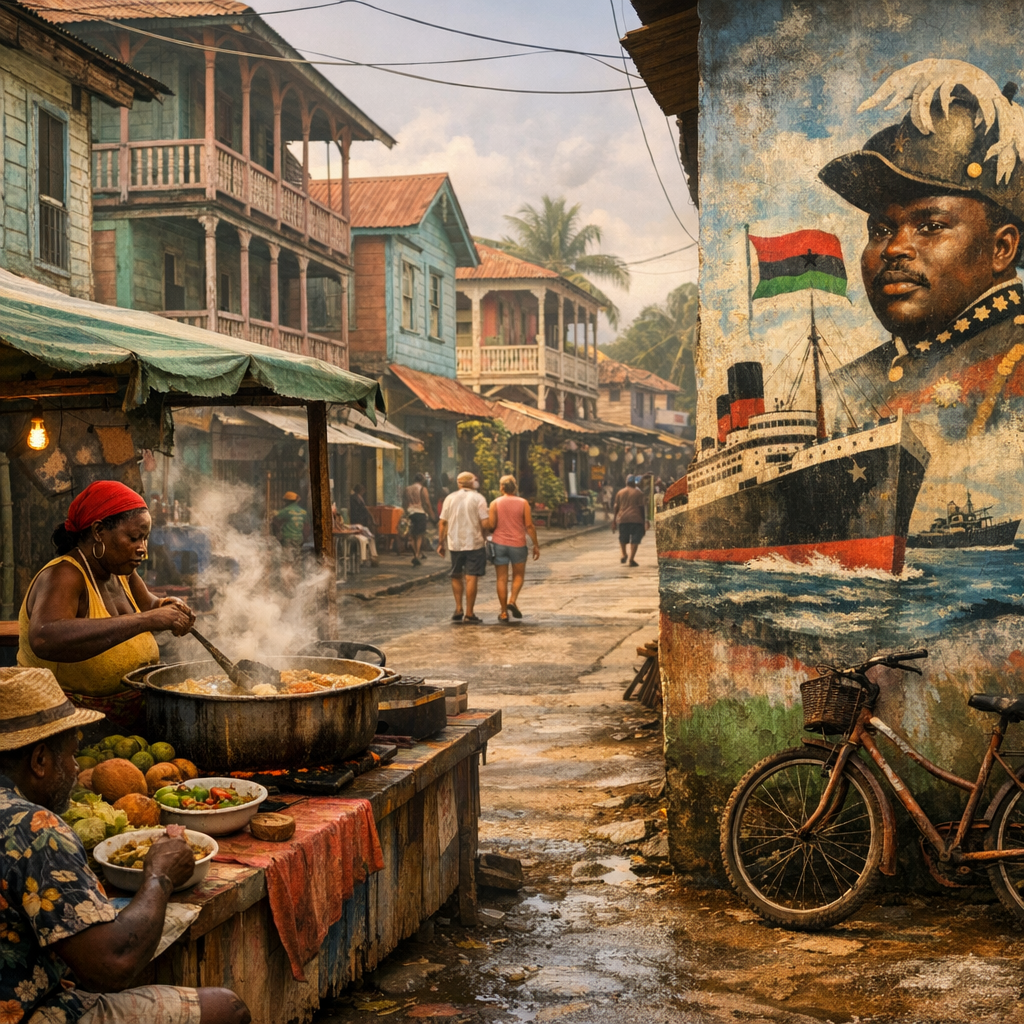
Historians who study Garvey’s early life treat his year in Puerto Limon as the ignition point of everything that followed. It was here, watching a corporate plantation economy extract Black labor while denying Black workers basic dignity or legal standing, that Garvey first articulated the core insight that would define his life’s work: that Black people scattered across the Americas, the Caribbean, and Africa were not separate populations with separate problems, but one people facing the same system under different flags. In 1914, back in Jamaica, Garvey founded the Universal Negro Improvement Association and African Communities League. Three years later he brought it to Harlem, where it grew into the largest Pan-African mass movement in history. The Black Star Line, UNIA’s most famous and most controversial enterprise, would go on to open an actual office in Puerto Limon, a direct, physical thread connecting Garvey’s global shipping company back to the port town where the whole idea started.
Citizens of Nowhere, for Decades
Here is the part of the story that most retellings of Garvey’s Costa Rica years leave out entirely, and it matters as much as anything Garvey personally did there: the community he lived among was, by design, kept separate from the rest of the country and denied full belonging in it. Costa Rica’s Afro-Caribbean population was confined, largely by law and policy, to Limon province for decades. West Indian immigrants and their Costa Rican-born children were shut out of full citizenship, land ownership, and free movement to the rest of the country under explicitly racialized naturalization and residency rules. It took a civil war and a new constitution in 1949 for Afro-Costa Ricans to be recognized as full citizens with the same rights as everyone else. That is not a footnote from centuries ago. People who were alive to remember life before 1949 have grandchildren alive today. The community that built the railroad, staffed the banana plantations, and hosted a future Pan-African icon spent close to seventy years being told, by the state whose infrastructure they built, that they did not fully belong to it.
Limonense Culture, Still Standing
That history of exclusion is exactly why Limon’s culture reads so distinctly from the rest of Costa Rica today, and why it’s worth a traveler’s time to notice the difference rather than flatten it into generic “Costa Rican culture.” Puerto Limon and the surrounding coast are the heart of Afro-Costa Rican, or Limonense, identity: a Jamaican-descended, historically Protestant, English-and-Creole-speaking Black culture that shares far more, linguistically and culturally, with Kingston or Colon than with San Jose. Limonese Creole, an English-based Creole close to Jamaican Patois, is still spoken in homes and on the street, though community leaders warn that younger generations are shifting toward Spanish, and local advocates have started English and Creole heritage schools to keep the language alive. Calypso music, brought over by the same laborers who built the railroad, remains a living tradition here rather than a museum piece, and the food, most famously rondon (a coconut-milk stew simmered with fish, tubers, and whatever the sea and garden provide that day), is Caribbean cooking with a Costa Rican zip code, not a regional variation on Costa Rican cuisine.
What to See
The Black Star Line Building — Built in 1922 as the local headquarters connected to Garvey’s UNIA and shipping enterprise, this building is one of the few physical structures in the world tying directly back to the Black Star Line. A 2016 fire damaged it, and restoration has been slow, but it remains a landmark for anyone tracing Garvey’s footprint through the diaspora, and a cause the local UNIA chapter continues to champion.
UNIA Liberty Hall — Blessed by Garvey himself and once a central gathering space for the local UNIA chapter, this building was later repurposed by tourism authorities and rebranded as a general “Casa de la Cultura.” Community advocates have been working to reclaim it as a recognized piece of Garveyist and Afro-Costa Rican history rather than a generic cultural venue. Ask locally about its status before you visit; it’s worth understanding what it used to be, and why that matters to the people fighting to have it recognized again.
UNIA Branch 300 — Founded in 1922 and still active today, Limon’s UNIA chapter runs community programming, cultural preservation events, and a local radio program dedicated to keeping Garvey’s legacy and Limonense identity alive. It’s a working community institution, not a historical reenactment, so approach it with the same respect you’d bring to any active civic organization.
Parque Vargas and the waterfront core — Puerto Limon’s central park and surrounding streets, with their weathered Caribbean-Victorian wooden architecture in faded pastels, are the best place to simply walk and feel the town’s Afro-Caribbean character rather than its Spanish-colonial one. This is where the port town’s identity is most visible at street level.
Calypso and live music — Ask around for local calypso musicians and venues rather than expecting a fixed tourist circuit; the tradition here is community-based and often tied to church halls, festivals, and informal gatherings rather than a dedicated club scene. If your visit lines up with October, the Limon Carnival (Carnaval de Limon), one of the largest Afro-Caribbean carnival celebrations in Central America, turns the whole city into a calypso and soca street party.
Rondon and Caribbean cuisine — Look for family-run kitchens and market stalls in and around downtown Limon serving rondon, rice and beans cooked in coconut milk, patí (a Jamaican-style patty), and ginger beer. This is home cooking, not restaurant-industry Caribbean food, and it’s the most direct, delicious way to understand what the community carried with it from Jamaica and adapted to a new coast.
Practical Notes for Visiting
Puerto Limon is roughly a two-and-a-half to three-hour drive or bus ride from San Jose, making it an easy day trip or overnight add-on to a Costa Rica itinerary that would otherwise skip the Caribbean side entirely. Direct buses run regularly from San Jose’s Caribe terminal. Most travelers use Limon as a jumping-off point for Cahuita and Puerto Viejo de Talamanca further south, both of which share the same Afro-Caribbean cultural roots and are worth combining with a Limon stop rather than treated as a substitute for it, since the city itself holds history those beach towns don’t. Cruise ships do call at Puerto Limon, which means a portion of the year the downtown fills with day-trippers headed straight for pre-booked jungle and canal tours; a visit timed outside those days, or one that deliberately walks into the city rather than out of it, will show you a very different place. As with any port city, standard urban travel awareness applies in Limon; stick to well-trafficked areas downtown and travel with a local guide or contact when exploring after dark, same as you would in any working port town anywhere in the world.
What the Detour Leaves You With
It is easy to visit Costa Rica and never learn that one of the most consequential Pan-Africanists in modern history spent a formative year here, radicalized not by a philosophy he read but by a job he worked, watching his own people harvest wealth for a foreign corporation while being denied the wages, dignity, and citizenship that wealth was built on. It is easy, too, to miss that the community he lived among is still there, still speaking its own Creole, still cooking rondon, still fighting to reclaim buildings that carry its name and its history. Puerto Limon doesn’t ask to be pitied and it isn’t a shrine. It’s a living Afro-Caribbean city on the wrong side of Costa Rica’s tourist map, and the short version of Marcus Garvey’s biography that starts in Harlem is missing its first chapter. Go find it.