The Drums You Feel Before You Hear Them
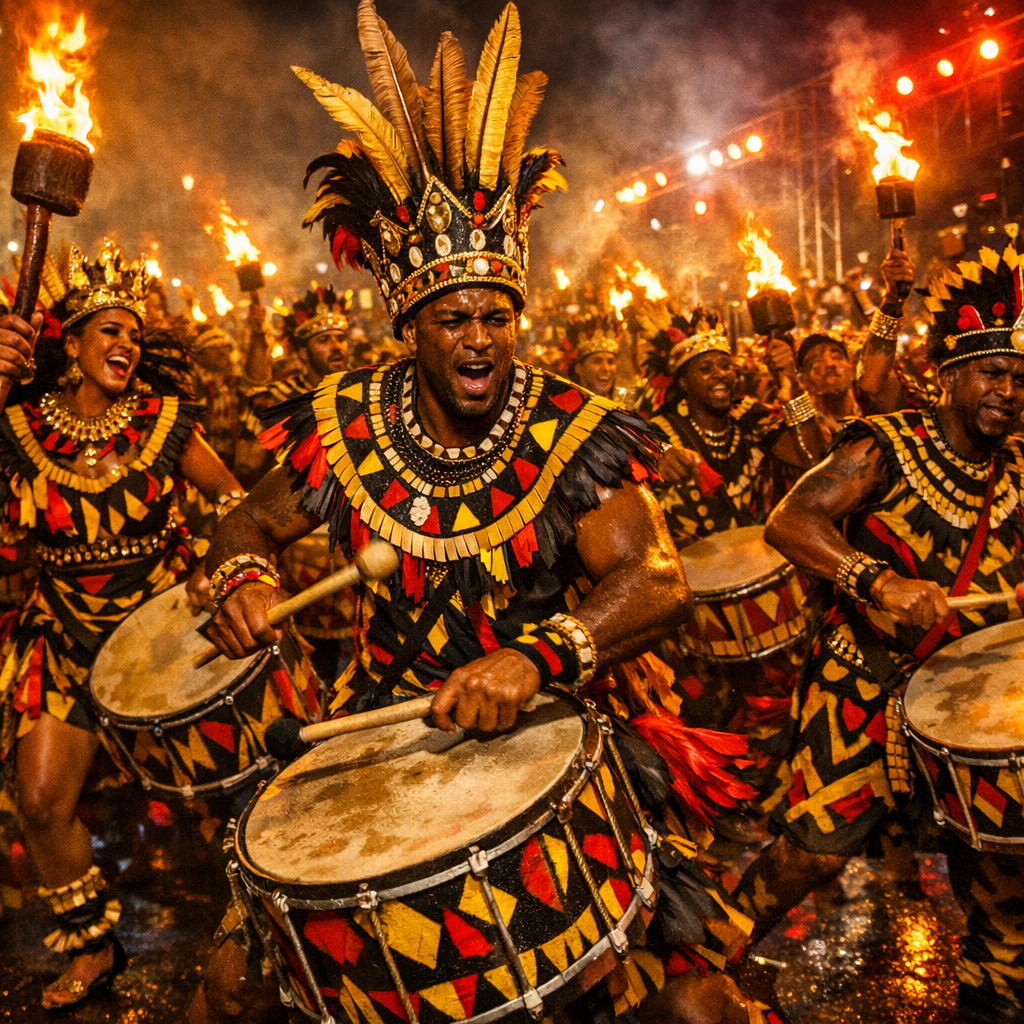
The rehearsal hall in Liberdade doesn’t look like much from the street — a low concrete building painted in flaking reds and yellows, tucked behind a row of lanchonetes and a barbershop with its door propped open to the heat. But get within two blocks on a Saturday night in the weeks before Carnival, and you feel it before you see it: a low-frequency thump moving through the pavement, through your ribs, up into your teeth. Follow it, and you land in the middle of an ensaio — a rehearsal — for Ilê Aiyê, and the sound stops being an abstraction and becomes several hundred drummers laying down surdo and repique rhythms in such tight formation that the crowd around them stops talking mid-sentence.
This is where a lot of Black travelers’ Carnival plans quietly change direction. The instinct, arriving in Brazil for the first time, is to chase Rio — the sequined stadium spectacle, the televised samba schools, the postcard image most of the world has of Brazilian Carnival. But talk to enough people who’ve actually done both, and a pattern emerges: they go to Rio once, and they go to Salvador da Bahia every year after that. Salvador’s Carnival isn’t a stadium show you watch from the stands. It moves through the streets, and one of the groups moving through those streets — arguably the most historically important one in the entire country — is Ilê Aiyê, the bloco afro that didn’t just join Bahian Carnival fifty years ago. It rewrote who got to be in it.
1974: A Bloco Born Out of a “No”
To understand why Ilê Aiyê exists, you have to understand what Bahian Carnival looked like before it did. By the early 1970s, Salvador’s street Carnival was dominated by trio-elétrico sound trucks and the dance clubs — mostly white, mostly upper-middle-class — that paraded roped off around them. Black Bahians, in a city and state where the majority of the population is of African descent, were largely relegated to the outside of those ropes: holding the cord that marked the boundary, working security, watching the parade they weren’t invited into. In a city sometimes called the Black Rome for how deeply African religion, food, language, and music run through its daily life, the biggest party of the year had built a wall around Blackness and hired Black hands to help hold it up.
In 1974, a group of friends from the Curuzu/Liberdade neighborhood — among them Antônio Carlos dos Santos, known universally as Vovô, and Apolônio de Jesus — decided to stop asking for a way in and build their own door instead. On November 11, 1974, they founded Ilê Aiyê, a name drawn from Yoruba meaning roughly “House of Life” or “House of the World.” The group made its full Carnival debut the following year, 1975, parading through Liberdade in red, black, white, and gold, singing an anthem, “Que Bloco É Esse?” (“What Bloco Is This?”), that answered its own question in the lyrics: this is the Black bloco, and it’s not asking permission.
The timing mattered as much as the intent. Brazil was six years into a military dictatorship in 1974, a regime deeply invested in the national myth of “racial democracy” — the official line that Brazil, unlike the segregated United States, had no race problem, because everyone had simply blended together into one harmonious people. An organization built explicitly around Black identity and Black self-determination punctured that myth in public, in the streets, during the one week of the year the whole country was watching Bahia. Ilê Aiyê’s early years brought real friction with police and press, exactly the kind of scrutiny that tends to fall on anyone who says out loud what a country has agreed not to say. They marched anyway.
The Policy That Still Gets Debated: Why Ilê Aiyê Restricted Its Own Parade to Black Members
Here’s the part of Ilê Aiyê’s story that a lot of coverage glosses over, and it deserves the opposite of glossing: from its founding, Ilê Aiyê restricted parading membership to Black participants. Non-Black Bahians could — and still can — stand along the route, buy the group’s albums, dance in the crowd, love the music. But marching in the bloco itself, wearing the year’s elaborate costumes, being part of the visual statement Ilê Aiyê makes as it moves through the streets, was reserved for Black members.
That policy was controversial in 1975, and it has remained controversial since, including among some Brazilians who read any race-based membership rule as a mirror image of the exclusion it was founded to answer. Vovô and the group’s leadership never framed it as a technicality. They framed it as the entire point. In a country that had spent decades insisting it didn’t have a race problem — while systematically excluding Black Bahians from the biggest cultural stage in their own city — Ilê Aiyê’s founders decided that Black joy, Black pageantry, and Black beauty needed one guaranteed, uncontested space of their own. “We’re helping Black people build their self-esteem,” Vovô has said of the group’s mission, and that self-esteem-building was never going to happen inside a space where Blackness was still the exception being tolerated rather than the standard being celebrated. The policy wasn’t about shutting a door. It was about building the one room in the house where Black Bahians didn’t have to explain themselves.
A Different Corner of Africa, Every Single Year
Since 1976, Ilê Aiyê has built its annual Carnival theme around a single African or Caribbean nation, culture, or historical figure — chosen each year and honored through the costumes, the pageantry, the music, and often a companion album released ahead of Carnival. The very first theme celebrated the Tutsi people of Rwanda. In the decades since, the group has turned its Carnival parade into a kind of moving, danceable survey course: honoring ancient Egypt, Angola, Mozambique, the Yoruba nations of Nigeria, Haiti, and dozens of others, each year rendered through elaborate hand-made costumes referencing that nation’s royal dress, symbols, and history.
This is, practically speaking, what makes an Ilê Aiyê parade or rehearsal so visually overwhelming even for travelers who’ve seen plenty of Carnival elsewhere. It isn’t generic sequins and feathers. It’s specific, researched, deliberately referential pageantry — Ilê Aiyê employs its own researchers and designers to build each year’s theme with some historical grounding, not just aesthetic flourish. For a lot of Black travelers, especially those from the U.S. and the wider diaspora who grew up with a fairly thin, flattened idea of “Africa” as a single place rather than a continent of distinct nations and histories, watching Ilê Aiyê name a specific country and specific history out loud, every year, in front of hundreds of thousands of people, lands differently than any other Carnival spectacle in Brazil.
Candomblé, and Why It Deserves More Than a Photo
You cannot tell Ilê Aiyê’s story without Candomblé, the Afro-Brazilian religion that enslaved Yoruba, Bantu, and Fon people carried across the Atlantic and kept alive, in secret and then in the open, through more than a century of colonial and post-colonial suppression. Bahia holds the largest population of African descent of any Brazilian state, and it is also the undisputed spiritual center of Candomblé in Brazil — a living religion, not a folkloric relic, practiced today in terreiros (temple houses) throughout Salvador where initiates honor the orixás, deities tied to forces of nature, ancestry, and human character, through drumming, song, and ceremony conducted largely in Yoruba.
Ilê Aiyê’s roots run directly into this soil. The group was born inside a Candomblé household: Mãe Hilda Jitolu, mother of co-founder Vovô, was the spiritual head of her own terreiro and served as Ilê Aiyê’s spiritual mother from its founding, and the group’s cultural complex in Liberdade still carries her name and legacy today. The rhythms Ilê Aiyê’s drummers play, the reverence built into its pageantry, the very idea that Black cultural memory was worth building an institution around — all of it draws directly from Candomblé’s insistence that African spiritual and cultural inheritance survived the Middle Passage intact and sacred.
This is exactly why a terreiro should never be treated as a Carnival photo-op. Candomblé is a closed, initiatory religion practiced by real communities who have spent centuries defending it against colonial bans, police raids, and social stigma — it is not a tourist attraction staged for visitors, and it is not owed to anyone’s curiosity. If you want to experience Candomblé’s role in Bahian life beyond what you see reflected in Ilê Aiyê’s music and costuming, do it through a terreiro that explicitly welcomes respectful visitors and through a local guide who has an actual relationship with that house of worship — never by wandering up to a ceremony uninvited or treating drumming and trance as spectacle. Several reputable Salvador-based cultural guides and Afro-Brazilian heritage tour operators can arrange terreiro visits the right way, with context, consent, and an invitation rather than a transaction. Ask before you point a camera anywhere near a ceremony, and follow your guide’s lead on what’s appropriate to photograph at all.
What to See
An Ilê Aiyê Ensaio (Rehearsal) — In the weeks leading up to Carnival, Ilê Aiyê holds public rehearsals in Liberdade where the full drum corps runs the year’s repertoire at volume. It’s less crowded than Carnival week itself, deeply immersive, and often the best way to experience the group’s musical force up close.
Ilê Aiyê’s Carnival Parade — The main event: Ilê Aiyê parades through the streets of Salvador during Carnival, typically departing from Largo do Curuzu in Liberdade, with thousands of costumed members moving through the neighborhood in the year’s chosen theme.
Casa do Peto and the Liberdade neighborhood — Ilê Aiyê’s home neighborhood is worth walking beyond Carnival season, too. Liberdade is one of Salvador’s largest predominantly Black neighborhoods, and its everyday rhythm — the barbershops, the street food stalls, the corner bars playing samba-reggae — gives context for the community the bloco was built to represent.
Pelourinho’s Afro-Brazilian cultural sites — Salvador’s historic center holds Candomblé-influenced museums, capoeira circles, and Afro-Brazilian craft markets that pair well with an Ilê Aiyê visit, offering a broader introduction to the culture Ilê Aiyê draws from and celebrates.
Practical Notes for Visiting
Ilê Aiyê’s Carnival parade draws enormous crowds, and Liberdade is a real, working-class residential neighborhood, not a tourist zone built for visitors — dress and behave accordingly, keep valuables secure the way you would at any large outdoor event, and consider going with a local guide or tour group for your first visit, especially at night. Book accommodations in Salvador well ahead of Carnival season, as the city fills up fast and prices climb sharply during the week itself. If your trip doesn’t line up with Carnival, ask a local guide or your hotel about upcoming ensaios — Ilê Aiyê and Bahia’s many other blocos afro rehearse and perform at points throughout the year, not just in the days before Lent. And if you go to a terreiro at all, go as a guest of someone who belongs there, not as a tourist checking a box.
Fifty Years Later, Still Answering the Question
“Que bloco é esse?” the founders sang back in 1975 — what bloco is this? — and answered it themselves before anyone else could define it for them. Fifty years on, the question isn’t really a question anymore; it’s a fact of Bahian Carnival that reshaped the whole country’s relationship to its own Blackness. Every blocos afro that formed in Ilê Aiyê’s wake, every Bahian kid who grew up watching a Carnival group choose to honor Angola or Rwanda or Haiti instead of chasing generic glitter, every visitor who leaves Liberdade understanding Blackness as something that builds its own institutions rather than waiting for a seat at someone else’s — all of it traces back to a handful of friends in 1974 who got tired of holding the rope and decided to throw the party themselves. Go to Rio if you want the postcard. Go to Salvador, and stand in Liberdade while the drums come through the ground and into your chest, if you want to understand what Carnival was actually for.