The Walk Back
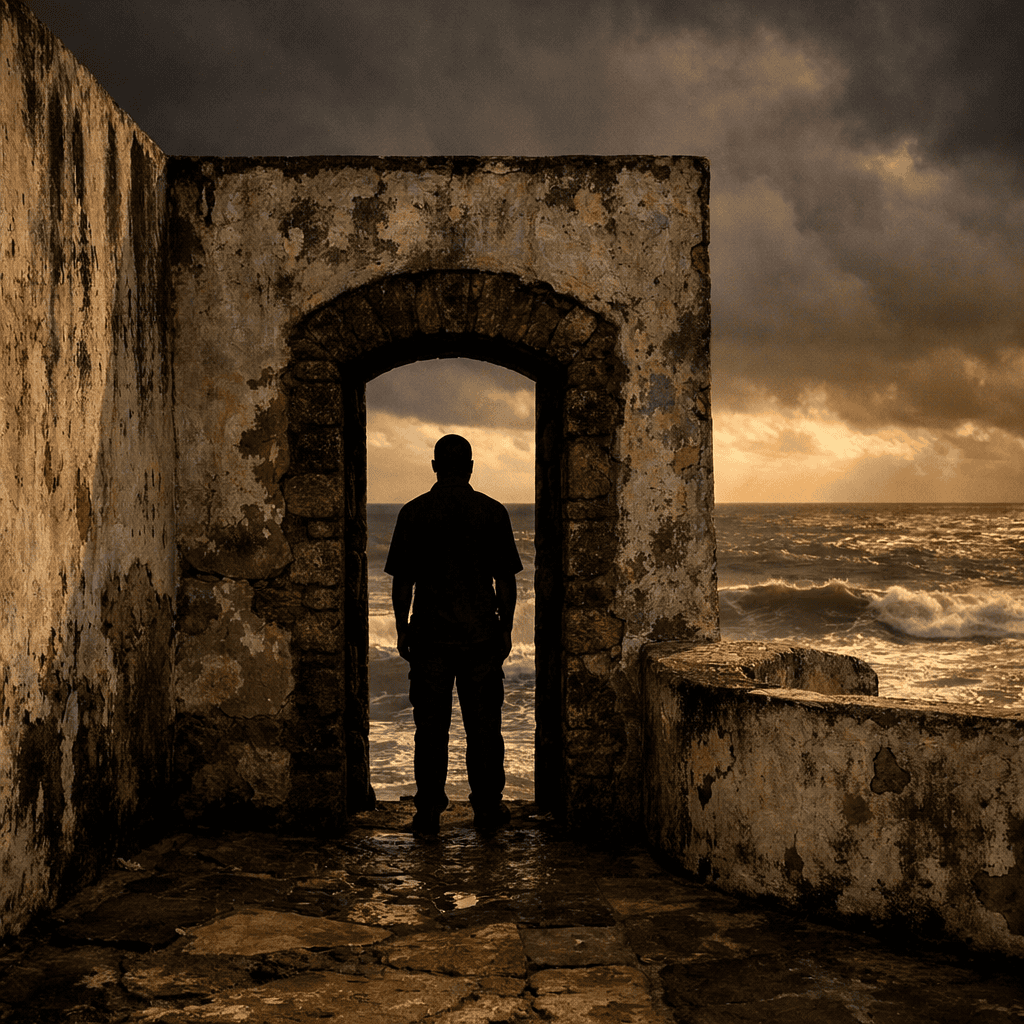
The Atlantic doesn’t announce itself at Cape Coast Castle. You hear it before you see it — a low, constant push of surf against the rocks below the ramparts — and by the time our small group reached the Door of No Return, that sound had become the only thing in the room. It’s a narrow stone archway, low enough that a tall man has to duck, cut into the outer wall of the castle’s male slave dungeon. For roughly three hundred years, it was the last piece of Africa that hundreds of thousands of people ever touched. On the other side is a short drop to the rocks, the surf, and the open ocean where ships once anchored to take on their human cargo.
Our guide, a Cape Coast native named Kwame who has led this tour for over a decade, didn’t rush us through it. He let the group sit in the dungeon first — low-ceilinged, airless, the walls still faintly ridged from what the placards describe, carefully, as “organic matter” — and then he walked us to the doorway itself and stopped. “This is where they left,” he said. “Now I want you to leave, and come back.” One by one, we stepped through the Door of No Return out onto the narrow ledge above the rocks, turned around, and walked back in. It took maybe four seconds. I have not stopped thinking about it since.
Nobody in our group had planned for that moment to undo them, but it did. A woman two people ahead of me sat down on the stone floor the second she stepped back inside and stayed there, alone, for several minutes while the rest of us waited in silence outside the doorway. I walked back through dry-eyed and then, twenty feet later, standing in the sun of the courtyard where European traders once held Sunday services directly above the dungeons, I was not. It’s a strange, specific grief — not for a person you knew, but for a possibility: that somewhere in those four seconds, you might have walked the exact path someone who shares your blood was dragged through in chains. Ghana built an entire national campaign, the 2019 Year of Return, around inviting people like me to find out. Nobody warns you what it costs to accept the invitation.
What the Walls Still Hold
Cape Coast Castle and its sister site up the coast, Elmina Castle, deserve to be understood as more than backdrops for an emotional photo. They are two of the oldest and most intact monuments to the transatlantic slave trade left standing anywhere in the world, and the history embedded in their stone is not abstract.
Elmina Castle came first. Portuguese traders built it in 1482 as São Jorge da Mina, hauling prefabricated stone and materials across the Atlantic on twelve ships — making it the first European structure ever built in sub-Saharan Africa. It began as a gold-trading post; within decades it had become something else entirely. The Dutch seized it from the Portuguese in 1637 and ran it as a slave-trading depot until 1814, after which it passed to British control in 1872. Cape Coast Castle, roughly ten miles east, was built later, in 1653, originally by Swedish traders before it was expanded into a major British-run fort and the administrative center of Britain’s Gold Coast colony. Both sites are inscribed together, along with fifteen other forts along roughly 500 kilometers of Ghana’s coastline, in a single UNESCO World Heritage designation — “Forts and Castles, Volta, Greater Accra, Central and Western Regions” — recognized in 1979 specifically because of their place in the slave trade.
Inside both castles, the dungeons held men and women separately, sometimes for weeks or months, in conditions built to break people before they ever reached a ship: no sanitation, minimal food, and rooms so overcrowded that disease moved through them constantly. Historians estimate that of the roughly 12.5 million Africans forced onto slave ships during the transatlantic trade, a significant share passed through fortified points exactly like these along the Gold Coast. The Door of No Return at each castle is the literal last threshold — the point past which a person left the continent and, in nearly every case, never returned. It is not hyperbole when Ghanaian guides call it sacred ground. It is the correct word.
A quieter, less-visited stop on many heritage itineraries makes the same point differently: Assin Manso, about an hour inland, marks the Slave River where captives were given a final bath before the last march to the coast. In 1998, Ghana repatriated and reburied the remains of two known descendants of the trade — one African American, one Jamaican — at Assin Manso as part of that year’s Emancipation Day observance, a symbolic act of bringing two people, at least, all the way home. The site is now part of the same pilgrimage circuit as the castles, and for many travelers it lands with a different, quieter weight than the dungeons do.
Why Ghana Built a Campaign Around This
The moment I walked through at Cape Coast Castle didn’t happen in a vacuum. It exists because of a deliberate, well-funded piece of Ghanaian government policy called the Year of Return, and understanding that campaign is essential to understanding what a modern “homecoming” trip to Ghana actually is.
President Nana Akufo-Addo formally launched the Year of Return in September 2018, announcing it in Washington, D.C. in partnership with the U.S.-based Adinkra Group. The target year, 2019, was chosen deliberately: it marked 400 years since the first recorded enslaved Africans arrived in the English colony of Virginia in 1619. Ghana’s pitch to the diaspora was direct and, for a lot of Black Americans, disarming in its simplicity — an open invitation to visit, invest, and in some cases stay, framed not as tourism but as a long-overdue reunion.
It worked, by any measure a tourism board would use to grade a campaign. Airport arrivals jumped roughly 45% during 2019. Average visitor spending rose from about $1,862 per trip in 2017 to $2,589 during the campaign, and Ghana’s government projected the year’s tourism impact at close to $1.9 billion. The momentum didn’t stop when the calendar flipped to 2020 — it carried into successor initiatives like Beyond the Return, and into an annual rhythm of diaspora-facing events that now includes PANAFEST, the biennial Pan-African Historical Theatre Festival based in Cape Coast, timed alongside Ghana’s Emancipation Day observances every August 1. Between the castles, PANAFEST, and Beyond the Return programming, Ghana has built something no other West African nation has matched at this scale: actual tourism and cultural infrastructure specifically designed to receive the descendants of the people taken from this coast.
The Part the Brochure Leaves Out
Here is where this story needs to be honest, because most coverage of the Year of Return isn’t. The campaign’s success has created real friction inside Ghana, and pretending otherwise does a disservice to both the Ghanaians living with the consequences and the diaspora travelers trying to make sense of where they actually stand.
The clearest flashpoint has been land. Reporting on Pan-African settlement communities built to house returning diaspora members has documented Ghanaian farmers losing generational family land — in some cases dozens of acres — to development tied to diaspora resettlement, sometimes without compensation. One farmer described losing lime, coconut, and orange groves his family had worked for generations; others reported intimidation when they tried to push back. Local residents have been candid about the imbalance this creates: diaspora arrivals often carry foreign currency and get access to land and opportunity that many Ghanaians, in their own country, do not. It’s a hard thing to sit with as a visitor, especially days after standing in a dungeon built on the theft of your own ancestors’ labor and freedom — the uncomfortable truth is that “homecoming” tourism, however well-intentioned, can still reproduce patterns of outsiders having more leverage than locals.
Ghana’s government has responded to some of this friction directly. In November 2024, President Akufo-Addo presided over a ceremony granting Ghanaian citizenship to 524 people of African descent in a single sitting — one of the largest mass naturalization events tied to the country’s diaspora outreach, and proof the “come home” invitation is backed by real policy, not just a hashtag. But the citizenship pipeline itself has been imperfect enough that Ghana has since paused and restructured parts of the diaspora citizenship process, publicly framing the pause as an effort to build a fairer, more orderly path rather than a reversal of the invitation. Read that as what it is: a young, still-evolving policy apparatus trying to catch up to a cultural movement that outran it.
None of this cancels out what the Year of Return has done. It has funded museums, created jobs, and given hundreds of thousands of Black Americans an experience that no domestic monument can replicate. But a mature relationship with this trip means holding both truths — the catharsis of walking back through that door, and the reality that some Ghanaians experience the wave of returnees as an economic and cultural pressure they never consented to. Ask your guide about it. Most of them, in my experience, would rather you ask than assume.
If the Trip Changes What You Want Next
It’s common enough that Ghanaian officials plan for it: some travelers leave Cape Coast Castle and start asking, seriously, what it would take to live in Ghana permanently. If that’s you, this story isn’t the place to walk through Ghana’s Right of Abode process or the mechanics of its citizenship application — BTN has already done that work in detail in Ghana Citizenship, Explained: What the Right of Abode Actually Gets You, part of our Blaxit series, along with a real cost-of-living breakdown in Blaxit Diaries: What It Actually Costs to Live in Ghana as a Black American Expat. Read those before you make any decisions bigger than a return flight. What I’ll say here is just this: the ceremony at the castle door and the paperwork at the immigration office are two entirely different kinds of homecoming, and conflating them is how well-meaning travelers end up disappointed by a bureaucracy that was never built to move at the speed of feeling.
If you’re planning your own trip, know that this is far from the only lens BTN has covered Cape Coast through. Pastor Bros Take Ghana follows a crew of clergy who treated the Door of No Return as a second pulpit in the middle of a ministry trip, and The Family Reunion That Left the Country covers what it looks like to bring three generations — grandparents to great-grandchildren — through that same dungeon together. Both are worth reading alongside this one; the geography overlaps, but the reasons people make this trip, and what they carry out of it, don’t.
Coming Home, Complicated
I don’t have a clean ending for this, and I’ve come to believe that’s the most honest thing I can tell you about it. Walking back through the Door of No Return didn’t heal anything in the way I half-expected it to, and it didn’t hand me an ancestor’s name or a country to call my own. What it gave me was smaller and stranger: four seconds of doing, on purpose and by choice, the one thing the people who built that doorway made sure could never happen. That’s not closure. It’s not supposed to be. It’s a door that Ghana built a whole national campaign to reopen, knowing full well that inviting the diaspora home would be complicated, contested, and imperfect — and choosing to do it anyway. Walk through it if you get the chance. Just go in with your eyes open on both sides of the threshold.