A Bridge Most People Drive Right Past
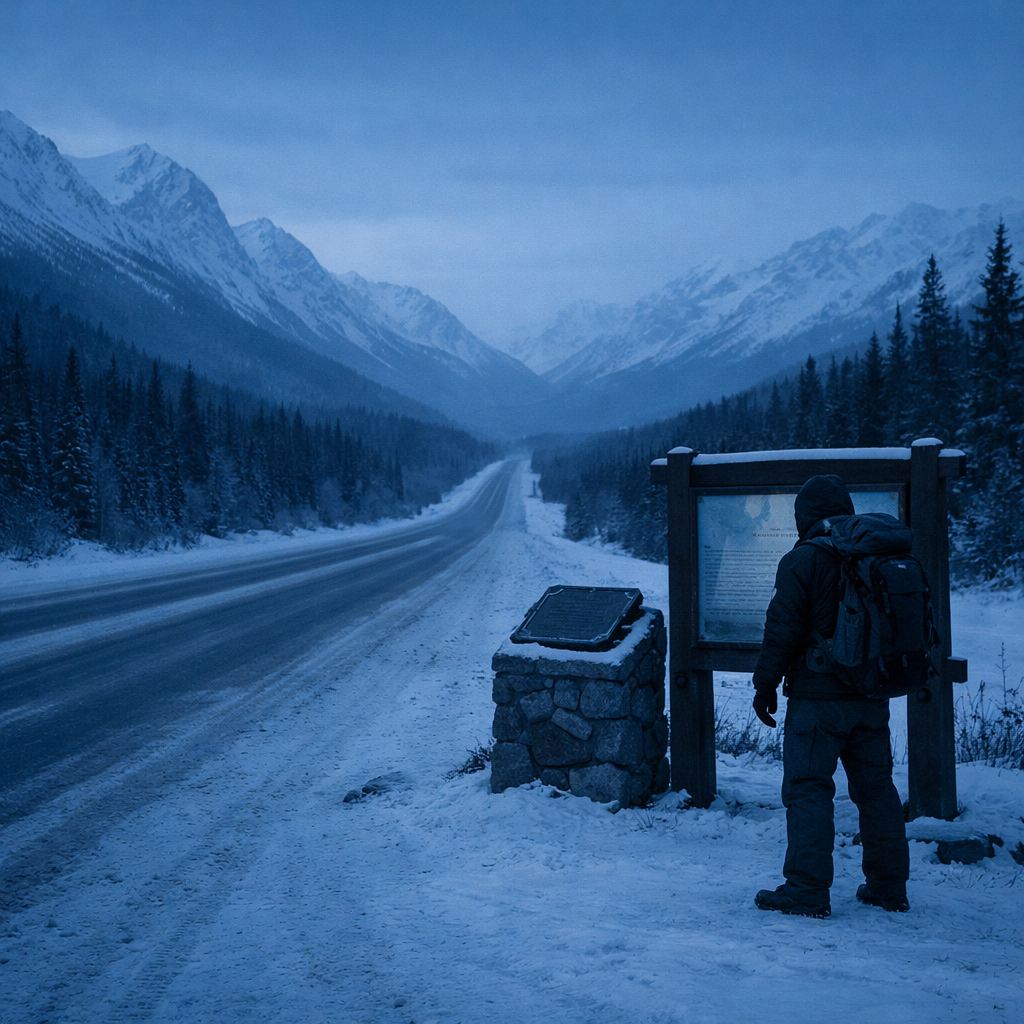
Somewhere south of Delta Junction, Alaska, where the Alaska Highway crosses the Gerstle River in a wide gravel valley ringed by black spruce, there’s a bridge sign that stops almost nobody. Most road-trippers are chasing the next fuel stop, the next moose sighting, the next Instagram pull-off with a mountain in frame. But if you slow down and read it, the sign says Black Veterans Memorial Bridge, and it names a story that most people driving the most famous road in the Far North have never once heard: that roughly a third of the soldiers who carved this highway out of raw Arctic wilderness were Black GIs, working segregated, under-equipped, and largely unrecognized, for eight brutal months in 1942.
Alaska gets sold to American travelers as the whitest place in the country — a frontier of Iditarod mushers and gold-rush prospectors, glaciers and cruise-ship decks, a place Black history supposedly never touched. That sell is wrong, and it has always been wrong. Long before statehood, Buffalo Soldiers were stationed in Skagway. And in 1942, the U.S. Army handed nearly 4,000 African American soldiers picks, shovels, axes, and a deadline the military itself considered close to impossible: build roughly 1,500 miles of road through uncharted Yukon and Alaskan wilderness, in eight months, so the United States could move troops and supplies overland to defend Alaska after Pearl Harbor and the Japanese occupation of Attu and Kiska in the Aleutians. They did it. Most of the country still doesn’t know their names.
A War Emergency and an Impossible Deadline
The Alaska Highway — originally called the Alaska-Canada Military Highway, or ALCAN — exists because of a genuine wartime panic. After Pearl Harbor, and especially after Japanese forces landed in the Aleutian Islands in June 1942, U.S. military planners feared Alaska could become the next front. There was no reliable overland route to move troops, equipment, and fuel north; everything depended on ships vulnerable to submarine attack. President Franklin D. Roosevelt authorized the highway in February 1942, and the Army Corps of Engineers was ordered to build a pioneer road from Dawson Creek, British Columbia, to Delta Junction, Alaska — through muskeg swamp, permafrost, uncharted mountain passes, and river crossings with no existing bridges — in a single construction season.
Roughly 10,000 to 11,000 troops were assigned to the project across seven Army engineer regiments. Nearly 4,000 of them — nearly four in ten — were African American soldiers serving in three segregated units: the 93rd, 95th, and 97th Engineer General Service Regiments. This was still a Jim Crow Army. Black and white regiments worked the same emergency project, on the same brutal terrain, toward the same deadline, but they worked it as two separate armies occupying the same road.
The 93rd, 95th, and 97th: What They Actually Built
The numbers alone are staggering. Working with hand tools far more than the heavy machinery given to white units, the 93rd Regiment cut roughly 240 miles of road between June and October 1942, building bridges and culverts largely with picks, shovels, axes, and hand saws. The 97th Regiment pushed through some of the most punishing mountain terrain on the entire route, a roughly 230-mile stretch, before meeting the white 18th Engineer Regiment on October 25, 1942, at a spot that came to be called Contact Creek — a meeting point marked, in period photographs, by a Black soldier and a white soldier shaking hands across the gap where the road finally connected. It’s one of the only images of interracial cooperation the segregated Army produced that year, and it happened because the road simply required it.
The 95th Regiment, meanwhile, became something close to legend among the engineer units for the Sikanni Chief River bridge in northern British Columbia. According to accounts passed down by the soldiers and later documented by historians, the regiment wagered its own pay that it could finish the crossing in four days instead of the scheduled eight — and did it in roughly three and a half, working around the clock in freezing river water. By the time the highway’s two halves connected in October 1942, engineers who had been told the project would take years had finished it in eight months and twelve days. Black regiments, by several accounts, completed a longer combined stretch of difficult terrain than their white counterparts working the same job.
Worst Gear, Hardest Miles: Jim Crow at Forty Below
None of that achievement erases what it cost, or the specific ways the Army made the work harder than it needed to be. Black soldiers were routinely denied the heavy equipment issued to white regiments and did enormous stretches of roadwork by hand. Housing was unequal: white troops were more often quartered in insulated Quonset huts, while Black regiments were more likely left in canvas tents through winters that regularly dropped to 40 and 50 degrees below zero for days at a stretch — followed by summers of nearly 90-degree heat and mosquito swarms thick enough to be its own kind of misery. Supply lines were unreliable for everyone on this project, but Black units disproportionately absorbed the shortages in cold-weather gear, food, and equipment. Regiments were also barred from entering the small towns along the route, kept isolated in wilderness camps even when off-duty, and commanding officers frequently viewed Black engineers with open suspicion or contempt regardless of the work they were turning in. Alaska’s own state Human Rights Commission has since specifically noted that 30 Black soldiers on the project were court-martialed during construction — a detail modern retrospectives treat as part of the record of how unevenly discipline and suspicion fell on Black troops doing identical work under identical pressure.
This is the part of the story that a highway-marker plaque can’t hold in one sentence: these men built one of the most significant engineering achievements of the Second World War while the Army that sent them there treated their competence as a surprise and their comfort as optional. Both things are true at once, and neither one cancels the other out.
From a Quiet Bridge Name to a State Holiday: How Recognition Actually Grew
For decades after 1942, this story mostly disappeared from the highway’s official memory. The first real institutional gesture came in 2002, when Alaska named that Gerstle River crossing near Delta Junction the Black Veterans Memorial Bridge — a small, specific act of naming that Alaska’s then-Lieutenant Governor Fran Ulmer tied directly to the record, saying plainly that without the Black soldiers, the highway would likely never have been finished in anything close to eight months.
Recognition kept building from there rather than stopping. In 2017, on the highway’s 75th anniversary, Alaska’s legislature passed Senate Bill 46, formally designating October 25 — the anniversary of the 97th and 18th Regiments’ meeting at Contact Creek — as Alaska Highway Day, with the governor at the time explicitly calling the ALCAN “the road to civil rights.” CBC and Alaska outlets covered veterans’ descendants and historians marking the anniversary that year, and the National Park Service has since published its own detailed account of the regiments’ work as part of its Black history in the Last Frontier series. Alaska Highway Day commemorations have continued in the years since — Anchorage’s American Legion Post 34, itself named for World War II pilot Chappie James, has hosted annual receptions on the date, using the occasion to fund youth civic programs and to keep the 30 court-martialed soldiers specifically part of the public record rather than a footnote.
As of 2026, the story has moved from obscure to actively maintained: the Alaska Department of Transportation is replacing the aging Black Veterans Memorial Bridge structure itself this year, and has committed to preserving a portion of the original span as a standalone tribute rather than letting the name and the history disappear with the old bridge. None of this means the story is common knowledge — most Alaska road-trippers still have no idea it’s the reason the road under their tires exists on this timeline at all. But it is no longer a story fighting from zero. It has a state holiday, a National Park Service page, a preserved monument, and a growing shelf of documentary and historical coverage behind it. The work now is less about discovery and more about making sure travelers actually encounter it.
What to See Along the Alaska Highway Today
Black Veterans Memorial Bridge, Gerstle River (near Delta Junction, AK) — The named bridge itself, with its interpretive signage, sits just south of Delta Junction on the final Alaska stretch of the highway. Even mid-reconstruction, the site and its preserved tribute span remain the most direct physical marker of this history on U.S. soil.
Delta Junction — Mile “0” (Alaska Highway terminus) — The official end of the Alaska Highway (or the beginning, depending on direction of travel) sits in Delta Junction, with a visitor center that covers the highway’s construction history broadly. Ask specifically about the segregated regiments — it’s worth requesting the fuller version of the story rather than assuming it’s on the main placard.
Sikanni Chief River, British Columbia — The site of the 95th Regiment’s legendary bridge sprint, roughly Mile 162 on the Alaska Highway in northern BC. The current bridge isn’t the original structure, but the crossing itself is a tangible stop on the actual route the regiment worked.
Contact Creek / Historical Mile 588 area, Yukon/BC border — Near where the 97th and 18th Regiments met and shook hands in October 1942, completing the highway’s final link. Roadside historical markers along this stretch of the Yukon highway corridor cover construction-era history for travelers making the full Dawson Creek–to–Delta Junction run.
Dawson Creek, British Columbia — Mile “0” (the other end) — The highway’s southern terminus has its own visitor center and historical displays anchoring the start of the entire 1942 project, useful context if you’re doing the drive south-to-north.
Planning the Drive
This is a serious, remote, multi-day road trip, not a day excursion — budget at least four to five days to drive the full Alaska Highway corridor from Dawson Creek to Delta Junction, more if you want to actually stop at the sites above rather than blow past them. Fuel, food, and lodging stops are spaced far apart in the Yukon and northern BC sections; fill your tank whenever you see a station, and check seasonal road conditions before you go, since winter travel on this route is genuinely hazardous even with modern vehicles and gear — a fact that only sharpens what it meant for the regiments who built it with 1940s equipment and no road at all. Whitehorse, Yukon, and Fairbanks, Alaska, are the largest cities near the corridor and make sensible overnight anchors with full services. When you stop at the interpretive markers, take the extra few minutes to actually read them rather than treating them as a photo op on the way to the next scenic overlook — that’s the whole ask this story makes of a traveler.
Why This Story Matters Now
The Alaska Highway gets marketed as one of the last great American road trips — raw wilderness, total isolation, a drive that tests you. All of that is true, and it’s exactly why the story of who built it belongs in the trip planning, not as a footnote discovered by accident at a bridge sign. Nearly 4,000 Black soldiers did some of the hardest physical labor of the Second World War, in conditions the Army itself made harsher than they needed to be, and finished a project that military planners doubted could be done at all in one season. They weren’t recognized for it in their own lifetimes the way they should have been. They are being recognized more now — a bridge name, a state holiday, a preserved span, a slowly growing body of documentation — and that recognition exists because people kept telling the story until institutions had to catch up.
Drive the Alaska Highway if it’s on your list. It should be. Just go knowing whose hands actually built the road under your tires, and say their names — the 93rd, the 95th, the 97th — out loud when you cross that bridge near Delta Junction.