The Lesson in the Courtyard
The lesson starts with a slap on wood, not a word.
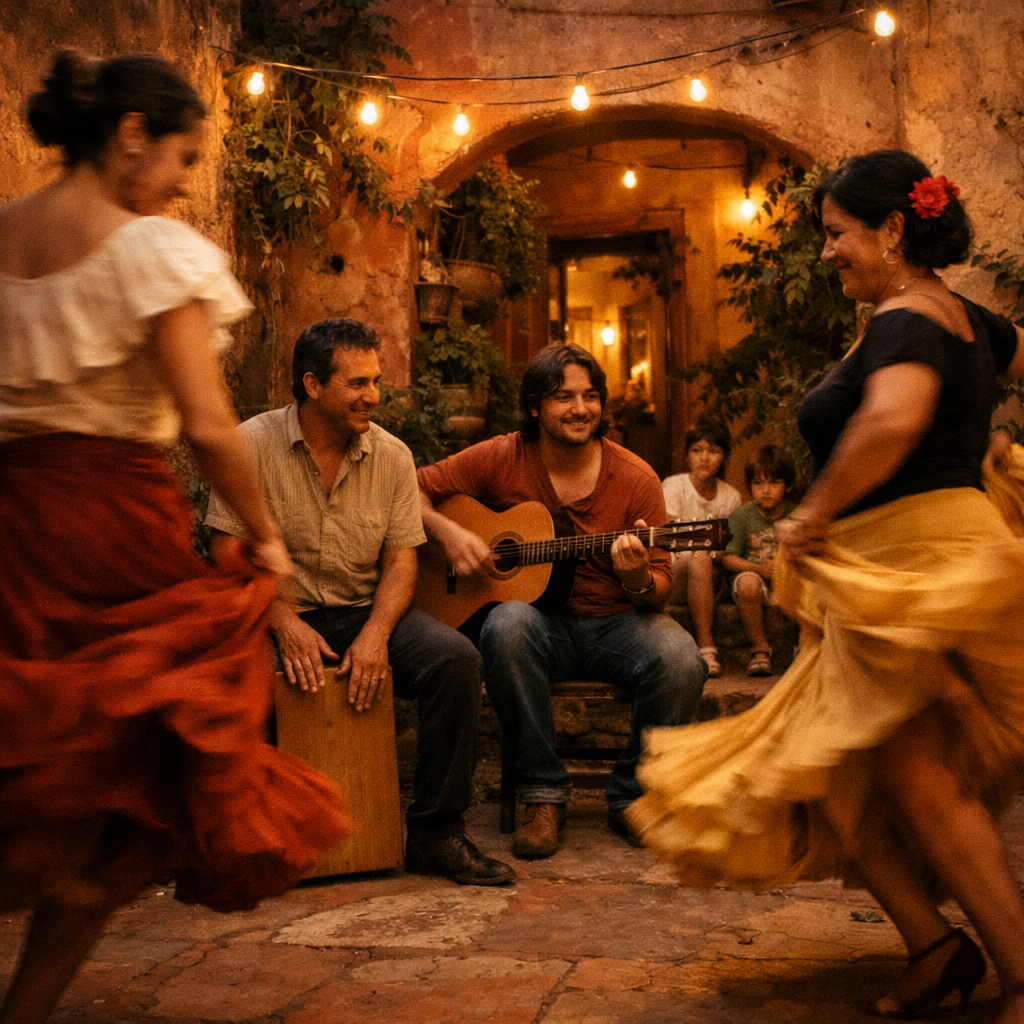
You are sitting on a low wooden box in a dirt courtyard in El Carmen, a small district in Peru’s Chincha Province, three hours south of Lima along the Pan-American Highway. The box under you is a cajón — a rectangular drum with a soundhole cut into the back panel and a front face, the tapa, thin enough to snap and buzz under a fingertip. Someone’s grandfather built this one by hand, the way his grandfather built one before him. A member of the family who owns this courtyard sits across from you on an identical box and, without much preamble, starts to play: heel of the palm on the low center for the deep tone, fingertips near the top edge for the crack, a triplet that lands exactly on the beat.
“Now you,” she says, and you try, and it sounds like nothing. She laughs, not unkindly, and shows you again. Behind her, someone starts a guitar line, unhurried and syncopated, and a kid who can’t be older than seven starts stamping a rhythm with bare heels on the packed earth that somehow locks in under everything else. This is not a performance staged for you. This is Tuesday.
This is also, if you grew up anywhere in the Black American travel world, a scene almost nobody has told you about. You know the cajón, even if you don’t know you know it — it’s the box drum flamenco guitarists thump between their knees, a fixture on world-music stages from Tokyo to Toronto. What almost no one tells you is that it was born here, in coastal Peru, in the hands of enslaved and free Afro-Peruvians who were forbidden to play the drums their ancestors brought from Africa — and that the place where that story is most alive today is this district, El Carmen, and the families who never stopped playing.
A Drum Ban, and the Box That Answered It
To understand why a box became a drum, you have to start with the ban.
Beginning in 1527 and continuing for more than three centuries, Spanish colonizers trafficked enslaved Africans into Peru, first through Lima and Callao, later across coastal plantations, mines, and elite households. Historians estimate roughly 95,000 enslaved Africans were forced into Peru by the mid-1800s. Alongside the physical brutality of enslavement, colonial authorities moved to suppress the cultural practices enslaved people carried with them — and drumming alarmed them most. African drums could carry messages, coordinate movement, call people together in numbers colonizers couldn’t control. So, over time, traditional African drums were restricted and effectively banned in much of colonial Peru.
What the ban couldn’t suppress was the impulse behind the drum. Enslaved Afro-Peruvians made rhythm out of whatever was at hand — pots, ladles, pans, machetes, gourds, bells, seeds, bones, canes, bottles. Among the most common objects lying around coastal households were wooden shipping crates. At night, during informal gatherings called jaranas, those crates got turned over, sat on, and played. A colonizer’s word for a plain wooden crate — cajón — became, over generations, the name of an instrument.
It wasn’t instant, and it wasn’t the only instrument born of that improvisation — Afro-Peruvian musicians of the era built out an entire family of homemade percussion, much of which has since disappeared. The cajón survived where roughly twenty other invented instruments didn’t, partly because it was furniture as much as instrument, a seat and a drum in the same object, impossible to confiscate without confiscating someone’s chair. That resilience is the point — the cajón is a physical record of people refusing to let an order to stop making music actually stop them.
How a Peruvian Box Drum Ended Up in Flamenco
The cajón’s leap onto the world stage has a specific date attached to it: 1977, when Spanish flamenco guitarist Paco de Lucía traveled to Lima with his sextet. At a reception, he watched Afro-Peruvian percussionist and composer Caitro Soto play cajón behind singer Chabuca Granda on her signature song “La Flor de la Canela.” De Lucía had never heard anything like it — flamenco at the time leaned on hand claps and borrowed bongos and congas, none of it with the low warmth and crack of what he was hearing. He reportedly bought a cajón from Soto on the spot for 12,000 pesetas and handed it to his sextet’s percussionist, Rubem Dantas, when they got home. Within a few years the cajón was standard equipment on flamenco stages across Spain, and from there it spread into jazz, folk, and pop percussion worldwide.
That’s the part of the story that occasionally makes it into a drum-shop blog. What almost never makes it past the drum shop is where the instrument came from before Caitro Soto ever picked it up — whose hands built the first one, under what threat, and why. Every cajón played on every stage in the world today is playing a story that starts with an enslaved person in coastal Peru, told no, and building an instrument anyway.
El Carmen: The Heartland That Kept the Beat
If Lima is where Afro-Peruvian music got documented and exported, El Carmen is where it never had to be revived because it never stopped. This small district in Chincha Province, in Peru’s Ica region, is widely regarded — by Peruvian scholars and Afro-Peruvian musicians themselves — as the heartland of Afro-Peruvian culture. The area’s cotton haciendas were worked for generations by enslaved and, after 1854, freed Afro-Peruvian families, and El Carmen became one of the densest concentrations of Black Peruvian communal life on the coast, which is exactly why its musical traditions stayed intact in ways thinner, more scattered communities elsewhere in Peru could not sustain.
Two genres in particular define the sound of El Carmen. Festejo is the fast, joyous, competitive one — its name comes from the Spanish for “party,” built for dance circles where performers trade improvised steps over driving cajón rhythm, often as a communal celebration tied historically to emancipation. Landó is its older, slower cousin, built on a rolling two-bar cajón pattern some scholars trace to West and Central African antecedents; its choreography had largely been lost by the twentieth century and had to be reconstructed during the Afro-Peruvian cultural revival of the 1960s. Both genres, along with related traditions like the elaborate devil-costume Hatajo de Negritos dances performed at Christmas, are documented as living traditions specifically in Chincha and El Carmen in ways they are not almost anywhere else in Peru.
The engine behind that 1960s revival deserves credit of its own: siblings Nicomedes and Victoria Santa Cruz, Afro-Peruvian poet-scholars and choreographers, spent decades collecting, documenting, and re-staging music and dance that colonial and then republican Peru had pushed to the margins. Without their fieldwork, a great deal of what’s still danced in El Carmen today might have been lost entirely.
The Ballumbrosio Family
Ask almost anyone in El Carmen where to start, and the name you’ll hear is Ballumbrosio.
Amador Ballumbrosio Mosquera, the family patriarch, was a violinist, zapateo (percussive footwork) dancer, and one of the central figures in keeping Hatajo de Negritos — the elaborate, UNESCO-recognized devil-and-shepherd dance performed at Christmas in Afro-Peruvian communities — alive in El Carmen through the twentieth century. With his wife, Adelina Guadalupe, Amador raised fifteen children, and the household became, in the most literal sense, a school: every child grew up learning cajón, zapateo, guitar, and the call-and-response traditions of festejo and landó as a matter of course, the way other families teach table manners. The Ballumbrosio home became known locally and internationally as a gathering place where visiting musicians and travelers could sit in a courtyard and watch the tradition passed down in real time, not performed as a show but lived as an ordinary evening.
Since Amador’s passing, his children have carried that work forward as Los Hermanos Ballumbrosio, touring and recording as a family ensemble — brothers Chebo, Miguel, Roberto, Camilo, and Pudy among them — and releasing collections like “Homenaje a El Carmen,” which moves through festejo, panalivio, and ceremonial repertoire like “Guanchivalito,” played on cajón, quijada (a percussion instrument made from a donkey’s jawbone), and other Afro-Peruvian instruments. If you end up in an El Carmen courtyard with a cajón in your lap, there’s a real chance it’s a Ballumbrosio courtyard, or one of their students’ or cousins’.
Alongside the Ballumbrosios, it’s worth knowing the name Caitro Soto not just as the man who sold Paco de Lucía a cajón, but as a serious composer and percussionist in his own right — he wrote “Toro Mata,” one of the most widely recorded Afro-Peruvian songs of the twentieth century, later covered by Susana Baca. These are not anonymous “tradition bearers” in the abstract; they are documented families and individuals whose names belong in the same sentence as the instrument they kept alive.
Festival de Verano Negro
If you can time a visit to El Carmen for the austral summer, do it. The Festival de Verano Negro (Black Summer Festival), held in Chincha roughly across February into early March, is the largest celebration of Afro-Peruvian culture in the country — about two weeks of parades, cajón and guitar performances, festejo and landó dance competitions, poetry, food, and craft. It’s a homecoming as much as a festival: Afro-Peruvian families who’ve moved to Lima or abroad return to El Carmen for it, and the streets fill with the multigenerational mix — grandmothers, teenagers, toddlers — that keeps a tradition a living thing instead of a museum piece. Dates shift slightly year to year, so confirm the current schedule with Chincha’s municipal tourism office or a local Afro-Peruvian cultural association before you book.
Say the Quiet Part
Here’s the part of this story that’s easy to skip past on the way to a good festival photo: Afro-Peruvians are not a footnote or a flavor added to Peruvian culture. They are an estimated three million people who have spent generations fighting simply to be counted. Peru’s last dedicated census of its Afro-descendant population before recent years was in 1940; not until the 2017 national census could Peruvians formally self-identify as Afro-descendant again, a change won only after sustained advocacy from Afro-Peruvian civil society organizations. Peru’s constitution provides specific protections for Indigenous communities that it does not extend, in comparable form, to Afro-descendant communities. Studies have found large majorities of Afro-Peruvians avoiding medical care out of fear of discrimination, and Peru didn’t see its first successful racial discrimination conviction until 2015.
None of that erases the joy in a Chincha courtyard on a Tuesday night. But it’s worth sitting with, because the same colonial logic that banned the drum is part of a longer story of erasure that didn’t end when slavery did in 1854, and doesn’t end because a box drum from El Carmen is now famous on flamenco stages a continent away. Enjoying the music without reckoning with that context isn’t really honoring the tradition — it’s tourism with a soundtrack.
What to See
El Carmen district — The center of gravity for the whole trip. Walkable, small, and built around family courtyards and workshops rather than formal museums; the experience here is relational, not transactional. Go with a local guide or a family-run cultural association rather than wandering in cold.
A Ballumbrosio family performance or lesson — Ask locally, or arrange through a Chincha-based Afro-Peruvian cultural tour operator, for a courtyard session with the family or their students. This is the most direct way to hear festejo, landó, and zapateo as they’re actually practiced, not staged for tourists.
A cajón workshop — Several artisans and family workshops in and around El Carmen still build cajones by hand using traditional joinery and tapa-tensioning techniques; watching one built, or commissioning one, connects the instrument’s craft history to its music.
Hacienda San José (Chincha) — A former colonial-era sugar hacienda with an underground tunnel system historically tied to the control and movement of enslaved people on the estate. It’s a difficult, necessary counterweight to the joy of the music scene — a physical reminder of the conditions the cajón was invented under, not a separate story from it.
Chincha’s town plaza and markets — Good for Afro-Peruvian cuisine (carapulcra, a dried-potato-and-pork stew, and sopa seca), and for simply being present in a coastal Peruvian town that isn’t built around a tourist checklist.
Practical Notes
Chincha is roughly a three-hour drive or bus ride south of Lima along the Pan-American Highway South; regular intercity buses run from Lima’s main terminals, making it a manageable day trip or a richer overnight stay. El Carmen itself is a short taxi or mototaxi ride from central Chincha. There’s no dense hotel infrastructure in El Carmen proper, so most travelers base in Chincha town; small guesthouses and family-run lodging around El Carmen are worth seeking out over a generic hotel, since that spending goes straight into the community keeping this culture alive. If you’re coming for Verano Negro specifically, book transport and lodging well ahead. Spanish is essential; English is not widely spoken here outside dedicated tour operators. And when you’re invited into a courtyard for music, bring the same respect you’d bring into someone’s home, because that’s exactly what it is.
Closing Reflection
There’s a particular vertigo in learning that an instrument you’ve heard your whole life — on a flamenco record, in a coffee-shop duo, maybe at a wedding — was built by someone in bondage who was told, explicitly, that they were not allowed to make the sound their ancestors made. The cajón isn’t a folk-music curiosity. It’s evidence. It’s what happens when a system tries to legislate joy out of a people and fails, not because the system wasn’t cruel enough, but because the impulse it was trying to kill turned out to be sturdier than any law.
El Carmen isn’t a museum built around that fact. It’s a district where families like the Ballumbrosios turned it into an inheritance, teaching it to their kids the way you’d teach a language, so that three centuries later a stranger can sit down on a wooden box in a dirt courtyard and be handed, without much ceremony, a piece of the story. Go learn it properly. Spend your money with the families who kept it. And when someone back home asks where the cajón came from, you’ll know the whole answer — not just Paco de Lucía’s flamenco stage, but the coastal Peruvian courtyard three centuries before it, where a drum ban met a wooden box and lost.