What Stood Here
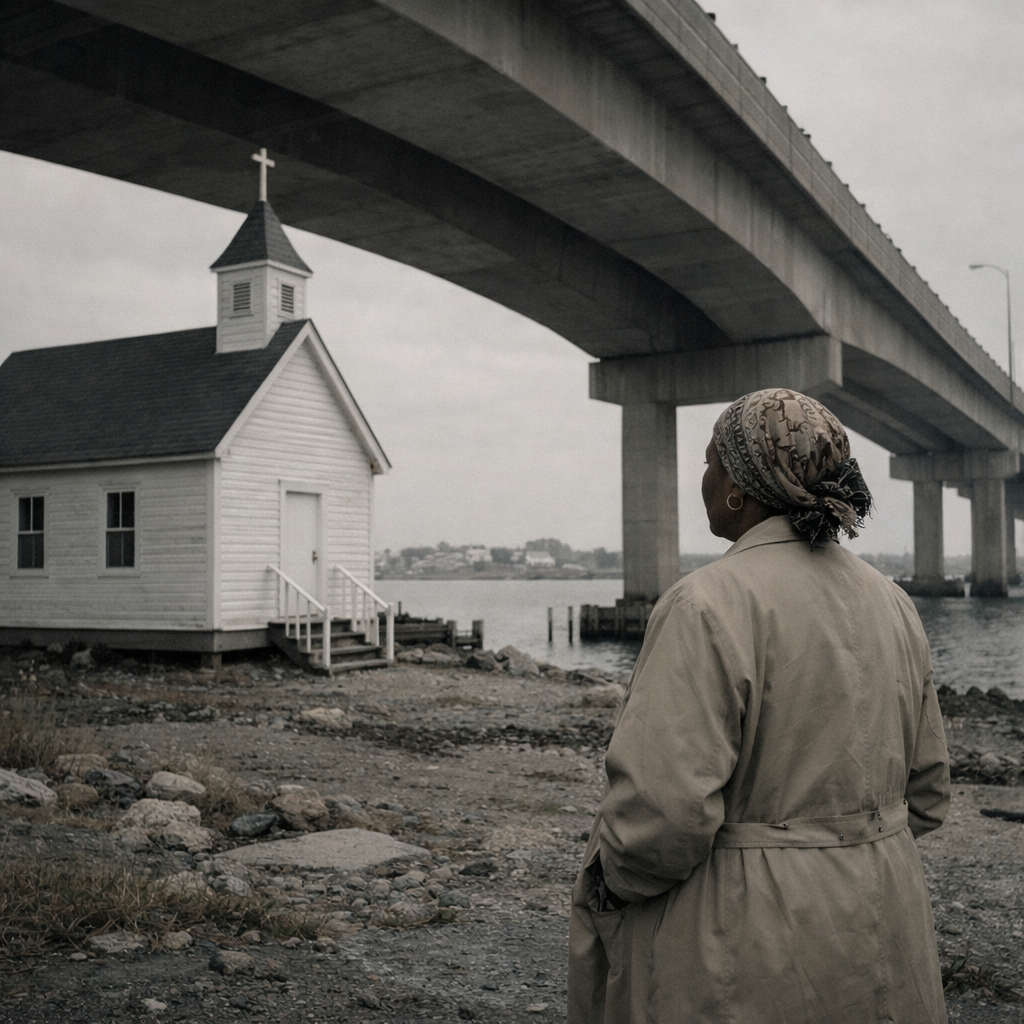
The first thing you notice at Africville is the sound of traffic overhead. The A. Murray MacKay Bridge rises directly above the site, its approach ramp curving through the exact air where rooftops used to be, and the cars never stop. Underneath it, on a green point where Halifax Harbour opens into Bedford Basin, there is a small white wooden church, a scatter of interpretive signs, a parking lot, and grass. That is what remains of a town.
Stand there long enough and a stranger might come by walking a dog — the park is popular for it now — and if you ask them what this place used to be, they may not know. That is not an accident. It is the outcome of a plan that worked exactly as intended for most of the twentieth century, and only partially unraveled in the twenty-first. Africville was a real place, with street names and porch lights and a graveyard, and then the City of Halifax decided it wasn’t, and made that decision true with bulldozers.
This is a story about what gets called progress, who pays for it, and what it means to apologize for something you can never actually give back.
A Town Built on Land No One Else Wanted
Africville’s roots on this shoreline stretch back to the mid-1700s, but the community as most descendants describe it took shape in 1848, when a formerly enslaved man named William Brown Sr. bought land overlooking Bedford Basin. Brown had arrived in Nova Scotia as one of the Black Refugees of the War of 1812 — Black Americans who escaped slavery during the war and were resettled by the British in Nova Scotia, distinct from the Black Loyalists who arrived after the American Revolution decades earlier, though the two groups are often collapsed into one another in casual retellings. Brown’s parcel, combined with land bought by William Arnold, became the roughly twelve acres that grew into Africville.
By the early 1900s, several hundred people called it home — fishermen, dock workers, domestic workers, small business owners, Pullman porters, families who had lived on the same ground for three and four generations. At the center of it all stood the Seaview African United Baptist Church, built in 1849, where every baptism, wedding, and funeral in the community’s history took place. Residents paid municipal property taxes like everyone else in Halifax. In exchange, they got almost nothing back.
A Century of Neglect That Was Never an Accident
No paved roads. No streetlights. No running water. No sewer connections. Africville sat inside Halifax’s city limits for generations while the city treated it as though it were somewhere else entirely — somewhere it was safe to put everything no other neighborhood in Halifax would accept. An infectious disease hospital went up nearby in 1870. A prison followed. A slaughterhouse. A fertilizer plant. And in the late 1950s, the city relocated its open municipal dump to sit almost directly against Africville’s homes, close enough that children grew up playing near it and some families scavenged it out of need.
This is the detail that matters most, and the one worth sitting with before anything else: none of it happened by drift or oversight. Every one of those decisions was made, one at a time, over decades, by a city government that had the power to pave a road or run a water line and chose, repeatedly, not to. By the time officials began calling Africville a “slum” in the late 1950s, they were describing conditions the city itself had spent a hundred years manufacturing. It was a diagnosis written by the people who caused the disease.
The Demolition
In 1962, Halifax City Council voted unanimously to relocate Africville’s residents. Two years later, the council adopted what became known as the Rose Report, formalizing a plan to raze the community entirely and use the land for industrial development and the approach to a new bridge crossing the harbour. The language of the era called it urban renewal. What it meant, in practice, was the organized removal of a Black community from land it had held for more than a hundred years.
Between 1964 and 1970, families were moved out of Africville, most of them into public housing scattered across Halifax, disconnected from each other for the first time in generations. Compensation was minimal and, for many, nonexistent — only fourteen families held clear legal title to their land, a direct result of the city’s own decades-long refusal to formalize property records in Africville, records that officials then used as a pretext to deny or shrink settlements. Some families received a few hundred dollars for a home their grandparents had built by hand.
On the night of November 20, 1967, the city demolished the Seaview church without meaningful warning. It went down in darkness, and with it went the church’s own records — the births, marriages, and deaths that had been kept there for over a century, the paper trail of a community’s own memory of itself, destroyed along with the building that held it. The last house in Africville came down on January 2, 1970. In the years between, residents watched their own belongings loaded onto city dump trucks alongside the rubble of their homes — the same trucks used to haul garbage from the dump the city had put at their doorstep. Descendants still describe that image, specifically, as the detail that will not let them go: not just losing the house, but watching what was inside it treated as trash by the same municipality that had always treated the neighborhood that way.
What an Apology Can and Cannot Undo
Former Africville residents did not let the story end there. Through the 1970s and 80s, they organized — first through the Africville Action Committee, then through the Africville Genealogy Society, founded by former residents in 1983 specifically to document the community’s history and press the city for accountability. It took decades of that unpaid, unglamorous advocacy work, carried out largely by people who had already lost everything once, to get Halifax to respond at all.
On February 24, 2010 — forty years after the last house fell — Halifax’s mayor stood on the former townsite and formally apologized for the destruction of Africville. The settlement that came with it included roughly $4.5 million, the return of about 2.5 acres of the original land, funding to rebuild a replica of the Seaview church, and seed money to establish the Africville Heritage Trust to preserve the site going forward.
It would be easy to end the story there. Many news accounts effectively do: apology delivered, museum built, chapter closed. Descendants who lived through the actual loss, and the generations raised on their memories, generally do not see it that way. A one-time settlement split among however many surviving families and descendants does not replace a hundred years of land, of proximity to family, of a church that held your grandmother’s baptism record. It does not restore the compound interest of what a family might have built if it had kept its home, its waterfront acre, its equity, across three more generations. And the reckoning is not even finished as a matter of law: former Africville residents have continued pressing the city in court well into this decade, telling a judge as recently as January 2025 that they want their land back — not a museum on it, the land itself, returned. That case is a direct continuation of the same fight the Genealogy Society started in 1983, not a coda to it.
Hold both things at once, because that is what the people who actually lived this ask visitors to do: the apology was real, hard-won, and mattered. It is also not the end of the story. It is one moment inside a fight that is still, right now, ongoing.
The Africville Reunion — Memory That Refuses to Stay Buried
Every summer, former residents, their children, their grandchildren, and people with only a thread of family connection to the old community return to the same green point of land for the Africville Reunion, a tradition that traces directly back to that 1983 organizing push and has now run for more than four decades. It is, by every account from people who attend, not primarily a tourist event. It is a homecoming — food, music, church services held on the exact ground where the original congregation once stood, elders pointing out where a specific house used to sit, children hearing family names spoken over land their family was pushed off of before they were born.
That the reunion still happens, every year, on the same soil, is itself a form of refusal. Halifax could level the buildings and disperse the residents, but it could not make several hundred people stop remembering where home was, or stop bringing their children back to stand in that spot and be told the truth about it. If you are planning a visit, the reunion typically falls in the summer months; confirm the current year’s exact dates through the Africville Museum directly, since they can shift from year to year, and be mindful that this weekend belongs first to former residents and descendants rather than to outside visitors.
What to See
The centerpiece of any visit is the Africville Museum — a careful replica of the Seaview African United Baptist Church, rebuilt on the original footprint and opened on the site in September 2011. It is not the original building; the original was destroyed in a single night in 1967, and everything you see now is a reconstruction built from memory, photographs, and the determination of people who refused to let the site stay empty. Inside, the museum’s exhibits are built largely around oral history — the voices of former residents themselves, walking you through what daily life in Africville actually looked like before it was reduced, in official language, to a “slum” that needed clearing.
Walk the surrounding grounds, now known as Africville Park or Seaview Park, and take note of what is not there: no street grid, no house foundations, nothing to mark exactly where any one family’s home stood, aside from the interpretive panels the Trust has since installed. That absence is part of the site’s testimony. In October 2024, Africville received UNESCO designation as a Place of History and Memory linked to the history of enslavement and the transatlantic slave trade, a recognition that situates this one Halifax shoreline within the much larger, much longer story of the African diaspora’s displacement — a story travelers researching Black heritage sites across the Americas and the Caribbean will recognize immediately.
Visiting With the Weight It Deserves
Africville is not a stop to work into a Halifax weekend between the waterfront boardwalk and dinner reservations, though plenty of visitors do exactly that. It rewards slowing down instead. Give yourself real time inside the museum, and more time afterward simply standing outside near the water, because that is where the most honest part of the visit tends to happen — not in front of an exhibit panel, but in the quiet of realizing how small the surviving footprint of an entire community actually is.
If a guide or staff member is present and willing to talk, listen more than you photograph. Many of the people who work and volunteer at the site are descendants themselves, and the version of this history they carry did not come from a textbook. For hours, admission, getting there, and where to stay in Halifax, BTN has a full practical guide to visiting Africville and the surrounding city — this piece is concerned with something a logistics guide can’t hold: what it actually means to stand on ground where a home used to be, and where the family who built it is still, all these years later, asking for it back.
Closing: The Apology Was Not the Ending
There’s a version of this story that Halifax’s official history would probably prefer to tell, and it goes something like this: a community was lost to the mistaken policies of an earlier era, the city made things right in 2010, and today the museum stands as proof of reconciliation completed. It is a tidy version. It is also not the version descendants tell, and it is not the version this story is going to tell either.
What actually happened is that a Black community built something durable out of land no one else wanted, and a city spent a hundred years making sure that community stayed poor and unserved before deciding, with a straight face, that its poverty was the reason to bulldoze it. What happened after is that the people who survived that decision spent the rest of their lives, and taught their children to spend theirs, refusing to let Halifax forget what it did — and that refusal is still active today, still in courtrooms, still asking not for another plaque but for the land itself.
Come to Africville to learn the history. Come to stand under that bridge and understand exactly what was traded for it. But leave understanding that the church you’re looking at is a replica, that the apology came four decades late, and that for the families who lost this ground, the story does not yet have an ending anyone has agreed to call closure.