Smart Prep, Not Fear
The best solo trips aren't the ones with no risk — they're the ones where you actually planned for it. That's the whole idea behind this episode, and it's worth saying plainly up front: nothing here is about convincing you that solo travel is dangerous. It isn't, and thousands of Black women prove that every year across every continent this series has covered. This is about the specific, unglamorous, entirely doable layer of prep that experienced solo travelers build into every trip — the apps on their phone, the check-in habits with someone back home, and the handful of small physical tools that live in the bottom of the packing cube. None of it is expensive. None of it requires paranoia. It's just what confident, seasoned solo travelers actually do, quietly, before they ever board the flight.
The Apps: Your Invisible Safety Net
You already have a phone in your pocket capable of more safety infrastructure than most travelers ever activate. The trick is turning on the features that matter and knowing which ones to add.
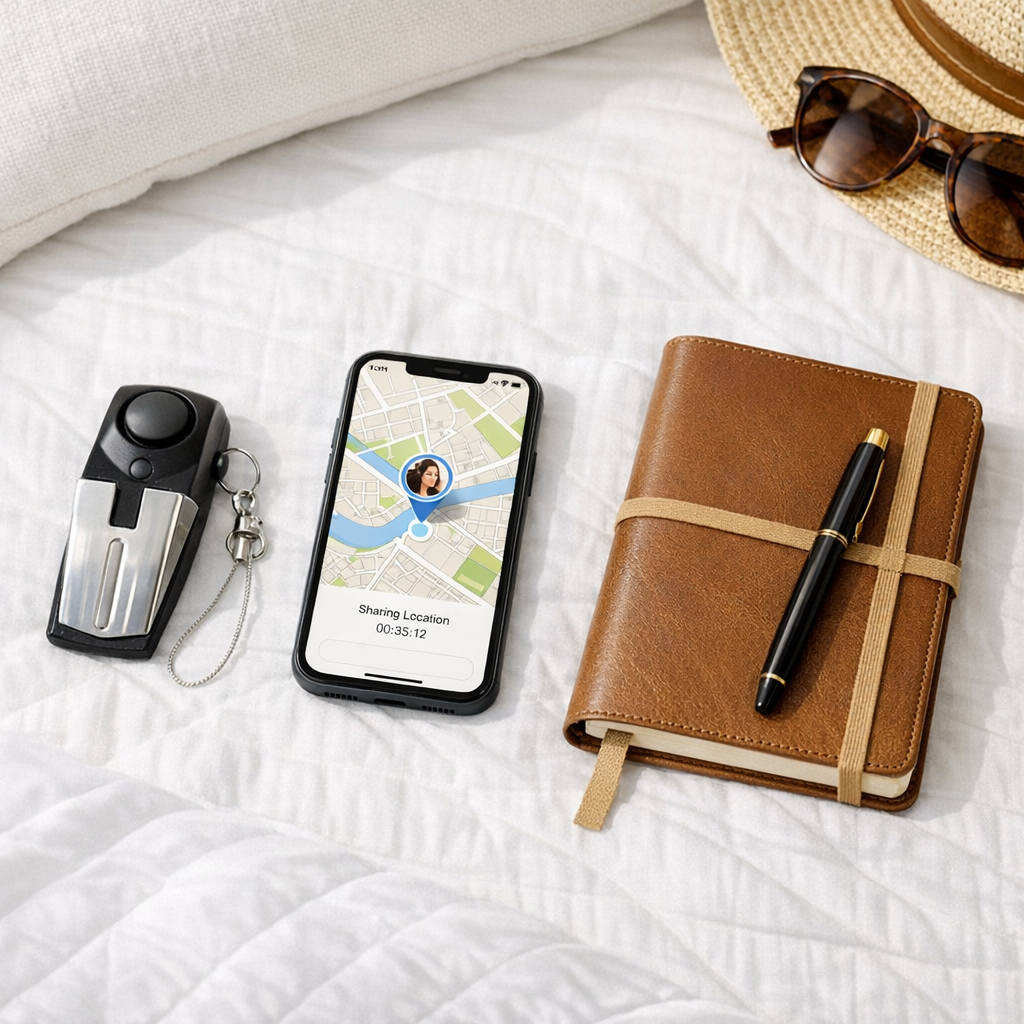
Location sharing (free, and non-negotiable). Both major phone ecosystems already have this built in, and it costs nothing. On iPhone, Find My lets you share your live location with a trusted contact indefinitely or for a set window, and Apple's Check In feature (inside Messages) goes a step further — it automatically notifies your chosen contact if you don't arrive at your expected destination on schedule, without you having to remember to text "made it safe" every single night. On Android or with a mixed-device household, Google Maps' location sharing does the same core job: share your real-time location and even your ETA with someone before a ride, a night out, or a solo hike. These are widely recommended by solo travel safety guides as the free baseline — there's genuinely no reason to skip this one, since it's already sitting on your phone.
For travelers who want a dedicated layer beyond the built-in tools, apps like Life360 add real-time circles with more configurable alerts, and bSafe or Noonlight add a one-tap SOS function that can loop in local emergency response with your GPS coordinates attached. None of these are required reading for every trip — the free built-in tools cover most solo travelers' actual needs — but they're worth knowing about for longer trips, remote destinations, or nights when you want an extra layer.
Translation. Google Translate's offline-download language packs and its camera translation feature (point your phone at a menu or a sign and get instant text overlay) remain the standard, and they work without a data connection once downloaded — download your destination's language pack before you leave the airport Wi-Fi, not after you land.
Ride-hailing. Uber and Bolt both include trip-sharing features that let a trusted contact watch your route in real time and get an alert if the car deviates significantly from the expected path (Uber calls this feature RideCheck). The safety rule underneath the app choice matters more than the app itself: use a registered rideshare app instead of hailing a taxi off the street, every time, in every city, no exceptions — this single habit does more for solo travel safety than any gadget on this list.
VPN. A VPN isn't just for streaming your shows from a hotel room — it encrypts your connection on public hotel and airport Wi-Fi, which matters anytime you're logging into a bank app, checking email, or sharing your location data over a network you don't control. A basic paid VPN subscription runs a few dollars a month and is one of the lowest-cost, highest-value additions on this entire list.
None of these apps require a security background to use well. Set them up once, before your flight, while you have reliable Wi-Fi and a clear head — not fumbling with settings jet-lagged in an arrivals hall.
The Check-In Routine That Actually Works
Apps are only half the system. The other half is a human being back home who knows your plan and knows what "something's wrong" looks like. This is the piece experienced solo travelers treat as genuinely non-negotiable, and it costs nothing but a little upfront conversation.
Pick one trusted contact, not a group chat. A group chat diffuses responsibility — everyone assumes someone else is tracking you. One person, explicitly designated, who knows they're your person for this trip.
Share the actual itinerary, not just the destination. Your trusted contact should have your flight numbers, your accommodation names and addresses, and a rough day-by-day plan — not just "I'll be in Marrakech for a week." If plans change mid-trip, a quick text update takes thirty seconds and closes a real gap.
Set a check-in cadence before you leave, and agree on what happens if you miss one. This is the part most people skip. A simple daily "made it to the hotel, all good" text at a rough time window, plus a clear, agreed-upon plan for what your contact does if they don't hear from you by a certain point (a follow-up call, then a message to your accommodation, then escalation) turns a vague worry into an actual protocol. Apple's Check In feature and several of the apps above can automate the routine piece; the human agreement about escalation is the part no app replaces.
Register with the State Department's STEP program before every international trip. It's free, takes about five minutes, and means the nearest US embassy has your travel dates and can reach you — or reach your emergency contact — if something happens regionally, from a natural disaster to a political situation, that has nothing to do with anything you did.
The Physical Gear Worth Packing
This is the shortest section on purpose — because the physical gear list for smart solo travel prep is genuinely small, lightweight, and cheap. None of it should feel like body armor. It's the travel equivalent of a spare tire: you hope you never need it, and you're glad it's there.
A portable door alarm or door wedge lock. This is the single most commonly recommended physical add for solo travelers staying in hotels, guesthouses, or short-term rentals with less robust security than a major chain hotel. A compact travel door alarm wedges under the door and sounds a loud alert (often well over 100 decibels) if anyone attempts to open it, while a portable door lock or door jammer physically reinforces an inward-opening door beyond what the factory lock provides. Both pack flat, weigh next to nothing, and typically run $10–$25.
An RFID-blocking wallet or passport sleeve. Skimming devices that lift card data from contactless chips are a real, if relatively low-frequency, risk in crowded tourist areas and transit hubs. A blocking sleeve or wallet costs $10–$20 and requires zero behavior change to use — you just carry the wallet you were already going to carry.
A portable charger (power bank). Not glamorous, not safety-specific on its face, but a dead phone is the single fastest way to lose access to every app on this list — your location sharing, your translation app, your rideshare app, your ability to call your check-in contact. A reliable 10,000mAh power bank runs $20–$35 and should live in your daypack, charged, every single day you're out exploring.
Altogether, a complete safety kit — door alarm, RFID sleeve, and a solid power bank — lands comfortably in the $20–$60 range, well under the cost of a single night's hotel splurge, and it packs into a space smaller than a paperback book.
This Is the Capstone, Not the Finish Line
If you've been with this run of Solo Sisters Abroad episodes, you've already done the harder work: you've read the safest-countries breakdown, you've sat with the honest safety picture in Medellín, you've explored what a life in Rwanda actually looks like, you've walked through Morocco's medinas in the destination guide, and you've weighed what building an expat life in Bali or Mexico really takes. Every one of those episodes handed you a place. This episode hands you the gear and the habits to go with any of them — or with wherever comes next that wasn't on this list at all.
That's really the point of closing out this thread here. Destination knowledge and safety prep aren't two separate categories of solo travel readiness — they're the same skill, applied at different scales. Knowing which neighborhood in Cape Town to avoid after dark and knowing to text your sister when you land are both just forms of the same thing: taking your own trip seriously enough to plan for it. The women who travel solo most confidently aren't the ones who never think about risk. They're the ones who thought about it once, built a system, and then stopped thinking about it — because the system is just running in the background while they actually enjoy the trip.
Pack the kit. Set up the apps before you fly, not at the gate. Tell your person the plan. Then go be solo and free.
Coming Up Next Episode
This closes out the current run of solo travel episodes for now — head back to the Solo and Free series hub to catch up on any destination or planning episode you missed, and subscribe to the BTN podcast so you're notified the moment the series picks back up.
Listen & Follow
Catch the full audio conversation on the BTN podcast, and follow Black Travel Now across social media for the rest of the Solo and Free series as it continues.