The City Everybody's Talking About — For Two Very Different Reasons
Medellín's nightlife is famous for a reason — and so, unfortunately, is its drink-spiking problem. Ask five different Black women solo travelers about El Poblado on a Friday night and you'll get five glowing reviews of the music, the food, the rooftop bars, and the easy, welcoming energy the city is known for. Ask the US Embassy in Bogotá the same question and you'll get a security alert. Both things are true at once, and Episode 9 of Solo and Free is built around holding them together honestly — because a safety-forward guide to Medellín that only tells half the story isn't actually safety-forward. It's just marketing.
This episode exists to do something specific: explain exactly what the scopolamine risk is, what US officials have actually said about it (not the exaggerated internet version), and how to enjoy everything Medellín genuinely offers — Comuna 13, the food scene, the Metrocable, a warm and increasingly visible Black travel community — without walking in either scared or uninformed. Go, but go informed. That's the whole thesis.
What Scopolamine Actually Is (Not the Urban Legend Version)
Scopolamine, known locally as burundanga and nicknamed “devil's breath” in international media, is a real pharmaceutical compound — derived from plants in the nightshade family and used in legitimate low doses for motion sickness and other medical purposes. In the doses criminals use it, it's a different story entirely. The US Embassy in Colombia has described it directly in a security alert to US citizens as an “odorless, tasteless, memory blocking substance used to incapacitate and rob unwary victims,” adding that “if ingested or exposed, scopolamine can render a victim unconscious up to 24 hours or more.”
Here's the part worth separating from the myth: credible reporting and harm-reduction research both point to drinks — not powder blown in someone's face, not a business card dusted with the drug — as the overwhelming method of administration. Someone spikes a drink, either their own that they then hand over, or one left unattended at a bar table. The stories about airborne exposure or a stranger's touch causing incapacitation are largely unsupported urban legend; the actual documented risk is almost entirely about what goes into your glass and who has access to it before it reaches your hand.
Once ingested, victims describe disorientation, severe memory gaps, and a kind of pliable compliance — they hand over PINs, walk to ATMs, or let themselves be led somewhere, then wake up hours later with no memory of what happened, missing cash, cards, phones, and sometimes far more. It is a real, physically dangerous crime, and it deserves to be taken seriously rather than dismissed as backpacker folklore.
What the US Government Actually Says
Colombia currently sits at Level 3: Reconsider Travel on the State Department's four-tier travel advisory scale, driven primarily by crime, terrorism, civil unrest, and kidnapping risk — the advisory's specific “Do Not Travel” (Level 4) guidance is reserved for the Venezuela border region and a handful of specific departments, none of which sit anywhere near Medellín's city center or the tourist and nightlife districts covered in this episode.
Separately from the general country advisory, the US Embassy has issued specific security alerts about this exact risk. One embassy alert titled “Increase in Crimes Involving Use of Sedatives” states plainly that criminals use scopolamine and similar drugs so “a sedative is introduced to the victim, leaving them disoriented and sedated so they are easily robbed,” and names the pattern as concentrated in “major cities, including Medellín, Cartagena, and Bogotá.” The alert also flags a specific, modern vector worth knowing about directly: “Foreigners are routinely targeted through online dating applications,” typically after a match leads to an agreed-upon in-person meeting.
The embassy's own recommended precautions are refreshingly unglamorous and specific: let someone know who you're meeting and where you're going, don't leave food or drinks unattended, don't accept food or drinks from strangers, avoid going to bars or nightclubs alone, and trust your instincts — if something doesn't feel right, walk away rather than talk yourself out of the feeling.
Why It's Concentrated in Nightlife Districts
The pattern isn't random, and understanding why makes the precautions make more sense. Bars, nightclubs, and late-night restaurants create exactly the conditions this crime needs: drinks are already being poured and passed around, environments are loud and dim enough that a few seconds of distraction go unnoticed, and the social norm of buying a stranger a drink or leaving your glass at the table while you dance is already built into the culture of a night out. El Poblado's Parque Lleras and Provenza corridor, Laureles' LA 70 strip, and La Candelaria in the historic center are the specific areas that show up most often in incident reports and embassy guidance — not because they're unsafe by day, but because they're where Medellín's nightlife economy is most concentrated after dark.
Historical reporting on this crime pattern has also skewed toward male victims perceived as wealthy, often targeted through dating apps or by someone posing as an interested romantic connection at a bar. That doesn't mean solo women are exempt — it means the entry points differ. A solo woman is statistically less likely to be approached the exact same way a targeted male tourist is, but drink-tampering at a crowded bar table doesn't check who's holding the glass, and dating app meetups carry real risk regardless of gender. Treat every precaution here as gender-neutral common sense, not a warning specific to being a woman alone.
The Precautions That Actually Matter
Strip away the panic and the actual playbook is short, concrete, and doesn't require canceling your trip:
- Never accept an open drink from someone you don't know — and watch your own drink get made and poured when you order one, whether that's from a stranger's generosity or your own bartender.
- Don't leave your drink unattended at the table while you dance, use the restroom, or step outside — order a new one instead of returning to the one you left.
- Use licensed rideshare apps (Cabify and inDriver both operate reliably in Medellín, alongside Uber, which functions in a legal gray area but is widely used and trackable) rather than hailing a cab on the street, especially leaving a bar late at night.
- Travel with a trusted companion after dark when possible, particularly in the nightlife corridors named above — and if you're meeting someone from a dating app, meet in a busy, well-lit public place first and tell a friend exactly where you'll be and when to expect a check-in text.
- Register your trip with the State Department's STEP program before you fly — it's free, takes five minutes, and means the embassy can reach you directly if a new alert goes out while you're on the ground.
- Trust the instinct that says something's off before you talk yourself out of it. Walking away from a too-friendly stranger buying rounds costs you nothing. The alternative can cost a great deal more.
None of this requires isolating yourself or skipping Medellín's nightlife entirely — it requires the same baseline vigilance experienced travelers already practice in nightlife districts in Miami, Atlanta, or Rio. The risk is real and specific; the response to it is ordinary and manageable.
The Medellín That Deserves Equal Airtime
Now for the part that gets buried under headlines: Medellín earned its “City of Eternal Spring” nickname honestly, and the reasons Black travelers keep returning have nothing to do with any of the above.
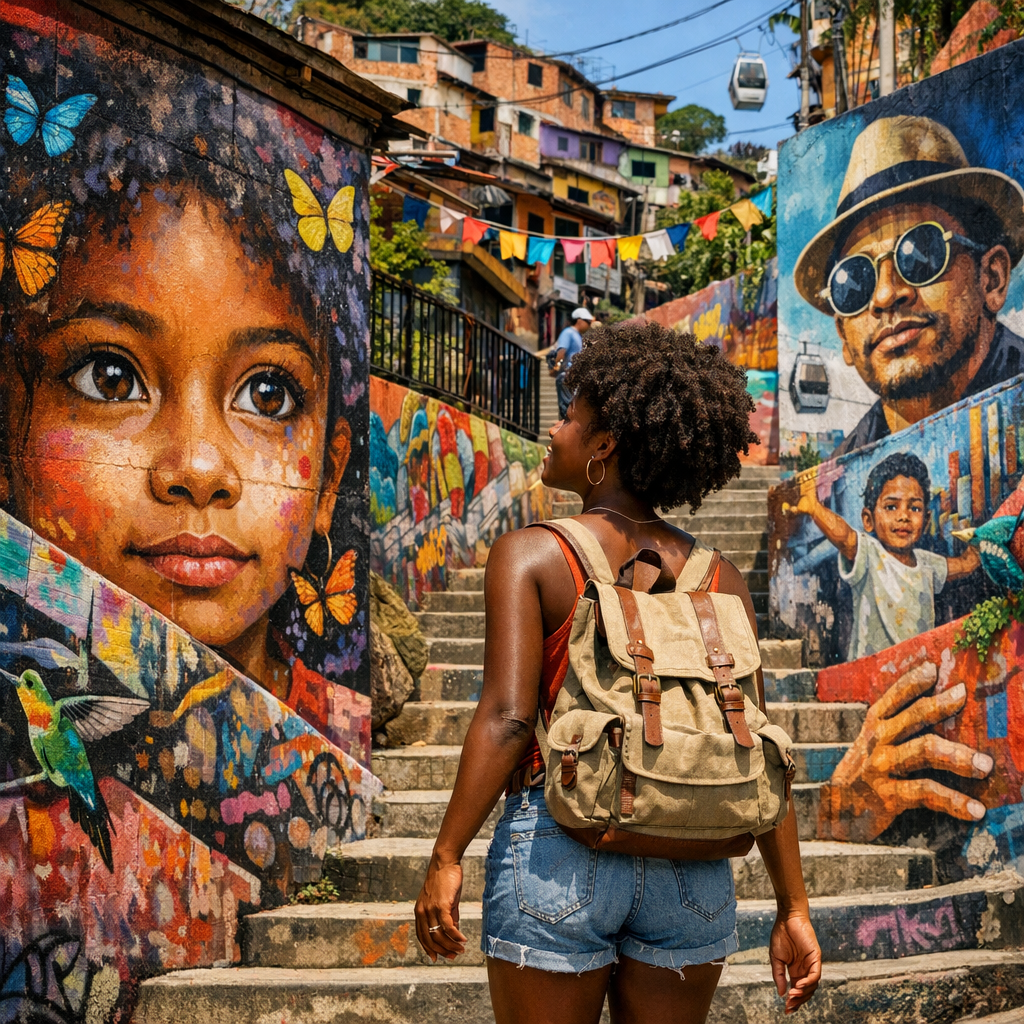
Comuna 13 is the single most transformative site in the city — a hillside neighborhood once considered one of the most dangerous in the world during the Escobar era, now covered in vivid murals and street art painted largely by community artists documenting the neighborhood's own survival and rebirth. Ride the outdoor escalators built to connect the hillside to the city below, book a walking tour led by a Comuna 13 resident (community-based operators channel tourism money directly back into the neighborhood), and expect breakdancers, hip-hop, and graffiti artists performing on the same streets that were once no-go zones. It's one of the most powerful urban redemption stories anywhere in Latin America, and it rewards travelers who show up to learn the history, not just photograph the murals.
The food scene runs from bandeja paisa (the hearty regional plate of beans, rice, chicharrón, and plantain) at neighborhood lunch spots to a genuinely exciting modern Colombian fine-dining scene in El Poblado. Day trips to Guatapé — the technicolor pueblo built around a reservoir, with the 649-step Peñol rock offering one of the best panoramic views in the country — are an easy, daylight-hours add to any itinerary. The Metrocable gondola system, built explicitly to connect Medellín's poorer hillside communities to the metro below, remains both a genuinely useful transit option and a quietly moving symbol of the city's infrastructure-as-equity approach to urban planning.
And the community keeps growing. BTN's Passport Bros coverage of Medellín has already documented why Black travelers and expats are increasingly making the city a base, and that same infrastructure — meetup groups, Black-owned tour operators, an active online community sharing real-time, peer-sourced advice — benefits solo women just as much as it does the relocating crowd.
Go, But Go Informed
The honest version of Medellín isn't the fear-driven version, and it isn't the sanitized influencer version either. It's a city with a real, documented, specific risk that's well understood and easy to plan around, sitting right alongside a genuinely extraordinary destination with world-class art, food, natural beauty, and an increasingly visible Black travel community. Knowing exactly what scopolamine is, exactly which precautions actually work, and exactly what the US government has and hasn't said about it isn't a reason to stay home. It's the reason you can go with your eyes open and have the trip everyone's been posting about — safely, and on your own terms.
Coming Up Next Episode
Solo and Free continues tracking the destinations, safety realities, and real community that Black solo travelers are navigating right now. Subscribe to the BTN podcast so you don't miss what's next.
Listen & Follow
Catch the full audio conversation on the BTN podcast, and follow Black Travel Now across social media for the rest of the Solo and Free series as it drops.