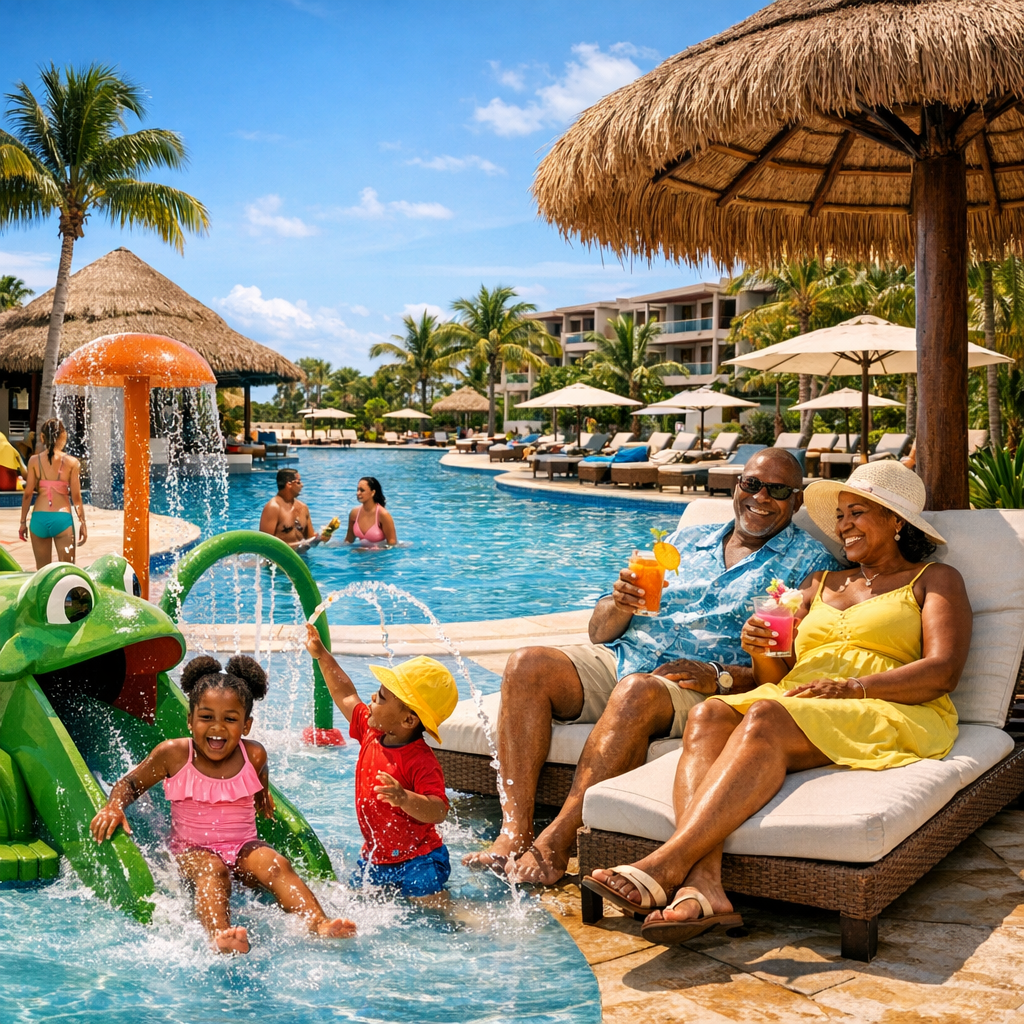
The Family Reunion Problem Nobody Talks About
Every family reunion trip runs into the same negotiation. Auntie wants a lazy river she can float on with a drink in hand. Uncle Ray wants a quiet chair by the pool and a book he never gets to finish at home. The toddlers want a splash pad and someone other than mom to watch them for an hour. Grandma, who had a hip replacement two years ago, needs a walk-in shower and a bed she doesn't have to climb into. Somewhere in the group chat, someone says "let's just do an all-inclusive," and the debate starts over which one can actually pull off all of that at once.
Here's the good news: it's a solved problem, at least at the right properties. The all-inclusive resorts built for the family-reunion crowd — not the honeymoon crowd, not the spring-break crowd — have quietly figured out how to serve a three-generation guest list under one roof. This episode of Black Family Travel breaks down exactly what to look for, and why the two biggest all-inclusive corridors in the hemisphere, Riviera Maya and Punta Cana, are where most of these reunions end up landing.
What "Multigenerational-Friendly" Actually Means
Resort marketing loves the word "family-friendly." It usually just means there's a kids' menu. Genuinely multigenerational-friendly is a different, more specific list, and it's worth checking every item before you book a block of rooms for fifteen relatives.
A real kids' club, not a rec-room afterthought. The best properties run supervised, age-segmented programming — toddler play areas separate from the 6-to-12 crowd, separate again from a teen lounge with video games and a pool table. Look for clubs that run structured hours (typically 9am-9pm or later) with trained staff, not a room with a TV and a college-age babysitter checking in occasionally. This is what actually gives the parents in the group a few uninterrupted hours, which is the whole point of a reunion trip in the first place.
Quiet adult zones that are genuinely quiet. This is the single most underrated amenity for a mixed-age trip. Look for an adults-only pool or section (often 18+ or 16+) that's physically separated from the main family pool and swim-up bar — not just a roped-off corner of the same deck. The best resorts put real distance between the two, sometimes an entire building or wing apart, so Uncle Ray's reading chair isn't twenty feet from a floating speaker blasting reggaeton.
Accessible rooms with actual accessible features. Not every "accessible" room is created equal. What you actually want to confirm: roll-in showers (not just a shower with a grab bar and a two-inch lip), handheld showerheads, grab bars near the toilet, lowered closet rods and peepholes, and enough clear floor space to maneuver a wheelchair or walker. Ground-floor or elevator-adjacent placement matters too — a beautiful accessible room on the third floor with an elevator that's "usually working" is not actually accessible.
Flexible, grab-and-go dining. A resort that requires every meal to be a reserved sit-down affair is a resort that will exhaust a group with small kids, mobility needs, or wildly different appetites and schedules. Look for at least one always-open buffet or food-hall-style venue, poolside grills with no reservation required, and room service that's actually included rather than upcharged. This is what lets Grandma eat lunch at 11:30 and the teenagers eat at 2pm without anyone missing anything.
Riviera Maya vs. Punta Cana: The Two Corridors Reunions Actually Choose
When BTN readers ask where to book a big multigenerational trip, it almost always comes down to these two corridors, and for good reason — both have built out some of the largest concentrations of all-inclusive resort inventory in the Western Hemisphere, with entire coastlines dedicated to nothing but the format.
Riviera Maya, Mexico stretches roughly from Cancun's Hotel Zone south through Playa del Carmen and Tulum, and it's genuinely world-famous for its scale of all-inclusive development — massive resort campuses with multiple pools, on-site water parks, and enough restaurant variety that a two-week stay wouldn't repeat a venue. The flight math is a major draw for reunions coordinating from multiple US cities: nonstop routes into Cancun International Airport from dozens of American hubs keep flight times short and fares competitive, which matters enormously when you're trying to get twelve to twenty family members from different departure cities to the same place on the same day.
Punta Cana, Dominican Republic has built its identity around going even bigger. The region continues to lead the Caribbean in large-scale resort development, with new mega-resorts regularly opening featuring thousands of suites, multiple golf courses, casinos, and water parks on a single property — the kind of self-contained scale that lets a family reunion never need to leave the resort grounds at all if that's the goal. Punta Cana's beaches also tend to be calmer and more consistently swimmable than parts of the Riviera Maya coastline, which is a real consideration if your group includes non-swimmers, young toddlers, or grandparents who want to wade rather than battle waves.
Neither corridor is objectively "better" — the honest answer is that Riviera Maya tends to win on flight convenience and inland excursion variety (cenotes, Mayan ruins, Xcaret-style parks), while Punta Cana tends to win on sheer resort scale and beach calm. Many reunion groups pick based on which airport gets the most family members there on a direct flight.
The Caution BTN Won't Skip: Verify Accessibility Directly With the Property
This is the part of the episode we want every reader planning around a grandparent, a family member with a disability, or anyone with mobility needs to sit with. Yes — most major all-inclusive resorts across both corridors now advertise accessible room categories, and many genuinely do include roll-in showers and grab bars. But "accessible" is not a standardized, audited term the way it functions under the Americans with Disabilities Act inside the US. These are Mexican and Dominican properties, and while many follow strong accessibility practices, the specific features, the number of accessible rooms available, and how recently they were updated vary property by property — sometimes even room by room within the same resort.
Do not book an accessible room based on a general marketing description or a photo on a booking site. Call the resort directly, or have your travel agent call on your behalf, and ask specifically: Is there a roll-in shower with no lip, or a shower with a seat and grab bars only? What is the exact clear floor width for a wheelchair? Is the room on the ground floor or elevator-accessible, and is that elevator reliably operational? How many accessible rooms exist in this category, and can you get written confirmation of the room number or type at booking? Get the answer in writing before you finalize payment, not after you arrive and find out the "accessible" room has a step into the shower.
What This Actually Costs
Across both corridors, expect all-inclusive room rates in the $180-$350 per night per room range, depending on season, resort tier, and room category — accessible and swim-up rooms sometimes carry a modest premium, and a full reunion group booking a block of rooms should budget within that range per room rather than per person. Shoulder seasons (late spring, early fall, excluding hurricane-sensitive weeks) tend to land at the lower end; winter holiday weeks and spring break push toward the top and beyond.
Booking Tips for the Reunion Coordinator
Book through a travel agent for group blocks. Ten or more rooms typically qualifies for group rates, extra amenities (a private welcome reception, discounted excursions), and — critically for accessibility needs — an agent who will call the resort directly to confirm accessible room specifics before you pay, rather than you finding out on arrival.
Request accessible rooms and adjoining/nearby family rooms in the same email. Resorts can often place these near each other on request, which matters when Grandma needs quick access to family but also needs her specific room type.
Confirm kids' club age cutoffs and hours before you book, not after. Some clubs stop at age 12, leaving young teens with nothing to do; some close mid-afternoon for a siesta break that catches first-time visitors off guard.
Ask about the adults-only zone's actual access policy. Some resorts allow a "day pass" for grandparents into the adults-only side even if they're staying in a family room — worth asking about explicitly if quiet time matters to your group.
Travel insurance matters more on a reunion trip than a solo one. With a mix of ages, health conditions, and non-refundable group deposits on the line, a policy covering trip cancellation and medical evacuation is worth the modest cost for a group this size.
Coming Up Next Episode
Black Family Travel continues with more destination breakdowns built specifically around what makes a trip work for every generation in the family — not just the ones planning it. Subscribe to the BTN podcast so you don't miss it.
Listen & Follow
Catch the full audio conversation on the BTN podcast, and follow Black Travel Now across social media for the rest of the Black Family Travel series as it drops.