Where the Kopje Meets the Sky
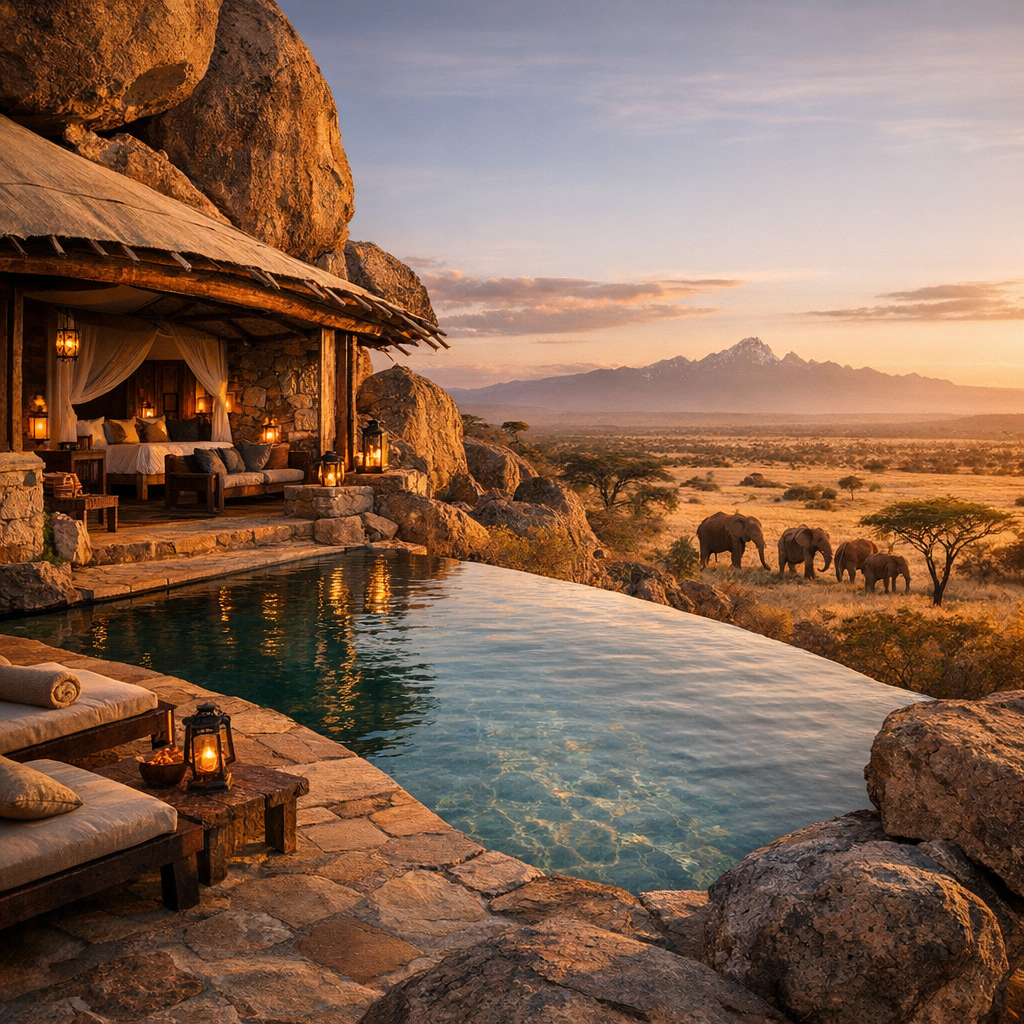
There are safari lodges, and then there's Saruni Samburu — six open-air villas carved directly into a volcanic rock outcrop, a kopje, rising out of Kenya's Kalama Conservancy like it grew there. From the infinity pool, the view runs straight off the escarpment across 240,000 acres of golden bushland toward the distant silhouette of Mount Kenya, with elephants, gerenuk, and reticulated giraffe — species you mostly find north of the equator and nowhere else in Kenya — moving through the thorn scrub below. This is Samburu country: harsher, drier, and far less trafficked than the Maasai Mara, and Saruni built its lodge to disappear into that landscape rather than dominate it.
BTN has been fielding more questions about Northern Kenya lately as travelers look past the Mara-Serengeti circuit for something quieter and more community-connected. Saruni Samburu keeps coming up as the answer, so we dug into what it actually is, who runs it, and whether the price tag holds up.
Ownership: What BTN Wants You to Know
BTN believes in giving readers accurate information, so let's be direct about who's actually behind Saruni Samburu: it is owned and operated by Saruni Basecamp, a Kenya-based safari company formed in 2021 through the merger of two existing operators — Basecamp Explorer (founded in 1998) and Saruni (founded in 2003 by Italian journalist-turned-safari-guide Riccardo Orizio). The combined company is currently chaired by Svein Wilhelmsen, a Norwegian conservationist and longtime Africa hand. In plain terms: this is a foreign-founded, professionally run luxury safari brand, not a Black- or Samburu-owned lodge, and BTN isn't going to imply otherwise.
What is genuinely community-rooted is the land underneath it. Saruni Samburu is the sole lodge operating inside Kalama Conservancy, a wildlife conservancy owned by the Samburu community itself and managed on their behalf by the Northern Rangelands Trust. The lodge pays land-use fees and conservancy fees to Kalama that fund conservancy operations, ranger salaries, school bursaries, and health center support for surrounding Samburu villages, and the vast majority of Saruni's on-the-ground staff — guides, housekeeping, kitchen team — are Samburu community members. That's a genuine, documented conservancy revenue-sharing partnership. It is not the same thing as community ownership of the lodge itself, and BTN thinks that distinction matters enough to spell out clearly rather than let the marketing blur it.
The Villas & Design
Saruni Samburu has just six villas, capping the whole property at around 20 guests — deliberately small, which is a meaningful part of the appeal. Two are single villas with en-suite bathrooms and dressing rooms; four are family villas split across two paired structures, bookable as a shared-entrance pair or, in one configuration, as fully separate units. There's also a standalone unit known simply as "The Samburu," with an open-air outdoor shower, and a Honeymoon Villa perched at the hillside's edge that consistently gets singled out by returning guests as having the single best view on the property.
The architecture is the whole point: stone walls built directly into the natural boulder formations of the kopje, canvas and netting closures instead of glass, and verandahs that open the villas fully to the bush air rather than sealing guests off from it. The stone keeps interiors cool through Samburu's dry heat without heavy reliance on air conditioning, and the open-fronted design means you fall asleep to actual bush sounds — not a soundtrack piped through a speaker. It's rustic-luxury in the true sense: five-star bedding and plumbing wrapped in a structure that looks like it was assembled by hand out of what was already on the hill.
The Safari & Wildlife Experience
Samburu National Reserve and the conservancies bordering it, including Kalama, are known among safari veterans for the "Samburu Special Five" — gerenuk, reticulated giraffe, Grevy's zebra, Somali ostrich, and beisa oryx, all species adapted to this arid ecosystem and essentially absent from the wetter, greener parks further south. Add elephants (the Ewaso Ng'iro River corridor is a major elephant thoroughfare), lion, and a real shot at leopard, and Samburu punches well above its profile as a "secondary" Kenya destination.
Because Kalama is a private conservancy rather than a national reserve, Saruni's guides aren't restricted to reserve roads or reserve hours. That means day and night game drives (spotlighted night drives are a genuine differentiator — most of Kenya's national parks prohibit them entirely), guided walking safaris on foot with an armed Samburu tracker, and access to a photographic hide positioned at a waterhole for guests who want serious wildlife photography without the vehicle in the frame. Guides are drawn from the local Samburu community and layer in bush knowledge — tracking, plant use, animal behavior — that goes well beyond a standard game-drive narration.
Cultural Experiences with the Samburu Community
This is where Saruni Samburu distinguishes itself from a lot of East Africa luxury safari product, which can treat "cultural visit" as a fifteen-minute photo-op bolted onto the itinerary. Saruni runs a genuine Warriors Academy program, developed with Samburu morans (warriors), where guests spend real time learning skills directly from the community: traditional fire-starting, spear-throwing, tracking techniques, and the medicinal use of local plants that Samburu families have relied on for generations. It's taught as an actual skills exchange rather than a performance, and it's become one of the property's most consistently praised experiences in guest reviews.
Saruni also arranges visits to Samburu villages (manyattas) for beadwork, dance, and conversation with families, and can arrange excursions to Reteti Elephant Sanctuary — Africa's first community-owned and -run elephant sanctuary, staffed largely by Samburu women as elephant keepers, rescuing and hand-raising orphaned calves before eventually releasing them back to wild herds. It sits within the broader Namunyak Conservancy network near Kalama and is a genuinely worthwhile half-day add-on, distinct from anything Saruni itself owns but well within reach of the lodge.
Dining
Meals are taken as a shared, communal experience overlooking the kopje view, with a kitchen team that leans into Riccardo Orizio's Italian roots alongside East African ingredients — guest reviews consistently single out the kitchen (long helmed by Chef Evans) for food quality well above what most remote safari lodges manage this far from a supply chain. Expect fresh pasta, wood-fired preparations, and produce sourced regionally where possible, plus the signature Saruni touch of a private bush dinner under the stars, set up away from the main lodge with lanterns and a fire, for at least one night of the stay. Drinks are included as part of the all-inclusive rate, with a reasonably serious wine list for a property this remote.
Rates & Booking Windows
BTN's original backlog note pegged this lodge at "from $600/night," and that figure is now out of date — verified 2026 rates start meaningfully higher. Saruni Samburu runs on a "Fully Inclusive Plus" model, quoted per person sharing (double occupancy), covering accommodation, all meals, select drinks, and most on-property activities:
- June, November 2026: from $800 per person, per night
- October, December 1–19, 2026: from $900 per person, per night
- July–September (peak season) 2026: from $1,000 per person, per night
- 2027 rates: trending roughly 5–8% higher across the same seasonal bands
A single-occupancy supplement applies if you're not sharing a villa. Scheduled light-aircraft flights, park and conservancy fees, and a shared 4x4 with dedicated guide are typically bundled into packages booked through safari operators, though direct lodge-only rates may exclude flights — confirm exactly what's included when you get a quote, since "all-inclusive" language varies between the lodge's direct rate and third-party operator packages. Because the property has only six villas, the Honeymoon Villa and peak July–September dates book out four to six months ahead; this is not a lodge you can decide on with two weeks' notice during high season.
Who This Lodge Is For
Saruni Samburu is built for travelers who've either already done a Maasai Mara or Serengeti safari and want a quieter, less-trafficked follow-up, or who specifically want Samburu's arid-ecosystem wildlife and its "Special Five" over the more familiar Big Five circuit. It suits honeymooners and couples chasing a genuinely private, architecturally striking villa, wildlife photographers who want night drives and a photo hide, and travelers who want their conservation dollars to visibly reach a specific, named community conservancy rather than a vague sustainability line item. It is less suited to first-time African safari travelers wanting maximum big-game density on a tight schedule (the Mara or Serengeti will out-perform Samburu on raw sighting volume), or to budget-conscious travelers — this is a genuine luxury price point with no shortcut version.
Getting There
Most guests fly scheduled light aircraft (Safarilink or AirKenya) from Nairobi's Wilson Airport (WIL) directly into one of the Samburu-area airstrips — Kalama, Samburu/Oryx, or Buffalo Springs — a flight of roughly one hour, followed by a lodge transfer of 30–45 minutes over conservancy roads. Driving from Nairobi is possible but long: figure five to six hours each way on a mix of tarmac and rougher conservancy track, which most travelers reserve for a multi-stop overland safari itinerary rather than a direct Samburu trip.
BTN Insider Tips
Book the Honeymoon Villa specifically if the view is the priority — it's consistently named by guests as the best of the six, and it's also the first to sell out for peak dates.
Ask directly whether flights and park fees are included in your quoted rate. "Fully Inclusive Plus" language differs between the lodge's own direct pricing and the packages sold through safari operators — get this in writing before you book.
Don't skip the night drive. Because Kalama is a private conservancy rather than a national reserve, Saruni can run spotlighted night game drives that most of Kenya's national parks simply don't allow, and it's genuinely one of the best wildlife experiences on offer here.
Add Reteti Elephant Sanctuary as a half-day excursion if it isn't already built into your itinerary — it's a short drive from the lodge and one of the most substantive community-conservation experiences in Northern Kenya.
Pack for real temperature swings. Samburu is hot and dry by day but the kopje elevation and open-air villas mean genuinely cool nights — bring a layer for dinner and the bush breakfast.
BTN's Verdict
Saruni Samburu earns its reputation: six thoughtfully designed villas built into a working landscape, wildlife you won't see on a standard Mara circuit, and a real, documented partnership with the Samburu-owned Kalama Conservancy — even though the lodge itself is owned and operated by a foreign-founded safari company, not a Black or Samburu ownership group, and BTN wants that stated plainly rather than implied away. The Warriors Academy and Reteti Elephant Sanctuary visits are the rare "cultural experience" add-ons that feel substantive rather than staged. At $800-plus per person, per night, this sits firmly in aspirational luxury-safari territory, not a budget alternative — but for travelers who've outgrown the standard Big Five checklist and want Samburu's rarer wildlife plus a lodge that visibly reinvests in the community whose land it sits on, this is a BTN Recommended stay.