Bed-Stuy's Brownstone That Refused to Be Ordinary
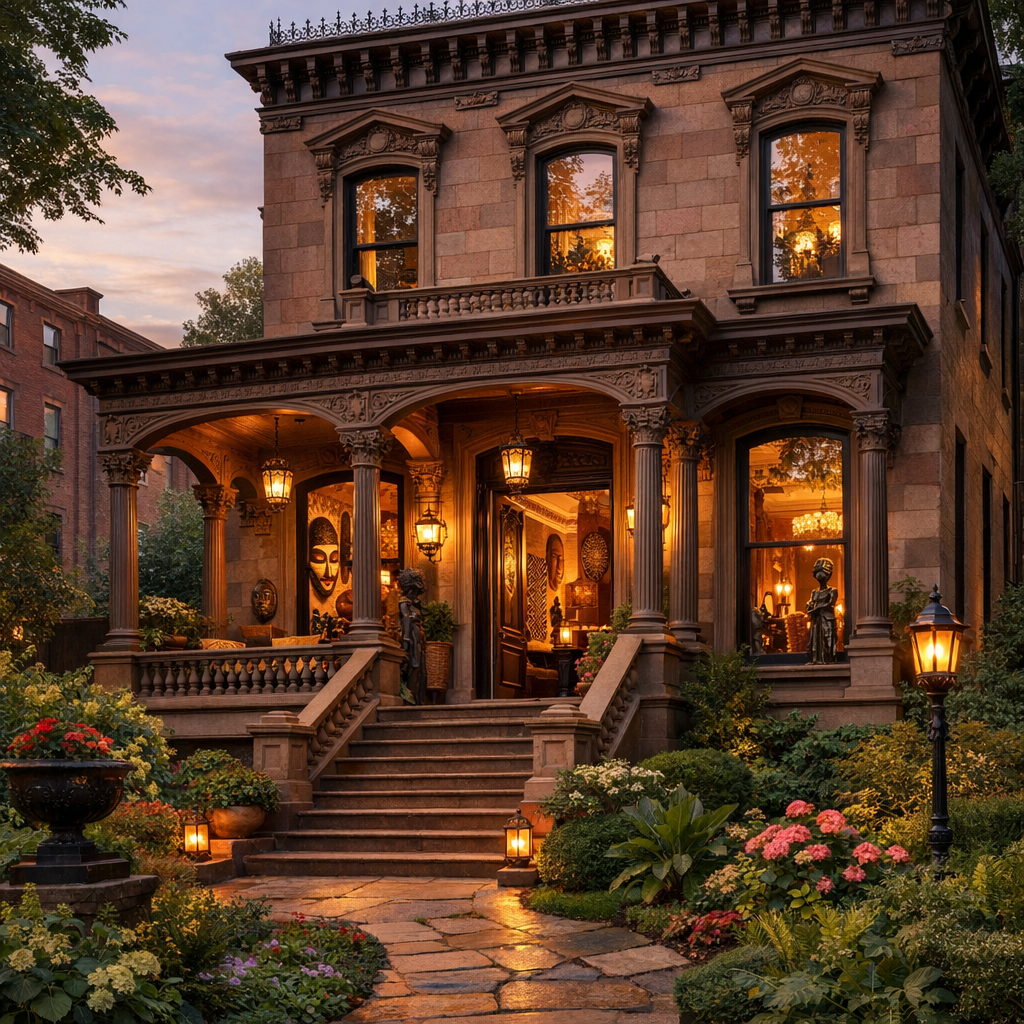
Before it was Brooklyn's most celebrated Black-owned bed and breakfast, the freestanding Italianate villa at 347 MacDonough Street was known to the neighborhood kids simply as "the haunted house." Boarded windows, an overgrown garden, a century of stories nobody could quite verify — that was the property Monique Greenwood and her husband Glenn Pogue bought in 1994 for $225,000. Greenwood, then a rising magazine editor who would go on to become editor-in-chief of Essence, had moved to Bed-Stuy in 1981 fresh out of Howard University and fallen for the neighborhood's brownstone blocks. A year of restoration later, in 1995, Akwaaba Mansion opened its doors — and became one of the first Black-owned bed and breakfasts in the United States.
The name itself is a mission statement. "Akwaaba" means "welcome" in Twi, spoken by the Akan people of Ghana, and Greenwood built the inn around that idea of welcome as a form of cultural affirmation. "We wanted people to really see us for who we are," she has said of the project. "That this is a community with gorgeous brownstones but even more gorgeous brown people." Three decades on, the mansion is still family-run, still independently Black-owned, and still one of the clearest proof points that Bed-Stuy's brownstone renaissance had Black homeowners and entrepreneurs at its center — not as an afterthought, but as its architects. The Akwaaba name has since grown into a small portfolio of sister inns in D.C., Cape May, the Poconos, and Philadelphia, plus an OWN network show, but Brooklyn remains the flagship — the one that started it all.
The Building & Design: 1860s Bones, Afrocentric Soul
Akwaaba Mansion occupies a genuine architectural rarity for the neighborhood: a freestanding 1860s Italianate villa, rather than the attached rowhouses that define most of Bed-Stuy's historic district. That means real light on multiple sides, 14-foot ceilings, ornate marble fireplaces, and the kind of grand proportions rarely found this close to Manhattan at bed-and-breakfast prices. Greenwood and Pogue's restoration preserved the bones — the crown moldings, the original woodwork, the formal parlor — while layering in an unapologetically Afrocentric design language: African art and sculpture throughout the common spaces, a ballroom anchored by a baby grand piano, and guest rooms individually themed rather than uniformly decorated.
The result reads less like a boutique hotel and more like staying in a beautifully kept, design-forward family home — one where the design has a point of view. The four signature guest rooms each carry their own identity: Jumping the Broom, a nod to the historic Black wedding tradition, with a king bed and jacuzzi tub for two; Regal Retreat, built around a Victorian headboard; Ashante, dressed in African artifacts with a double-sink bath and jacuzzi; and Black Memorabilia, a step-down bath with a deep soaking tub. In warmer months, the property adds a glamping option in its garden, letting guests bed down under a century-old chestnut tree for a lower nightly add-on.
Amenities & Experience
Akwaaba markets itself around "modern-day amenities meet ol'-fashioned hospitality," and that framing holds up. Every stay includes a full Southern-style breakfast — the kind of made-to-order Southern cooking that most city hotels can't touch — served in the mansion's formal dining room or, weather permitting, out in the garden. Guests get personal concierge-style attention rather than a front-desk transaction, along with wireless internet, air conditioning, custom bath products, and plush robes in-room. The secluded back garden, anchored by that chestnut tree, functions as a genuine escape from the city — a place to read, work, or just decompress that most Brooklyn accommodations simply don't have room for.
It's worth setting expectations correctly: this is a four-room historic inn, not a full-service hotel. There's no elevator, no 24-hour room service, no on-site gym. What you're trading up for is space, history, personal hospitality, and a level of design specificity no chain property can replicate.
Rates & Booking Windows
Nightly rates at Akwaaba Mansion typically run from roughly $199 at the lower end for shoulder-season stays in the more modestly sized rooms, climbing into the $300s for the signature suites (Jumping the Broom and Ashante among them) during peak weekends, holidays, and high-demand stretches like Black History Month, Essence Festival season, and the fall brownstone-tour crowds. Seasonal glamping in the garden runs as a lower-cost add-on option when available. Because the inn has only a handful of rooms, weekends and marquee dates can book out weeks to months in advance — this is not a property where you can call the morning of and expect availability. BTN's advice: book your preferred room type directly as early as your travel dates are confirmed, and always call to ask about current specials, since a four-room inn's pricing flexes more with demand than a 300-room hotel's does.
Nearby Bed-Stuy & Brooklyn Highlights
Akwaaba's MacDonough Street address puts guests in the middle of the Bedford-Stuyvesant Historic District, blocks of some of the most architecturally significant brownstones in New York City — an attraction in its own right, best explored on foot with no itinerary at all. A short walk brings you to the Hattie Carthan Community Garden and its farmers' market, a genuine neighborhood institution rooted in urban agriculture and youth programming. For art, Richard Beavers Gallery on Marcus Garvey Boulevard showcases emerging Black artists working in social and political themes, while BLK MKT Vintage curates vintage goods and ephemera celebrating Black culture and history.
Food-wise, Peaches HotHouse on Tompkins Avenue is the neighborhood's go-to for Southern-style fried chicken and seafood, and Golda on Franklin Avenue mixes California and Middle Eastern influences with standout pastry. For evenings, C'mon Everybody on Franklin Avenue blends live music and gallery space with a proper bar scene, Brownstone Jazz hosts intimate jam sessions, and Tilly's Bklyn brings Caribbean sound systems to Bedford Avenue. All of it is walkable or a short ride from the mansion's front porch — Bed-Stuy rewards guests who wander rather than stick to a checklist.
Who This Property Is For
Akwaaba Mansion is built for travelers who want history and hospitality over hotel amenities — couples celebrating an anniversary or planning a wedding weekend (that Jumping the Broom suite name is no accident), heritage travelers tracing Brooklyn's Black brownstone history, solo travelers and writers who want a quiet, design-rich space to work, and anyone who'd rather support an independently Black-owned institution than book a chain property in Manhattan for the same money. It's less suited to large groups (only a handful of rooms total), travelers who need elevators or full ADA-accessible rooms, or anyone expecting resort-style amenities like a pool, gym, or 24-hour front desk. Families with very young children should also note the antique furnishings and adults-oriented decor throughout the common spaces.
Getting There
From JFK, Akwaaba Mansion is roughly a 30-45 minute drive or rideshare depending on traffic, or reachable via the AirTrain to the subway system with one or two transfers into Brooklyn. From LaGuardia, expect a similar 30-40 minute drive, with express bus and subway combinations also available for travelers without checked luggage. By subway, the mansion sits within walking distance of the C train's Kingston-Throop Avenues station in central Bed-Stuy, with the A/C line at points further along MacDonough and Halsey Streets also within reasonable range — making a car service, rideshare, or a short cab hop from the station the easiest way to arrive with luggage. Given the inn's residential, tree-lined block, BTN recommends arranging a car for arrival night, especially if you're coming in after dark or with bags.
BTN Insider Tips
Book the Jumping the Broom or Ashante suites if you want the full jacuzzi experience — the other two rooms are lovely but more modestly appointed, and the price difference is usually modest.
Ask about the seasonal garden glamping option if you're traveling on a tighter budget but still want the full Akwaaba experience — it's a genuinely unique way to stay on the property for less.
Don't skip breakfast to sleep in. The Southern breakfast service is one of the most consistently praised parts of the stay, and it's included in your rate — treat it as a reason to get up, not an afterthought.
Book weekends and Black History Month dates as early as possible. A four-room inn sells out fast during high-demand periods, and last-minute availability is rare.
Bring a walking mindset, not a car. Bed-Stuy's brownstone blocks, gardens, and galleries are built for wandering, and the neighborhood's best moments tend to happen off any planned itinerary.
BTN's Verdict
Akwaaba Mansion isn't just a place to sleep in Brooklyn — it's a piece of Black entrepreneurial history you get to stay inside of. Monique Greenwood took a boarded-up "haunted house" and turned it into one of the first Black-owned bed and breakfasts in the country, and three decades later it remains independently owned, family-run, and unapologetically Afrocentric in its design, from the suite names to the art on the walls. It won't suit travelers chasing resort amenities or elevator convenience, but for anyone who wants historic architecture, genuine hospitality, and the quiet significance of supporting a legacy Black-owned business in the heart of Bed-Stuy, this is a BTN must-book. Reserve early, request one of the signature suites, and don't rush breakfast.