A Festival Built on a Single Radical Idea
In a walled medieval city where the call to prayer still rings out over a thousand-year-old skyline, the Fes Festival of World Sacred Music was founded in 1994 on a deceptively simple premise: that music rooted in spiritual tradition — whatever the tradition — could do what politics and diplomacy so often can't. Founded by anthropologist and Sufi scholar Faouzi Skali through the Esprit de Fès Foundation (Spirit of Fez Foundation), the festival set out to "promote unity among individuals of all races and religions through spiritual and humanitarian values." The United Nations took notice, recognizing the festival in 2001 as one of the most significant events contributing to the global dialogue of civilizations — the same year the festival added its companion Fes Forum, a parallel program of talks and debates that puts scholars, artists, and spiritual leaders from wildly different traditions in the same room.
More than three decades on, that mission has only gotten more urgent. Each June, Sufi qawwals, gospel choirs, Gregorian chant ensembles, Indian classical ragas, West African griots, and Andalusian orchestras all share stages within the same ancient walls — proof, as the festival's own framing puts it, that sacred music from wildly different corners of the world speaks a shared language of transcendence.
Event at a Glance
- Event: Fes Festival of World Sacred Music (Festival de Fès des Musiques Sacrées du Monde)
- Location: The medina and surrounding venues of Fez, Morocco
- When: Typically 8-10 days in late May or June; 2027 dates not yet announced (see below)
- Price: Full Festival Pass around €305; individual evening concerts and free daytime Forum sessions also available
- Main Audience: Diaspora travelers, world-music and spiritual-travel seekers, culture and heritage tourists
- Travel Vibe: Reverent, transcendent, intimate, culturally immersive
History: From a Local Vision to a Global Gathering
The festival launched in 1994 in a Morocco eager to present a different face to the world — one built on Fez's centuries-old identity as a center of Islamic scholarship, Andalusian musical heritage, and interfaith coexistence. What began as a modest gathering has grown into a production hosting dozens of concerts and roughly 60 performances each edition, drawing artists from 15 to 20-plus countries in a typical year. Past lineups read like a genre-defying who's-who: Patti Smith, Youssou N'Dour, Ravi Shankar, Björk, Joan Baez, and the late South African legend Miriam Makeba have all shared festival bills with Sufi brotherhoods, Qur'anic reciters, and traditional Moroccan Andalusian orchestras. The festival paused in 2020 and 2021 during the COVID-19 pandemic before returning to its full medina footprint.
The Medina Is the Stage
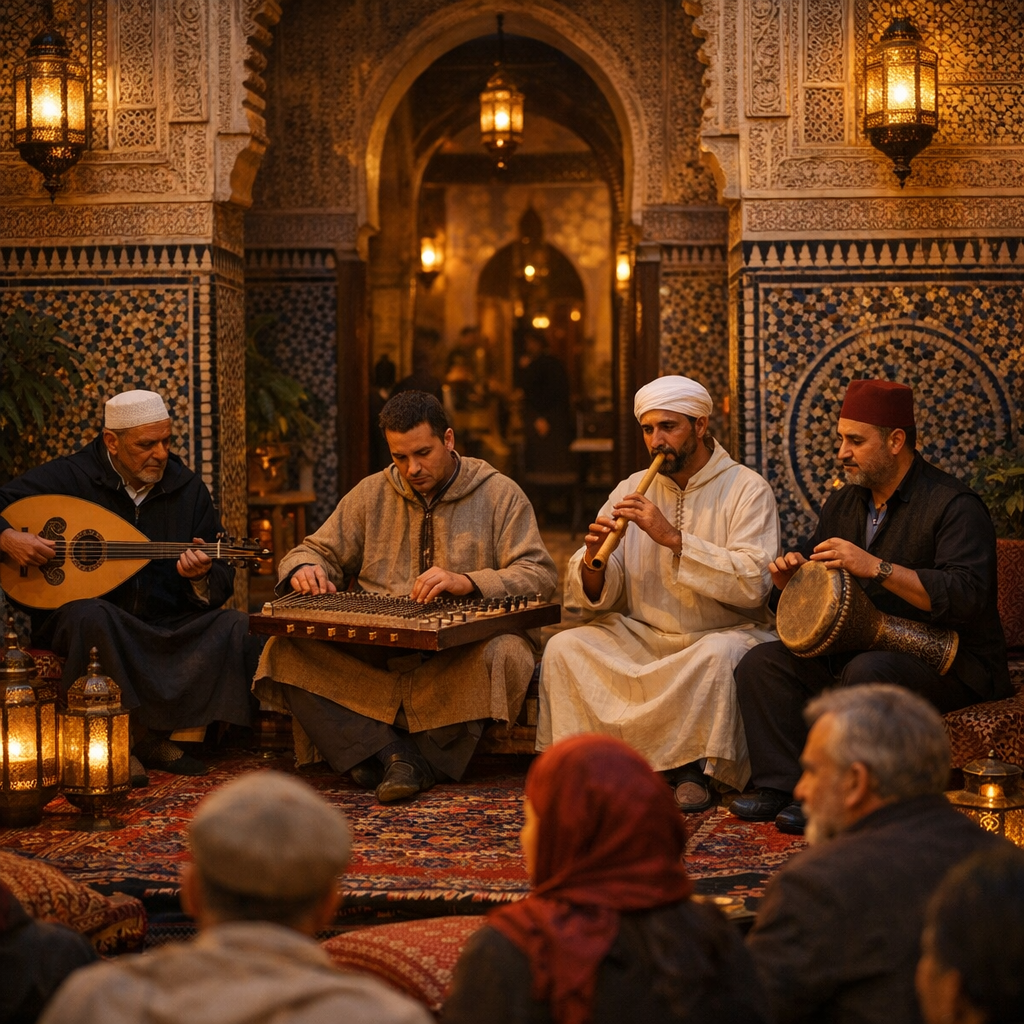
Part of what makes this festival unlike any other music event on earth is the setting itself. Fez's medina — Fes el Bali, a UNESCO World Heritage Site and one of the largest car-free urban zones in the world — isn't a backdrop rented for the occasion; it's a living, working medieval city that becomes the festival's architecture. The marquee evening concerts typically fill Bab Al Makina, a grand square near the Royal Palace whose old royal ramparts give every performance a genuinely monumental feel. Daytime programming moves to gentler settings like the 18th-century Jnan Sbil Gardens, while additional concerts and Forum sessions unfold at heritage sites including the Dar Batha Museum, Palais Jamai, the Batha Prefecture Hall, and intimate riads tucked inside the medina's maze of alleyways. Sitting inside a centuries-old palace or garden while a Sufi ensemble performs isn't festival theming — it's the real thing, which is exactly the point.
What a Recent Edition Looked Like
Because the 2027 edition hasn't been scheduled yet, it's worth grounding expectations in a real, recently confirmed edition. The festival's 29th edition ran June 6-14, 2026 under the theme "Renaissances," bringing together artists from more than 16 countries for a program spanning ancestral and contemporary sacred traditions from all five continents — Central Asian ensembles performing music from Mongolia, Uzbekistan, and Tajikistan; Pakistani Sufi vocalist Sanam Marvi; Indian classical performances led by Pandit Shyam Sundar Goswami; and multidisciplinary productions blending sacred dance, chant, and instrumental traditions. The prior year's 28th edition (May 16-24, 2025), also themed "Renaissances," featured more than 200 artists from 15 countries with Africa and Italy as spotlighted regions — a reminder that the festival's African through-line, connecting Morocco to Senegal, Côte d'Ivoire, Ghana, Burundi, and Togo, runs as deep as its better-known Western bookings.
Why This Festival Matters for Diaspora Travelers
For Black travelers building a cultural or spiritual itinerary, Fez offers something genuinely distinct from the Caribbean carnival circuit or U.S. heritage festivals: a direct thread into North and West African musical lineage, staged in a city whose scholarly and Sufi traditions predate the festival by nearly a thousand years. The programming's deliberate inclusion of Sub-Saharan African artists alongside global sacred-music traditions makes it a rare stage where African spiritual and musical heritage sits at the center of a world conversation, not the margins. It's also simply a gorgeous, contemplative way to experience Morocco — slower and more reflective than the country's more commercialized tourist circuits.
Important: 2027 Dates Are Not Yet Announced
Here's the practical reality for anyone planning ahead: as of this writing, the Fes Festival of World Sacred Music has not announced its 2027 dates. Given the festival's consistent late-May-to-June timing in recent years, a similar window is the reasonable expectation, but nothing is confirmed. Treat this page as a bookmark-and-check-back guide — we've used the verified June 2026 edition as the illustrative example of what to expect (the Bab Al Makina evening concerts, the Forum discussions, the medina-wide program) while the official 2027 dates and lineup are finalized. Follow the festival's channels and check fesfestival.com directly for the announcement, and we'll update this guide the moment new dates drop.
Getting to Fez
Fez-Saïss Airport (FEZ) handles domestic and a growing number of direct European connections; many international travelers instead fly into Casablanca's Mohammed V International Airport (CMN) and connect via a roughly 3.5-4 hour train ride on Morocco's ONCF rail network, a scenic and comfortable option that many festival-goers prefer to a domestic flight connection. Book both flights and Fez accommodations early — the festival fills the medina's riads quickly, especially during the marquee opening and closing weekends.
Where to Stay and Practical Tips
Staying inside or immediately adjacent to the medina is worth the tradeoff in navigational complexity — a traditional riad (a converted courtyard house, often the same architectural style as the festival's own venues) puts you walking distance from Bab Al Makina and the Forum venues, and the experience of sleeping inside the medina is part of the trip. Pack layers: Fez evenings can turn cool even when the June days run warm, and the medina's tiled interior venues hold a cooler, breezier feel than the streets outside. Dress modestly and respectfully, as is customary throughout Morocco, and budget time to simply get lost in the medina's souks between concerts — it's one of the most intact historic Islamic cities in the world, and half the experience is wandering it.
Plan Your Trip
The Fes Festival of World Sacred Music is proof that a travel bucket list can be built around transcendence as much as spectacle. Bookmark this guide, watch for the 2027 announcement, and start planning your Fez trip so you're ready to book the moment dates are confirmed.
🕌 Check Festival Updates →✈️ Book Your Morocco Trip →*Some links on this page are affiliate links — Black Travel Now may earn a commission at no extra cost to you.