Harlem's Biggest Day of the Year
Every third Sunday in September, Adam Clayton Powell Jr. Boulevard in Harlem shuts down to traffic and fills instead with marching bands, decorated floats, drill teams, and a crowd that has, in past years, swelled past 900,000 people. This is the African American Day Parade — often billed as "The Largest Black Parade in America" — and in 2026 it returns on Sunday, September 20, with festivities beginning the day before on Saturday, September 19.
For Black travelers building an itinerary around culture, community, and history rather than just sightseeing, this parade is a genuine bucket-list day. It's free, it's outdoors, and it turns one of the most historically significant Black neighborhoods in America into one giant, joyful celebration.
Event at a Glance
- Event: African American Day Parade 2026
- Location: Adam Clayton Powell Jr. Boulevard, Harlem, New York City
- When: Sunday, September 20, 2026 (weekend festivities begin Saturday, September 19)
- Price: Free to attend
- Main Audience: Culture travelers, families, HBCU alumni networks, diaspora communities, history lovers
- Travel Vibe: Proud, communal, celebratory, deeply rooted in Harlem history
Nearly Six Decades of History
The African American Day Parade was founded in 1968 by two organizations, Afro-American Day and the United Federation of Black Community Organizations, who joined forces to create a public showcase of Black achievement, culture, and unity. The inaugural parade stepped off on September 21, 1969, under the theme "Africa's Gift to America." Thirteen community organizers are credited as founders, including first chairman Livingston Wingate along with Conrad Peters, Jacqueline Peterson, Abdel Krim, Abe Snyder, and others who built the parade from the ground up.
That first parade in 1969 drew an estimated 200,000 people. By 1975, attendance had grown to more than 900,000 — and the parade has continued to draw crowds of that scale in the decades since, making it one of the largest annual gatherings of Black Americans anywhere in the country. Today the event is genuinely national in scope, with more than 200 participating organizations traveling in from 12 or more states, plus diaspora community groups, to march.
Grand marshals over the years have included some of Black America's most recognized civic and political leaders — past honorees have ranged from New York City's first Black mayor, David Dinkins, to Rev. Al Sharpton, Congressman Charles Rangel, and other elected officials and civil rights figures, reflecting the parade's role as a stage for Black political and civic leadership as much as a cultural celebration.
The Route: Marching Up Adam Clayton Powell Jr. Boulevard
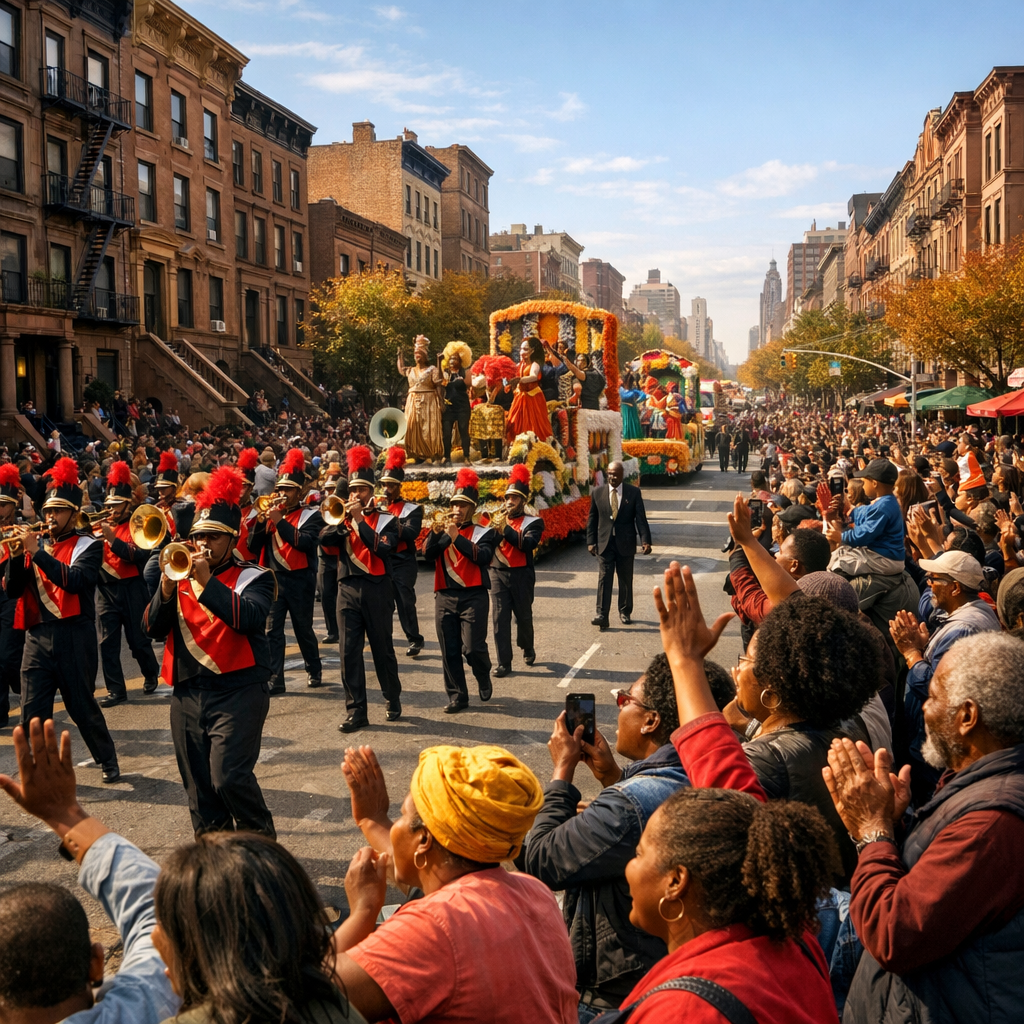
The parade travels along Adam Clayton Powell Jr. Boulevard — Harlem's central artery, formerly Seventh Avenue — chosen deliberately for its place at the heart of the Harlem Renaissance and Black New York history. In past years the route has run from around 111th Street north to 142nd Street, with the parade typically stepping off in early afternoon. Along the way, marching bands, drill teams, dance troupes, floats sponsored by community organizations, HBCU alumni chapters, churches, fraternities and sororities, and civic groups all pass in front of crowds packed several rows deep on the sidewalks.
The parade's 2026 theme, "Good Businesses Sustain Our Future," continues a tradition of building each year's parade around a message tied to community empowerment — past themes have highlighted everything from African heritage to anti-racism and community health. Related programming this year includes the AADP Press Conference and Guest Panel on Saturday, September 12, 2026, held at the Schomburg Center for Research in Black Culture, one of the country's premier archives of Black history, just blocks from the parade route itself.
What to Expect on Parade Day
Expect a full sensory experience: brass and drumline marching bands competing for energy, elaborately decorated floats carrying honorees and community queens, dance teams and drill squads in matching uniforms, and a rolling wave of applause and music that moves block by block up the boulevard. Community organizations use the parade as a showcase — expect banners and representation from historically Black colleges and universities, Black fraternities and sororities (the Divine Nine), churches, hospitals, and civic and health organizations. Major sponsors and partners in recent years have included ABC7, Northwell Health, Memorial Sloan Kettering, the NAACP, AARP New York, WBLS radio, and the Schomburg Center — several of whom also help fund the parade's scholarship, grant, and community giveaway programs.
Media coverage is substantial: outlets including ABC7, CBS News, FOX 5 NY, PIX11, NY1/Spectrum News, NBC New York, and the New York Amsterdam News have all covered the parade in recent years, with past broadcasts featuring interviews with grand marshals and celebrity guests. If you can't make it in person, portions of the parade are typically broadcast or streamed by local New York stations.
Practical Travel Tips for Visiting Harlem in September
Early autumn is one of the best times to visit New York City — daytime temperatures in September typically sit in the comfortable 70s°F, with lower humidity than summer, making a full afternoon on your feet along the parade route much more pleasant.
Getting there: Harlem is well served by the 2/3 and A/B/C/D subway lines, with stops directly along or near Adam Clayton Powell Jr. Boulevard — public transit is by far the easiest way in, since streets along the route close to vehicle traffic for the parade. Arrive early to claim a good sidewalk spot, since the crowd fills in fast along the most popular viewing blocks.
Where to stay: Basing yourself in Harlem itself puts you inside the action and within walking distance of the route, with a growing number of boutique hotels in the neighborhood. Staying in Midtown or the Upper West Side is also workable, with just a short subway ride up to Harlem.
Make a day (or weekend) of it: Since festivities span Saturday's press conference and community programming through Sunday's parade, consider building a full weekend around it — pair the parade with a visit to the Studio Museum in Harlem, the Apollo Theater, the Schomburg Center, or one of Harlem's classic soul food restaurants.
🏨 Book Your Harlem/NYC Stay →Why It Matters
The African American Day Parade isn't a tourist spectacle built for outsiders — it's a community institution, run by a Black-owned nonprofit under the motto "Power Through Unity," that has spent nearly six decades using Harlem's most storied boulevard as a stage for Black pride, achievement, and mutual support. For Black travelers, showing up isn't just about watching a parade — it's about standing shoulder to shoulder with hundreds of thousands of people from across the country and the diaspora, in the neighborhood that gave rise to the Harlem Renaissance, on a day built entirely around celebrating Black culture and community.
Who This Event Is For
History-minded travelers, HBCU alumni and Greek-letter organization members, families looking for a free full-day cultural outing, and anyone building a Black-travel itinerary around Harlem's cultural landmarks.
BTN Insider Tips
Take the subway, not a car — the route and surrounding streets close to traffic, and Harlem's subway access is excellent.
Arrive by late morning to get a solid curbside viewing spot before the early-afternoon step-off.
Pair it with the Schomburg Center — the AADP's own press conference is held there, and it's one of the best Black history archives in the country.
Book Harlem lodging early — hotel inventory in the neighborhood is limited and this is one of its busiest weekends of the year.
Plan Your Trip
The African American Day Parade is Harlem doing what it does best — turning history, music, and community pride into one unforgettable Sunday. Mark September 20, 2026, book your stay, and come stand on Adam Clayton Powell Jr. Boulevard.
🎟️ Festival Details →✈️ Book Your NYC Trip →*Some links on this page are affiliate links — BTN may earn a commission at no extra cost to you.