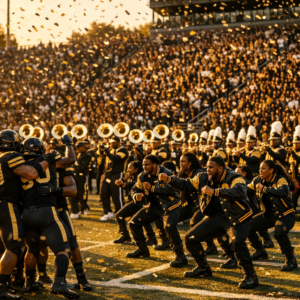
The Yard Is Calling — And Every Golden Tiger Comes Home to Answer
There is a particular kind of quiet that settles over a small Alabama town in the days before Tuskegee University's homecoming, right before the whole place breaks wide open. You feel it walking under the oaks near the historic Chapel, past the George Washington Carver Museum, past The Oaks — Booker T. Washington's own home — and out toward Cleve L. Abbott Memorial Alumni Stadium, where thousands of Golden Tigers are about to reunite from every corner of the country. This is not just a football weekend. This is a homecoming to one of the most historically significant square miles in Black America — the campus where Booker T. Washington built a university brick by brick, where George Washington Carver reinvented American agriculture, and where the Tuskegee Airmen learned to fly and changed the course of a war and a nation.
On Saturday, November 7, 2026, Tuskegee University hosts Miles College for the marquee matchup of Tuskegee Homecoming 2026 — a week that turns this small city in Macon County, Alabama, into a gathering point for the descendants of Washington's original vision: that education is liberation.
🐯 Plan Your Tuskegee Homecoming Trip
What Makes Tuskegee Homecoming Unlike Any Other
Every HBCU homecoming has its own personality. Tuskegee's is built on three things you will not find anywhere else.
First, the institution itself. Tuskegee University was founded in 1881 by Booker T. Washington and grew, under his leadership and George Washington Carver's genius, into one of the most consequential Black institutions in American history. This is the campus that trained the Tuskegee Airmen, the nation's first Black military pilots, at nearby Moton Field during World War II. When Golden Tigers come home, they come home to a campus that is itself a National Historic Site.
Second, the town. Tuskegee, Alabama is not a big city that happens to host a university — it is a small, historically Black-led community of roughly 9,000 people where the university, the Veterans Affairs hospital, and Black institutional life are woven directly into daily life. There is an intimacy to Tuskegee Homecoming that big-city HBCU homecomings simply cannot replicate.
Third, the football tradition. The Golden Tigers have won more Southern Intercollegiate Athletic Conference (SIAC) championships than any other program in the conference's history, and Tuskegee has long held one of the highest all-time win totals of any HBCU football program. Homecoming Saturday at Cleve L. Abbott Memorial Alumni Stadium is Golden Tiger football at its proudest.
The History: Tuskegee University & Its Legendary Homecoming
Tuskegee University was founded on July 4, 1881, when the Alabama Legislature authorized a normal school for training Black teachers and installed a young educator named Booker T. Washington as its first principal. Washington was given a small annual appropriation and no land, no buildings, and no facilities. What he built from that nothing became one of the most important institutions in African American history — literally brick by brick, as Washington had his students make the bricks themselves and construct the campus with their own hands.
In 1896, Washington recruited George Washington Carver to lead the school's agricultural research. Carver's work on crop rotation, soil health, and the hundreds of alternative uses he discovered for the peanut and sweet potato transformed Southern agriculture and made Tuskegee a center of scientific innovation recognized around the world. Carver taught, researched, and lived on this campus until his death in 1943, and his grave sits on campus grounds today, alongside Washington's.
Then, in 1941, the U.S. Army Air Corps established a pilot training program at Tuskegee to test — against the era's ugly assumptions — whether Black men could be trained to fly combat aircraft. The cadets trained at nearby Moton Field, earned their wings, and became known to history as the Tuskegee Airmen, one of the most celebrated fighting units of World War II. Their success helped push the U.S. military toward desegregation.
Tuskegee Homecoming grew out of this extraordinary institutional history — a tradition of Golden Tigers returning each fall to a campus that does not just teach Black history, it is Black history.
Why Tuskegee Homecoming Matters
Tuskegee Homecoming matters because Tuskegee University matters, and that is not an overstatement. This is the campus of Booker T. Washington and George Washington Carver, the training ground of the Tuskegee Airmen, and the alma mater of Olympic champions, four-star generals, and generations of Black doctors, veterinarians, engineers, and scientists trained at an institution founded specifically because Black students were shut out everywhere else. Coming home to Tuskegee is an act of remembrance — a reconnection with the generations who built something extraordinary out of almost nothing.
For visitors who are not alumni, Tuskegee Homecoming offers something rare: the chance to experience an HBCU homecoming's joy and pageantry inside one of the richest concentrations of African American history anywhere in the United States.
Why You Should Attend Tuskegee Homecoming 2026
You do not need a Tuskegee degree to feel the pull of this weekend. The marching band, the tailgates, the Greek step show, and the sheer warmth of a small HBCU town welcoming its own home are open to any traveler who wants to experience Black excellence and Black history in the same breath.
Come ready to learn something, too. Very few homecoming weekends double as a walking tour of American history — Tuskegee's does.
🎟️ Get Tuskegee Homecoming Details
What to Expect: Day by Day
Tuskegee's full 2026 homecoming week schedule had not yet been officially released by the university at the time of writing. Based on the established annual pattern (2025's "Homecoming 101: The Renaissance" ran October 26 – November 2 with the football game on the closing Saturday), here is what Golden Tigers can typically expect during homecoming week leading into the confirmed Saturday, November 7, 2026 game against Miles College:
- Early in the week — Arrival & Coronation: Alumni begin arriving, campus fills back up, and Mister and Miss Tuskegee are typically crowned in a coronation ceremony.
- Midweek — Fashion Show & Comedy Show: Student-organized fashion shows and a homecoming comedy show are annual staples of the week.
- Thursday or Friday — Greek Step Show: Tuskegee's Divine Nine chapters compete in one of the week's most anticipated events.
- Friday night — Pep Rally & Concert: A campus pep rally, bonfire, and student concert typically build energy ahead of game day.
- Saturday, November 7 — Parade, Tailgate & Football: The homecoming parade winds through campus, the tailgate takes over the lots around Cleve L. Abbott Memorial Alumni Stadium, and the Golden Tigers take the field against Miles College.
- Saturday night — Concert & Afterparties: A headline concert and citywide afterparties close out the celebration.
Confirm the exact day-by-day schedule at tuskegee.edu/homecoming as the 2026 dates are finalized.
Career & Networking Opportunities
Tuskegee's alumni network runs deep in medicine, veterinary science, engineering, agriculture, aviation, and the military — fields where Tuskegee-trained professionals have historically been underrepresented and overachieving. Homecoming week is prime time to tap into it.
- National Alumni Association chapter events — Tuskegee alumni chapters across the country host receptions and meetups tied to homecoming week. Reach out to your local chapter before you travel.
- College and department reunions — Tuskegee's College of Veterinary Medicine, College of Engineering, and School of Business regularly host homecoming gatherings for their graduates.
- Campus conversations — some of the most valuable connections at Tuskegee Homecoming happen informally, walking the same paths Washington and Carver once walked with classmates who went on to careers in medicine, aviation, and federal service.
Social Events & Parties
Tuskegee is a small town, and homecoming week is when it feels the fullest. Campus-organized events — the step show, the concert, the pep rally — are the backbone of the week, and they tend to sell out or fill up fast, so plan around the official calendar first.
Because Tuskegee itself is compact, a good share of the after-hours social scene spills over into nearby Auburn and Opelika, about 20 minutes away, where alumni groups and local promoters often host homecoming-adjacent parties and mixers during game week.
Where to Eat: Tuskegee's Best for Homecoming
- Blue Seas 2 — A Tuskegee soul food spot locals swear by. Come hungry for classic Southern plates and go easy on the wait during homecoming week.
- The New House of Stewart's — A beloved local fish-and-chips counter that's become a Tuskegee institution in its own right.
- Torch 85 Restaurant — A Tuskegee burger spot named for the interstate that brings so many alumni home every homecoming.
- City Kitchen — A lighter, fresher option in Tuskegee for salads and casual bites between events.
- China Pavilion — A longtime Tuskegee favorite for a quick, satisfying meal away from the tailgate crowds.
- Ariccia Italian Trattoria & Bar (Auburn) — If you're staying out toward Auburn, this upscale Italian spot inside the Auburn University Hotel is worth the 20-minute drive for a proper sit-down dinner.
What to Do in Tuskegee
- Walk the historic campus — Tuskegee's core campus, much of it built by Washington's students, is itself a National Historic Landmark District. Wander past the Chapel, Tompkins Hall, and the historic quad.
- George Washington Carver Museum — Located right on campus, the museum houses Carver's original research, inventions, and personal effects.
- The Oaks — Booker T. Washington's restored family home, preserved on campus grounds and open for tours through the National Park Service.
- Tuskegee Airmen National Historic Site at Moton Field — A must for any visitor, alumni or not. Walk the same hangars and airfield where the Tuskegee Airmen trained to fly.
- Tuskegee National Forest — One of the smallest national forests in the country, right outside town, with hiking trails if you need a quiet morning before the tailgate.
- Main Street Historic District — A short stroll through Tuskegee's historic downtown core, part of the same fabric of Black institutional life that shaped the town.
Black History & Cultural Sites in Tuskegee
Few homecoming destinations in America carry the historical weight that Tuskegee does. This is not incidental Black history — it is some of the richest in the country, concentrated on and around a single campus.
- Tuskegee Institute National Historic Site — The National Park Service site preserving the story of Washington, Carver, and the university's founding, anchored by The Oaks and the Carver Museum.
- Tuskegee Airmen National Historic Site — At historic Moton Field, this NPS site tells the story of the first Black military aviators and the segregated training program that ultimately proved their excellence beyond doubt.
- Booker T. Washington and George Washington Carver Gravesites — Both men are buried on Tuskegee's campus, a quiet, powerful stop for any visitor.
- Butler Chapel A.M.E. Zion Church — A site tied to Tuskegee's civil rights history and organizing during the movement.
- Grey Columns — An 1857 antebellum home, now the university president's residence, that stands as a striking visual marker of the town's layered history.
Recommended Places to Stay
Tuskegee is a small town with limited lodging directly on the ground, so many homecoming visitors base themselves in nearby Auburn/Opelika (about 20–25 minutes away) or Montgomery (about 40 minutes away). Book early — homecoming weekend sells out the region's hotels fast. All rates below are estimates and will vary.
Premium
- The Auburn University Hotel & Dixon Conference Center — A full-service, upscale hotel on Auburn's campus, about 20 minutes from Tuskegee. Estimated from $220–$280/night during homecoming week.
- Renaissance Montgomery Hotel & Spa at the Convention Center — Montgomery's top downtown option, about 40 minutes away. Estimated from $200–$260/night.
Mid-Range
- Hampton Inn & Suites Auburn Downtown — Reliable, well-located mid-range option near Auburn's campus. Estimated from $150–$190/night.
- Embassy Suites by Hilton Montgomery Hotel & Conference Center — Spacious suites, good for groups traveling together. Estimated from $160–$200/night.
Budget & Group
- Chain budget hotels along I-85 in Opelika — Several budget-friendly chain properties cluster near the Opelika I-85 exits, roughly 20 minutes from Tuskegee. Estimated from $90–$130/night.
- Airbnb/VRBO in Tuskegee, Auburn, or Opelika — With limited on-the-ground hotel inventory in Tuskegee itself, short-term rentals fill in the gap and are ideal for groups splitting costs.
🏨 Find & Compare Hotels for Tuskegee Homecoming →
BTN Travel Tip: Your Tuskegee Homecoming Itinerary
- Thursday — Arrive & Tuskegee Airmen NHS: Check in around Auburn or Opelika, then head straight to Moton Field to walk the grounds where the Tuskegee Airmen trained.
- Friday — Campus & Step Show: Morning at the Carver Museum and The Oaks, evening at the Greek step show if it falls on this night.
- Saturday morning — Parade & Tailgate: Catch the homecoming parade, then get to the lots around Cleve L. Abbott Memorial Alumni Stadium early for the tailgate.
- Saturday afternoon — Golden Tigers vs. Miles College: Kickoff at the stadium. Wear your crimson and old gold.
- Saturday night — Concert & Afterparties: Catch the homecoming concert or head toward Auburn for the late-night scene.
- Sunday — Gravesites & Depart: A quiet morning visit to the Washington and Carver gravesites before the drive home.
Mark Your Calendar
Tuskegee University Homecoming 2026
📅 Homecoming week leading into Saturday, November 7, 2026 (full week schedule pending official release)
🏈 Golden Tigers vs. Miles College — Cleve L. Abbott Memorial Alumni Stadium
📍 Tuskegee University, 1200 W Montgomery Rd, Tuskegee, AL 36088
🎟️ Pricing varies by event — many are free — tuskegee.edu/homecoming
⚠️ Regional hotel inventory is limited and sells out fast — book Auburn, Opelika, or Montgomery lodging early.
🐯 Get Tuskegee Homecoming Updates →
How to Stay Connected
- Official Website: tuskegee.edu/homecoming
- Tuskegee University Instagram: @tuskegeeuniv
- Hashtags: #TuskegeeHomecoming2026 #GoldenTigers #TuskegeeUniversity #HBCU
- BTN Coverage: Follow @myblacktravelnow for homecoming guides and Alabama HBCU travel tips