The Hill Is Calling. And Every Rattler Comes Home.
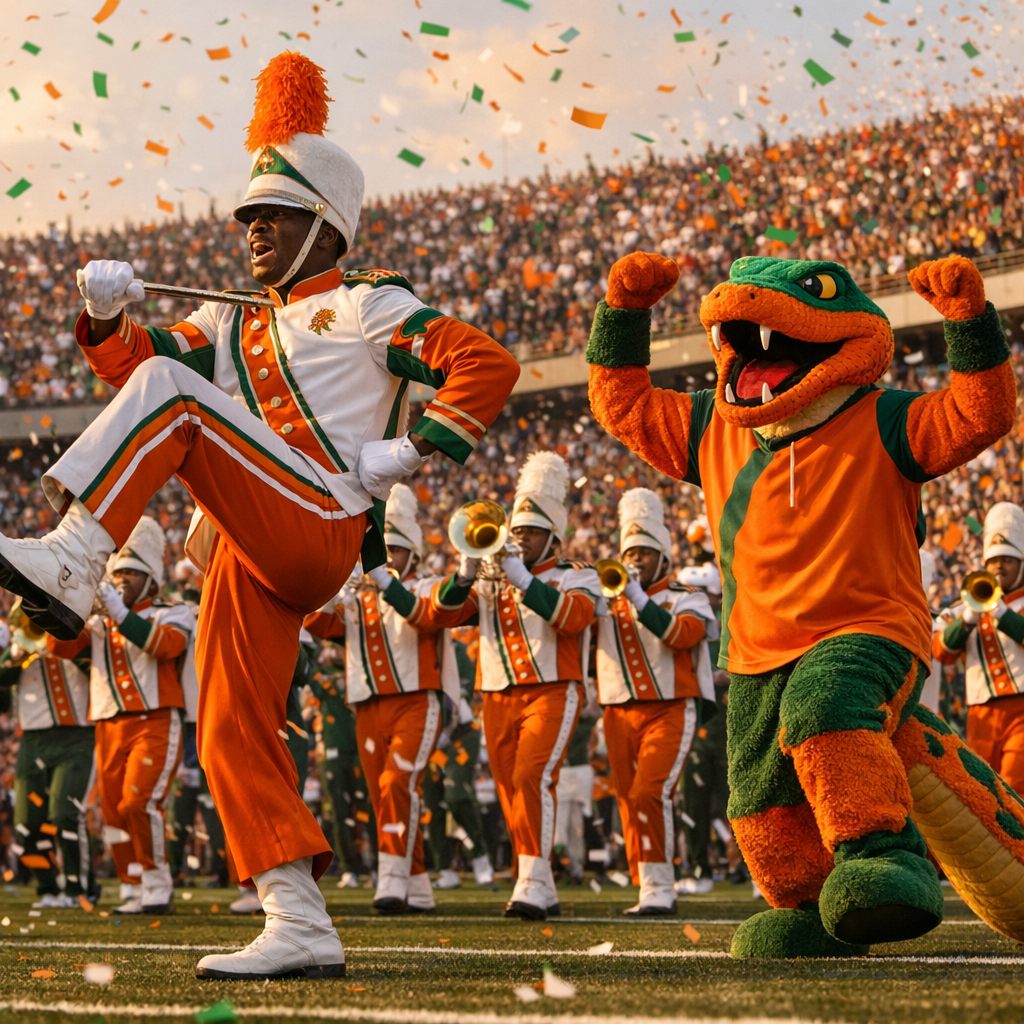
There is a moment every Rattler describes the same way. You are standing somewhere on The Hill — the highest of Tallahassee's seven hills, where Florida A&M University has sat since 1887 — and the Marching 100 is warming up somewhere close enough that you can feel it in your chest before you can hear it. Orange and green are everywhere: on the sorority line sisters walking past in matching fits, on the frat brothers posted up outside the Set, on the grandmother in her lawn chair who has been coming back every October since before you were born. Someone yells "Strike!" across the yard and a dozen strangers answer back without thinking twice.
You feel it before you understand it. This is what it means to come home to a place that never stopped being yours.
That is FAMU Homecoming. Widely regarded as the gold standard among HBCU homecomings — the one every other school's alumni association quietly measures itself against — anchored by the single most famous marching band in America. In 2026, the week runs October 19–24, building to a Saturday matchup against Arkansas-Pine Bluff at Bragg Memorial Stadium, and for six days, Tallahassee belongs to the Rattlers.
🐍 Get Your FAMU Homecoming Tickets
What Makes FAMU Homecoming Unlike Any Other
Every HBCU has a homecoming. FAMU's is in a category by itself — and three things set it apart.
First, Florida A&M University itself. Founded in 1887, FAMU is Florida's only public HBCU and the third-largest HBCU in the country by enrollment — ranked first among public HBCUs nationally by U.S. News. Its alumni network runs through Congress, sports halls of fame, newsrooms, and Fortune 500 boardrooms: Common, Anika Noni Rose, Pam Oliver, Andre Dawson, Althea Gibson, Bob Hayes, and sitting members of the U.S. House of Representatives all call themselves Rattlers. When FAMU alumni come home, they come from every level of Black excellence in America.
Second, the Marching 100. No other HBCU band carries this much national weight, and homecoming is the week it's most fully on display, right at home on The Hill.
Third, the culture. FAMU Homecoming is not one event; it's a full week — Market Monday, a royal court luncheon, a pep rally, a homecoming concert, the Greek step show, a 5K, an 8 a.m. parade down Althea Gibson Way, and a tailgate that turns campus parking lots into a full-blown festival before a single snap is played. Nothing else quite matches it.
The History: FAMU & Its Legendary Homecoming
Florida A&M University was founded on October 3, 1887, as the State Normal College for Colored Students, after Black abolitionist and Florida Secretary of State Jonathan C. Gibbs helped push the legislation that created it. Tallahassee was chosen in part because Leon County held the state's largest African American population at the time. The school became a land-grant institution in 1891, and the 1905 Buckman Act reorganized it into the university it is today — the only public HBCU in Florida, and one of only a handful of public land-grant HBCUs in the country.
The band that would come to define homecoming week was founded just five years after the university itself: the Marching 100, established in 1892. Under legendary director William P. Foster, who took over in 1946 with just 16 members, the band grew into the 400-plus-member institution now credited with roughly 30 innovations that became standard practice for marching bands across the country. The Marching 100 has performed at multiple Super Bowls, the Summer Olympics, presidential inaugurations for Bill Clinton and Barack Obama, France's Bicentennial Celebration, and as the opening act for Louis Vuitton's menswear show at the Louvre during Paris Fashion Week. There is no HBCU band with a bigger national footprint, and every October, it comes home to lead its own parade.
Homecoming at FAMU grew up alongside that reputation — from a campus tradition into the week that HBCU culture writers, band nerds, Greek life alumni, and first-time visitors alike now treat as the one to see at least once.
Why FAMU Homecoming Matters
FAMU Homecoming matters because FAMU matters — and that's not a marketing line. For nearly 140 years, this has been the institution that opened doors when almost nothing else in Florida would: to teachers, to scientists, to engineers, to a U.S. Representative or two, to the athletes who represented this country on Olympic podiums. Coming back to The Hill is an act of remembering that legacy in person, surrounded by the generations who built it and the ones still building it.
For visitors who never set foot on campus as students, FAMU Homecoming is a window into what sustained Black institution-building looks like — a school, a band, and a city that have kept a tradition alive and growing for well over a century.
Why You Should Attend FAMU Homecoming 2026
You don't need a FAMU degree to experience FAMU Homecoming, and if you've never been, this is the year. The Marching 100 alone is worth the trip — there is genuinely nothing else like watching them work a parade route or a halftime show live. Add in a week of step shows, concerts, a 5K, and one of the most famous tailgate scenes in college sports, and it's an easy case for any HBCU homecoming traveler's list.
Come dressed, too. Orange and green fashion culture at FAMU homecoming is taken seriously — from tailgate fits to Greek show attire — and blending in matters.
You will leave believing in the Rattler hype. Guaranteed.
✈️ Plan Your FAMU Homecoming Trip
What to Expect: Day by Day
FAMU's official 2026 lineup and headliners hadn't been announced at publication time, but the week reliably follows a rhythm built over decades. Based on recent years' programming, here's what to expect:
- Monday — Market Monday & Arrival: Vendors set up across campus, early alumni chapters roll into town, and the week officially kicks off.
- Tuesday — Royal Court Luncheon & Pep Rally: A daytime luncheon honoring the homecoming court, followed by an evening pep rally with a musical guest to get campus loud.
- Wednesday — Rest & Reception Day: Lighter on official programming, heavy on alumni chapter dinners, industry mixers, and informal Set reunions.
- Thursday — Walmart 5K & Homecoming Concert: A morning 5K at Bragg Stadium, then the week's headline concert at the Al Lawson Center that evening — historically the ticket that sells fastest.
- Friday — Convocation & Greek Step Show: Alumni luncheons and college mixers by day, then the Divine Nine step show — one of the most anticipated nights of the week — that evening.
- Saturday — Parade, Tailgate & The Game: An 8 a.m. parade down Althea Gibson Way led by the Marching 100, tailgating across campus lots and the Paddyfote Lawn from mid-morning on, and kickoff at Bragg Memorial Stadium against Arkansas-Pine Bluff.
Career & Networking Opportunities
FAMU Homecoming doubles as one of the most concentrated Black professional networking weeks in the Southeast. Alumni working in law, government, journalism, business, engineering, and public health all funnel back through Tallahassee in the same 72 hours.
- Alumni chapter events — FAMU's National Alumni Association chapters across the country host receptions and dinners during homecoming week; connect with your local chapter before you travel.
- School and college mixers — FAMU's individual colleges (business, pharmacy, journalism, engineering, and more) often run their own alumni luncheons and receptions during the week — worth checking for your major.
- The tailgate and the parade route — some of the best real conversations of the week happen standing in a parking lot before kickoff, reconnecting with classmates who are now years into serious careers.
Social Events & Parties
Tallahassee goes all-in for FAMU Homecoming week. Official events — the Homecoming Concert and the Greek Step Show especially — tend to sell out, so buy the moment tickets are released rather than waiting.
Unofficial parties fill every night of the week, with promoters bringing events in from Atlanta, Orlando, and Miami in addition to the local Tallahassee and FSU/FAMU-adjacent scene. Saturday night after the game is peak season for the social calendar, with multiple major events running at once across downtown and near campus.
Where to Eat: Tallahassee's Best for FAMU Homecoming
- Olean's Café — A soul food institution near FAMU's campus, serving Southern cooking "from the soul" for more than 20 years. A homecoming week staple for returning alumni.
- Earley's Kitchen — Southern comfort food done right: fried chicken, pork chops, and made-from-scratch vegetables and desserts, with a Savannah-style influence.
- JoEllen's — Upscale comfort and soul food serving breakfast, lunch, and dinner — a good pick for a sit-down group dinner during the week.
- Halisi Africa — An Afro-fusion spot doing brunch and dinner with dishes like fufu and egusi stew — a great change of pace mid-week.
- Ma's Diner — A family-style traditional diner for breakfast and lunch, open Wednesday through Sunday — ideal before a morning parade or the 5K.
- Pineappetit — A lighter, colorful stop in the Railroad Square Art District with pineapple-bowl combinations and a range of protein options — good for a break between events.
What to Do in Tallahassee
- Cascades Park — A large downtown greenspace with walking trails, water features, and an amphitheater — a good spot to reset between homecoming events.
- Railroad Square Art District — Tallahassee's arts and makers district, packed with galleries, studios, and local shops within walking distance of several restaurants.
- Wakulla Springs State Park — One of the world's largest and deepest freshwater springs, about a 30-minute drive south of the city — boat tours, swimming, and a chance to spot manatees if you have a free morning.
- Walk The Hill — FAMU's historic campus itself, including Lee Hall and the surrounding academic quad, is worth walking even if you're not an alumnus — it's the highest of Tallahassee's original seven hills.
- Tallahassee Museum — A combined history and nature museum with historic structures, wildlife trails, and exhibits covering the region's past.
Black History & Cultural Sites in Tallahassee
- John G. Riley Center & Museum — A historic house museum in downtown Tallahassee dedicated to educator and civic leader John Gilmore Riley, and to African American history and culture in the region since Reconstruction. An essential stop.
- Knott House Museum — The site where the Emancipation Proclamation was first publicly read in Florida, on May 20, 1865 — a date still commemorated locally.
- Tallahassee-Leon County Civil Rights Sidewalk & Cascades Historical Plaza — Terrazzo panels and a memorial documenting the 1956 bus boycott and the 1960s lunch counter sit-ins, many of which were led by FAMU students.
- Smokey Hollow Commemoration — A public tribute to Smokey Hollow, a historic Black neighborhood displaced by urban renewal, preserving its story in the heart of downtown.
- Frenchtown Walking Trail — Soul Voices — A self-guided trail through Frenchtown, one of Tallahassee's oldest historically Black neighborhoods, with audio markers featuring residents telling the community's own history.
Recommended Places to Stay
Hotels near FAMU and downtown Tallahassee sell out early for homecoming week — book as soon as your dates are set. Rates below are general estimates and will run higher during homecoming.
Premium
- Hotel Duval, Autograph Collection — A boutique property downtown with a rooftop lounge, central to both FAMU and FSU. From an estimated $220–$280/night during homecoming week.
- AC Hotel Tallahassee Universities at the Capitol — Modern, design-forward, and walkable to campus and the Capitol. From an estimated $200–$250/night.
Mid-Range
- Hyatt House Tallahassee Capitol-University — About half a mile from FAMU, walkable to restaurants and parks. From an estimated $170–$210/night.
- Hampton Inn & Suites Tallahassee Capitol-University — Breakfast included, close to campus. From an estimated $150–$190/night.
- Hotel Indigo Tallahassee — Collegetown — Boutique-style and close to both campuses. From an estimated $160–$200/night.
Budget & Group
- Holiday Inn Tallahassee E Capitol-University — A regular host hotel for FAMU family weekends, a short drive from campus. From an estimated $130–$160/night.
- Airbnb in Frenchtown or Providence — Tallahassee's historically Black neighborhoods near campus, with full-house rentals well suited to groups splitting costs.
🏨 Find & Compare Tallahassee Hotels for FAMU Homecoming →
BTN Travel Tip: Your FAMU Homecoming Itinerary
- Monday — Arrive & Market Monday: Check in, walk Market Monday vendors on campus, dinner at Olean's Café.
- Tuesday — The Hill & Pep Rally: Daytime walk of FAMU's historic campus, evening pep rally.
- Wednesday — Black History Day: John G. Riley Center & Museum in the morning, Knott House and the Civil Rights Sidewalk in the afternoon, alumni mixer that night.
- Thursday — 5K & Concert: Morning 5K at Bragg Stadium (or sleep in), afternoon at Railroad Square, evening Homecoming Concert.
- Friday — Step Show: Relax by day — maybe a trip to Wakulla Springs — then the Greek Step Show that night.
- Saturday — Parade, Tailgate, Game, After-Party: 8 a.m. parade down Althea Gibson Way, tailgate all afternoon, kickoff at Bragg Memorial Stadium, and a night out to close the week. Sleep when you get home.
Mark Your Calendar
FAMU Homecoming 2026
📅 October 19–24, 2026 — homecoming game Saturday, October 24
📍 Bragg Memorial Stadium, 1500 Wahnish Way, Tallahassee, FL 32310
🎟️ Ticket prices vary — football tickets, the Homecoming Concert, and the Greek Step Show are sold separately via famuathletics.com
⚠️ The Homecoming Concert and Greek Step Show are historically the first tickets to sell out. Set a reminder for the on-sale date.
🐍 Get FAMU Homecoming Tickets →
How to Stay Connected
- Official Website: famu.edu
- FAMU Instagram: @famu_1887
- Hashtags: #FAMUHomecoming2026 #Marching100 #Rattlers
- BTN Coverage: Follow @myblacktravelnow for homecoming guides and Tallahassee travel tips
📩 Join the BTN List — Never Miss an HBCU Event
*Some links on this page are affiliate links — BTN may earn a commission at no extra cost to you.