Where the Indian Ocean Meets a Thousand Years of Swahili History
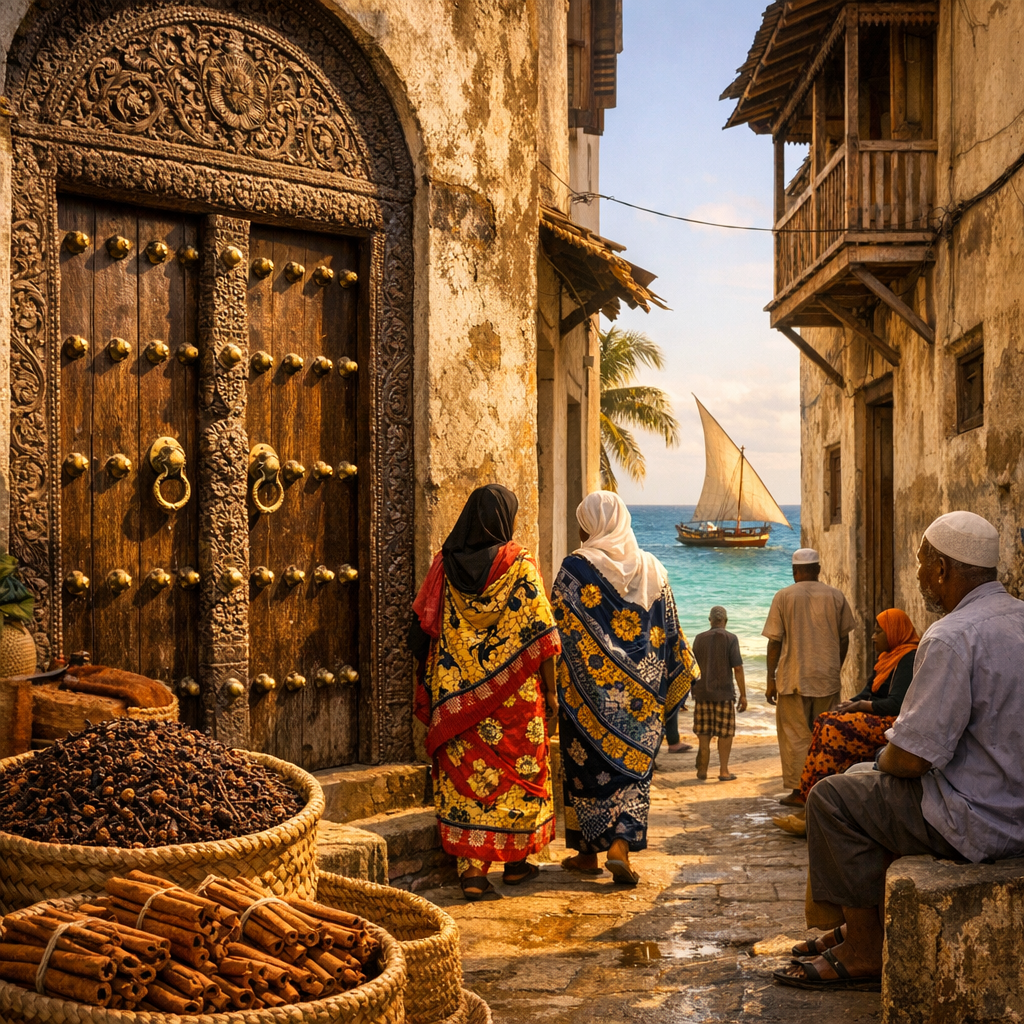
Stone Town's alleyways are barely wide enough for two people to pass, walled in on both sides by carved wooden doors so ornate they've become the island's unofficial symbol — Arab-influenced brass studs on one, Indian floral patterns on another, a testament to a thousand years of trade winds carrying people, goods, and culture across the Indian Ocean. Follow those alleys far enough and they open onto a waterfront where dhow sailboats still cut across turquoise water exactly as they have for a millennium, delivering catch and cargo the same way their ancestors did before Zanzibar was even a name on a map.
Zanzibar — technically a semi-autonomous archipelago within Tanzania, made up primarily of Unguja (the main island, often called Zanzibar itself) and Pemba — is one of the most historically layered destinations in the entire diaspora travel landscape. It was a center of the East African slave trade for centuries, a hub of the spice trade that gave it its enduring nickname the "Spice Island," and is today home to a population that is over 95% Muslim and deeply, visibly African-Arab-Indian in its cultural DNA. For Black travelers, Zanzibar offers something rare: a chance to sit with the full, complicated weight of the Indian Ocean slave trade — a history far less discussed in the West than the Atlantic trade — while also relaxing on some of the most stunning beaches on the planet.
Why Black Travelers Choose Zanzibar
Zanzibar draws diaspora travelers for a blend of reasons that don't exist together anywhere else. It is a serious historical pilgrimage site — the old Slave Market in Stone Town and the East African slave trade route are essential, difficult, necessary history. It is also a world-class beach destination, with the sugar-white sands of Nungwi, Kendwa, and Paje ranking among the best in Africa. And it is a deeply distinctive cultural experience — Swahili language and hospitality, taarab music, biryani and pilau rooted in centuries of Indian Ocean trade, and an Afro-Arab identity that broadens what "diaspora travel" can mean beyond the more commonly visited West African hubs.
Unlike Ghana or Senegal, Zanzibar's diaspora-tourism infrastructure is younger and its history less widely taught — which makes visiting feel less like a well-worn circuit and more like genuine discovery. It rewards travelers who come ready to learn as much as to relax.
Must-See Historic Sites
The Old Slave Market & Anglican Cathedral, Stone Town — The most essential site in Zanzibar and one of the most important in the global history of slavery. Zanzibar was the largest slave-trading port in East Africa, and this site — now home to the Anglican Cathedral built directly atop the former whipping post — includes underground holding chambers where enslaved people were kept before auction. The chambers can be visited, and the experience is somber, cramped, and deeply moving. A guide is essential to fully understand the scale of what happened here — over the 19th century alone, an estimated 600,000 to 1 million people passed through Zanzibar's slave markets.
Stone Town (UNESCO World Heritage Site) — The historic core of Zanzibar City, a labyrinth of coral-stone buildings, carved doors, bustling bazaars, and centuries of Swahili, Arab, Persian, Indian, and European influence layered on top of each other. Simply wandering it for a day is one of the richest urban experiences in East Africa.
The House of Wonders & Old Fort — Once the ceremonial palace of the Sultan of Zanzibar, the House of Wonders was the first building in East Africa with electricity and an elevator. Adjacent to it, the Old Fort, built by Omani Arabs in the late 1600s, now hosts cultural events, craft markets, and live taarab music performances in the evenings.
Freddie Mercury's Birthplace — Queen's legendary frontman was born Farrokh Bulsara in Stone Town in 1946, and a small house-turned-museum near the waterfront traces his Zanzibari-Parsi roots — an unexpected but beloved stop for music fans passing through.
Beaches & Island Experiences
Nungwi & Kendwa — The island's premier beach villages on the northern tip, known for calm, tide-independent swimming, epic sunsets, and a lively but low-key beach bar scene. Kendwa Rocks' full moon parties are legendary among travelers passing through East Africa.
Paje & Jambiani — On the southeast coast, these villages are the heart of Zanzibar's kitesurfing scene, with wide tidal flats, laid-back beach lodges, and a slower pace than the north.
Spice Tour — A half-day tour through working spice farms where guides walk you through cloves, nutmeg, cinnamon, vanilla, and cardamom growing in the ground — the literal source of the island's centuries-old spice-trade wealth and its enduring nickname.
Jozani Forest — Home to the endangered red colobus monkey, found nowhere else on Earth, alongside mangrove boardwalks and dense tropical forest — Zanzibar's best nature excursion outside the beach.
Where to Eat — Must Try
Zanzibar Pizza — Not Italian pizza at all, but a Stone Town street-food invention: a thin dough stuffed with minced meat, egg, vegetables, and cheese, folded and grilled on a flat pan. Best found at the nightly Forodhani Gardens food market on the Stone Town waterfront.
Biryani and Pilau — Rice dishes rich with cloves, cardamom, and cinnamon, direct descendants of centuries of Indian Ocean trade between Zanzibar, Oman, and the Indian subcontinent — a cuisine that tells the island's trade history in every bite.
Urojo (Zanzibar Mix) — A tangy, spiced soup loaded with potato fritters, boiled egg, cassava chips, and mango pickle — Stone Town's favorite street snack, sold from carts across the old town.
Forodhani Gardens Night Market — The must-do food experience on the island: dozens of vendors grilling fresh seafood skewers, Zanzibar pizza, sugar cane juice, and mishkaki (spiced meat skewers) every evening along the Stone Town waterfront as the sun sets over the harbor.
Where to Stay
Luxury: Park Hyatt Zanzibar sits directly on the Stone Town waterfront in a restored historic building, blending five-star service with old-world architecture. Zuri Zanzibar on the northwest coast offers vividly designed thatched villas and one of the island's most photogenic pools.
Mid-Range: Zanzibar White Sand Luxury Villas & Spa and Kena Beach Hotel in Nungwi offer beachfront comfort at more moderate prices, both popular with diaspora travelers.
Budget: Guesthouses throughout Stone Town and beach hostels in Paje and Jambiani run $25–50/night and put you close to the action on either coast.
🏨 Book Zanzibar Hotels →Getting There
Abeid Amani Karume International Airport (ZNZ) receives direct flights from several European hubs and one-stop connections from the US, typically routing through Doha, Addis Ababa, Nairobi, or Amsterdam. Most US travelers connect through Ethiopian Airlines via Addis Ababa or Qatar Airways via Doha, with total travel time of 18–22 hours. A domestic hop from Dar es Salaam (a common add-on for travelers combining Zanzibar with a Tanzania safari) takes about 20 minutes.
US citizens need a visa for Tanzania, obtainable as an eVisa in advance (recommended) or on arrival for around $50–100 depending on visa type.
✈️ Find Zanzibar Flights →A Note on Current Travel Advisories
As of late 2025, the US State Department raised its travel advisory for Tanzania to Level 3 ("Reconsider Travel"), citing civil unrest concerns tied to mainland political developments. This advisory has primarily concerned mainland areas rather than the semi-autonomous Zanzibar archipelago specifically, but BTN strongly recommends checking travel.state.gov for the current advisory level and any Zanzibar-specific guidance before booking, registering with the US Embassy's STEP program, and purchasing travel insurance that covers evacuation. Conditions can change — always verify with the most current official source before finalizing travel plans.
Best Time to Visit
June through October is Zanzibar's long dry season — warm, low humidity, and ideal beach weather, coinciding with the best whale shark sightings off Mafia Island nearby. December through February offers a shorter dry window with hotter, more humid conditions. Avoid April and May, the long rains, when many smaller lodges close entirely.
Budget Guide
Budget: $50–85/day — guesthouse or hostel, street food, dala-dala (local minibus) transport, spice tour and free historic sites.
Mid-range: $130–220/day — beach lodge, restaurant dining, private tours, snorkeling/diving excursions.
Luxury: $350+/day — five-star beach resort, private guides, fine dining, sunset dhow cruises.
BTN Insider Tips
Dress modestly, especially in Stone Town. Zanzibar is over 95% Muslim; cover shoulders and knees in town out of respect, even though beach areas are more relaxed.
Bring cash. Cards are accepted at larger hotels but small vendors, spice tours, and food markets are cash-only — Tanzanian shillings or US dollars (2009 or newer bills only, no marks or tears).
Get a Tanzania eSIM or local SIM immediately. Vodacom and Airtel SIMs are cheap and available at the airport; data makes navigating Stone Town's maze-like alleys far easier.
Take the slave market history seriously. This is heavy, essential history — go with a knowledgeable guide, budget real emotional space for it, and don't rush the visit.
Combine with a mainland safari if you can. Many diaspora travelers pair Zanzibar's beaches with a short Serengeti or Ngorongoro safari extension — ask your travel agent about combined itineraries.
Mark Your Calendar
- February — Sauti za Busara, Africa's premier pan-African music festival, held in Stone Town's Old Fort
- July — Zanzibar International Film Festival (ZIFF), the largest cultural festival in East Africa
- Year-round (Fridays) — Forodhani Gardens night market, Stone Town's daily sunset food gathering
Book Your Zanzibar Trip
Zanzibar asks you to hold two truths at once — the deep, difficult weight of the Indian Ocean slave trade, and the exhale of standing on some of the most beautiful beaches on the planet. Few destinations offer both with such honesty.
✈️ Book Your Zanzibar Trip Now →*Affiliate links — BTN may earn a commission at no extra cost to you.