The Drums That Refused to Be Silenced
Ask most travelers what they know about Uruguay and you'll hear the same three words: gauchos, steak, and Punta del Este. Montevideo gets filed away as a quiet, tidy European-feeling capital wedged between Argentina and Brazil — pleasant, safe, a little sleepy. What almost nobody outside South America knows is that this small country is home to one of the most significant unbroken Afro-descendant cultural traditions in the Americas: Candombe, a drumming and dance practice born from enslaved Africans and still alive, every single week, in the streets of Barrio Sur and Palermo.
This isn't a museum exhibit or a folkloric reenactment for tourists. Candombe is a living neighborhood practice — families who have played the same drum rhythms for generations, comparsas that rehearse in the street on Sunday evenings, and a UNESCO-recognized heritage that culminates every Carnival season in one of the most overwhelming parades in the Western Hemisphere: the Desfile de Llamadas. For Black travelers building a Latin America itinerary beyond Brazil and Cuba, Montevideo's Afro-Uruguayan heartland deserves a serious look.
From Bantu Angola to the Río de la Plata: The Origins of Candombe
Candombe's roots trace back to Bantu-speaking peoples of present-day Angola and the wider Congo basin, whose musical and spiritual traditions were carried across the Atlantic during the transatlantic slave trade. Beginning in the 18th century, Montevideo's colonial port became a major entry point for enslaved Africans brought to the Río de la Plata region to work in the city and surrounding countryside. Uruguay's Black population was smaller than Brazil's or Cuba's, but the cultural imprint enslaved and formerly enslaved Africans left on the country was profound and permanent.
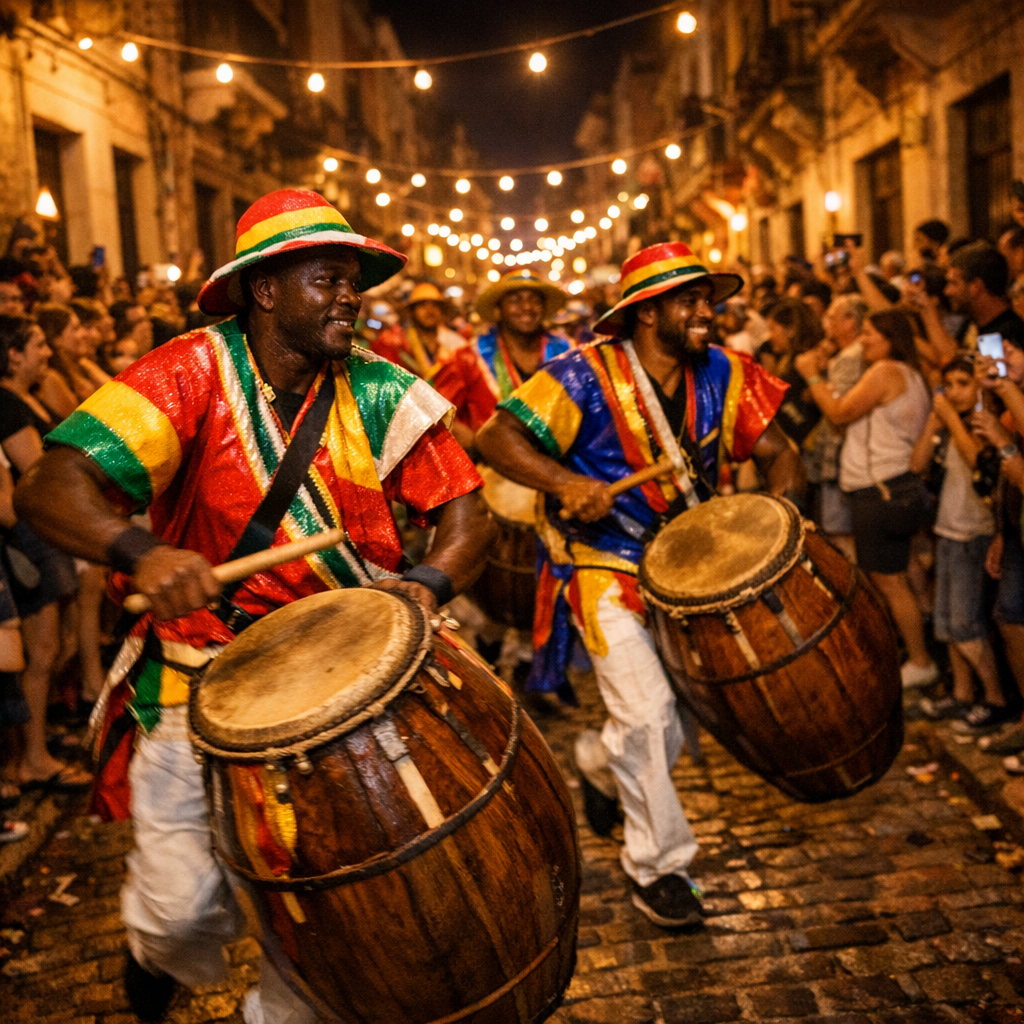
Candombe emerged as enslaved and later free Afro-Uruguayans adapted ancestral drumming traditions to their new environment, using distinct drums — the tambores — each with its own role: the chico (highest pitch, fastest pattern), the repique (the improvising, conversational drum), and the piano (the deepest, foundational heartbeat). Together they created a call-and-response pattern unmistakably African in structure and unmistakably Uruguayan in sound. Historically, Afro-Uruguayans gathered to play Candombe every Sunday and on major holidays, turning the practice into both spiritual release and quiet resistance under conditions designed to strip them of exactly that kind of cultural continuity.
Barrio Sur and Palermo: Where the Drums Still Live
Three historically Afro-Uruguayan neighborhoods in southern Montevideo carried Candombe forward into the present day: Barrio Sur, Palermo, and Cordón. Of these, Barrio Sur and Palermo remain the most concentrated and visible centers of the culture. Walk through either neighborhood on a Sunday evening and you'll likely stumble into a llamada — an impromptu "calling" of the drums, where a handful of players start a rhythm on a street corner and it builds, drummer by drummer, into a full comparsa parading down the block.
Each neighborhood has its own distinct drumming style and identity, passed down through families recognized within the community as Candombe royalty — some tracing their lineage back generations to the original enslaved and freed Afro-Uruguayan communities that settled here. This is intangible heritage in the truest sense: no recordings or written scores, just direct transmission from elder to child, block by block, for more than two centuries.
UNESCO Recognition: A Living Heritage of Humanity
In 2009, UNESCO inscribed "Candombe and its socio-cultural space" on the Representative List of the Intangible Cultural Heritage of Humanity, formally recognizing Candombe as a defining practice of Afro-Uruguayan identity and one of the clearest surviving links between the African diaspora and its Bantu ancestral roots in Latin America. The inscription credits the drumming families of Barrio Sur, Palermo, and Cordón as guardians of a tradition that functions, in UNESCO's words, as a living symbol of community memory.
For diaspora travelers who've visited Salvador da Bahia for Candomblé and capoeira, or Havana for rumba, Montevideo's Candombe belongs on the same list of essential Afro-Latin American cultural pilgrimages — and it remains far less visited by international Black travelers than any of them.
The Desfile de Llamadas: Uruguay's Signature Afro-Descendant Parade
The single biggest annual expression of this culture is the Desfile de Llamadas, literally the "Parade of Calls." Held on consecutive nights during Uruguay's Carnival season — famously the longest carnival celebration in the world, stretching some 40 days from late January into March — the Llamadas sends dozens of comparsas, each with dozens of drummers plus dancers, flag-bearers, and the traditional stock carnival characters (the elegant Gramillero, the escaped-slave-turned-trickster Mama Vieja and Escobero), parading through the narrow colonial streets of Barrio Sur and Palermo after dark. String lights, packed sidewalks, and wall-to-wall percussion turn both neighborhoods into an all-night open-air concert.
A quick date note for travelers reading this in mid-2026: this year's Desfile de Llamadas already took place in February 2026 as part of Uruguay's Carnival calendar, so if you're planning now, you're planning for the 2027 edition. Uruguay's Carnival authorities and the Intendencia de Montevideo typically confirm the exact Llamadas dates only a few months ahead of the event itself — historically it falls on two consecutive nights within the first two to three weeks of February, routed through the heart of Barrio Sur and Palermo. Check the official Carnaval Montevideo calendar through the Ministerio de Turismo or Intendencia de Montevideo as your travel dates approach, and book accommodations in or near Barrio Sur, Palermo, or Ciudad Vieja well in advance — rooms fill up fast during Carnival season.
If your trip doesn't line up with Carnival, don't write off the culture entirely. Candombe llamadas happen informally most Sundays year-round in Barrio Sur and Palermo, and Montevideo's Carnival museum (Museo del Carnaval) in the Mercado del Puerto area offers a strong primer on Candombe's history, instruments, and costumes any day of the year.
Must-See Sites Beyond the Parade Route
- Museo del Carnaval — Montevideo's dedicated Carnival museum near the Mercado del Puerto, with a strong collection on Candombe's instruments, costumes, and Afro-Uruguayan history.
- Mercado del Puerto — Montevideo's historic port market, now a beloved parrilla destination and a good orientation point for Ciudad Vieja.
- Teatro de Verano — The open-air amphitheater in Parque Rodó where official Carnival comparsa competitions are judged.
- Barrio Sur & Palermo street murals — Both neighborhoods are dotted with murals honoring Candombe drumming families; a self-guided walk doubles as a cultural history lesson.
- Rambla de Montevideo — The city's iconic waterfront promenade, worth a sunset walk any time of year.
Where to Eat
Chivito — Uruguay's national sandwich: steak, ham, cheese, egg, olives, and more piled onto a bun. Find a strong version at any parrilla in Ciudad Vieja or Barrio Sur.
Asado — Uruguayan barbecue rivals Argentina's, and locals will argue it's better. Mercado del Puerto is the classic (if touristy) place to try it; ask around Barrio Sur for a favorite neighborhood parrilla for a more authentic version.
Mate — Gourds and thermoses are everywhere in Montevideo, at all hours. It's less a menu item than a way of life; accept an offer to share if one comes your way.
Dulce de leche pastries — Medialunas and pastafrola stuffed or topped with dulce de leche are the standard Uruguayan sweet fix, sold at panaderias across the city.
Where to Stay
Ciudad Vieja — Montevideo's atmospheric old town, walkable to Barrio Sur and full of boutique hotel conversions in colonial-era buildings.
Barrio Sur / Palermo — Staying directly in these neighborhoods puts you inside the culture itself, especially during Carnival season or on Candombe Sunday nights, though options skew toward apartment rentals rather than hotel chains.
Pocitos — A leafy, beachfront neighborhood a short taxi ride from Barrio Sur, popular for restaurants and rambla-front hotels if you'd rather stay somewhere quieter.
🏨 Book Montevideo Hotels →Getting There & Getting Around
Carrasco International Airport (MVD) is about 20 minutes from downtown Montevideo, with direct or one-stop service from Miami, New York, Panama City, São Paulo, and Buenos Aires; expect 10-13 hours total from the US East Coast with a connection. Many travelers pair Montevideo with Buenos Aires via the Buquebus ferry, a scenic 2.5-hour crossing of the Río de la Plata. In the city, Barrio Sur, Palermo, and Ciudad Vieja are all walkable to one another, and taxis and rideshare apps are cheap and plentiful for anything farther out; renting a car isn't necessary unless you're planning day trips to the coast.
✈️ Find Montevideo Flights →Best Time to Visit
Uruguay's seasons are reversed from the Northern Hemisphere: summer runs December through March, with Carnival and the Desfile de Llamadas landing squarely in that warm, high-energy stretch (typically early-to-mid February, exact dates confirmed annually). Expect warm days in the 75-85°F range and lively late nights during Carnival season. Outside of Carnival, April-May and October-November offer mild weather and thinner crowds if your priority is city sightseeing over the parade itself.
Budget Guide
Budget: $80-120/day — hostel or budget guesthouse, chivito or parrilla counter meals, city buses and occasional taxis, free neighborhood walks and museums.
Mid-range: $140-220/day — boutique hotel in Ciudad Vieja or Pocitos, sit-down parrilla dinners, day trips, Carnival museum and cultural site entry.
Luxury: $250-400+/day — upscale hotel on the rambla, private guided Candombe or Carnival experiences, fine dining, premium day trips to Punta del Este or Colonia del Sacramento.
Entry Requirements for US Travelers
US citizens do not need a visa to enter Uruguay for tourism — a valid US passport is sufficient for stays of up to 90 days. Make sure your passport has at least one blank page for the entry stamp and is valid well beyond your travel dates. Requirements can change, so confirm current entry rules with the US State Department or the Uruguayan consulate before you fly.
Is Montevideo Safe for Black Travelers?
Uruguay consistently ranks as one of the safest, most stable countries in Latin America, and Montevideo is no exception; violent crime against tourists is low and the culture is generally welcoming and low-key. That said, Uruguay's Black population is a small minority nationally, so Black travelers may draw curious glances outside Barrio Sur and Palermo — almost always benign, but worth being mentally prepared for. Standard city precautions apply: watch your belongings in Carnival crowds, use licensed taxis or rideshare apps at night, and keep valuables low-key in Ciudad Vieja after dark.
BTN Insider Tips
Go looking for a Sunday llamada. You don't need Carnival season to hear Candombe — informal drumming llamadas happen most Sundays in Barrio Sur and Palermo. Ask a local guesthouse or the Museo del Carnaval staff where that week's llamada is expected to start.
Book Carnival-season lodging early. Rooms in and around Barrio Sur, Palermo, and Ciudad Vieja sell out weeks ahead of the Desfile de Llamadas.
Pair it with Buenos Aires. The Buquebus ferry makes it easy to combine Montevideo's Afro-Uruguayan heritage with a stop in Argentina's capital on the same trip.
Respect the culture bearers. Candombe is a living family tradition, not a photo backdrop — ask before photographing individual drummers up close, especially outside official parade settings.
Mark Your Calendar
- January–March — Uruguay's Carnival season, the longest in the world at roughly 40 days
- February (exact dates confirmed annually) — Desfile de Llamadas, two consecutive parade nights through Barrio Sur and Palermo
- Sundays, year-round — Informal Candombe llamadas in Barrio Sur and Palermo
- Throughout Carnival season — Comparsa competitions at Teatro de Verano, Parque Rodó
Book Your Uruguay Trip
Montevideo isn't chasing the diaspora travel spotlight the way Salvador or Havana do — and that's exactly what makes Barrio Sur and Palermo worth the trip. This is Afro-descendant culture still living in the block it was born on, drums and all.
✈️ Book Your Uruguay Trip Now →*Affiliate links — BTN may earn a commission at no extra cost to you.