The Wealth Black America Built on 35 Blocks
Before it became shorthand for one of the worst acts of racial violence in American history, Greenwood was proof of something else entirely: what a Black community could build when it pooled its money, protected its own, and refused to wait for permission. By 1921, this roughly 35-block district just north of downtown Tulsa, Oklahoma, was home to an estimated 10,000 Black residents and had more Black-owned businesses per capita than almost anywhere else in the country. Locals called it "Black Wall Street." It is one of the most important places in the story of Black America — and today, it is also a working lesson in how a community rebuilds after devastation.
This guide covers Greenwood's rise, the massacre that nearly erased it, and — just as importantly — the neighborhood's long, ongoing rebirth, so you can visit with the full context this history deserves.
Black Wall Street: A Self-Sufficient Black Economy
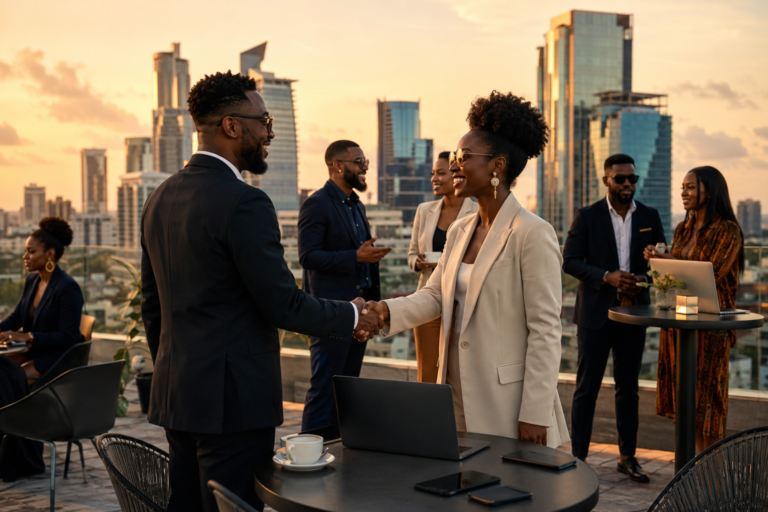
Greenwood's rise traces back to O.W. Gurley, born in Alabama to formerly enslaved parents, who arrived in Tulsa in 1905 and purchased 40 acres of land he restricted to Black buyers only. He built a rooming house on the dirt road he named Greenwood Avenue, after Greenwood, Mississippi, and used his growing wealth to make loans to Black entrepreneurs who wanted to start their own businesses. By 1921, Gurley owned more than 100 properties and had accumulated a personal fortune estimated between $500,000 and $1 million — an extraordinary sum for anyone in that era, let alone a Black man born into slavery's aftermath.
J.B. Stradford, a Kentucky-born lawyer with a degree from Indiana University, arrived a few years later and shared Gurley's conviction that Black economic power depended on Black dollars circulating within the community rather than leaking out to white-owned businesses. Stradford bought up large tracts of Greenwood real estate and built the Stradford Hotel, a 65-room luxury property that became the largest Black-owned hotel in the United States — offering the same comfort and dignity to Black travelers that downtown Tulsa's white-only hotels refused them.
Around Gurley's and Stradford's investments grew a fully self-contained Black economy: grocery stores, law offices, movie theaters, pharmacies, restaurants, a hospital, newspapers, churches, and nightclubs, all Black-owned and Black-staffed. Estimates from the era suggest a dollar could circulate within Greenwood dozens of times before leaving the community — at a time when segregation made that kind of self-sufficiency both a necessity and a radical act of defiance.
May 31–June 1, 1921: The Tulsa Race Massacre
We tell this part of the story plainly, because Greenwood's history cannot be honestly told without it.
On May 30, 1921, a young Black shoeshiner named Dick Rowland was accused of assaulting a white elevator operator, Sarah Page, in a downtown Tulsa office building — an incident historians now believe was most likely an accidental stumble, not an assault. The next day, the Tulsa Tribune ran an inflammatory front-page story about the arrest. A white mob gathered at the courthouse demanding Rowland be handed over for lynching. A group of armed Black men, many of them World War I veterans, went to the courthouse to help protect him. A scuffle broke out, a shot was fired, and within hours a white mob numbering in the thousands — some of them deputized on the spot by city officials — descended on Greenwood.
What followed, over less than 24 hours, was one of the most destructive acts of racial violence in U.S. history. Mobs looted and burned more than 35 square blocks of Greenwood. Eyewitness and later forensic accounts describe private airplanes used to drop incendiary devices on rooftops. By the time the Oklahoma National Guard restored order on June 1, some 1,256 homes had been burned, 191 businesses were destroyed, and roughly 10,000 Black residents were left homeless in a single night.
On the death toll, sources vary significantly, and BTN wants to be transparent about that range rather than pick one number. The Oklahoma Department of Vital Statistics recorded 36 official deaths at the time (26 Black, 10 white). But the 1921 event was chronically undercounted from the start — the American Red Cross, which coordinated relief efforts, refused to issue a firm number, stating at the time that "the number of dead is a matter of conjecture." The 2001 Oklahoma Commission to Study the Tulsa Race Riot of 1921 concluded the real toll was almost certainly much higher, citing credible estimates ranging from 75 to 300 deaths; NAACP investigator Walter White, writing shortly after the massacre, estimated as many as 150–200 Black Tulsans killed. Because so many victims were buried in unmarked or mass graves without documentation, historians widely agree the true number will likely never be known with precision. Since 2020, the City of Tulsa has conducted ongoing forensic excavations at Oaklawn Cemetery searching for and attempting to identify victims of suspected mass graves — an effort that continues today.
In the massacre's immediate aftermath, more than 800 people were treated for injuries and roughly 6,000 Black residents — nearly the entire displaced population — were rounded up and interned under armed guard at the Convention Hall, the Tulsa County Fairgrounds, and McNulty Park, some held for over a week and only released with white sponsors' permission. Not a single perpetrator was ever convicted. Insurance companies denied nearly every claim filed by Black property owners, citing riot exclusion clauses, while some white civic leaders quietly pushed to rezone Greenwood for industrial use rather than allow Black residents to rebuild at all.
Rebuilding: Greenwood's Long Road to Resilience
What happened next is the part of this story that too often gets left out — and it's the reason BTN frames this as a story of resilience, not only tragedy. Despite losing almost everything, and despite receiving no insurance payouts and virtually no government assistance, Black Tulsans rebuilt Greenwood themselves, largely through the following winter. By the mid-1920s, Greenwood had more than 200 Black-owned businesses operating again, and the district continued as a center of Black commercial and cultural life for decades.
J.B. Stradford, notably, was falsely indicted for inciting the riot in the massacre's aftermath and fled Tulsa for Chicago to escape prosecution rather than face what he and his family believed would be mob justice disguised as a trial; the state of Oklahoma posthumously cleared his name in 1996. O.W. Gurley lost roughly $200,000 in property, including his hotel, and relocated to Los Angeles, where he ran a small hotel until his death in 1935.
Greenwood's second, quieter devastation came decades later: in the 1960s and '70s, urban renewal policies and the construction of Interstate 244 razed large sections of the rebuilt district, displacing residents and businesses all over again in the name of "progress." It took until 1997 for the Oklahoma legislature to commission a formal investigation, whose 2001 report recommended reparations, a memorial, and scholarships — recommendations only partially acted on in the years since, and a subject of continued advocacy and litigation by massacre survivors and descendants today.
Greenwood Rising: Telling the Full Story
Greenwood Rising, the Black Wall Street History Center, opened in 2021 to mark the massacre's centennial. Located at 23 North Greenwood Avenue — on the original Black Wall Street footprint — the museum uses immersive exhibits, oral histories, and interactive displays to walk visitors through Greenwood's rise, the massacre, and its aftermath, without flinching from the hardest parts of the history while also centering the entrepreneurship and resilience that built the district in the first place.
- Hours: Tuesday–Sunday, 10 AM–7 PM (closed Mondays; last admission 6 PM)
- Admission: $15 adults, $10 seniors (65+), $8 youth (7–17), free for children 6 and under
- Tickets: Timed-entry tickets are recommended in advance via greenwoodrising.org
Plan for at least 90 minutes to two hours to move through the center properly. It is, deservedly, considered essential viewing before walking the surrounding district.
Walking Black Wall Street Today
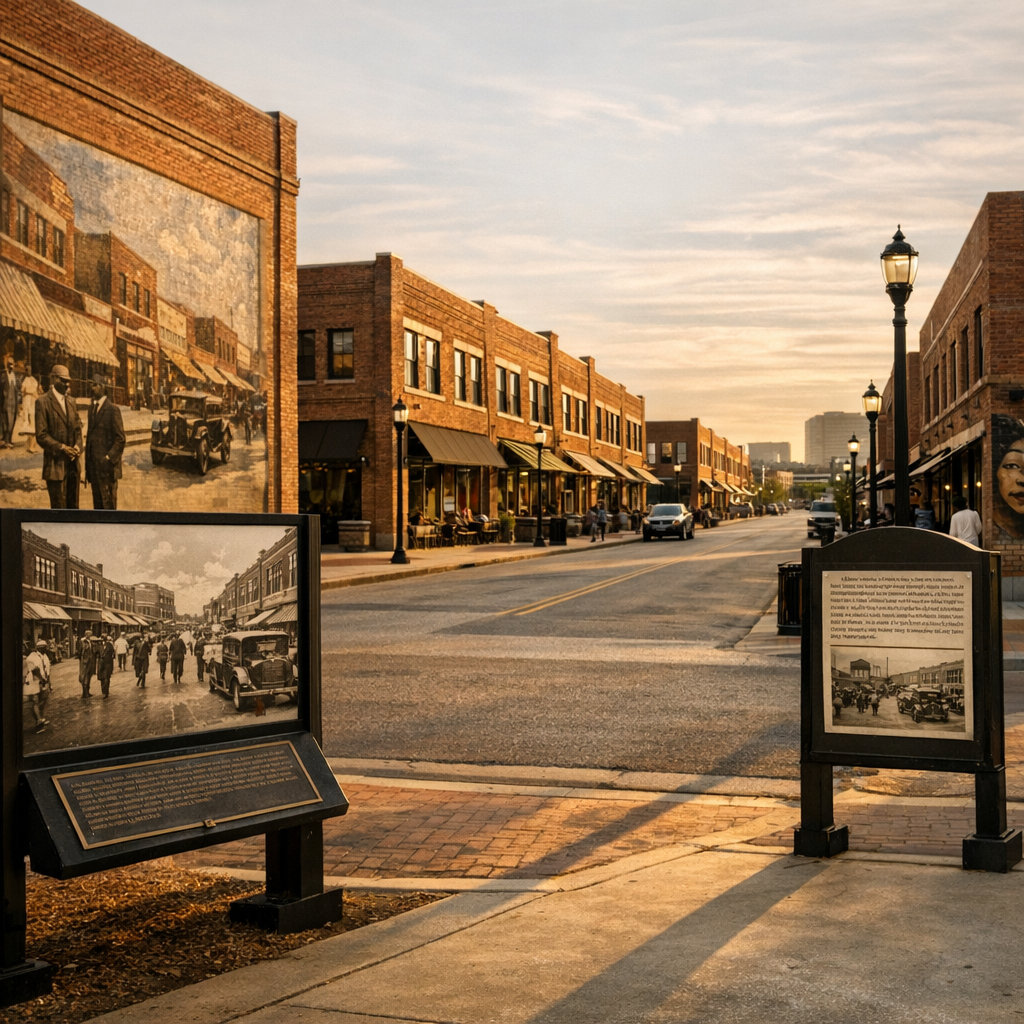
Modern Greenwood Avenue is a working, rebuilding neighborhood, not a static memorial — and that's the point. A few sites worth anchoring your visit around:
- Vernon AME Church — One of the only structures whose basement survived the 1921 fires intact; the congregation has worshipped continuously on this site since 1905 and remains an active anchor of the community today.
- Black Wall Street Memorial & historical markers — Sidewalk plaques and murals along Greenwood Avenue mark the footprints of businesses that once stood there, including the original site of Stradford's hotel.
- John Hope Franklin Reconciliation Park — A quiet memorial space named for the celebrated Tulsa-born historian whose father survived the massacre.
- Greenwood Cultural Center — A community institution preserving Greenwood's history through photography, archives, and public programming, a short walk from Greenwood Rising.
- Wanda J's Next Generation Restaurant — A beloved soul food restaurant on Greenwood Avenue carrying the tradition of Black-owned business in the district forward into the present day.
Planning Your Visit
Getting there: Tulsa International Airport (TUL) has direct flights from most major U.S. hubs, and Greenwood sits about 15 minutes north of downtown Tulsa by car or rideshare.
Getting around: A rental car is useful for exploring greater Tulsa, but Greenwood and downtown are walkable on foot, and rideshare covers the rest easily.
Best time to visit: March through May and September through November offer the mildest weather; Oklahoma summers run hot and humid, and winters can bring ice storms.
Budget Guide
Budget: $90-130/day — budget hotel, casual dining, self-guided walking tour of Greenwood's markers.
Mid-range: $150-250/day — downtown hotel, Greenwood Rising admission, sit-down meals, guided tour.
Comfort: $300+/day — upscale downtown hotel, private guided history tour, fine dining.
🏨 Book Tulsa Hotels →Mark Your Calendar
- May 31–June 1 — Annual commemoration events marking the anniversary of the Tulsa Race Massacre, held throughout Greenwood
- Juneteenth (June 19) — Tulsa hosts citywide Juneteenth celebrations, with Greenwood as a central gathering point
- Various dates — Black Wall Street Legacy Festival and community programming through the Greenwood Cultural Center
BTN Insider Tips
Start at Greenwood Rising before you walk the district. The context makes every marker and mural you pass afterward land differently.
Book timed tickets in advance, especially around the May 31–June 1 commemoration and Juneteenth, when visitor volume is highest.
Give yourself unhurried time. This is not a quick photo-op stop — budget a half-day minimum to do the history justice.
Support Black-owned Greenwood businesses directly while you're there — it is the most concrete way to participate in the neighborhood's ongoing rebuilding.
Read before you go. The 2001 Oklahoma Commission report and Hannibal Johnson's "Black Wall Street 100" are excellent primers that will deepen what you see on the ground.
Why This Visit Matters
Greenwood is not a story that ends in 1921. It's the story of Black Tulsans who rebuilt a burned neighborhood with their own hands and no help, who kept building through a second wave of destruction by "urban renewal" decades later, and who are still, in this generation, fighting for a fuller public reckoning and repair. Walking Greenwood Avenue today — past the rebuilt storefronts, the murals, the markers naming what stood there before — is a way of witnessing both what was lost and what has never stopped being rebuilt.
✈️ Book Your Tulsa Trip Now →*Affiliate links — BTN may earn a commission at no extra cost to you.