Tokyo Will Not Give You the Story You Expect
Every year, Tokyo lands near the top of global safety rankings — the Economist Intelligence Unit's Safe Cities Index has repeatedly put it in the top five worldwide, and violent crime against tourists is, statistically, close to nonexistent. For Black travelers weighing where to go next, that reputation matters. Walking home at 2AM in Shinjuku, taking the last train alone, leaving a bag on a café chair to hold your seat — these are ordinary Tokyo behaviors that would raise eyebrows almost anywhere else.
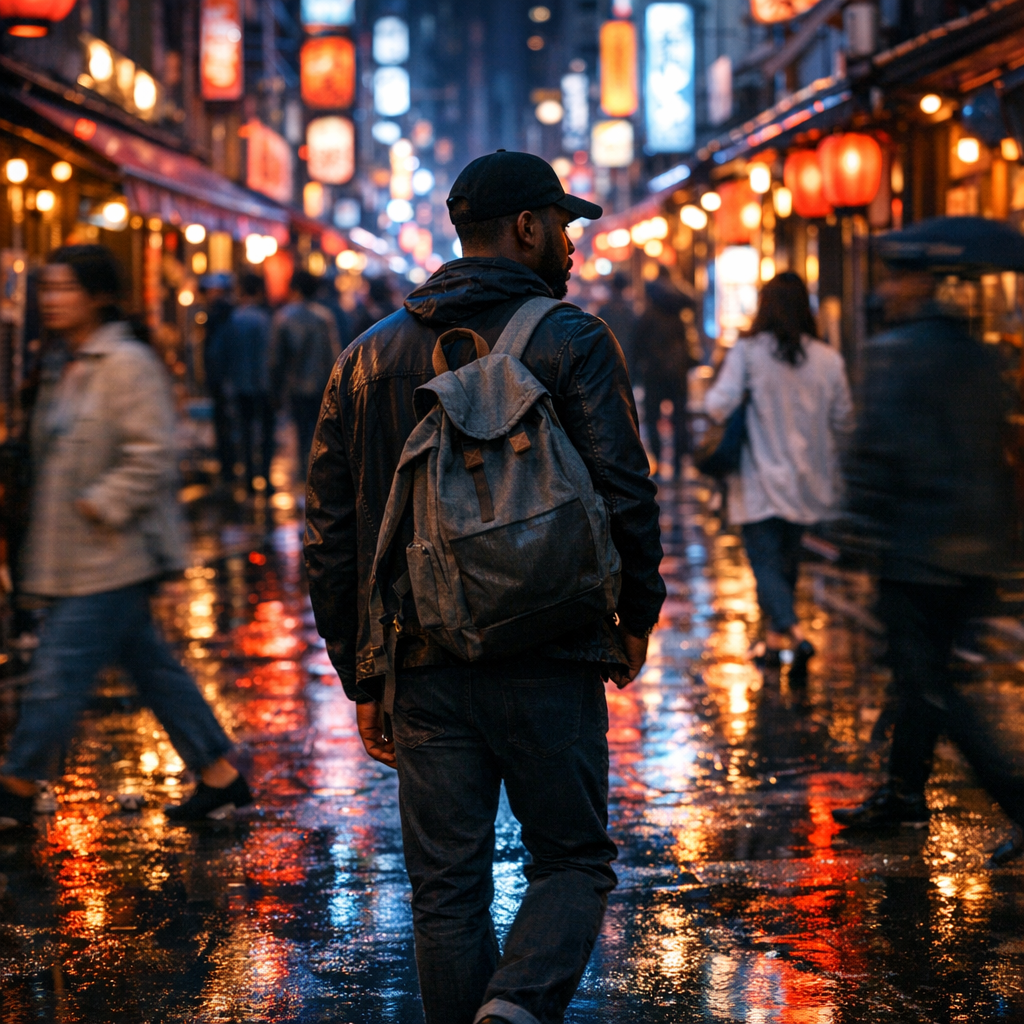
But safety from crime and comfort with being seen are two different things, and the honest version of this guide has to hold both. Tokyo is not a city where Black travelers report being harassed, threatened, or targeted for violence. It is also not a city where you disappear into the crowd. Foreign residents make up roughly three percent of Japan's population, and Black residents and visitors are a small fraction of that. You will be looked at. The question worth answering before you book the flight is what that looking actually feels like — and what it doesn't.
The Real Talk: What Black Travelers Actually Report
We built this guide around first-person accounts rather than sanitized brochure copy, because Tokyo deserves better than a highlight reel. The clearest recent account comes from Travel Noire's "What It's Like Being Black In Japan" by Faith Katunga, which draws on interviews, documentaries, and academic research to paint a picture that is neither utopia nor horror story. The throughline: "there is no single 'Black in Japan' story."
What does show up consistently across these first-person accounts:
- Visibility and staring. Being the only Black person on a train car, at a shrine, or in a small-town izakaya is common, and it can mean stares, kids pointing, or people quietly moving a seat away. Multiple residents describe feeling like "a spectacle" in daily life, especially outside central Tokyo.
- Curiosity more than hostility. The staring is rarely aggressive. It's frequently rooted in genuine unfamiliarity rather than animosity — questions about hair, skin, or where you're "really" from are common, and can range from charming to exhausting depending on the day.
- Fetishization, particularly for Black women. Travel Noire's reporting is direct on this point: some Black women in Japan describe unwanted sexualization and assumptions rooted in stereotype, not just innocent curiosity. This is a real pattern worth knowing about before you go, not an isolated complaint.
- Occasional exclusion from small, private venues. Some bars, clubs, and traditional establishments — a minority, but a real and documented one — have turned away non-Japanese patrons, including Black travelers, citing "Japanese only" policies or vague discomfort. It is not the norm in a city with Tokyo's international profile, but it happens, and pretending otherwise does travelers a disservice.
- Colorism within the experience itself. Lighter-skinned Black residents sometimes describe relatively smoother treatment than darker-skinned residents, and Black Japanese children face their own distinct pressures around hair and appearance that differ from what visiting Black travelers encounter.
- Real community and real friendships. None of the above cancels out the genuine warmth many Black travelers and expats describe from Japanese friends, coworkers, and neighbors, or the fact that day-to-day physical safety remains a consistent, repeated theme in these same accounts.
Other outlets covering the Black travel and expat beat — Matador Network among them — have run similar first-person essays hitting the same notes: low crime, high curiosity, an uneven workplace hierarchy, and a city that rewards travelers who show up informed rather than starry-eyed. Tokyo is neither a diaspora paradise nor a cautionary tale — just a major world city with its own racial dynamics.
Tokyo's Black Expat Community
Tokyo's Black expat community is real, but small and concentrated rather than sprawling. The largest visible pipeline is teaching — the JET Programme and private eikaiwa (English conversation school) chains bring Black American, British, and Caribbean teachers into Japan every year. A second thread runs through military-adjacent postings: US installations at Yokosuka and Yokota, within striking distance of central Tokyo, keep a rotating population of Black service members and their families moving through the greater metro area. A third, increasingly visible group works in creative and entertainment fields — models, musicians, YouTubers, and content creators documenting Black life in Japan, which is part of why so much first-person material exists online today.
This community organizes itself deliberately: Juneteenth celebrations, Black expat networking mixers, African and Caribbean restaurant pop-ups, and social media groups that exist specifically to help new arrivals find each other. If you're visiting rather than relocating, searching Instagram and Facebook for "Black in Tokyo" or "Black expats Japan" ahead of your trip will usually turn up an event or meetup worth showing up to — and a much faster education on current, on-the-ground realities than any single article, including this one.
Getting There & Entry Logistics
Here's the good news on paperwork: US citizens can enter Japan visa-free for tourism for stays of up to 90 days. There's no visa application, no embassy appointment, no fee — just a valid passport with enough validity remaining for your trip.
What you do need to handle before you land is Visit Japan Web, Japan's official pre-arrival digital portal for immigration and customs. Filling it out online in advance — typically a day or two before departure — lets you generate a QR code that speeds you through dedicated fast-track lanes at Narita or Haneda instead of filling out paper disembarkation and customs forms on arrival. It takes about fifteen minutes, it's free, and skipping it just means doing the same paperwork by hand at the airport after a long-haul flight. Do it before you fly.
Narita (NRT) and Haneda (HND) both serve Tokyo with direct flights from New York, Los Angeles, Chicago, and other major US hubs, running roughly 11–14 hours depending on origin city. Haneda sits closer to central Tokyo and is generally the more convenient arrival point if your itinerary gives you a choice.
Getting Around Once You're There
Tokyo's train and subway network is extensive, punctual to the minute, and safe to ride alone at any hour — a real plus for solo Black travelers weighing nighttime logistics. Grab a Suica or Pasmo IC card at the airport; it covers every train, bus, and most convenience store purchases citywide. Central signage is bilingual, and Google Maps transit directions are reliably accurate.
Top Neighborhoods
- Shinjuku — neon, nightlife, the Golden Gai bar alleys, and the energy that shows up in every Tokyo photograph you've ever seen.
- Shibuya — the scramble crossing, youth fashion culture, and a dense concentration of shopping and street style.
- Roppongi — Tokyo's most international nightlife district, with a visibly higher concentration of foreign residents and expat-friendly bars.
- Azabu-Juban — quieter, upscale, popular with long-term expat families and embassy staff.
- Nakameguro — canal-side cafés, boutiques, and a laid-back, artsy pace away from the tourist crush.
Where to Eat — Must Try
Ramen — entire sub-cultures by neighborhood; a bowl at a standing-room shop for under $10 is one of the city's great equalizers.
Sushi & sashimi — from Tsukiji Outer Market stalls to conveyor-belt chains to reservation-only omakase counters, quality stays consistent across price points.
Yakitori — grilled skewers under train tracks in izakaya alleys like Omoide Yokocho, best paired with a cold beer and zero plans for the night.
Wagyu — splurge-worthy, and by international standards still a relative bargain versus the same cut back home.
Konbini food — don't sleep on 7-Eleven, Lawson, and FamilyMart. Japan's convenience store food is genuinely excellent.
Where to Stay
Luxury: The Ritz-Carlton Tokyo and Park Hyatt Tokyo (the "Lost in Translation" hotel) both deliver five-star service with iconic skyline views.
Mid-Range: Hotel Gracery Shinjuku puts you in the middle of the action; Cerulean Tower Tokyu Hotel in Shibuya offers excellent value with strong transit access.
Budget: Capsule hotels and business hotel chains like APA and Toyoko Inn offer clean, secure, well-located rooms from roughly $50–80 a night — a real option in a city where budget travel usually still means safety.
🏨 Book Tokyo Hotels →Best Time to Visit
Autumn (late September through November) is Tokyo's best-kept secret — mild temperatures, dramatic fall foliage in parks like Shinjuku Gyoen, and thinner crowds than the famous cherry blossom season. Spring (March–May) brings the sakura bloom but also the peak-tourist prices and crowds that come with it. Summer is hot, humid, and best avoided if you have flexibility; winter is cold but dry and clear, with excellent city-light views.
✈️ Find Tokyo Flights →Budget Guide
Budget: $80–130/day — capsule or business hotel, ramen and konbini meals, subway transit, free temple and park visits.
Mid-range: $150–280/day — 3-4 star hotel, mix of casual and sit-down dining, day trips, museum and attraction entry.
Luxury: $350–600+/day — five-star property, omakase dining, private guides, premium experiences.
BTN Insider Tips
Get an IC card and an eSIM on day one. Both make the trip smoother and help you research venues in real time.
Carry cash. Japan is more card-friendly than it used to be, but many smaller restaurants and shops are still cash-only.
Complete Visit Japan Web before you fly. It's the easiest way to shorten your arrival after a long flight.
Expect to be looked at, and decide in advance how you'll carry that. Most accounts describe the staring as curiosity rather than hostility — but knowing it's coming beats being caught off guard.
Connect with the Black expat community before you land. A quick search for Black-in-Tokyo social groups turns up current, on-the-ground guidance no single article can replace.
Learn a few basic phrases. "Sumimasen" (excuse me) and "arigatou gozaimasu" (thank you) go a long way.
Is Tokyo Safe for Black Travelers?
By the numbers, yes — Tokyo is among the safest big cities on the planet, with low violent crime, minimal petty theft, and a level of late-night comfort most American cities can't match. That much is not in dispute, and it's the reason Tokyo consistently shows up on "safest cities for solo travelers" lists.
What the safety statistics don't capture is the everyday texture of being visibly Black in a country where you'll rarely see another Black face outside a handful of neighborhoods. Staring, curiosity, well-meaning-but-invasive questions, and occasional exclusion from small private venues are real, documented, and worth planning for emotionally — not as reasons to avoid Tokyo, but as part of an honest picture. The travelers and expats whose accounts informed this guide overwhelmingly still recommend Tokyo. They just recommend going in with clear eyes rather than a fantasy.
Book Your Tokyo Trip
Tokyo rewards travelers who come prepared — for the food, the trains, the neon, and yes, for the stares. Go anyway. Go informed.
✈️ Book Your Tokyo Trip Now →*Affiliate links — BTN may earn a commission at no extra cost to you.