Two Volcanoes, Two Nobel Prizes: Welcome to St. Lucia
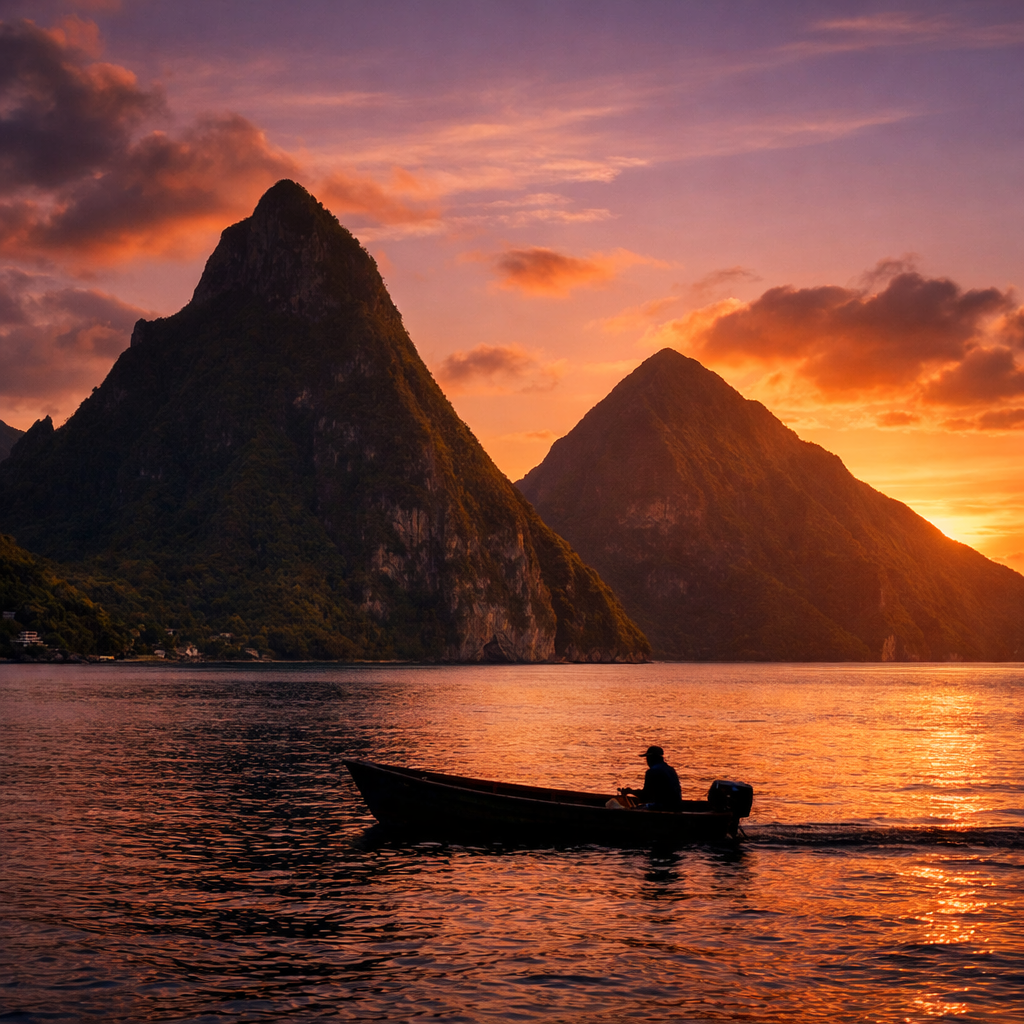
There's a moment, usually somewhere on the winding coastal road south from Castries, when the Pitons come into view for the first time. Two volcanic spires — Gros Piton and Petit Piton — rise straight out of the Caribbean Sea like something a movie set designer invented and then decided was too dramatic to be believed. They are real. They have stood there for hundreds of thousands of years, and they anchor one of the most physically stunning islands in the Western Hemisphere.
But St. Lucia's story isn't only written in volcanic rock. This is a nation of roughly 180,000 people that has produced two Nobel laureates — a statistical improbability so extreme it's hard to find a comparable example anywhere on earth. An economist who reshaped how the world thinks about development, and a poet who reshaped how the world thinks about Caribbean identity. Add in a lush rainforest interior, a legendary Friday-night street party, and some of the best Creole cooking in the Caribbean, and you have an island that rewards travelers who go deeper than the resort pool.
Why Black Travelers Choose St. Lucia
St. Lucia sits in that sweet spot many Caribbean-bound Black travelers look for: a Black-majority nation with real cultural depth, a manageable size that makes island-hopping unnecessary, and a tourism infrastructure mature enough to make planning easy without feeling manufactured. Roughly 85% of St. Lucians are of African descent, the legacy of the sugar plantation economy the British and French fought over for more than a century (the island changed hands between the two empires fourteen times before becoming permanently British in 1814).
That history is present everywhere — in the Creole patois still spoken alongside English, in the drumming and dance traditions passed down through generations, and in a national self-confidence that produced not one but two people the world recognized as among the greatest thinkers of their time. St. Lucia isn't trying to be a diaspora homecoming destination the way Ghana or Senegal are. It's something else: living proof of what a small Black nation can build and produce when given the room to do it.
The Pitons: A UNESCO World Heritage Icon
The Pitons Management Area was inscribed as a UNESCO World Heritage Site in 2004, recognized under criteria for both exceptional natural beauty and geological significance. Gros Piton rises 2,619 feet (770 meters) and Petit Piton 2,438 feet (743 meters), connected by an inland ridge called Piton Mitan, just outside the fishing town of Soufrière on the island's southwest coast. The protected area spans nearly 2,900 hectares of combined land and sea, and the marine zone around the Pitons holds coral reefs covering roughly 60% of the seafloor, home to some 168 recorded fish species along with sea turtles and a striking variety of coral.
The peaks are the visible tip of a still-active volcanic system. A short drive from Soufrière brings you to the Sulphur Springs, often marketed as "the world's only drive-in volcano" — a collapsed volcanic crater where you can walk right up to bubbling, steaming, sulfur-scented mud pools. Nearby, the Diamond Falls Botanical Gardens feed a waterfall whose mineral-rich waters run through shifting shades of yellow, orange, and grey, and channel into mineral baths built during the era of French colonial rule.
Climbing Gros Piton is achievable for reasonably fit travelers (it's a certified guide-required hike, roughly 3-4 hours round trip, with a steep final push) and rewards you with sweeping views across the southern coastline. Petit Piton's ascent is far more technical and generally reserved for experienced climbers. Most visitors instead admire both peaks from the water — a boat trip along the Soufrière coast, timed for sunset, is the classic way to take in the full scale of the twin spires without the climb.
A Nation of Nobel Laureates
Here is the fact that stops people cold: a country smaller than a mid-size American city has produced two Nobel Prize winners.
Sir Arthur Lewis, born in Castries in 1915, became the first Black person to win a Nobel Prize in a scientific category when he was awarded the 1979 Nobel Memorial Prize in Economic Sciences (shared with Theodore Schultz). Lewis's work theorized how labor-surplus developing economies could industrialize by absorbing rural workers into urban manufacturing — a framework that shaped development economics for decades and directly influenced policy across the postcolonial world. He taught at the London School of Economics, Manchester, and Princeton, and remains the only person of Caribbean birth to win a Nobel Prize in economics.
Derek Walcott, also born in Castries, in 1930, won the 1992 Nobel Prize in Literature "for a poetic oeuvre of great luminosity, sustained by a historical vision, the outcome of a multicultural commitment." Walcott's epic poem Omeros, which reimagines Homer's Iliad through Caribbean fishermen and history, is considered one of the great literary achievements of the 20th century. He co-founded the Trinidad Theatre Workshop, taught for years at Boston University, and remained deeply tied to St. Lucia throughout his life — he died in Gros Islet in 2017 and is buried on the island.
Literary and history-minded travelers can visit Walcott's grave and the Derek Walcott Square in Castries (renamed in his honor, home to two massive centuries-old saman trees), and seek out the small but growing network of cultural sites and events that mark both men's legacies. It's a rare thing to be able to stand in the actual streets that shaped a Nobel economist and a Nobel poet within the same few blocks.
Gros Islet's Friday Night Street Party
If the Pitons are St. Lucia's daytime showpiece, the Gros Islet Friday night street party is its nighttime soul. Every Friday, this small fishing village in the island's north — not far from Rodney Bay — shuts down its main streets and turns them into an open-air party. Vendors grill fish, chicken, and pork over roadside coal pits, rum punch and local Piton beer flow, and soca, dancehall, and reggae blast from stacked speaker systems while locals and visitors dance in the street.
It's an unpretentious, come-as-you-are affair that's been running in some form for decades, born out of local fishermen's Friday celebrations and grown into one of the most reliable weekly parties in the Caribbean. It gets going after dark and runs well past midnight. Bring small bills, wear shoes you don't mind getting a little grimy, and go with an appetite — the grilled fish stalls are the real draw as much as the music.
Top Tourist Attractions
Sulphur Springs Park, Soufrière — Walk the boardwalk over an active volcanic crater, then follow it with a dip in the adjacent mud and mineral baths.
Anse Chastanet & Anse Mamin Beaches — Twin volcanic-sand beaches beneath the Pitons with some of the island's best snorkeling reefs just offshore.
Marigot Bay — Frequently called one of the most beautiful bays in the Caribbean, a narrow, palm-lined inlet that has doubled as a film location for decades.
Toraille and Diamond Falls — Accessible waterfalls near Soufrière, the latter set in botanical gardens with mineral baths fed by the same volcanic system as the Sulphur Springs.
Tet Paul Nature Trail — A shorter, less strenuous alternative to climbing Gros Piton, with viewpoints that frame both Pitons without the technical hike.
Where to Eat — Must Try
Green fig and saltfish — St. Lucia's national dish: green (unripe) bananas boiled and served with salted codfish, onions, and peppers. Find it at almost any local restaurant.
Bouyon — A hearty one-pot stew of meat, dumplings, and root vegetables, deeply satisfying and found at family-run Creole spots across the island.
Callaloo soup — A rich, dark-green soup made from the callaloo leaf, coconut milk, and crab or salted meat.
Anse La Raye Seafood Friday — A smaller, more local counterpart to Gros Islet's Friday party, held in the fishing village of Anse La Raye and centered entirely on fresh-caught seafood grilled streetside.
Rum — St. Lucia Distillers, the island's producer, makes several well-regarded rums; a distillery tour near Roseau pairs well with a Pitons day trip.
Where to Stay
Luxury: Jade Mountain and Anse Chastanet, both perched directly above the Pitons in Soufrière, are among the most photographed resort properties in the Caribbean — open-air "sanctuaries" with private infinity pools framing the twin peaks.
Mid-Range Boutique: Ti Kaye Resort & Spa, also near Soufrière, offers cliffside cottages with more accessible pricing and the same dramatic coastal setting.
Budget: Rodney Bay and Gros Islet have the widest range of guesthouses and small hotels, putting you steps from the Friday street party and a short drive from the marina's restaurants.
🏨 Book St. Lucia Hotels via Expedia →Getting There
Most international flights land at Hewanorra International Airport (UVF) in the south near Vieux Fort — the more convenient entry point if you're heading straight to Soufrière and the Pitons (about a 45-60 minute drive). George F.L. Charles Airport (SLU) near Castries handles regional flights and small charters and sits closer to Rodney Bay and Gros Islet. Direct flights run from New York (JFK), Miami, Charlotte, and Atlanta, with additional connections available through San Juan or Antigua.
✈️ Find St. Lucia Flights →Best Time to Visit
December through April is the dry season and the most popular window, with temperatures in the 75-85°F range and minimal rainfall. The June-through-November period is wetter and carries hurricane season risk, but also brings lower prices and lusher, greener landscapes around the Pitons. If you want the Friday street party without the peak-season crowds, the shoulder months of May and November are a strong compromise.
Budget Guide
Budget: $120-180/day — guesthouse in Rodney Bay or Gros Islet, local Creole meals ($8-15), shared or public transport, free beaches and hikes.
Mid-range: $200-350/day — boutique hotel near Soufrière, a mix of local and resort dining, guided Pitons-area excursions.
Luxury: $500-1,000+/day — Jade Mountain or Anse Chastanet-level resort, private tours, fine dining, spa treatments.
BTN Insider Tips
Base yourself in Soufrière if the Pitons are your priority. The drive from Rodney Bay is scenic but long and winding; staying near Soufrière puts the UNESCO site, Sulphur Springs, and Diamond Falls all within a short ride.
Hire a local guide for Gros Piton. It's required by law and genuinely improves the experience — guides know the terrain, the pace, and the history.
Go to Gros Islet on a Friday and Anse La Raye on the corresponding weeknight seafood event if your schedule allows both. They offer different flavors of the same tradition.
Carry small-denomination Eastern Caribbean dollars for street food vendors, even though US dollars are widely accepted.
Visit Derek Walcott Square in Castries for a quiet, low-key way to connect with the island's literary legacy before or after a Pitons day trip.
Is St. Lucia Safe for Black Travelers?
St. Lucia is generally considered one of the safer islands in the Eastern Caribbean for tourists, with a tourism economy that depends heavily on visitor safety and satisfaction. As with anywhere, petty theft can occur in tourist areas and at busy events like the Gros Islet street party — keep valuables minimal and secure. Rural areas around Soufrière and the Pitons are typically very low-crime. Solo travelers and women traveling alone generally report positive experiences, particularly in Rodney Bay and Soufrière's resort areas; standard nighttime precautions apply in Castries after dark, as in any Caribbean capital.
Entry Requirements for US Citizens
US citizens do not need a visa for short tourist stays in St. Lucia. You'll need a passport valid for the duration of your stay, an onward or return ticket, proof of accommodation, and evidence you can support yourself financially during the visit. Always check current requirements with the St. Lucia Tourism Authority or the US State Department before booking, since entry rules can change.
Mark Your Calendar
- Every Friday — Gros Islet Street Party (Friday Night Jump Up)
- Weekly — Anse La Raye Seafood Friday
- May — Saint Lucia Jazz & Arts Festival
- February 22 — Independence Day
Book Your St. Lucia Trip
Between the volcanic drama of the Pitons and the improbable literary and intellectual legacy of Sir Arthur Lewis and Derek Walcott, St. Lucia offers a rare combination: postcard beauty backed by real substance. Plan your trip, book smart, and go see the peaks for yourself.
✈️ Book Your St. Lucia Trip Now →*Affiliate links — BTN may earn a commission at no extra cost to you.