The Island Where Freedom Was Practiced Before It Was Law
In November 1862, a full year before the Emancipation Proclamation took effect, two women stepped off a boat onto St. Helena Island, South Carolina, and began teaching formerly enslaved people to read. Laura Towne, an abolitionist from Philadelphia, and Ellen Murray, a Quaker educator who joined her that same year, had come to the Sea Islands as part of the Port Royal Experiment — the Union's early, imperfect test of what freedom might look like for people just declared free behind Confederate lines. What they built, Penn School, became one of the very first schools founded anywhere in the American South specifically to educate the formerly enslaved.
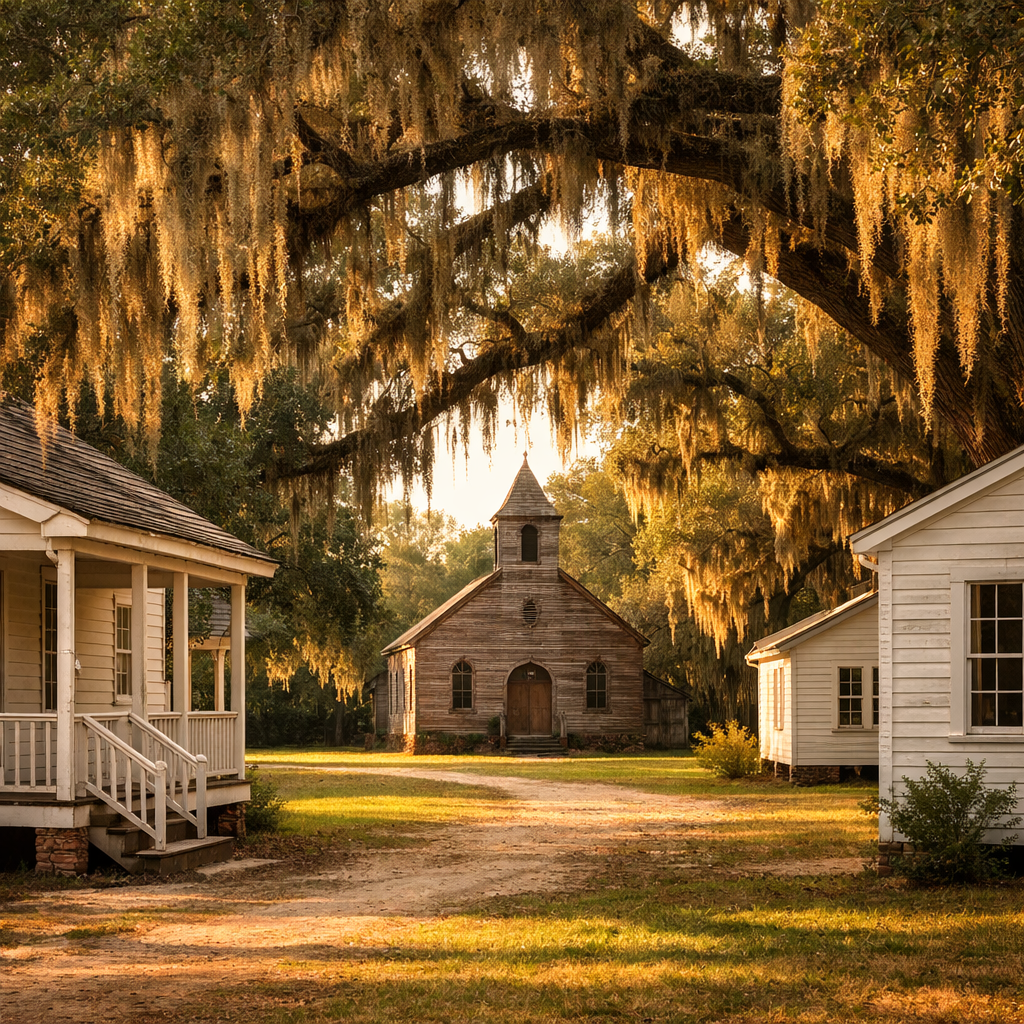
More than 160 years later, that campus still stands under a canopy of live oaks dripping with Spanish moss, still known as Penn Center, still holding the living memory of Gullah Geechee culture in place while the rest of the Lowcountry gets paved over by golf courses and resorts. It is also, quietly, one of the most important Civil Rights sites most Black travelers have never heard of — the place Dr. Martin Luther King Jr. and the Southern Christian Leadership Conference came when they needed somewhere in the segregated South where an integrated group of organizers could safely sit down together.
St. Helena Island isn't Charleston's carriage-tour version of history. It's the real, unpolished, still-inhabited story — and it anchors a Sea Islands itinerary most travelers never think to plan.
Penn School: Educating the Formerly Enslaved, One Year Before Freedom Was Law
Penn School opened its doors on St. Helena Island in 1862, founded by Laura Towne and Ellen Murray with support from Philadelphia and Boston abolitionist societies. At a moment when the legal status of formerly enslaved people in the Sea Islands was still unsettled, Towne and Murray built a curriculum around a radical premise: education was the foundation on which freedom would actually be built, not just declared.
The school grew steadily over the following decades. Darrah Hall, the oldest surviving building on campus, was rebuilt in 1903 and still stands today, alongside Frissell Community House (1925), Hampton House (1904), Benezet House (1905–1906), and the Cope Industrial Shop (1912). Penn School operated continuously as an educational institution for Black students for roughly 80 years, later evolving into Penn Center — a community organization that has spent the century since focused on land preservation, community development, and cultural continuity for the Gullah Geechee people of the Sea Islands.
In recognition of that history, the Penn School Historic District was added to the National Register of Historic Places in September 1974 and designated a National Historic Landmark on December 2, 1974 — one of the highest levels of federal historic recognition.
Where Dr. King Came to Plan: Penn Center and the SCLC
This is the part of the story that surprises even people who know their Civil Rights history well. During the 1960s, Dr. King and staff from the Southern Christian Leadership Conference traveled to Penn Center repeatedly — historical accounts document at least five visits between 1964 and 1967 — because it was one of the only places left in the Deep South where a racially integrated group of organizers could meet, eat, sleep, and strategize together without the threat of violence or arrest that would have followed them almost anywhere else in the Jim Crow South.
King stayed in Gantt Cottage, a modest structure rebuilt by Penn students in 1940, which became his retreat and working space during these visits. The Frissell Community House served as the meeting hall where King and SCLC staff held strategy sessions, including planning connected to the 1963 March on Washington; Penn Center's own historical materials note King worked on ideas that would shape his "I Have a Dream" speech during time spent on the island. It's worth sitting with what it meant that this rural, all-Black community founded by two schoolteachers in 1862 was, a century later, one of the few square miles of the American South where the movement's leadership could safely close the door and simply work.
The York W. Bailey Museum
The best starting point for any visit is the York W. Bailey Museum, housed inside the 1912 Cope Industrial Shop — originally built to train Penn students in trades including blacksmithing, wheelwrighting, harness-making, basketry, carpentry, and cobbling. The building was repurposed into a museum named for York W. Bailey, a Penn School student who went on to become a physician serving St. Helena Island for decades.
Inside, exhibits trace Penn School's roughly 80 years as an educational institution for African Americans, with photographs of students at work dating back to the 1860s, artifacts from the campus's trade programs, and a video weaving together the school's founding, its Civil Rights-era history, and Gullah Geechee life on the Sea Islands. Give yourself at least an hour here before walking the rest of the campus — the museum provides the context that makes Gantt Cottage and Darrah Hall land differently.
Gullah Geechee Culture — and Why Penn Center Isn't the Whole Story
It's worth being precise here, because it's an easy thing to conflate: Penn Center is not the same thing as the Gullah Geechee Cultural Heritage Corridor. The Corridor is a National Park Service-affiliated heritage area stretching roughly 12,000 square miles of coastline from Wilmington, North Carolina down through South Carolina and Georgia to Jacksonville, Florida — the historic range of Gullah Geechee communities descended from enslaved West and Central Africans who worked the region's rice, indigo, and Sea Island cotton plantations, whose relative isolation on barrier islands let African language patterns, foodways, and craft traditions survive with unusual continuity.
Penn Center is one specific site within that much larger Corridor — but arguably the most historically significant single site in it. Having spent over 160 years organizing around land retention and cultural preservation for St. Helena Island specifically, it functions today as the cultural and institutional heart of Gullah Geechee identity, even though the culture itself lives across four states. Don't let a trip to St. Helena Island convince you you've "done" Gullah Geechee culture — treat it as the best introduction to a culture worth exploring from Wilmington to Jacksonville.
While on St. Helena Island, listen for Gullah (also called Sea Island Creole), the English-based creole language that developed here and remains spoken by island elders today. Look for sweetgrass basket weaving, a craft descended from West African traditions brought by enslaved people working rice plantations, still practiced and sold by Gullah artisans throughout the Lowcountry.
Penn Center Heritage Days
The single best time to experience Penn Center at full life is Heritage Days, the community's annual multi-day celebration of Gullah Geechee music, food, storytelling, and history, held every November. The 2026 celebration — the 42nd annual — is scheduled for November 12–14, 2026 on the historic Penn Center campus. Expect live gospel and spiritual singing, traditional foodways demonstrations, historical talks, a parade, and vendors selling sweetgrass baskets, art, and Gullah cuisine. Because exact dates shift within November from year to year, confirm the current schedule directly on Penn Center's events page before booking travel.
Planning Your Sea Islands Trip
St. Helena Island sits between Beaufort and Hunting Island State Park, roughly 20 minutes from historic downtown Beaufort and about an hour from Hilton Head Island and Savannah, Georgia. Most travelers base themselves in Beaufort, a walkable antebellum-era waterfront town with excellent seafood, and treat Penn Center as a half-day trip from there. Pair it with Hunting Island's beach and historic lighthouse for a full long weekend most Charleston or Hilton Head visitors never think to add.
🏨 Book Beaufort & Sea Islands Hotels →Getting There
The closest commercial airports are Savannah/Hilton Head International (SAV), about an hour away, and Hilton Head Island Airport (HHH), roughly 45 minutes away, both with connections through Atlanta and Charlotte. Charleston International (CHS) is about 90 minutes north with more nonstop options. From any of these, a rental car is the practical way in — there is no public transit to the island, and Penn Center's grounds are best explored on foot once you arrive.
✈️ Find Flights to the Lowcountry →Where to Stay
Boutique & Historic: Downtown Beaufort's antebellum inns, many in restored 19th-century homes along the Beaufort River, offer the most atmospheric base, typically 15–20 minutes from Penn Center.
Mid-Range: Chain hotels near Beaufort's Highway 21 corridor offer reliable options within a short drive of St. Helena Island and Hunting Island State Park.
Beach Access: Combine history with beach time at accommodations near Hunting Island State Park, or expand to Hilton Head Island properties about 45 minutes south.
Must-Try Foods
Frogmore Stew (Lowcountry Boil) — Named for the historic community on St. Helena Island itself, this one-pot boil of shrimp, sausage, corn, and potatoes is a Sea Islands original.
Red Rice — A tomato-and-rice dish with deep West African roots, a Gullah Geechee staple found throughout the Beaufort area.
Shrimp and Grits — The Lowcountry classic, best made with local shrimp pulled from the surrounding tidal creeks.
Benne Wafers — Thin, sweet cookies made from benne (sesame) seeds, brought by enslaved West Africans and still baked as a regional specialty.
Best Time to Visit
Spring (March–May) and fall (September–November) offer the Lowcountry's best combination of comfortable temperatures and lower humidity, and fall has the added benefit of lining up with Heritage Days. Summer brings heat, humidity, and afternoon thunderstorms but also the fullest island energy. Winter is mild and quiet, with fewer crowds at Penn Center and Hunting Island alike.
Budget Guide
Budget: $100–150/day — mid-range Beaufort motel or inn, casual seafood dining, free access to Penn Center's grounds and campus (museum admission is modest).
Mid-range: $200–300/day — historic Beaufort inn, sit-down Lowcountry dining, day trips to Hunting Island and Hilton Head.
Luxury: $350+/day — upscale Hilton Head or Beaufort waterfront property, private guided history tours, fine dining.
BTN Insider Tips
Go with a guide, or at least go slow. The York W. Bailey Museum should be your first stop, not an afterthought.
Respect that this is a living community, not a theme park. St. Helena Island is home to Gullah Geechee families today. Visit with the same respect you'd bring to Cape Coast Castle or the National Museum of African American History and Culture.
Book Heritage Days accommodations early. Beaufort-area lodging fills up fast during the November celebration.
A car is non-negotiable. There is no rideshare density or public transit on St. Helena Island.
Mark Your Calendar
- November 12–14, 2026 — Penn Center's 42nd Annual Heritage Days Celebration (dates shift yearly within November — confirm at penncenter.com before booking)
- Year-round — York W. Bailey Museum open for self-guided and guided tours of the historic campus
- Spring & Fall — Best weather windows for combining Penn Center with Hunting Island State Park and downtown Beaufort
Book Your Sea Islands Trip
Penn Center isn't a detour on the way to Charleston or Hilton Head — it's a reason to plan the trip in the first place. Two schoolteachers, a community that never let go of its land or its language, and a Civil Rights leader who found rare safety under these live oaks: that's a Lowcountry story worth spending a weekend inside.
✈️ Book Your Sea Islands Trip Now →*Affiliate links — BTN may earn a commission at no extra cost to you.