The Island That Doesn't Let You Look Away
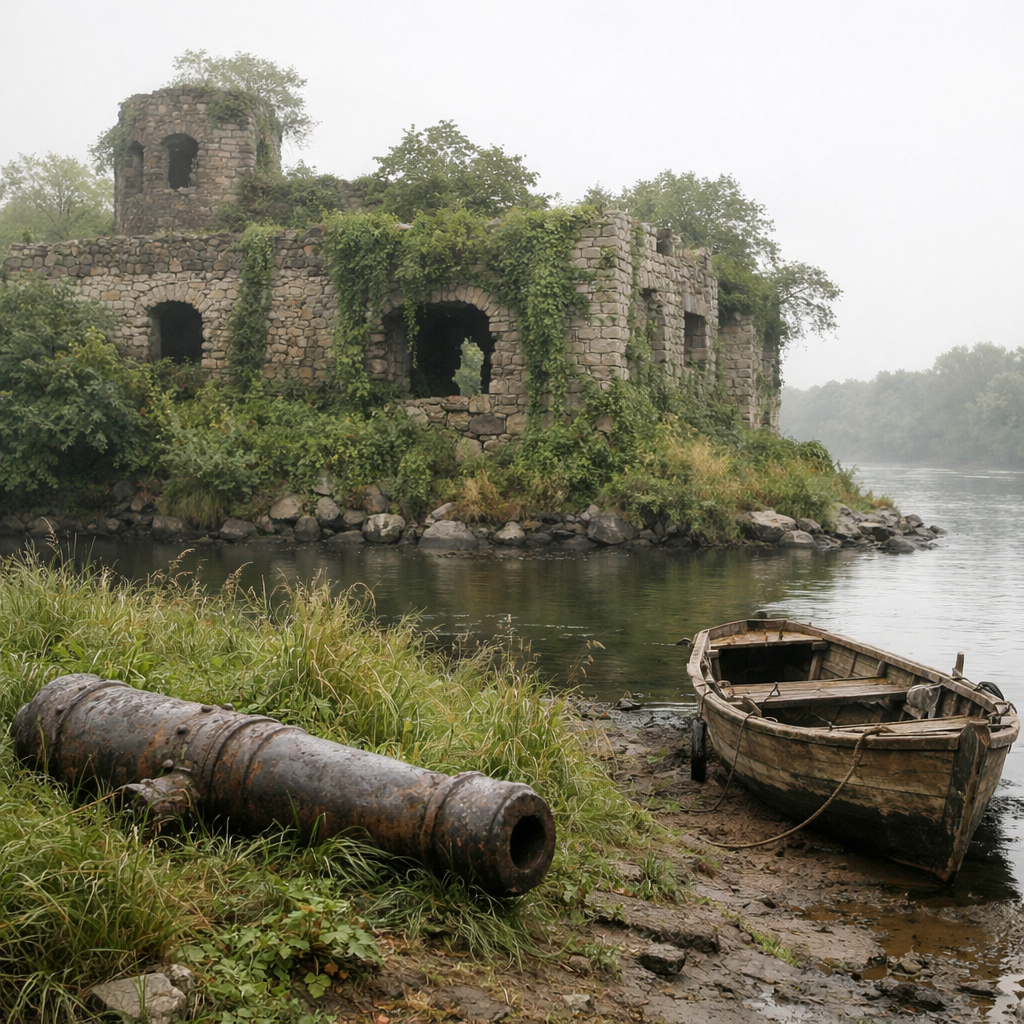
Twenty miles up the Sierra Leone River from Freetown, past mangroves and fishing canoes and the everyday rhythm of the river, a small island sits mostly forgotten — overgrown, half-collapsed, and largely unrestored. There is no gift shop. No paved walkway. No polished interpretive center. What's left of Bunce Island is ruins: a crumbling stone fort, a fallen watchtower, cannons swallowed by grass. And yet this quiet, hard-to-reach island holds one of the most direct, documented, and thoroughly researched ancestral through-lines between West Africa and a specific American community anywhere on the continent — the line running straight from Bunce Island to the Gullah Geechee people of coastal South Carolina and Georgia.
Bunce Island doesn't get the visitor numbers or global name recognition of Ghana's Cape Coast Castle or Elmina, or Senegal's Góree Island. In terms of documented ancestral specificity, it arguably should. This is a site where historians can point to particular plantations, particular family names, and particular communities in the American Lowcountry and trace them back — not generally, but genealogically and linguistically — to this exact stretch of riverbank. For descendants of the Gullah Geechee, and for any Black traveler serious about roots travel, Bunce Island is not a detour. It is a primary source.
A British Slave Castle Built for the Rice Trade
The Royal African Company established the first fortification on Bunce Island around 1670, the start of nearly two centuries in which the site functioned as a British slave-trading castle. The original structure didn't survive intact — a Luso-African trader named José Lopez da Moura destroyed it in 1728, and the island sat abandoned for two decades before the Liverpool trading firm Grant, Oswald & Company rebuilt it in 1748 and ran it as a major slave-trading operation through the back half of the eighteenth century. From there, as ownership and fortunes changed hands, the castle continued trafficking captives until roughly 1840.
What made Bunce Island distinct from other West African slave castles wasn't just its scale — though at points it was the largest British slave castle on what planters and traders called the "Rice Coast," the stretch of West African coastline running from present-day Senegal and Gambia down through Sierra Leone and into Liberia. It was the specificity of what Bunce Island's operators were trafficking: skilled rice farmers.
Rice cultivation is technically demanding — flooding and draining fields on precise schedules, building and maintaining irrigation systems, understanding tidal rice culture along a coastline. Planters in the Carolina and Georgia Lowcountry, building a rice economy that would make Charleston one of the wealthiest cities in colonial America, needed workers who already possessed that expertise. They didn't need to teach rice farming to the people they enslaved — they specifically sought captives from West Africa's Rice Coast who already knew how to do it, and Bunce Island's traders built their business around supplying exactly that. Slave auction notices in Charleston and Savannah in the eighteenth century routinely advertised cargoes as arriving from "Bance Island" or "Bense Island," explicitly marketing the rice-growing expertise of the people being sold. Henry Laurens, who served as Bunce Island's business agent in Charleston, went on to become President of the Continental Congress — a reminder of how deeply the wealth generated by this trade was woven into the founding economy, and later the founding politics, of the United States.
Joseph Opala's Research — and Why This Story Reaches All the Way to St. Helena Island
What separates Bunce Island from most West African heritage sites is how rigorously the American side of this story has been documented. Beginning in the 1980s, American anthropologist Dr. Joseph Opala — working alongside Sierra Leonean and American researchers, linguists, and Gullah Geechee community members — built a body of research establishing direct ancestral, linguistic, and cultural links between captives trafficked through Bunce Island and the Gullah Geechee communities of the South Carolina and Georgia Sea Islands today.
Opala's work didn't stop at historical plausibility. It produced documented, filmed reunions between Gullah Geechee Americans and Sierra Leonean communities whose ancestors were left behind — most famously captured in two documentaries, Family Across the Sea (1990) and The Language You Cry In (1998), the latter tracing a Gullah funeral song sung for generations in a South Carolina family back to a specific village and language in Sierra Leone's interior. A third film, Priscilla's Homecoming (2005), followed an African American woman traveling to Sierra Leone to meet descendants of the community her enslaved ancestor, Priscilla, was taken from as a child.
This is precisely why Bunce Island deserves to be understood alongside — not instead of — St. Helena Island, South Carolina, home to Penn Center and the living heart of Gullah Geechee culture, which BTN has covered as the American anchor point of this same story. St. Helena Island and Penn Center are where Gullah Geechee culture is lived today — the language, the foodways, the land, the community. Bunce Island is where that same community's specific, documented ancestral line begins. Traveling to one without knowing the other means missing half the story. Together, they form one of the clearest, most specific ancestral geographies available anywhere in the African diaspora experience — a story that isn't "West Africans were taken to America" in the abstract, but a searchable, named, filmed line from a particular river island to a particular set of barrier islands three thousand miles away.
Ruins, Not a Museum: What You'll Actually See
Be clear-eyed about what a visit to Bunce Island is before you book a boat. This is not Cape Coast Castle, restored and staffed with trained guides walking groups through preserved dungeons. Bunce Island is unrestored ruins — crumbling stone walls, a collapsed watchtower, cannons lying in overgrown grass, the outline of a fortification slowly being reclaimed by the forest. A 1974 hurricane caused significant additional structural damage on top of more than a century of abandonment and decay.
The island holds real, formal historic status: it was designated Sierra Leone's first officially protected historic site in 1948, the same year Sierra Leonean physician and historian M.C.F. Easmon led an expedition that produced the first detailed maps and photographs of the ruins. Bunce Island has also been on Sierra Leone's UNESCO World Heritage Tentative List since 2012, recognized for its outstanding and specific historical value — the formal first step toward full UNESCO World Heritage status, though that designation has not yet been achieved. A preservation initiative launched in 2010 pledged roughly $5 million toward stabilizing the ruins and building an interpretive museum in Freetown, but as of today the site remains largely as it has been for generations: quiet, overgrown, and essentially unrestored.
That is, in its own way, part of what makes the visit so powerful. There's no gift shop pulling focus, no crowd control, no polish standing between you and the physical reality of what happened here. It also means you should arrive with real information and real support, not assumptions.
Getting There: Chartered Boat Only, Guide Strongly Recommended
There is no bridge, ferry schedule, or public transit to Bunce Island. The only way to reach it is by chartered boat from Freetown, roughly a 20-mile trip up the Sierra Leone River. Boats are arranged informally through Freetown-based tour operators, guesthouses, or fixers — there is no formal, standardized booking system, and availability, price, and boat condition vary considerably by operator and season.
This is a destination where hiring a local guide or fixer isn't a luxury add-on — it's effectively a requirement. Tourist infrastructure on and around Bunce Island is minimal to nonexistent: no signage system to speak of, no on-site staff most days, no facilities, and limited-to-no mobile signal once you're on the water. A knowledgeable local guide handles the boat charter logistics, provides the historical interpretation that turns overgrown ruins into a legible story, and — practically speaking — knows current river and weather conditions well enough to make the trip safely. Arrange this through a reputable Freetown-based tour operator or your accommodations well before you arrive; do not expect to show up in Freetown and improvise same-day river transport to a historic site with no dock infrastructure.
Visa and Entry Requirements for US Citizens
US citizens need a visa to enter Sierra Leone — this is not a visa-free destination. Sierra Leone offers two paths: an eVisa, applied for and approved online in advance through the official Sierra Leone Immigration eVisa portal, or a visa on arrival available at designated entry points including Freetown's Lungi International Airport. BTN's recommendation is to apply for the eVisa before you travel rather than count on the arrival line — it removes uncertainty and airport delays. Visa fees and processing windows are subject to change, so confirm current pricing and requirements directly on the official portal before booking flights.
Beyond the visa itself, build in the standard entry requirements: a passport valid at least six months beyond your arrival date with at least one full blank page, proof of Yellow Fever vaccination (an International Certificate of Vaccination is checked at entry), and a separate airport security fee (roughly $25 at the time of writing, payable online or at designated banks) collected apart from the visa fee. The U.S. State Department currently advises travelers to exercise increased caution in Sierra Leone due to crime and civil unrest, and specifically flags Freetown for opportunistic crime after dark and areas outside the capital for limited emergency services — good reason, again, to travel with a trusted local guide rather than solo improvisation, particularly for a river excursion to a remote, unstaffed historic site.
Best Time to Visit
Sierra Leone's dry season, roughly November through April, is the most practical window for a Bunce Island trip — calmer river conditions, less rainfall to complicate a small-boat crossing, and more comfortable heat and humidity for a day spent walking overgrown ruins. The rainy season, May through October, brings heavier downpours and rougher river conditions that can make boat charters unreliable or unsafe on short notice.
Budget Guide
Budget: $70–110/day — modest Freetown guesthouse, local meals, and a shared or negotiated boat charter split across a small group.
Mid-range: $150–250/day — comfortable Freetown hotel, a private guide and boat charter, and a driver for airport and city transport.
Higher-end: $300+/day — top Freetown accommodations, a dedicated private guide-historian for the day, and a well-maintained private boat.
BTN Insider Tips
Book your guide before you land. This is the single most important piece of planning advice for this destination — arrange your Bunce Island excursion through a reputable Freetown operator days or weeks in advance, not on arrival.
Pair it with Freetown's own history. Freetown was itself founded in 1792 as a settlement for freed and formerly enslaved Black people from Britain, Nova Scotia, and Jamaica — a resettlement history that adds important context to a Bunce Island trip and is worth a day of its own.
Bring cash, sun protection, and sturdy shoes. There are no vendors, shade structures, or paved paths on the island — you'll be walking uneven, overgrown ground in full sun with no on-site facilities.
Watch the Opala documentaries before you go. "The Language You Cry In" and "Family Across the Sea" will fundamentally change how you experience standing on the island.
Confirm your visa and vaccination paperwork weeks ahead. Yellow Fever vaccination has to happen in advance, and eVisa processing is not instant — leave real buffer time before your flight.
The Story This Island Tells
Most heritage travel across West Africa asks visitors to hold history in the abstract — millions of people, centuries of trade, an ocean's worth of grief. Bunce Island, because of Joseph Opala's decades of research, asks something more specific and in some ways more demanding: it asks you to hold a name, a language, a family, a specific stretch of South Carolina and Georgia coastline, and a specific island in the Sierra Leone River, and understand that they are the same story told from two ends. Very few places on earth let you do that. Fewer still let you do it standing in the actual ruins where it began.
🏨 Book Freetown Hotels →Getting There: Flights to Freetown
International flights arrive at Freetown Lungi International Airport (FNA), with connections available through hubs including Brussels, Casablanca, Accra, and Dakar; there are no direct flights from the United States, so expect at least one connection and total travel time of 14-20+ hours from most US cities. From Lungi Airport, travelers cross the estuary to central Freetown by water taxi, ferry, or helicopter transfer, as the airport sits on the opposite side of the bay from the city center.
✈️ Find Flights to Freetown →Book Your Trip
Bunce Island will not meet you halfway. There's no gift shop, no paved path, no easy version of this trip — only a chartered boat, a good guide, and a piece of ground that connects, more directly than almost anywhere else in the world, a specific West African coastline to a specific American one. For descendants of the Gullah Geechee, and for anyone serious about tracing this history to its source, that makes the difficulty part of the point.
✈️ Book Your Sierra Leone Trip Now →*Affiliate links — BTN may earn a commission at no extra cost to you.