An 800-Year-Old African Story Hiding in Plain Sight in India
Most travel bucket lists that pair "Africa" and "India" stop at trade routes and spice history. Almost no one arrives in Gujarat or Karnataka expecting to meet Indian citizens who look like they could be your cousins from Nairobi or Maputo — who speak fluent Gujarati or Kannada, who have never set foot in Africa, and whose families have lived on the subcontinent for eight centuries or longer. But that is exactly who you'll meet if you know where to look: the Siddi, one of the world's most remarkable and least-known African diaspora communities.
The Siddi (also spelled Sheedi or Sidi) are descendants of East Africans — predominantly Bantu peoples from what is now Tanzania, Mozambique, and the Zanzibar coast — who arrived in India over many centuries as sailors, soldiers, merchants, and enslaved laborers, brought by Portuguese, Arab, and Indian traders and rulers. Today, an estimated 20,000 to 50,000 Siddis live across India, with the largest concentrations in Gujarat's Gir region and Karnataka's Uttara Kannada district. This is not a historical footnote. It is a living, present-tense community with its own villages, its own Sufi devotional traditions, its own music, and its own relationship to a homeland most of its members have never visited. This guide is an introduction to that story — and to how to engage with it respectfully, as a guest, not a spectator.
Who Are the Siddi? Origins and History
The Siddi story begins earlier than most people assume. Some of the first recorded East African arrivals on the Indian subcontinent date to around the 7th and 8th centuries, tied to Indian Ocean trade networks and the Arab conquests of Sindh, when East African soldiers served in regional armies. But the migrations that built the communities we see today intensified between the 12th and 17th centuries, as Portuguese, Arab, and Indian traders and ruling houses brought East Africans to India as sailors, dock workers, palace guards, domestic laborers, and — for many — as enslaved people with no say in the journey.
What makes Siddi history distinct from a simple story of displacement is what some Siddis went on to build. The best-known example is Malik Ambar, a formerly enslaved East African who rose in the 16th and 17th centuries to become a brilliant military strategist and the de facto ruler of the Ahmadnagar Sultanate in the Deccan, holding off the Mughal Empire for decades and reshaping regional urban planning and taxation systems still studied by historians today. His life is a reminder that Siddi history includes power, statecraft, and resistance — not only servitude.
Modern genetics has confirmed what oral history and physical resemblance long suggested. Studies of Siddi populations in Gujarat and Karnataka show that the majority of their ancestry traces to Bantu East Africa — Y-chromosome and mitochondrial DNA studies find Bantu-associated lineages in a large majority of Siddi men and women sampled, and autosomal DNA studies estimate that Siddi communities carry roughly two-thirds to three-quarters Southeast African ancestry, with the remainder reflecting centuries of intermarriage with neighboring Indian communities — admixture that genetic dating suggests has been occurring for approximately the last 200 years, or about eight generations. In other words: African by ancestry, Indian by nationality and citizenship, and regionally Gujarati or Kannadiga by language, food, and daily life. That layered identity is the heart of the Siddi story, and it's worth sitting with rather than flattening into a single label.
Where the Siddi Live Today: Gujarat and Karnataka
In Gujarat, the Siddi population — roughly 8,500 people per the most recent census — is concentrated in and around the Gir Somnath district, on the edge of Gir National Park, India's last refuge for the Asiatic lion. The village of Jambur, home to around 5,000 residents, is the best-known Siddi settlement in the state, sitting about 68 kilometers south of Junagadh. Families here have lived in this landscape for centuries, working in agriculture, forestry, and increasingly in small-scale tourism and craft work tied to the Gir region's wildlife economy.
In Karnataka, a larger Siddi population — over 10,000 by the last census — lives across the forested talukas of Uttara Kannada district: Yellapur, Haliyal, Ankola, Joida, Mundgod, and Sirsi. These communities settled here in waves, some as escapees from indentured servitude during the colonial period who found refuge in the dense Western Ghats forest, and some through later resettlement programs. The Karnataka Siddi communities have retained a distinct set of oral traditions and musical forms even as they've built lives fully embedded in Kannada-speaking rural Karnataka.
It's worth saying plainly: these are not heritage museums or reconstructed "villages" built for visitors. Jambur and the Siddi settlements of Uttara Kannada are ordinary Indian villages where people live, work, raise families, and go about daily life. Any travel here should be approached with the same basic respect you'd want extended to your own neighborhood — not as a site to observe, but as a community to meet.
The Dhamaal: A Living Bantu Musical Tradition
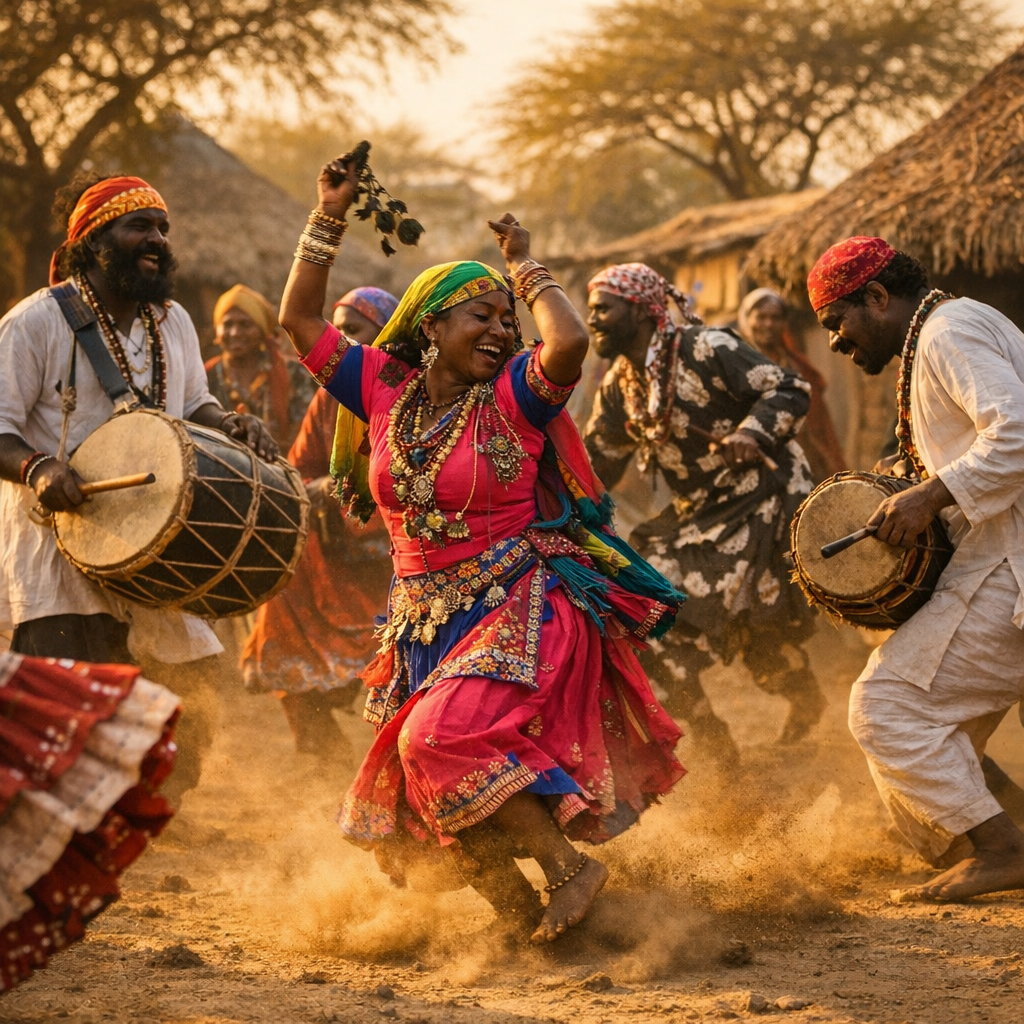
The most visible and celebrated piece of Siddi culture is the Dhamaal (sometimes called Goma), a percussion-driven devotional dance built around large drums and call-and-response singing. Linguists trace the word itself back to the Kiswahili "ngoma," meaning drum — a direct linguistic thread connecting the Siddi to the Bantu ngoma drumming and dance traditions of Central, East, and Southern Africa. Performers use large frame drums, coconut-shell rattles called mai misra, and other instruments passed down through generations, often performing barefoot in call-and-response rhythms that build in intensity.
Dhamaal is not primarily a stage show — it is devotional and communal, often performed at weddings, community celebrations, and Sufi religious gatherings honoring Siddi saints, most notably Bava Gor, a revered Siddi Sufi figure whose shrine at Ratanpur in Gujarat remains an important pilgrimage site for the community. At the height of a Dhamaal performance, some dancers are believed by participants to become vessels for the spirit of Siddi saints of the past — a moment of genuine religious significance, not a photo opportunity. If you're fortunate enough to witness a Dhamaal performance, the respectful posture is the one you'd bring to any house of worship: watch attentively, ask before photographing, and follow the lead of the community members hosting you.
Visiting Respectfully: Coordination Over Curiosity
This is the most important section of this guide. The Siddi communities of Gujarat and Karnataka are not tourist attractions, and they should never be framed or marketed that way. They are living villages with the same right to privacy, consent, and dignity as any community anywhere in the world. Showing up unannounced, treating a village as a photo backdrop, or approaching Dhamaal performances as spectacle rather than sacred practice causes real harm and closes doors for the travelers who come after you.
The right way to visit is through coordination, not improvisation:
- Go through a local guide or community-based tour operator. Junagadh and Gir-area tour operators, as well as Karnataka-based cultural and eco-tourism guides in Uttara Kannada, can arrange visits with community consent, appropriate compensation to hosts, and context you won't get on your own.
- Ask before you photograph or film anyone — people, homes, or ceremonies. This applies doubly to children and to any religious or devotional gathering.
- Support the community directly. If Dhamaal performers, artisans, or hosts are compensated for their time, pay a fair rate without haggling — this is livelihood, not a tourist transaction to negotiate down.
- Confirm festival and event dates directly with your local guide or a community contact before you build a trip around them. Community celebrations such as the urs at Bava Gor's shrine in Ratanpur and other Siddi cultural gatherings don't run on a fixed international tourism calendar, and dates shift year to year. Do not rely on secondhand blog posts (including this one) for exact scheduling — verify locally, close to your travel dates.
- Come to learn, not to collect an exotic experience. The Siddi are not a curiosity or a "hidden tribe" — they are Indian citizens with a distinct and layered heritage. Language that treats them as a spectacle to be discovered says more about the visitor than the community.
Planning Your Trip: e-Visa & Practical Details
US citizens need to arrange an e-Tourist visa (e-Visa) before traveling to India — there is no visa-on-arrival option for US passport holders (that facility is limited to Japan, South Korea, and UAE nationals). The process is handled entirely online through India's official e-Visa portal: you upload a photo and your passport bio page, pay the visa fee, and receive an Electronic Travel Authorization (ETA) by email, which you print and present on arrival for a passport stamp. Apply at least four days before your travel date, though earlier is safer. Options for US citizens include 30-day, 1-year, and 5-year multiple-entry e-Tourist visas (the longer visas cap total stay at 180 days per calendar year). Entry on an e-Visa is only permitted through a list of designated airports and seaports, so confirm your specific arrival point qualifies. Make sure your passport has at least six months of validity remaining and that you're carrying proof of onward travel.
Getting There & Getting Around
For the Gujarat leg (Jambur and the Gir region), fly into Ahmedabad's Sardar Vallabhbhai Patel International Airport, then continue by road or rail to Junagadh, the nearest major town to Jambur (roughly a 4-5 hour onward journey, less with a direct connection to Diu's smaller regional airport). For the Karnataka leg (Uttara Kannada), the closest major airports are Goa's Dabolim/Manohar International Airport or Hubli Airport, followed by a drive into the Western Ghats forest talukas of Yellapur, Ankola, or Sirsi. Distances between villages in both regions are significant, and public transit is limited — hiring a car and driver, ideally arranged through the same local guide coordinating your community visits, is the most practical approach.
Best Time to Visit
October through March is the most comfortable window for both regions, avoiding the intense pre-monsoon heat of April-May and the heavy monsoon rains of June through September, which can make rural roads in both Gir and the Western Ghats difficult to navigate. Cooler, drier weather also makes it easier to spend time outdoors in village settings.
BTN Insider Tips
Pair your visit with Gir National Park, but don't make the Siddi community an afterthought to it. Many travelers come to Gir for Asiatic lion safaris and treat Jambur as a five-minute stop. Budget real time and go with intention.
Learn a handful of Gujarati or Kannada phrases depending on which region you're visiting — a basic greeting goes a long way and signals genuine respect rather than a drive-by visit.
Carry cash in smaller denominations for rural areas where card payments are unreliable, and keep a portion set aside to fairly compensate hosts, guides, and performers.
Dress modestly as you would in any rural Indian village, particularly if your visit coincides with a religious observance.
Set expectations before you go: this is a cultural-heritage and human-connection trip, not a checklist attraction. The richest version of this trip is slow, guided, and built on relationships rather than a rushed itinerary.
Practical Basics
Currency: Indian Rupee (INR). Languages: Gujarati (Gujarat), Kannada (Karnataka), with Hindi and English widely understood in tourism contexts. Emergency number: 112 (India's unified national emergency helpline, covering police, fire, and medical). US Embassy: New Delhi, with consulates in Mumbai, Chennai, Kolkata, and Hyderabad for regional support.
🏨 Book Gujarat & Karnataka Stays →Is This Trip Right for You?
This is not a beach vacation or a nightlife destination — it's a slower, more intentional kind of travel for people genuinely interested in the full, complicated map of the African diaspora, including the parts that don't run through the Atlantic. If you're drawn to learning how African heritage took root and endured on the other side of the Indian Ocean, and you're willing to travel with humility, a local guide, and patience, the Siddi Trail offers something few other trips can: a living, breathing chapter of diaspora history that most of the world has never been told about.
✈️ Find Flights to Gujarat & Karnataka →*Affiliate links — BTN may earn a commission at no extra cost to you.