The Bridge That Changed a Nation
There are places in America where history does not feel like the past. Selma, Alabama is one of them. Walk to the crest of the Edmund Pettus Bridge, look down at the Alabama River, and it is hard not to feel the weight of March 7, 1965 pressing up through the pavement. This is the single most photographed square footage of the American Civil Rights Movement — yet most visitors see it only as a blur outside a tour-bus window en route to Montgomery. This guide is for the traveler who wants to stop, get out, and walk it.
Selma deserves that. It is not a theme-park version of the movement — it is a working Alabama Black Belt town, still grappling with the poverty that followed the spotlight leaving, still home to the sidewalks and the bridge where ordinary people changed American democracy. Visit respectfully, and spend a little money in Selma's Black-owned businesses while you're there.
Bloody Sunday: What Happened Here
On the afternoon of Sunday, March 7, 1965, roughly 600 people set out from Brown Chapel AME Church in Selma, intending to walk the 54 miles to the state capitol in Montgomery to demand the right to vote. Alabama at the time used literacy tests, poll taxes, and outright intimidation to keep Black citizens off the voter rolls — in Dallas County, where Selma sits, barely 2 percent of eligible Black residents were registered to vote despite making up a majority of the county's population.
The march was led by 25-year-old John Lewis of the Student Nonviolent Coordinating Committee and Hosea Williams of the Southern Christian Leadership Conference. As marchers crested the bridge and started down the far side, they found Alabama state troopers and a mounted posse under Sheriff Jim Clark waiting for them. Major John Cloud gave the marchers two minutes to disperse, then, before that time had elapsed, troopers charged the column — beating marchers with clubs, firing tear gas, and riding into the fleeing crowd on horseback swinging whips and rubber tubing wrapped in barbed wire. John Lewis suffered a fractured skull. Amelia Boynton Robinson was beaten unconscious, and a photograph of her lying on the bridge became one of the defining images of the movement.
What set Bloody Sunday apart from the violence that had met earlier protests was that television cameras captured it. That night, ABC interrupted its broadcast of the film "Judgment at Nuremberg" — about the world's failure to stop Nazi atrocities — with footage of state troopers attacking unarmed American citizens on a bridge in Alabama. Millions of households saw it happen in something close to real time, and the outrage was immediate and national.
Two more attempts to march followed. A second, led by Dr. Martin Luther King Jr. on March 9, turned back at the bridge after a court order — a moment sometimes called "Turnaround Tuesday." Finally, under the protection of federalized National Guard troops ordered in by President Lyndon B. Johnson, marchers completed the full walk to Montgomery from March 21 to 25, arriving 25,000 strong at the state capitol steps. Five months after Bloody Sunday, on August 6, 1965, President Johnson signed the Voting Rights Act into law, outlawing the discriminatory practices that had kept Black Americans from the ballot box across the South. Historians widely regard it as one of the most consequential civil rights laws in American history, and its passage traces directly back to what happened on this bridge.
Walking the Route: From Brown Chapel AME to the Bridge
The single best thing you can do in Selma is walk the same ground the marchers walked. It is a short distance — a little over half a mile, roughly six blocks — but every step of it is marked by the National Park Service as part of the Selma to Montgomery National Historic Trail.
Start at Brown Chapel AME Church, a red-brick building completed in 1908 that served as the movement's headquarters in Selma and the starting point for all three marches. It remains an active congregation; be respectful of services, and call ahead if you'd like to see the sanctuary interior. Outside stands a monument to the movement's foot soldiers.
From Brown Chapel, follow Sylvan Street and then Water Avenue toward the river, through the modest residential blocks where marchers gathered that Sunday afternoon. This is ordinary Selma, not a monument-lined boulevard, and that plainness is part of what makes the walk affecting — you are retracing the steps of people who did not know, when they set out, whether they would come home.
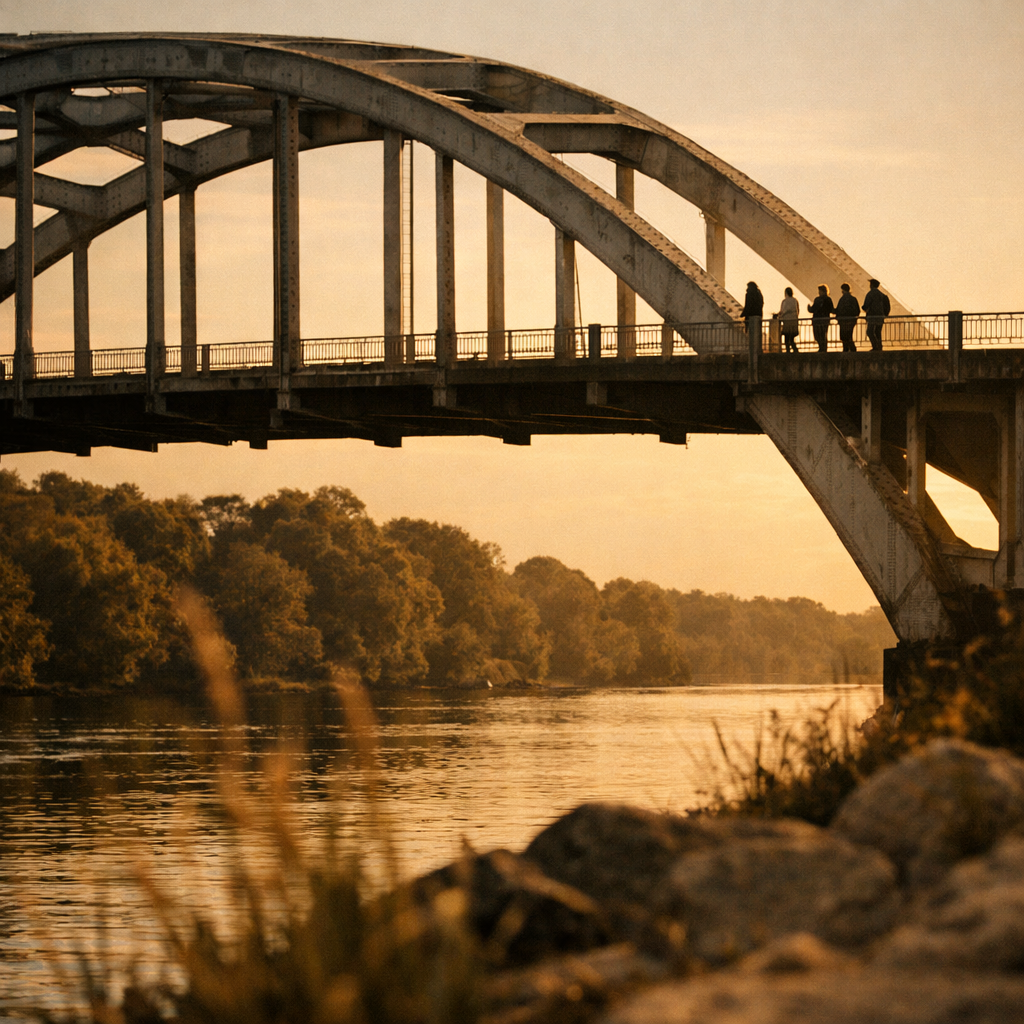
The route ends at the Edmund Pettus Bridge, a steel through-arch bridge completed in 1940 that carries US Route 80 over the Alabama River. Walk up and across it, and pause at the crest, where marchers first saw the wall of troopers waiting on the other side. The view — river below, downtown Selma behind, the road continuing toward Montgomery ahead — is the same one John Lewis and Hosea Williams had a moment before everything changed.
The National Voting Rights Museum and Institute
At the foot of the bridge on the Selma side sits the National Voting Rights Museum and Institute (NVRMI), founded by Bloody Sunday participant and longtime Selma activist Rose Sanders (now Faya Rose Toure) and JOANNE Bland, who was just eleven years old when she marched across the bridge in 1965. This is the museum most tour groups skip in favor of a quick photo at the bridge — and it is the single best way to understand what you are standing on.
Its exhibits are built substantially from oral histories and personal artifacts of the foot soldiers themselves — handwritten testimonies, photographs, and objects donated by movement veterans rather than borrowed institutional pieces. It has the intimate, community-built feel of a museum assembled by the people who lived the history, because it was. As of this writing, general admission is $6.50 for adults and $4.50 for students and seniors (55+), and guided tours led by movement veterans can be arranged directly through the museum. Because NVRMI is a small nonprofit, hours can shift seasonally — call (334) 418-0800 to confirm the day's schedule before you plan your visit around it.
A Name Still Under Debate
Any honest guide to this bridge has to reckon with its name. Edmund Pettus, for whom the bridge was named when it opened in 1940, was a Confederate brigadier general and, after the war, an Alabama Grand Dragon of the Ku Klux Klan. The bridge that carried the Voting Rights Movement's most consequential moment into American living rooms is named for a man who dedicated part of his life to violently suppressing Black political power.
That contradiction has not gone unnoticed. Petitions to rename the bridge gained real traction in 2015 around the march's 50th anniversary, and again in 2020 after Congressman Lewis's death, when a renaming resolution was introduced in the Alabama Legislature. Neither effort succeeded; the 2020 resolution stalled, and the bridge still carries Pettus's name today. Opinion remains genuinely split, including among civil rights veterans and Selma residents — some argue the name should change to stop honoring a Klan leader, while others have argued that keeping "Edmund Pettus" attached to the images of Bloody Sunday is itself a rebuke, a permanent reminder of what was overcome there. There is no consensus, and the debate continues. Visitors should know this history rather than assume the bridge honors the movement it is now famous for.
The Bridge Crossing Jubilee
Every year on the first weekend of March, Selma fills with civil rights veterans, elected officials, faith leaders, and thousands of visitors for the Bridge Crossing Jubilee, a multi-day commemoration built around a symbolic reenactment of the march. The weekend typically includes a mass meeting at a historic church, panel discussions on voting rights, a parade, youth programming, and the culminating bridge crossing itself — a slow, largely silent walk by thousands across the same span, often alongside marchers who were present in 1965.
If you can time a trip around the Jubilee, do it — it's the closest thing to experiencing the moral weight of Bloody Sunday firsthand, and it draws an unmatched gathering of the people who shaped this history. Outside Jubilee weekend, the bridge and museum are open year-round, and a quieter visit has its own value: more space to sit with the history without the crowds.
Getting There and Getting Around
Selma has no commercial airport. The closest options are Montgomery Regional Airport (MGM), about 50 miles east, and Birmingham–Shuttlesworth International Airport (BHM), roughly 90 miles north. From either, renting a car is by far the easiest way in — public transit is limited, and a car makes it simple to continue to Montgomery for the Legacy Museum, the Rosa Parks Museum, and the Alabama State Capitol, where the march ended.
Downtown Selma, including the walk from Brown Chapel AME to the bridge, is entirely walkable. Sidewalks are uneven in places, so wear comfortable shoes.
Best Time to Visit
Early spring — specifically the first week of March around the Jubilee — is the most meaningful time to visit, though also the busiest and warmest way to experience it emotionally. For milder weather and smaller crowds, October through April offers comfortable temperatures for walking the route; Alabama summers (June through September) bring serious heat and humidity that make the outdoor walking portions considerably more demanding.
Where to Stay
Selma is a small town, and hotel options are limited compared to Montgomery or Birmingham. Chain properties along Highland Avenue and near Highway 80 offer straightforward, budget-friendly stays for a one- or two-night visit. Many visitors base themselves in Montgomery, about an hour away, and combine a Selma day trip with the fuller slate of civil rights sites there, including the Equal Justice Initiative's Legacy Museum and National Memorial for Peace and Justice.
🏨 Find Selma & Montgomery Hotels →BTN Insider Tips
- Call the museum before you go. NVRMI is a small nonprofit and hours can shift; confirm the day's schedule at (334) 418-0800.
- Walk the route, don't just photograph the bridge. Starting at Brown Chapel AME and walking to the bridge is what makes the history register.
- Bring cash for museum admission and small local businesses.
- Pair Selma with Montgomery. The Legacy Museum, the National Memorial for Peace and Justice, and the State Capitol steps complete the arc of the story.
- Treat it as hallowed ground. Keep voices low on the bridge and inside Brown Chapel out of respect for movement veterans and their families.
Mark Your Calendar
- First weekend of March — Bridge Crossing Jubilee, commemorating the anniversary of Bloody Sunday with a mass reenactment crossing, panels, and a parade
- March 7 — Anniversary of Bloody Sunday
- August 6 — Anniversary of the signing of the Voting Rights Act of 1965
Plan Your Visit
Selma is not a destination for spectacle. It is a place to slow down, walk quietly where history happened, and leave understanding a little more about what it took — and still takes — to secure the right to vote in America.
✈️ Plan Your Alabama Civil Rights Trail Trip →*Affiliate links — BTN may earn a commission at no extra cost to you.