Four Days Before Europe's Biggest Caribbean Street Party Nobody Told You About
Right now, this week, the streets of central Rotterdam are being roped off for a parade route. Sound systems are being tested on Coolsingel. Feather-and-sequin costumes that took months to build are getting their final fittings. If you're reading this on or before Saturday, July 25, 2026, you still have time to get to Rotterdam for the Straatparade — the marquee event of Zomercarnaval, confirmed by organizers to run from noon to 7 PM on Saturday, July 25, starting at Blaak in the heart of the city. If you're reading this after that date, treat everything below as your head start on 2027: same city, same tradition, same last-week-of-July timing, and now you'll actually know it exists.
Because here's the thing almost no American traveler knows: while Notting Hill Carnival gets the documentaries, the celebrity Instagram posts, and the two million attendees clogging West London every August, Rotterdam has been quietly running an equally massive, equally joyous Caribbean-diaspora carnival since 1984 — and outside of the Dutch Caribbean and Surinamese community, almost nobody outside Europe has heard of it.
What Is Zomercarnaval, Exactly?
Zomercarnaval — literally "Summer Carnival," now branded under the umbrella name Rotterdam Unlimited — is a multi-day festival built around Caribbean, Surinamese, Antillean, Cape Verdean, and Latin American carnival traditions. It was founded in 1984 by members of Rotterdam's Surinamese and Antillean communities who wanted a Trinidad-style carnival of their own on Dutch soil, and it has grown steadily for four decades into one of the largest events of its kind in Europe. In 2023, Zomercarnaval was formally recognized as Intangible Cultural Heritage of the Netherlands, an official acknowledgment of just how deeply the tradition has rooted itself in Dutch cultural life.
The festival today draws crowds estimated in the hundreds of thousands to well over a million across its full program, with the Straatparade alone typically featuring more than 2,000 costumed carnivalists across roughly 25 tropical carnival groups, dozens of musical acts and DJs, and elaborate floats moving along a five-kilometer route through the city center. It is, by any honest measure, a genuine peer to Notting Hill — just one that has largely stayed a local and regional secret rather than an international tourist magnet.
Zomercarnaval vs. Notting Hill: The Comparison Everyone Makes
The comparison to Notting Hill Carnival is almost unavoidable, and it's a fair one. Both events trace their roots to Caribbean carnival traditions brought to Europe by post-war and mid-century immigrant communities. Both center on a parade of costumed masqueraders, steel pan and soca-influenced sound, and a diaspora community reclaiming public space in a European city that wasn't originally built with them in mind. Both have been running for roughly the same length of time in carnival-years — Notting Hill's outdoor carnival dates to the mid-1960s, Zomercarnaval to 1984, so Notting Hill has the longer pedigree, but both are now multi-generational institutions.
The difference is visibility. Notting Hill Carnival has become a fixture of British cultural life and a bucket-list stop for American and international Black travelers specifically because word has spread. Zomercarnaval draws its crowd overwhelmingly from the Netherlands, Belgium, Suriname, and the Dutch Caribbean — Aruba, Curaçao, Bonaire — with only a trickle of American tourists making the trip. For BTN readers who've already done Notting Hill or are looking for the "next" carnival before everyone else finds out, Rotterdam is exactly that: the same energy, comparable scale, a fraction of the American crowd, and (for now) noticeably easier hotel booking.
The 2026 Schedule: What's Actually Happening This Week
Based on the confirmed 2026 program from organizers, here's how the lead-up to Saturday's parade breaks down:
- June 28, 2026 — Royalty Election, the ceremonial crowning event that kicks off the carnival season weeks ahead of the main festival.
- July 19, 2026 — Kindercarnaval, the children's carnival, with its own smaller parade and family programming.
- Friday, July 24, 2026 — Battle of Drums, an evening percussion and sound-system showcase, plus the illuminated evening parade component that lights up the city center after dark.
- Saturday, July 25, 2026 — The big day: Mercado (the festival's international food and craft market), Rueda de Casino (a mass salsa dance gathering), and the Straatparade itself, running noon to 7 PM from Blaak through a five-kilometer route in Rotterdam's center.
If you're planning a last-minute trip this week, Saturday is the day to build your schedule around — arrive by Friday evening if you can, so you catch the Battle of Drums energy the night before the parade.
What to Expect at the Straatparade
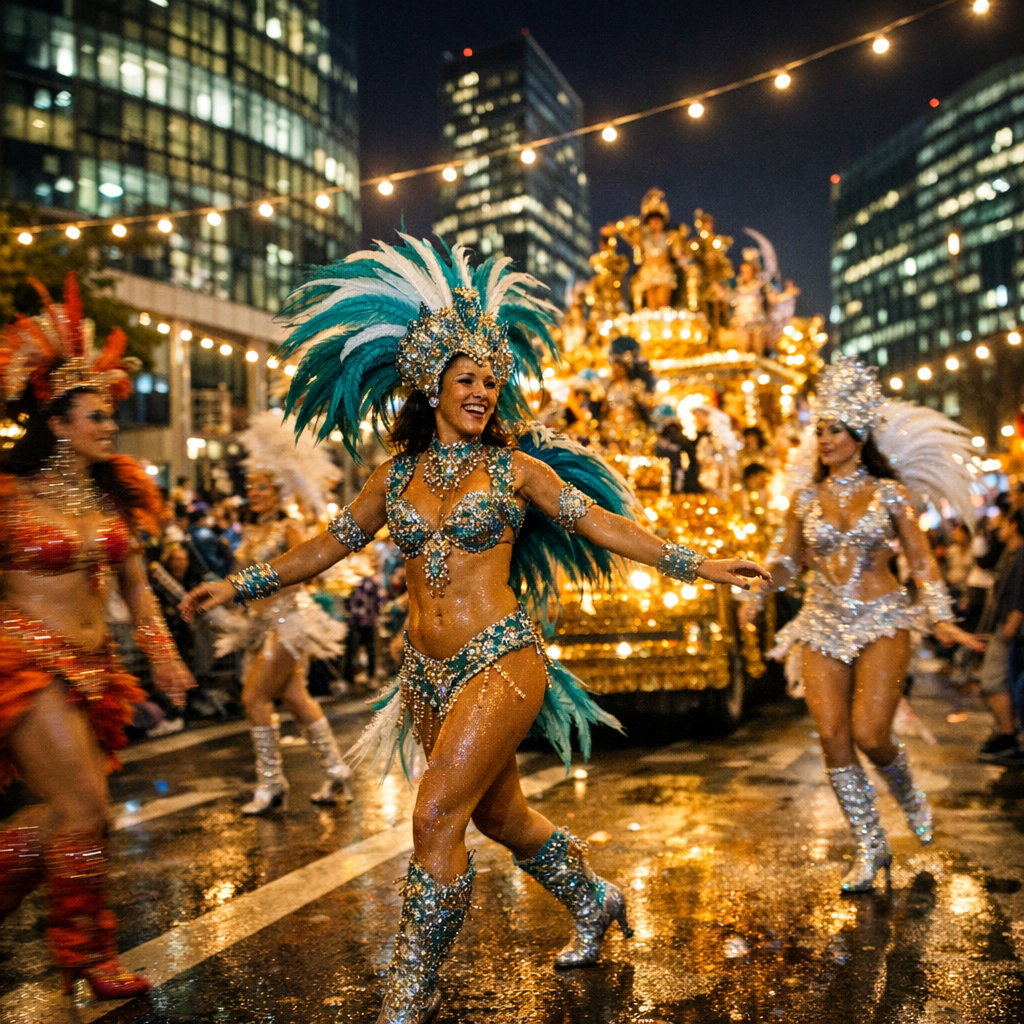
The Straatparade is a full sensory experience: dancers in glittering, feather-heavy costumes that rival anything you'd see in Port of Spain or on the streets of West London, sound trucks blasting soca, dancehall, bachata, and Afrobeats in rotation, and elaborate allegorical floats built by carnival groups who spend the better part of a year designing them. Expect the route along Blaak and Coolsingel to be packed shoulder-to-shoulder by early afternoon, with food vendors selling Surinamese and Caribbean street food lining the side streets. Unlike Notting Hill's residential-street setting, Rotterdam's parade moves through a wide, modern city center with plenty of glass-and-steel high-rises as a backdrop — a genuinely striking contrast between the ultra-contemporary Dutch skyline and a centuries-old Caribbean carnival tradition playing out beneath it.
The Diaspora Community Behind the Party
Rotterdam is home to one of the largest Surinamese and Antillean communities in the Netherlands, concentrated in neighborhoods like Zuidplein, Afrikaanderwijk, and Katendrecht — the same communities that built Zomercarnaval from the ground up in 1984 and have sustained it for four decades. This isn't a manufactured tourist event; it's a community celebration that happens to be extraordinary enough to draw outside visitors. That distinction matters: showing up as a respectful guest, buying from diaspora-run food stalls and vendors, and engaging with the history rather than just the spectacle is the right way to experience it.
Where to Stay
Luxury: Mainport Hotel Rotterdam and the Bilderberg Parkhotel Rotterdam both put you within easy reach of the city center and parade route with full five-star amenities.
Mid-Range Boutique: The Millennium Hotel Rotterdam and Hotel New York — the atmospheric former Holland America Line headquarters on the Maas waterfront — offer character and a short taxi or water-taxi ride from the parade action.
Budget: Stayokay Rotterdam and a wide range of centrally located budget hotels near Rotterdam Centraal offer solid value, though during carnival week you should book as early as possible — rooms near the route sell out to regional visitors well in advance.
🏨 Book Rotterdam Hotels →Getting There & Around
Amsterdam Schiphol (AMS) is the practical US gateway, with direct flights from most major American cities running roughly 8-9 hours from the East Coast. From Schiphol, hop the direct intercity train to Rotterdam Centraal — about 40 minutes, with multiple departures every hour, making Rotterdam an easy add-on even if your flights are booked into Amsterdam. Once in Rotterdam, the RET metro, tram, and bus network covers the city efficiently, and the center is compact and walkable. Expect road closures around Blaak and Coolsingel on parade day, with RET typically adding service to manage the crowds.
✈️ Find Rotterdam Flights →Visa & Entry: What US Citizens Need to Know
US citizens can currently enter the Netherlands visa-free for tourism stays of up to 90 days within any 180-day period, under the Schengen Area's standard visa waiver policy — no advance application required today. The EU's long-discussed ETIAS pre-travel authorization system, which will eventually require US travelers to complete an online registration before flying to Schengen countries, has been repeatedly delayed and had still not launched as of mid-2026. Keep an eye on the official EU travel information page before booking future trips, since the requirement could take effect with relatively short notice once a firm date is set — but for a trip this week, no visa or advance authorization is needed beyond a valid US passport.
Best Time to Visit & Planning Ahead for Future Editions
If Zomercarnaval is the draw, late July — specifically the week culminating in the last Saturday of the month — is the time to go, and that pattern has held consistently in recent years. Outside of carnival season, Rotterdam is at its most pleasant May through September, with long daylight hours and the mildest weather the Netherlands has to offer. Whether you're scrambling to catch this year's parade or you missed the window and are already eyeing 2027, the planning logic is the same: watch for the official Rotterdam Unlimited schedule to post in the spring, book flights into Amsterdam or directly if Rotterdam The Hague Airport adds capacity, and reserve city-center lodging as early as you can once dates are confirmed.
Budget Guide
Budget: $90-140/day — hostel or budget hotel, market and street-food dining, RET transit passes, mostly free festival viewing along the public route.
Mid-range: $150-250/day — boutique hotel, sit-down restaurant meals, occasional taxis, paid attractions and day trips beyond carnival weekend.
Luxury: $350+/day — five-star hotel, fine dining, private transport, and any premium viewing or hospitality packages tied to the parade.
BTN Insider Tips
Book lodging the moment you decide to go. Rotterdam hotel inventory is smaller than Amsterdam's, and regional Dutch, Belgian, and Surinamese visitors book up carnival weekend well ahead of most Americans even thinking about it.
Amsterdam Schiphol, not Rotterdam The Hague Airport, is your best US entry point. Build the 40-minute train transfer into your itinerary rather than searching for direct US-to-Rotterdam flights that largely don't exist.
Arrive Friday night for Battle of Drums if your schedule allows — it's a genuinely great warm-up to Saturday's Straatparade and far less crowded.
Cash and contactless both work, but carry some small euro bills for food stalls where card readers can bottleneck in a crowd.
Dress for a long day on your feet in warm, humid late-July weather — comfortable shoes over anything else.
Is Rotterdam Safe for Black Travelers?
Rotterdam is a large, diverse, majority-minority port city and consistently rates as very safe for tourists, including Black travelers and solo travelers. It's also one of the most ethnically diverse cities in the Netherlands, with a significant Surinamese, Antillean, Cape Verdean, Turkish, and Moroccan population woven into everyday life — a real difference from the more homogenous image many Americans have of the Netherlands. As with any major European city during a packed festival weekend, standard precautions around belongings in dense crowds apply, but violent crime against tourists is rare and the carnival itself is a heavily attended, well-policed, family-inclusive event.
Mark Your Calendar
- Late June — Royalty Election, kicking off the Zomercarnaval season
- Mid-to-late July — Kindercarnaval, Battle of Drums, Mercado, and the Straatparade, Rotterdam Unlimited's core festival week
- Late August — Notting Hill Carnival in London, for travelers building a European carnival-hopping itinerary
- Year-round — Rotterdam's Katendrecht and Afrikaanderwijk neighborhoods for Surinamese and Caribbean food and culture outside carnival season
Book Your Rotterdam Trip
Notting Hill will always get the headlines, but Rotterdam has been throwing an equally massive Caribbean carnival since 1984 — and for one more year, at least, you can still get a hotel room the week of.
✈️ Book Your Rotterdam Trip Now →*Affiliate links — BTN may earn a commission at no extra cost to you.