A Port Built on Stolen Gold, Reclaimed by the People Spain Tried to Erase
Portobelo does not look, at first glance, like a place that would unsettle an empire. It is a small, sun-bleached town on Panama's Caribbean coast, its bay ringed by jungle-covered hills and the crumbling stone walls of Spanish fortresses. Pelicans dive over the water where treasure galleons once anchored, loaded with Peruvian silver bound for Seville. But look closer at what still happens in the streets of Portobelo every year, and you find something the Spanish crown never managed to stamp out: a living, breathing, drum-driven tradition built by the very people it tried to enslave — and which now exists, in part, to make fun of the colonizers who thought they'd won.
This is Congo culture. And it did not survive by accident. It survived because the enslaved Africans brought to Portobelo refused to stay enslaved.
The Cimarrones: The Resistance That Built a Culture
Portobelo was founded by Spain in 1597 as one of the most important treasure ports in the Americas — the Caribbean terminus of the Camino Real, the royal road that carried Peruvian silver and gold across the isthmus for shipment to Spain. To build and guard that port, and to work the surrounding plantations, the Spanish brought enslaved Africans in large numbers, many of them from Congo, Angola, and other Central African regions — which is where the name "Congo" originates.
They did not accept it quietly. Beginning in the mid-1500s and accelerating through the 1600s and 1700s, enslaved Africans along Panama's Caribbean coast escaped into the dense jungle interior and formed independent maroon communities — cimarrones, in Spanish. Historical accounts describe cimarrón settlements numbering in the thousands by the 1570s, with fortified towns and their own leadership. One of the most famous cimarrón leaders, a Mandinka man remembered as Bayano, led a community strong enough that Spanish colonial authorities were eventually forced to negotiate rather than exterminate it. Cimarrones later allied with English privateer Francis Drake against their common Spanish enemy, guiding his raiders across hidden jungle routes to intercept Spanish treasure convoys — a partnership built on the simple fact that Spain was every bit as much the cimarrones' enemy as it was England's.
Spain eventually crushed the independent cimarrón settlements militarily, forcing survivors into designated pueblos under colonial oversight by the late 1570s. But the culture those maroon communities built — their language innovations, their music, their social structures, their defiant sense of self — did not die with their independence. It went underground, embedded itself in the enslaved and free Black communities of the coast, and re-emerged over the following centuries as performance. That performance is Congo culture, and its beating heart is a town called Portobelo.
Diablos y Congos: A Festival That Mocks the Colonizer to His Face
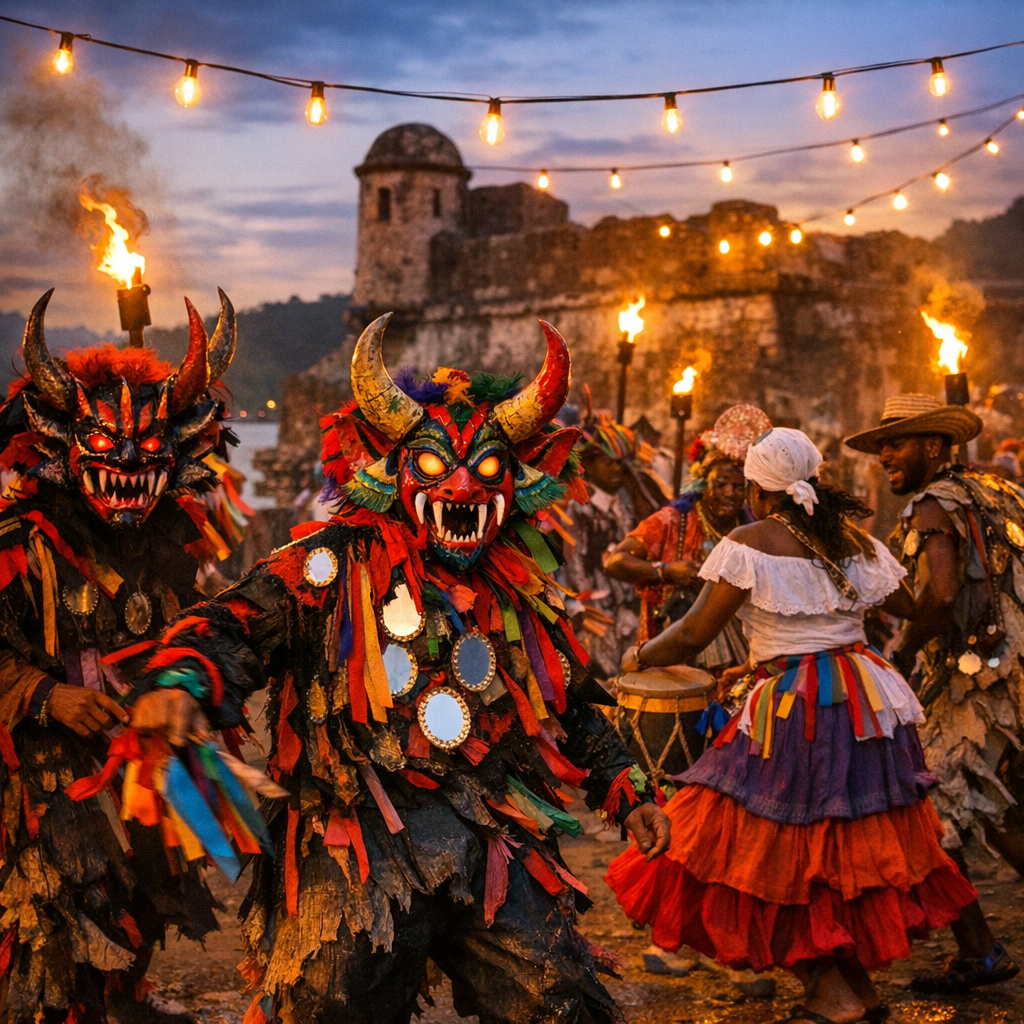
Every year, Portobelo and neighboring Caribbean coast towns stage the Diablos y Congos (Devils and Congos) festival — and it is unlike almost any other cultural performance tradition in the Americas, because its entire structure is built around satire aimed directly at colonial power.
The performance works like this: "Congo" characters — representing the free Black community descended from the cimarrones — organize themselves into palisades, or camps, under matriarchal leadership. A Congo queen presides over a royal court of named roles, each with specific responsibilities protecting her and the community. Opposing them are the "diablos," devil-masked figures in elaborate, often frightening costume, representing the Spanish colonizers and the oppressive system they built. Throughout the celebration, the Congos symbolically outwit, mock, and humiliate the devils — using exaggerated Spanish speech, comic reversals of colonial hierarchy, and ritual theater that flips the power dynamic of slavery on its head, if only for the length of the performance. Music, call-and-response singing, and dance — much of it performed barefoot, deliberately, "to communicate with the earth" — run through the entire celebration.
Traditionally, the Congo season runs from January 20 (San Sebastián Day) through Ash Wednesday, the day before Lent begins. The celebration builds toward a climactic ritual on Ash Wednesday itself, in which the Congos remove their masks and ceremonially "baptize" the devils — symbolically neutralizing their power until the cycle begins again the following year. It is street theater, spiritual practice, and historical memory all at once, performed in the open air of the same town the treasure galleons once sailed from.
A Note on Dates — Here's What We Actually Know for 2026
We want to be straight with you about something the official tourism circuit tends to gloss over: exact 2026 festival dates for Diablos y Congos are reported inconsistently across sources. What we can confirm is the underlying structure UNESCO itself documents — the Congo season runs from January 20 through Ash Wednesday, which falls on February 18, 2026. That places the core of the 2026 celebration, including its Ash Wednesday culmination, squarely within Panama's Carnival period in February. You may also see some sources, tour operators, or event listings reference Congo-related festivities in May — this likely reflects a separate, later reenactment, cultural exposition, or community anniversary event distinct from the traditional Lenten-season ritual calendar, or simply outdated/conflicting reporting. Because dates and specific town schedules can shift from year to year and are set locally, confirm the current calendar directly with Panama's Autoridad de Turismo (ATP) or a Portobelo-based guide before booking travel around a specific date. Don't build non-refundable plans around a date you haven't verified within a few weeks of travel.
UNESCO Recognition: The World Finally Caught Up
In 2018, UNESCO inscribed the "Ritual and festive expressions of the Congo culture" on its Representative List of the Intangible Cultural Heritage of Humanity — an international acknowledgment that this tradition, born from resistance to slavery, is a cultural treasure worth actively safeguarding. UNESCO's own documentation describes the tradition as a collective celebration of the descendants of enslaved Black rebels, transmitted today not only within families and palisades but increasingly through schools, university programs, and community workshops to ensure it survives another generation. For a tradition that Spain spent centuries trying to suppress, the recognition is a quiet, official vindication.
Beyond the Festival: What Else to See in Portobelo
The Fortifications (UNESCO World Heritage Site) — Fuerte San Jerónimo, Fuerte Santiago, and the ruins of the Real Aduana (Royal Customs House) still stand along the bay, cannons pointed out to sea, a physical reminder of exactly how much wealth passed through this small town. The fortifications were inscribed as a UNESCO World Heritage Site in 1980 (shared with San Lorenzo, further along the coast), though they've also been flagged on the List of World Heritage in Danger due to environmental damage and deferred maintenance — see them now.
The Church of the Black Christ (Nazareno Negro) — Portobelo's most famous religious site houses a dark-wood statue of Christ that draws tens of thousands of pilgrims every October 21 for one of Panama's largest religious festivals, distinct from the Congo season but deeply woven into the town's Afro-Panamanian spiritual identity.
Portobelo Bay diving and snorkeling — Calm, warm Caribbean water, sunken Spanish-era wrecks, and healthy reef make Portobelo a low-key dive destination that most Panama itineraries skip entirely.
Isla Grande — A short boat ride from the mainland, this is the easy beach-day add-on if you want sand and hammocks after a day of history and festival culture.
Where to Stay
Portobelo itself is small, and most travelers base themselves either in the town's handful of guesthouses and eco-lodges or make the trip a long day trip / overnight from Panama City. Small beachfront and jungle-adjacent guesthouses in and around Portobelo offer simple, comfortable rooms from roughly $40-80/night. For more amenities, Panama City (90 minutes to 2 hours away) or a lodge on Isla Grande give you a wider range of hotel options to combine with your Portobelo day trip.
🏨 Book Panama Stays →Getting There
Fly into Tocumen International Airport (PTY) in Panama City, which has direct connections from most major US gateway cities (Miami, Atlanta, Houston, New York, and more via Copa Airlines and US carriers). From Panama City, Portobelo is a scenic 90-minute to 2-hour drive northeast through the Colón corridor — rent a car, book a private transfer, or take a bus to Colón and connect via local taxi or bus for the final stretch.
✈️ Find Flights to Panama →Best Time to Visit
For the Congo culture experience, plan around the January 20-to-Ash Wednesday season, keeping the date-verification caveat above firmly in mind. For general sightseeing and diving, Panama's dry season (mid-December through mid-April) offers the most reliable weather on the Caribbean coast, with less rain and calmer seas. The rainy season (May through November) brings lush green scenery but frequent afternoon downpours.
Budget Guide
Budget: $50-80/day — guesthouse lodging, local comida corriente meals, public bus transport, free access to the fort ruins and church.
Mid-range: $100-180/day — private transfer or rental car, sit-down seafood restaurants, a guided history or diving tour.
Luxury: $250+/day — private guide, boutique lodge base on Isla Grande or in Panama City, chartered boat excursions.
BTN Insider Tips
If you're coming for Diablos y Congos, confirm the exact schedule locally. Contact a Portobelo-based guide or Panama's tourism authority within a few weeks of your trip — town-level schedules shift, and you do not want to arrive on the wrong weekend for the culmination.
Bring cash. Portobelo is a small town; card acceptance is inconsistent outside of a few tourism-facing businesses.
Approach the festival with respect, not just a camera. This is a living ritual tradition carrying centuries of resistance history, not a staged photo-op — ask before photographing performers up close, and support local artisans and performers directly when you can.
Pair it with San Lorenzo Fort. The other half of the shared UNESCO World Heritage designation sits near the mouth of the Chagres River and makes an easy combined day trip with Portobelo.
Combine with Panama City's Afro-Antillean heritage sites for a fuller picture of Black Panamanian history spanning both the maroon resistance era and the later Canal-construction migration of West Indian laborers.
Is Portobelo Safe for Black Travelers?
Portobelo is a small, low-crime town that sees a modest, steady flow of tourists, and Black travelers are generally warmly received in a country with a substantial and visible Afro-Panamanian population. As with any coastal Panama town, use standard precautions after dark, keep valuables secured, and travel the Colón corridor (Colón city itself has a rougher reputation than Portobelo) with a trusted driver or reputable transfer service. During festival season, crowds are large and joyful — stay aware of your belongings amid the celebration the way you would at any major street festival.
Mark Your Calendar
- January 20 — San Sebastián Day, the traditional start of the Congo culture season
- February 18, 2026 — Ash Wednesday, the traditional culmination of the Diablos y Congos ritual cycle (confirm local town schedule before booking)
- October 21 — Festival of the Black Christ (Nazareno Negro), Portobelo's major pilgrimage celebration
- Year-round — Fort ruins, church, and Portobelo Bay are open for visits outside festival season
Book Your Panama Trip
Portobelo is proof that some things cannot be conquered out of existence. The gold is long gone. The culture Spain tried to erase is still dancing in the street.
✈️ Book Your Panama Trip Now →*Affiliate links — BTN may earn a commission at no extra cost to you.