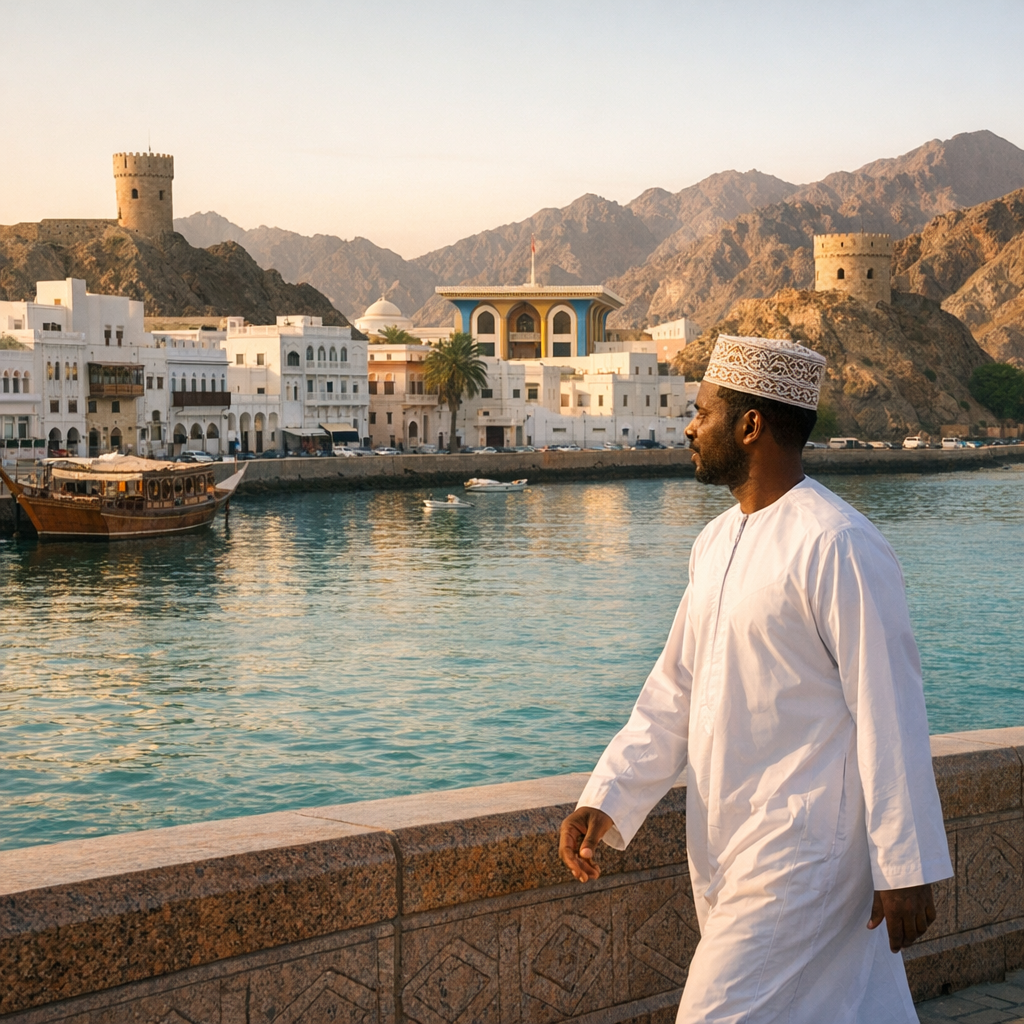
Oman's Quiet, Underrated Case for Black Travelers
Say "Gulf travel" to most people and Dubai's skyline comes to mind first, then maybe Qatar's stadiums or Abu Dhabi's museums. Oman rarely makes that list, and that is precisely why it belongs on it. This is a country of mountain fortresses, turquoise fjords, frankincense-scented souqs, and a genuinely warm, unhurried hospitality culture that stands apart from its flashier neighbors. It is also, consistently, rated among the safest countries in the Middle East for any traveler — and for Black travelers specifically, Oman offers something rarer still: a living, centuries-deep connection between the Arabian Peninsula and East Africa that shows up in the country's food, its family names, and its people.
That connection has a name — Afro-Omani — and it deserves to be understood on its own terms before you ever book a flight.
Who Are Afro-Omanis? A History Older Than Most Visitors Realize
Afro-Omanis are Omani citizens — full stop. They are not a roadside attraction or a demographic to observe from a tour bus window; they are part of the fabric of Omani national identity, concentrated today in Muscat, the port town of Sur, and the southern region of Dhofar around Salalah. Their presence in Oman traces back generations, largely to the Indian Ocean and East African slave trade that Omani maritime power participated in for centuries, moving enslaved people from the Swahili Coast and the African interior into the Arabian Peninsula, Persia, and beyond.
That history is not ancient in the way it can feel from a distance. Slavery in Oman was not formally abolished until July 1970, in the earliest days of Sultan Qaboos bin Said's reign, as part of the sweeping modernization program he launched after taking power that same month. That date — within living memory for many older Omanis — is a sobering reminder of how recently this chapter closed, and how directly it connects to the Oman travelers experience today: a modern, oil-wealthy Gulf state whose rapid development in roads, hospitals, and schools happened almost entirely within the last two generations.
Today, an estimated 5% or more of Oman's population traces some or all of its ancestry to East Africa. In neighborhoods across old Muscat, in the fishing families of Sur, and throughout Dhofar's hill towns, Afro-Omani identity exists as one thread within a broader, multiethnic Omani society that also includes Baluchi, Indian, Persian, and Bedouin Arab communities. Visiting Oman with an awareness of this history means understanding it as part of the texture of the place you're visiting — not something to seek out and photograph, but something to hold with the same respect you'd bring to any nation's complicated past.
The Zanzibar Thread: Two Sides of One Story
If you've read BTN's companion piece on Zanzibar's Omani-African story, you already know half of this history from the other direction: for 266 years, Oman's ruling dynasty governed Zanzibar as the seat of its East African power, profiting for generations from the same slave trade that shaped Afro-Omani communities today. When the 1964 Zanzibar Revolution ended that rule almost overnight, thousands of Zanzibaris of Arab and Omani descent — many of whose families had lived in East Africa for generations and had never set foot in Oman — fled into an uncertain resettlement in the land of their ancestors.
That migration, arriving in the years around and after 1970, layered a second, more recent East African current on top of Oman's older Afro-Omani communities. Zanzibari families — sometimes called "Zinjibaris" locally — became doctors, engineers, teachers, and civil servants during Sultan Qaboos's development era, and their imprint is still visible in Muscat today: restaurant menus built around coconut, cassava, and Swahili-inflected spicing sitting alongside classic Omani shuwa and majboos; family names that trace straight back to Stone Town; a community, generations deep now, holding a dual identity as fully Omani and distinctly East African at once. Two very different histories — one of enslavement centuries ago, one of displacement six decades ago — converge in the same coastal capital, and both deserve to be understood rather than flattened into a single story.
Muscat: Where Sultanate History Meets Modern Gulf Life
Muscat is not a city that announces itself with towers. It unfolds low and white against dramatic brown mountains, hugging a coastline of coves and forts, and it rewards travelers who slow down. Start in Old Muscat, the walled harbor district where the Sultan's residence, Al Alam Palace, sits flanked by two 16th-century Portuguese forts, Mirani and Jalali, watching over the water. Walk the corniche at dawn or just before sunset, when the light turns the buildings gold and the heat breaks.
Muttrah Souq, one of the oldest marketplaces in the Arab world, is a maze of frankincense stalls, gold shops, textiles, and khanjar daggers under a wooden lattice roof — arrive early to browse before the midday heat and crowds set in. Just outside, the Muttrah Corniche offers a beautiful walk past traditional dhow boats still used for fishing.
The Sultan Qaboos Grand Mosque is Muscat's must-see architectural landmark — one of the few mosques in the Gulf open to non-Muslim visitors during set morning hours, home to one of the world's largest hand-woven carpets and a Swarovski crystal chandelier that took years to install. Modest dress is mandatory here for everyone (see below), and it is worth the effort; the scale and craftsmanship are genuinely awe-inspiring.
For a more contemporary side of the city, the Royal Opera House Muscat hosts world-class performances in a building as architecturally stunning as its programming, and the neighborhoods of Qurum and Al Khuwair offer Muscat's best restaurant density, from Omani home cooking to Indian, Lebanese, and increasingly, East African-influenced menus tied to the city's Zanzibari community.
Salalah: Oman's Green, Frankincense-Scented South
Fly two hours south from Muscat and Oman transforms entirely. Salalah, capital of the Dhofar region, sits closer culturally and geographically to the Horn of Africa and southern Arabia than to the desert Gulf most people picture. This is frankincense country — the resin that built ancient trade fortunes moving between Arabia, East Africa, and the Mediterranean for millennia. The UNESCO-listed Land of Frankincense sites, including the ruins of Al-Baleed and Sumhuram, tell that trading history in stone.
Salalah's real spectacle, though, is seasonal: from roughly late June through early September, the khareef monsoon rolls in off the Arabian Sea and turns Dhofar's hills a lush, un-Arabian green, drawing crowds of Gulf tourists to waterfalls, misty coastal cliffs, and coconut groves that would look at home on the Swahili Coast. Outside khareef season, Salalah's beaches, the dramatic blowholes at Al-Mughsail, and the tomb attributed to the Prophet Job (Nabi Ayoub) draw a steadier, quieter stream of visitors. Dhofar's population includes long-established Afro-Omani communities, and the region's cuisine, music, and even some architectural details carry East African influence more visibly here than almost anywhere else in the country.
Food Worth Traveling For
Omani cuisine centers on slow-cooked, subtly spiced dishes: shuwa (meat marinated in spices and buried to cook underground for a day or more, traditionally for Eid), majboos (spiced rice with meat or fish, a cousin of Gulf-wide biryani traditions), fresh grilled kingfish along the coast, and Omani halwa, a dense, rosewater-and-saffron sweet served with karak tea as a welcome ritual in nearly every home and business. In Muscat, look for restaurants run by or serving Zanzibari-Omani families, where coconut, cassava, and East African spice blends appear alongside standard Omani dishes — a direct, edible line to the history above.
Dress and Cultural Etiquette
Oman is a conservative Muslim country, and modest dress is expected of all visitors, not just at mosques. For women, that generally means covering shoulders and knees in public, with loose-fitting clothing preferred over anything tight or sheer; at the Grand Mosque specifically, a full-length abaya and headscarf are required for women, and long trousers and sleeves for men. Beachwear is fine at hotel pools and designated beaches but should stay there — cover up before walking through town. Public displays of affection are best avoided, alcohol is available only in licensed hotels and restaurants, and Fridays follow a slower, more family-oriented rhythm citywide. None of this is unusually strict by regional standards, and Omanis are famously unlikely to police visitors' dress harshly — but showing that you've made the effort goes a long way, and it's the baseline for how BTN recommends approaching this trip.
Is Oman Safe for Black Travelers?
Yes — Oman consistently ranks as one of the safest countries in the Middle East and one of the most politically stable in the Gulf, with low violent crime and a culture that prizes hospitality toward visitors of all backgrounds. Black travelers, including solo travelers and groups, generally report warm, curious, welcoming interactions rather than hostility. As anywhere, some visitors may draw stares or questions rooted in unfamiliarity rather than malice, particularly outside Muscat's more cosmopolitan core — the same curiosity, notably, that Afro-Omanis themselves have sometimes navigated as a minority within their own country. Standard Gulf travel precautions apply: dress modestly, respect local customs around gender and public behavior, and keep in mind that Oman's laws differ meaningfully from Western norms around alcohol, relationships, and public conduct.
Planning Your Trip: Visa, Timing, and Getting There
US citizens need a visa to enter Oman and should apply in advance through the official Royal Oman Police eVisa portal rather than relying solely on arrival processing. An unsponsored single-entry tourist e-visa typically runs in the range of $25 to $50 depending on validity length (roughly 10 days versus one month), with approval usually taking a few business days — apply at least a week before departure to avoid any last-minute stress. Muscat International Airport (MCT) has direct and one-stop connections from major European and Gulf hubs, including strong options via Doha, Dubai, and Frankfurt from US cities.
The best time to visit Muscat and the north is October through April, when temperatures are pleasant rather than punishing — Gulf summers here are brutally hot. Salalah flips that calendar: its khareef season (roughly late June to early September) is the region's peak draw specifically because it's cool, green, and misty when the rest of the Gulf is unbearable.
🏨 Book Oman Hotels →Budget Guide
Budget: $60-100/day — guesthouses, local rice-and-curry restaurants, public buses, self-guided sightseeing.
Mid-range: $130-220/day — three- to four-star hotels, rental car, guided day trips to forts and wadis, restaurant dining.
Luxury: $300+/day — five-star resorts in Muscat or Salalah, private desert and mountain excursions, fine dining.
✈️ Find Oman Flights →BTN Insider Tips
Rent a car in Muscat. Public transit is limited and ride-hailing coverage is inconsistent outside the city core; a rental car opens up the mountain wadis and coastal forts on your own schedule.
Visit the Grand Mosque before 11am. Non-Muslim visiting hours are limited to mornings (Saturday–Thursday), and it closes to tourists for prayer times and all day Friday.
Ask, don't assume, when it comes to history and identity. If conversations about Afro-Omani heritage or the Zanzibar connection come up naturally with people you meet, let them lead. This is lived history and present-day identity for Omani citizens, not a topic to probe on arrival.
Pack for two climates. Muscat can be desert-hot and dry; Salalah during khareef is misty, cool, and genuinely needs a light jacket.
Carry small bills. The Omani Rial is a high-value currency (roughly 2.6x the US dollar), and souq vendors appreciate exact change.
BTN Verdict
Oman is one of the Gulf's most underrated destinations for Black travelers — not because it markets itself that way, but because its history, hospitality, and safety record all quietly make the case on their own. Afro-Omani communities in Muscat, Sur, and Salalah are part of a national story that includes a slave-trade past not formally closed until 1970, and a more recent, still-living connection to Zanzibar's Omani diaspora that flows in both directions across the Indian Ocean. Come for Muscat's forts and souqs and Salalah's frankincense hills and monsoon-green cliffs. Come, too, with the humility to understand this history as belonging to the people who live it, not as a sight to check off a list. Pair this piece with BTN's companion guide to Zanzibar's Omani-African story for the fuller picture of a connection that spans an ocean and three centuries.
*Affiliate links — BTN may earn a commission at no extra cost to you.