The Pharaohs Egypt's Postcards Rarely Show You
Most trips to Egypt are sold on the same handful of images: the Giza pyramids at sunrise, a felucca on the Nile, camels silhouetted against the desert. What rarely makes the brochure is this — for nearly a century, Egypt was ruled by Black African kings from the south, warrior-pharaohs from the Kingdom of Kush who conquered the Nile Valley, restored its temples, and were buried under pyramids of their own. Their story is not a footnote to Egyptian history — it is a chapter of it, and it is best understood not in Cairo, but 500 miles upriver in Aswan and Luxor.
This is the Egypt trip built for travelers who want more than the postcard. It pairs the Nubian Museum and the temples of Aswan with Luxor's Valley of the Kings and a slow cruise down the Nile — a route that traces Black African history in Egypt from its ancient capital at Napata to the tomb walls of the pharaohs who called themselves Kushite kings of Egypt.
The Kingdom of Kush and Egypt's 25th Dynasty
South of Egypt, in what is now Sudan, the Kingdom of Kush had been a powerful, literate, urban civilization for centuries before its kings ever ruled Egypt directly. Centered at Napata near the sacred mountain of Jebel Barkal, Kush traded with, fought against, and was at times colonized by its northern neighbor. By the 8th century BCE, the tables had turned.
Around 744 BCE, the Kushite king Piye marched north, defeated a fractured patchwork of rival Egyptian rulers, and was crowned pharaoh — founding what historians call Egypt's 25th Dynasty, the Kushite (or "Nubian") Dynasty. Piye was followed by Shabaka, who moved the capital to Memphis and restored temples across the Nile Valley; Shebitku; Taharqa (690–664 BCE), the dynasty's most powerful and celebrated ruler, who commissioned major construction at Karnak and across Nubia and led Egypt through decades of prosperity; and finally Tantamani, who lost Egypt to an invading Assyrian army in 656 BCE, closing out roughly 88 years of Kushite rule over the Nile Valley.
The 25th Dynasty pharaohs were devout custodians of Egyptian religion and architecture — Taharqa in particular rebuilt and expanded temples that had fallen into disrepair — while also reviving a practice Egypt had abandoned a thousand years earlier: burial under pyramids. The Kushite kings built their own pyramids at Nuri and El-Kurru in Sudan, sharper and steeper than their Giza predecessors. Remarkably, more pyramids stand in Sudan today than in Egypt — a fact almost never mentioned in mainstream Egypt tourism marketing, and one more reason this history deserves top billing rather than a passing mention.
This is one of the clearest, best-documented instances of Black African rule at the center of one of the ancient world's great civilizations — and it's a story you can trace on the ground, not just read in a book.
The Nubian Museum: Where This History Lives
Aswan's Nubian Museum is the single best place in Egypt to understand this history in full context. Opened on November 23, 1997, and designed by Egyptian architect Mahmoud El-Hakim, the museum was built in direct response to a UNESCO-led international campaign to document and preserve Nubian heritage — and it went on to win the Aga Khan Award for Architecture in 2001, one of the most prestigious architecture prizes in the world, for the way its design integrates with the Aswan landscape.
Inside, the museum traces Nubian civilization from prehistory through the Kingdom of Kush and the 25th Dynasty to the Nubian communities of today, with statues, jewelry, pottery, and reconstructed tomb pieces recovered from Nubian sites before they were submerged. It does not shy away from the harder part of this history either: the museum also documents the Nubian people who were displaced when the Aswan High Dam was built.
The Aswan High Dam and a Displaced Nubian Homeland
To understand Aswan today, you have to understand what was lost to build it. The Aswan High Dam, completed in 1970, created Lake Nasser — one of the largest reservoirs on Earth — by flooding a long stretch of the Nile Valley that had been Nubian homeland for millennia. More than 50,000 Nubians were displaced and over 45 villages were submerged; most resettled around 1963–1964, primarily in and around Kom Ombo, roughly 60 kilometers north of their ancestral land. Many were promised an eventual right of return that was never fulfilled.
Today, Nubian culture is very much alive in and around Aswan despite that displacement — in the colorfully painted Nubian villages on Elephantine Island and the west bank, in Nubian music and cuisine, and in community-run guesthouses where travelers can stay overnight, share a meal, and hear this history from Nubian families directly. A visit to one of these villages, paired with the museum, gives the fuller, more honest picture that the dam-and-development narrative alone leaves out.
Abu Simbel: The Temples That Were Moved to Survive
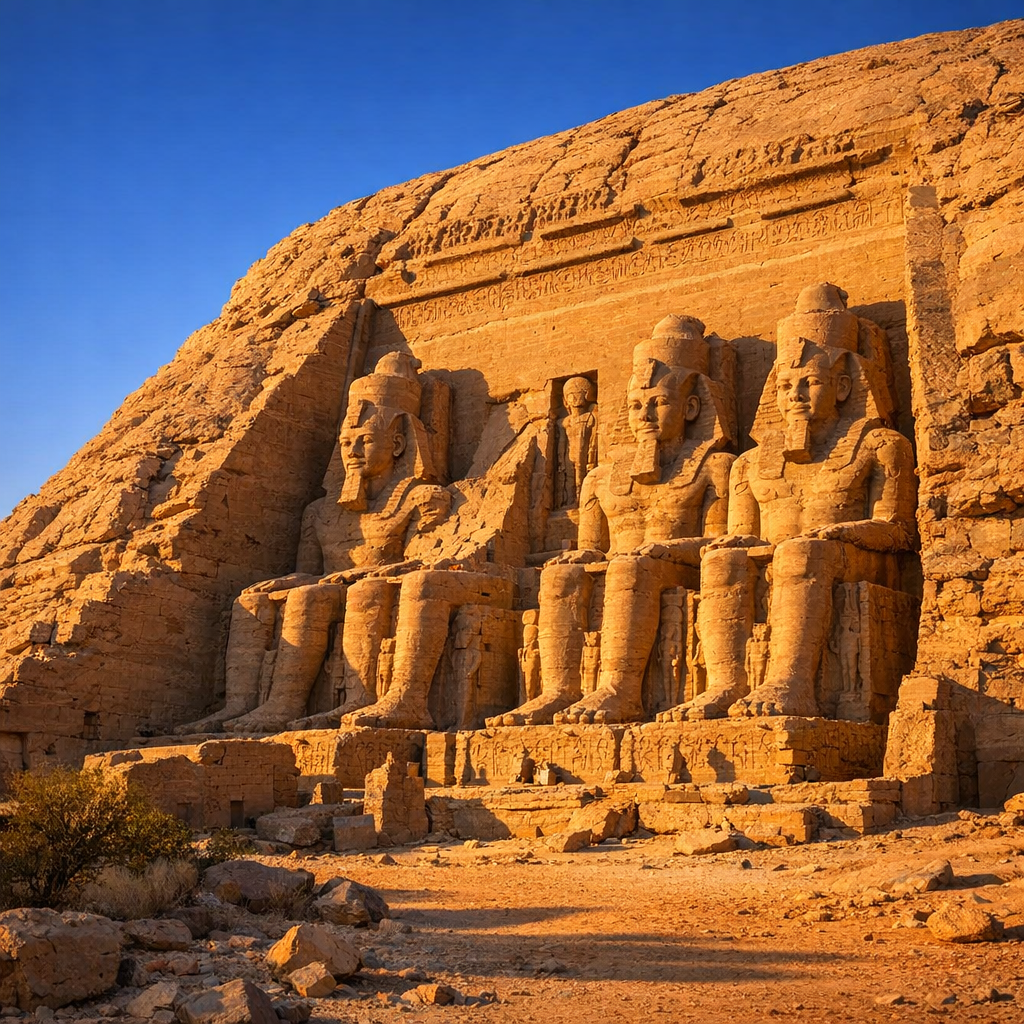
The most dramatic evidence of what the Aswan High Dam threatened sits three hours south of Aswan at Abu Simbel — the twin rock-cut temples built by Ramesses II, fronted by four colossal 66-foot seated statues of the pharaoh carved directly into a sandstone cliff face. Rising Lake Nasser waters would have submerged the temples completely.
Between 1964 and 1968, in one of the 20th century's most audacious heritage rescue efforts, UNESCO coordinated an international campaign — with more than 50 countries contributing funding — to cut both temples into an estimated 1,042 blocks weighing 20 to 30 tons each, and reassemble them 200 meters back from the original site and 65 meters higher on the plateau above. The project cost roughly $40 million at the time and is now regarded as the founding achievement behind UNESCO's World Heritage program, which grew directly out of the 1960–1980 Nubian monuments campaign. Seeing Abu Simbel today, few visitors realize the entire mountain behind the statues is a modern concrete dome built to replicate the original setting — the temples are exactly where engineers put them in 1968, not where Ramesses II built them roughly 3,200 years ago.
Pairing Aswan with Luxor and a Nile Cruise
Aswan is best experienced as one half of a longer Upper Egypt itinerary. A three- to four-night Nile cruise between Aswan and Luxor is the classic way to connect the two, gliding past riverside villages, sailboats, and farmland largely unchanged for centuries, with stops at temples along the way including Kom Ombo and Edfu.
In Luxor, the itinerary shifts from Nubian history to the height of New Kingdom Egypt: the Valley of the Kings, burial site of Tutankhamun and dozens of other pharaohs; the temple complexes of Karnak and Luxor Temple; and the Colossi of Memnon on the west bank. Seeing Luxor's monuments after Aswan and the Nubian Museum adds context most visitors miss entirely — you arrive already understanding that Egyptian history includes a century in which the pharaohs themselves were Nubian, and that the temples at Karnak carry additions from Kushite kings like Taharqa alongside their better-known Ramesside inscriptions.
Visa and Entry Logistics for US Travelers
US citizens need a visa to enter Egypt. As of March 2026, the visa-on-arrival fee is $30 USD (cash, single-entry), up from $25 previously, and is available at Cairo International Airport and other major airports and seaports. Travelers who prefer to skip the arrival line can apply in advance for an e-visa online through Egypt's official visa portal; e-visa applicants are not affected by on-arrival fee changes. Either way, a US passport valid for at least six months beyond your travel dates is required.
Best Time to Visit
Aswan and Luxor sit in Egypt's deep south, where summer heat is extreme — daytime temperatures regularly exceed 104°F (40°C) from June through August. The best window is November through March, when daytime highs settle into the comfortable 75–85°F range and Nile cruise season is in full swing. Shoulder months of October and April offer lower prices and thinner crowds at Abu Simbel and the Valley of the Kings, with slightly warmer but still manageable weather.
Practical Trip Planning
Getting there: Fly into Cairo International Airport (CAI), then connect via a short domestic flight to Aswan (AWS) or Luxor (LXR) — roughly 1.5 hours each way. Many travelers fly into Aswan and fly out of Luxor (or vice versa) to avoid backtracking, picking up a Nile cruise in between.
Getting around: Nile cruise ships handle transport between Aswan and Luxor directly. Within each city, hotels and cruise operators arrange private guided transport to Abu Simbel, the Valley of the Kings, and the Nubian villages — a licensed Egyptologist guide is strongly recommended for historical context at every site.
Must-try foods: Nubian-style grilled Nile fish, ful medames (stewed fava beans) for breakfast, koshari (Egypt's beloved rice-lentil-pasta dish), molokhia stew, and karkade (hibiscus tea), a Nubian and Upper Egyptian specialty served hot or iced.
Where to stay: Aswan's Old Cataract Hotel is the storied colonial-era landmark overlooking the Nile; Nubian-run guesthouses on Elephantine Island and the west bank offer a more intimate, community-connected stay. In Luxor, riverside hotels near Luxor Temple put you within walking distance of the East Bank monuments.
Safety: Upper Egypt's tourist circuit (Aswan, Luxor, Nile cruises, Abu Simbel) is well-patrolled and heavily used by international travelers, with a strong safety record. Standard travel precautions apply — stick to licensed guides and drivers, agree on prices in advance at markets, and keep copies of your passport and visa separate from the originals.
Book Your Nubia and Nile Journey
Book flights into Cairo and on to Aswan, secure your e-visa in advance, and look for Nile cruise packages that bundle Aswan, Abu Simbel, and Luxor into one itinerary — the most efficient and popular way to see this entire region.
🏨 Book Aswan & Luxor Hotels → 🚢 Find Nile Cruise Packages →*Affiliate links — BTN may earn a commission at no extra cost to you.