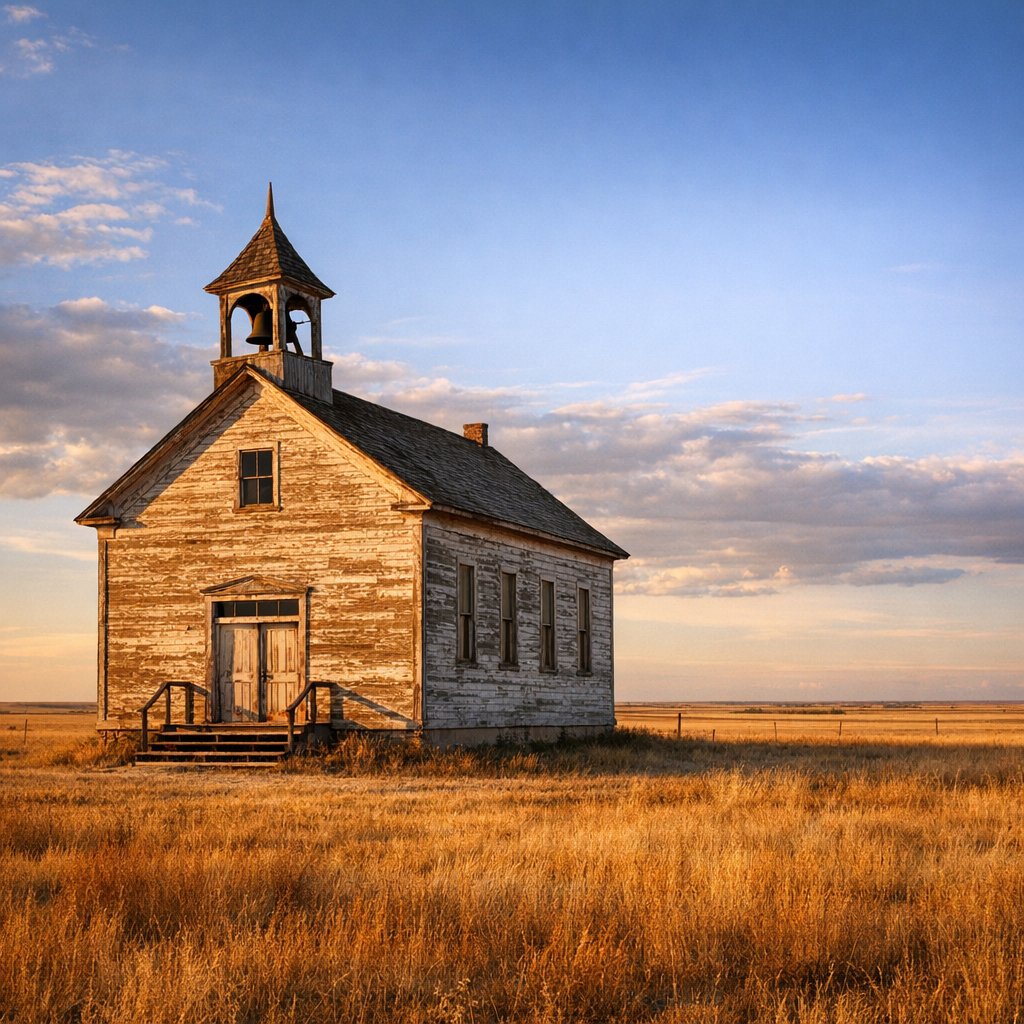
The Last Town Standing
There used to be dozens of them. Across the Kansas prairie in the 1870s and 1880s, formerly enslaved people who fled the collapsing promises of Reconstruction in the South built entire towns from nothing — Nicodemus, Morton City, Hill City's early Black settlements, Dunlap, Blackdom further south in New Mexico. Most of them didn't make it. The railroads bypassed them, the droughts broke them, the young people left for Topeka and Kansas City and Denver, and one by one the all-Black towns of the Great Plains emptied out and disappeared into wheat fields.
Nicodemus didn't disappear. Nearly 150 years after a small group of formerly enslaved Kentuckians staked their claim on a stretch of empty prairie in Graham County, Nicodemus is still there — still home to descendants of its original founders, still gathering its extended family back every summer, and still standing as the only remaining Black settlement west of the Mississippi River founded during the Reconstruction era. That single fact makes this unassuming town of a few dozen residents one of the most historically important places in Black America, and one most travelers have never heard of.
How Nicodemus Was Built — From Scratch, By Choice
On April 18, 1877, seven men — six of them Black — organized the Nicodemus Town Company. The company's first president was Reverend W.H. Smith, a formerly enslaved minister who helped lead the effort to recruit settlers; W.R. Hill, a white land speculator, served as treasurer and helped promote the venture. Together they marketed Nicodemus to Black communities across Kentucky as a "Promised Land" — a place where formerly enslaved people could own land outright, govern themselves, and build lives beyond the reach of the sharecropping system and the terror campaigns rapidly reclaiming the post-war South.
The pitch worked. Settlers arrived by wagon, by rail to the nearest station, and on foot, carrying what little they owned across open prairie to a townsite that, in its first year, had no trees, no buildings, and no water source beyond the Solomon River. Many of the earliest arrivals survived that first winter in dugouts cut into the riverbank. By 1878, word had spread and roughly 600 people had settled in and around Nicodemus, part of the larger wave of Black Kentuckians and, soon after, "Exodusters" fleeing the Deep South for Kansas. A second wave of settlers arrived in 1878–79 with more capital and equipment, and for a few remarkable years Nicodemus was a genuine boomtown — with its own newspaper, hotels, churches, a bank, and a school district, all built and run by Black homesteaders on land they owned themselves.
Why It Survived When Every Other Town Like It Didn't
Nicodemus's decline actually began the way most of these towns died: in 1888, the Union Pacific Railroad chose to route its line through Bogue, a few miles away, instead of through Nicodemus. Without rail access, the town's commercial ambitions collapsed almost overnight, and much of the population that had come for opportunity moved on to towns the railroad did serve. It's the same story that erased nearly every other all-Black Great Plains settlement from the map.
What makes Nicodemus different is that a core of families simply stayed. Farming families with deep roots in the land didn't need the railroad the way merchants did, and generation after generation of the same founding families kept the town alive — smaller, quieter, but never empty. That continuity is the whole story. Nicodemus isn't a historic site built to commemorate something that ended; it's a living town where the people walking past the old Township Hall today are the great-great-grandchildren of the people who built it.
A National Historic Landmark — and a National Park
Nicodemus's significance didn't go unrecognized. The town was designated a National Historic Landmark in 1976, and on November 12, 1996, Congress established Nicodemus National Historic Site, bringing five surviving historic structures — the Township Hall, First Baptist Church, AME Church, St. Francis Hotel, and the District No. 1 School — under National Park Service protection and interpretation. It remains one of the smallest and least-visited units in the entire National Park System, which is exactly why so few travelers, Black or otherwise, have ever put it on a map.
Today, the historic Township Hall serves as a temporary NPS visitor center (a purpose-built center has long been discussed, but the century-old Township Hall — itself one of the five protected landmark buildings — currently does double duty as museum, film theater, gift shop, and Junior Ranger station). Inside, exhibits and a short park film walk visitors through the founding story, the Exoduster movement, and the lives of the families who made Nicodemus home. A 30-minute stop covers the exhibits and film; budget 1–2 hours if you want to walk the compact historic district and see all five landmark buildings up close, plus the historic cemetery on the edge of town where many of the original founders are buried.
Homecoming: The Celebration That Brings Nicodemus Back to Life
Once a year, this town of barely a few dozen year-round residents swells with hundreds of visitors, and it is unlike anything else on the Black travel calendar. Nicodemus holds one of the longest continuously running Emancipation celebrations in the United States — a tradition that dates back to the community's earliest decades, when descendants and former residents returned each summer to celebrate freedom and family. Over time the event became known as Homecoming, and it endures as the single most important date on the town's calendar: descendants travel back from Kansas City, Denver, Los Angeles, Chicago, and everywhere in between to reconnect with cousins, tend family graves, worship in the historic churches, and celebrate a heritage most of America has forgotten existed.
Homecoming is traditionally held during the last full weekend of July. Given today's date, that timing matters immediately: in 2026, the last full weekend of the month falls on July 25–26 — which means if you're reading this in the third week of July, the celebration is likely only days away, not a far-off event to pencil in for next year. Expect a weekend built around a parade, gospel programs and church services in the historic AME and First Baptist congregations, family reunion gatherings, storytelling from elders, and food. Because the exact schedule, and even the precise dates, can shift slightly year to year and are set by the Nicodemus Historical Society in coordination with the National Park Service, always confirm current details directly with the visitor center (785-839-4233) or the park's official events page before you finalize travel — this is a small-town celebration run by a small, dedicated community, not a large commercial festival with a locked-in calendar published years in advance.
Planning Your Visit — Why You'll Base Yourself in Hill City
Be honest with yourself about what Nicodemus is: a National Historic Site inside a working residential community of well under 100 people, not a tourist town. There are no hotels, and dining options inside Nicodemus itself are essentially nonexistent outside of Homecoming weekend, when the community pulls together to feed its returning families. That's part of what makes it special — but it also means you need a plan.
The overwhelming majority of visitors base themselves in Hill City, Kansas, about a 15-minute drive east on Highway 24. Hill City has the area's motels, a handful of diners and cafés serving solid Kansas comfort food, a grocery store, and gas — everything Nicodemus doesn't have. Stockton, a similar distance to the west on Highway 24, is a smaller secondary option. Plan to fuel up, eat, and sleep in Hill City, and treat Nicodemus itself as a focused half-day (or full Homecoming weekend) visit rather than a home base.
🏨 Find Hill City Lodging →Getting There
Nicodemus sits on Highway 24 in Graham County in northwestern Kansas, between Hill City and Stockton. There's no commercial airport nearby — the closest regional service is Hays Regional Airport, roughly an hour southeast, with limited connections; most travelers will fly into Denver or Kansas City and drive. From Denver, it's about 5.5 hours via I-70 east to Colby, then Highway 24 east through the prairie. From Kansas City, plan on roughly 5 hours via I-70 west to Hays, then north and west via Highway 183 and Highway 24. However you arrive, this is a driving trip — rent a car and budget real time for two-lane highway through genuinely rural Kansas.
✈️ Search Flights to Denver or Kansas City →Best Time to Visit
Late July, timed to Homecoming, is the single best week to experience Nicodemus — the town is at its fullest, most alive, and most welcoming to visitors. Outside of that weekend, spring (May–June) and early fall (September) offer the most comfortable prairie weather for walking the historic district and visiting the cemetery, with mild temperatures and lower humidity than the height of summer. Winters on the northwestern Kansas plains are harsh and the site's hours can be limited, so plan a warm-season trip.
BTN Insider Tips
Call ahead. The visitor center is small and seasonal hours can shift — a quick call to 785-839-4233 before you drive out saves a wasted trip.
If you're coming for Homecoming, book Hill City lodging as early as possible. Rooms are extremely limited across the whole area and the one weekend a year Nicodemus draws a crowd is exactly when those few rooms disappear first.
Visit the historic cemetery respectfully. It's an active burial ground for founding families, not simply a historic attraction.
Bring cash and fuel up before you leave Hill City or Stockton — services in Nicodemus itself are minimal to nonexistent outside Homecoming weekend.
Get your National Park Passport stamped at the Township Hall — a small but meaningful way to mark a visit to one of the rarest units in the entire park system.
Is Nicodemus Safe to Visit?
Yes. Nicodemus and the surrounding Graham County area are quiet, rural, and low-crime, with essentially none of the safety considerations that come up in bigger-city travel. The main practical concerns are entirely logistical — limited cell service in stretches of open prairie, long distances between fuel stops, and the need to plan around a small town's very real lack of infrastructure — rather than anything related to personal safety.
Mark Your Calendar
- Last full weekend of July — Nicodemus Homecoming/Emancipation Celebration (2026 dates: July 25–26) — parade, gospel services, family reunions, and community gatherings
- Year-round — Self-guided walking tours of the five National Historic Landmark buildings, available daily during visitor center hours
- February — Nicodemus National Historic Site publishes its annual newsletter recapping the prior year and previewing upcoming programming
The Bottom Line
Nicodemus, Kansas isn't a resort destination or a weekend nightlife scene — it's a pilgrimage. It's the chance to stand in the one place on the entire Great Plains where the Reconstruction-era promise of Black self-determination, land ownership, and community wasn't just attempted but actually survived, generation after generation, into the present day. Descendants still call it home. The Township Hall their ancestors built still stands. And once a year, in the last days of July, the whole extended family comes back to prove it.
🏨 Book Your Hill City Base Camp Now →*Affiliate links — BTN may earn a commission at no extra cost to you.