The Trance Music That Refused to Disappear
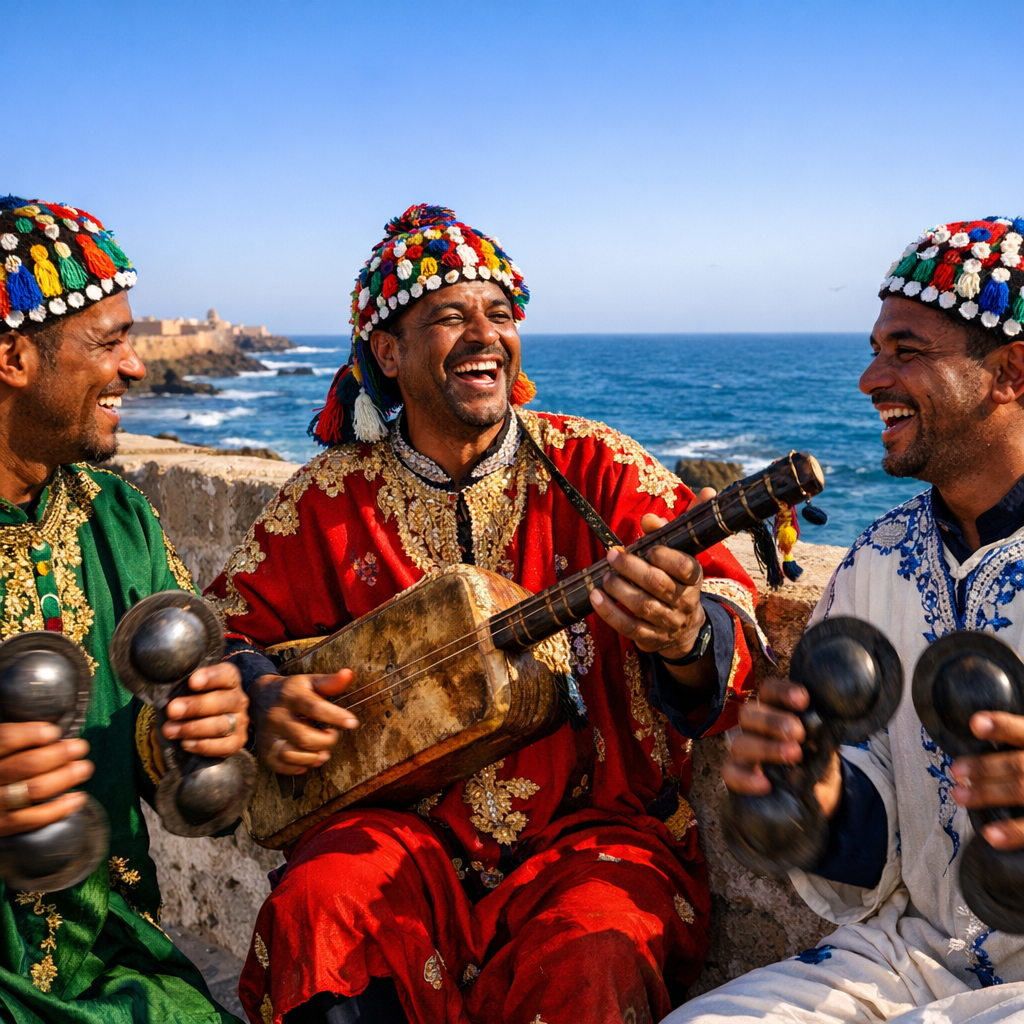
On a sunlit rampart in Essaouira, a musician in a tasseled cap raises two heavy iron castanets over his head and slams them together in a rhythm that feels older than the stone wall he's standing on. Behind him, a three-string lute called a guembri thumps out a bassline that seems to come from the earth itself. The crowd — Moroccan teenagers, European backpackers, diaspora travelers who flew in specifically for this — starts to sway, then spin, then lose themselves entirely. This is Gnaoua music, and it was not born as entertainment. It was born as survival.
Marrakech and Essaouira make one of the easiest, most rewarding entry points into North Africa for Black travelers — a red-walled imperial city and a windswept Atlantic port, connected by a straight three-hour road and a shared musical inheritance most visitors never learn the real story of. That story starts with enslaved West and Sub-Saharan Africans, and it deserves to be told with the same seriousness BTN brings to any site tied to the transatlantic slave trade, even as we cover the genuinely joyful, thumping, trance-inducing festival culture it produced.
Why Black Travelers Should Know Gnaoua's Real History
Gnaoua (also spelled Gnawa) music took shape in Morocco roughly between the 16th and 17th centuries, carried and created by people forcibly displaced through the trans-Saharan slave trade — a system that, over centuries, moved captives from a vast swath of West and Sub-Saharan Africa, from Senegal to Chad, Mali to southern Nigeria, into North Africa and the Arab world. Many of the Gnaoua's ancestors came from Hausa, Fulani, and Bambara communities. The word "Gnaoua" itself is believed to descend from Amazigh (Berber) and Sanhaja terms for "Black person," and it echoes the same root that gave us "Guinea" and the historic Ghana Empire — a linguistic fingerprint of exactly where these communities came from.
What the enslaved Gnaoua built out of that displacement was music that functioned as memory. Early Gnaoua songs speak plainly of abduction, suffering, and loss — coded testimony passed down through rhythm because it could not be safely spoken any other way. Over generations, that testimony fused with Sufi Islamic devotional practice into something distinctly Moroccan: sacred healing ceremonies called lila or derdeba, all-night rituals led by a master musician (the maalem) that invoke seven families of spirits, each tied to its own color, incense, and rhythm. Participants enter a trance state called jedba, seeking healing and spiritual balance. In 2019, UNESCO inscribed Gnaoua on its Intangible Cultural Heritage of Humanity list, recognizing it as a living tradition rather than a museum piece.
Today's Gnaoua community identifies first as Moroccan and Muslim, with sub-Saharan ancestry as a secondary but unmistakable layer of identity — different from how diaspora identity tends to work in the Americas, and worth sitting with rather than glossing over.
An Important Distinction: This Is Not a Slave-Castle Narrative
If you've traveled to Ghana's Cape Coast or Elmina castles, or Senegal's Gorée Island, it's tempting to file Morocco's Black history under the same heading. Don't. Those sites mark the Atlantic slave trade — the system that forced millions of West Africans through coastal dungeons and the literal Door of No Return, onto ships bound for the Americas and the Caribbean. Marrakech and Essaouira sit on a different, older route entirely: the trans-Saharan and Arab-Mediterranean slave trade, which moved captives north across the desert into Morocco, Algeria, Tunisia, Egypt, and beyond, over many centuries and largely by different mechanisms and destinations.
Both systems were brutal. Both are part of the global story of African enslavement. But they are separate diasporas with separate histories, separate present-day communities, and separate memorials. Essaouira has no equivalent to a Door of No Return, and you shouldn't expect one. What you will find is a living community — the Gnaoua — whose music is the clearest surviving thread connecting Morocco to West and Sub-Saharan Africa. Come for that thread. Don't force it into a different story.
The Gnaoua World Music Festival — What Just Happened, and What's Next
Essaouira's Gnaoua World Music Festival is Morocco's largest music festival and one of the biggest gatherings of its kind in North Africa. Founded in 1998 by Moroccan producer Neila Tazi, it started as a modest four-day celebration of Gnaoua tradition and has since grown from roughly 20,000 attendees to well over 200,000 — spilling across Essaouira's ramparts, squares, and beaches with dozens of free stages pairing Gnaoua maalems with jazz, blues, reggae, and hip-hop artists from around the world.
Here's the timing to know if you're planning around it: the 2026 edition (the festival's 27th) ran June 25–27, 2026 — which means if you're reading this any time after late June, you've missed this year's festival by a few weeks. We're covering it here as both a recap of what just went down and a planning guide for 2027, when the festival should return on its typical late-June schedule. If Gnaoua is your main reason for visiting, mark your 2027 calendar now and book Essaouira accommodation the moment dates are confirmed — rooms in the medina sell out months ahead.
Missed the festival window entirely? Essaouira's Gnaoua culture isn't seasonal. Smaller lila ceremonies, informal jam sessions in medina riads, and Gnaoua-influenced live music happen year-round — ask your riad host or a local guide to point you toward an authentic one rather than a tourist-trap version.
Marrakech's Medina — Sensory Overload, By Design
The Medina of Marrakesh has been a UNESCO World Heritage Site since 1985, and walking into it feels like stepping into a maze built specifically to disorient you in the best way. Eighteen souks packed with more than 40,000 artisans sell leather, carpets, lanterns, spices, and metalwork down narrow alleys that all look identical until you've walked them a dozen times. Everything converges on Jemaa el-Fnaa, the main square, where snake charmers, storytellers, and food stalls have operated since the Almoravid era — and where, as the sun sets, dozens of open-air grill stands turn the square into the city's biggest, loudest dinner party. The 12th-century Koutoubia Mosque, with its 77-meter minaret, anchors the skyline and reportedly inspired Seville's Giralda tower.
Budget a full day just to get comfortably lost. Hire a local guide for your first souk visit — it's worth the fee to navigate efficiently and to buy at fair prices rather than tourist markups.
Essaouira — Morocco's Chillest Coastal Escape
Two and a half to three hours west of Marrakech by road, Essaouira is the deliberate exhale after Marrakech's intensity. Also UNESCO-listed (inscribed in 2001 as the "Medina of Essaouira, formerly Mogador"), its blue-and-white medina sits behind sea-battered stone ramparts — the Skala du Port and Skala de la Kasbah — that offer some of the best sunset views on Morocco's coast. The Atlantic wind that makes the city one of the world's top windsurfing and kitesurfing spots also keeps the temperature noticeably cooler than inland Marrakech, a welcome relief in summer.
Essaouira's fishing port is still a working one — watch the blue boats come in each morning and grab grilled sardines straight off the dock for a few dirhams. The medina's gallery scene, built on a long tradition of Gnaoua-adjacent visual artists, is one of Morocco's most underrated art destinations.
Where to Eat
- Tagine — the slow-cooked stew (chicken with preserved lemon and olives is the classic) served in its namesake conical clay pot, available everywhere from street stalls to riad restaurants.
- Pastilla — a sweet-savory pigeon or chicken pie dusted with cinnamon and sugar, a Marrakech specialty best eaten at a traditional restaurant in the medina.
- Msemen — flaky, square, pan-fried flatbread sold hot off griddles across both cities; eat it with honey or cheese for breakfast.
- Harira — a hearty tomato-lentil soup, especially good in the evening, sold at food stalls and restaurants alike.
- Fresh grilled sardines — Essaouira's signature dish, bought straight from the port fish stalls and grilled to order.
- Moroccan mint tea — poured from height into small glasses, offered constantly, and impossible to refuse gracefully (don't try).
Where to Stay
Marrakech: Traditional riads inside the medina walls — courtyard guesthouses with rooftop terraces — offer the most atmospheric stay, typically $60-150/night for boutique properties. For full luxury, the Guéliz district's five-star resorts offer pools and spas outside the medina hustle.
Essaouira: Medina riads near the ramparts put you steps from the port and beach, often for less than comparable Marrakech properties. Book well ahead for late June if you're targeting the 2027 festival dates.
🏨 Book Marrakech & Essaouira Hotels →Getting There & Getting Around
Marrakech Menara Airport (RAK) has direct flights from several European hubs and connections from major US cities via Paris, London, or Casablanca; expect 12-16 hours total travel time from the US East Coast. Essaouira has its own small airport (ESU) with limited service, but most travelers fly into Marrakech and take the scenic 2.5-3 hour drive or CTM bus west to the coast.
Within Marrakech, petit taxis (metered, for short in-city trips) and grand taxis (shared, for longer routes) are the norm; ride-hailing apps have limited coverage. Morocco's ONCF rail network connects Marrakech to Casablanca and other major cities efficiently.
✈️ Find Flights to Marrakech →Visa & Entry for US Travelers
US citizens do not need a visa for tourist stays in Morocco of up to 90 days — just a passport valid for the duration of your trip. This visa-free access, combined with direct flight options and a straightforward entry process, makes Morocco one of the easiest North African countries for American travelers to visit on relatively short notice.
Best Time to Visit
Spring (March-May) and fall (September-November) offer the most comfortable temperatures in both cities. Marrakech summers get brutally hot (regularly 100°F+), while Essaouira's coastal breeze keeps it noticeably milder year-round — a smart summer alternative if you're set on traveling in the heat months. If the Gnaoua Festival is your priority, plan around late June and expect Essaouira to be at its most crowded and its most alive.
Budget Guide
Budget: $40-70/day — shared or budget riad rooms, street food and cheap tagines, walking and petit taxis.
Mid-range: $100-180/day — boutique riad, sit-down restaurant meals, guided souk tour, day trip to Essaouira.
Luxury: $250-450+/day — five-star riad or resort, private guide, spa hammam experiences, fine dining.
BTN Insider Tips
Agree on taxi fares before you get in. Meters are inconsistently used; negotiate the price upfront, especially from airports.
Dress modestly, especially outside tourist zones. Shoulders and knees covered will make your medina walks noticeably smoother.
Learn a few Darija (Moroccan Arabic) phrases. "Shukran" (thank you) and "La, shukran" (no, thank you — essential for polite souk exits) go a long way.
Seek out a real Gnaoua lila, not just the festival stage. Ask your riad host to connect you with an authentic ceremony for a deeper, quieter experience of the tradition.
Carry cash in dirhams. Many medina vendors and small restaurants don't take cards.
Is Morocco Safe for Black Travelers?
Morocco is generally safe and welcoming for Black travelers, with low violent crime rates in tourist areas. As in any major medina, petty theft and aggressive vendor tactics are the most common annoyances rather than genuine danger. Some Black travelers report occasional stares or assumptions of being sub-Saharan African migrants (a group that faces real discrimination in Morocco) rather than tourists — a dynamic worth being aware of, though it rarely escalates beyond curiosity or minor friction. Standard urban travel precautions apply after dark, and solo travelers should stick to well-lit, populated medina routes at night.
Mark Your Calendar
- Late June (2027 dates TBA) — Gnaoua World Music Festival, Essaouira
- Year-round — Informal Gnaoua lila ceremonies in Marrakech and Essaouira riads
- April — Marrakech Biennale (art, in biennial years)
Book Your Morocco Trip
Marrakech will overwhelm your senses. Essaouira will let you exhale. And Gnaoua's rhythm — born from displacement, kept alive through generations, still thundering off the ramparts every June — will follow you home.
✈️ Book Your Morocco Trip Now →*Affiliate links — BTN may earn a commission at no extra cost to you.