A City That Asks You to Look Directly at the Truth
Montgomery does not let you visit casually. This is a city built around a hinge point in American history — the place where Dr. Martin Luther King Jr. preached his first sermons as a young pastor, where Rosa Parks refused to give up her seat, and where, in April 2018, Bryan Stevenson's Equal Justice Initiative (EJI) opened the two institutions that changed how the country talks about its own past: the Legacy Museum and the National Memorial for Peace and Justice.
Together they form the first major American museum and memorial to tell slavery, lynching, and mass incarceration as one continuous story rather than three separate chapters. That framing is the whole point. EJI's argument — made through documents, first-person narratives, sculpture, and, at the memorial, 800 suspended steel monuments — is that the racial terror of the past did not end; it changed shape. This is a serious visit, built with the same intent and dignity as a place like the U.S. Holocaust Memorial Museum, and it deserves the same unhurried attention.
The Legacy Museum: From Enslavement to Mass Incarceration
The Legacy Museum sits at 400 N. Court Street in downtown Montgomery, built on the site of a former warehouse where enslaved people were once held before being sold — EJI chose the location deliberately. Inside, the exhibits move chronologically and thematically through the domestic slave trade, the decades of racial terror lynching that followed emancipation, the enforced segregation of Jim Crow, and the through-line EJI draws to mass incarceration and the modern criminal justice system.
The museum uses first-person slave narratives, soil collected from lynching sites around the country, video testimony from currently and formerly incarcerated people, and immersive holographic installations of enslaved men and women describing their own experiences. It is not an exhibit designed for a quick walkthrough. Plan for two to five hours, and know that same-day re-admission is generally available if you need to step outside and reset.
The National Memorial for Peace and Justice
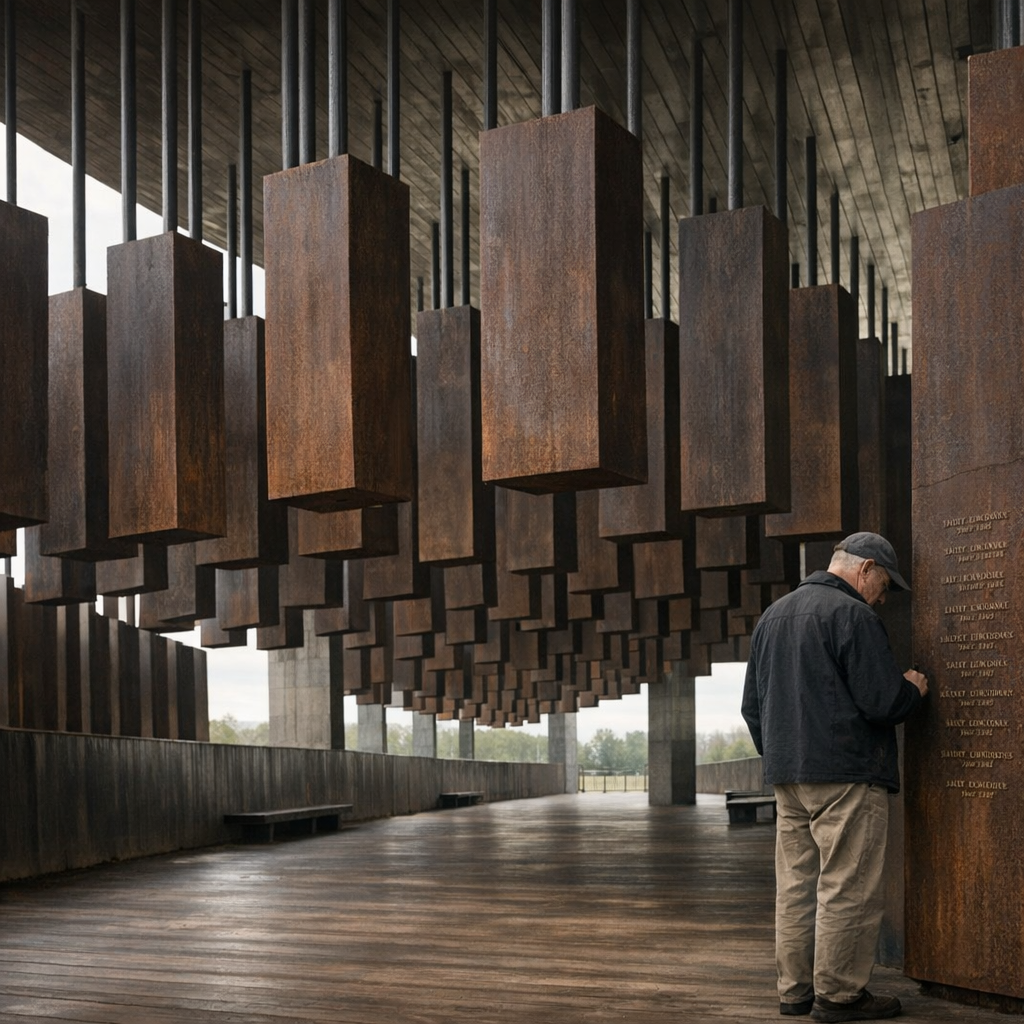
A short distance away, at 417 Caroline Street, the National Memorial for Peace and Justice occupies a six-acre site on a rise overlooking the city. Its centerpiece is more than 800 corten-steel monuments, each engraved with the name of a U.S. county and the names of the documented lynching victims from that county between roughly 1877 and 1950. As you walk further into the pavilion, the ground slopes downward and the monuments begin to rise overhead, until you are walking beneath them the way lynching victims' bodies once hung — a design choice EJI has been explicit about, and one that lands with real physical weight.
Outside the main pavilion, a duplicate set of the 800 monuments lies waiting, unclaimed, in a field — EJI's invitation to the counties named on them to claim their monument and install it at home as a public acknowledgment of what happened there. Only a fraction have been claimed so far. The memorial also includes a wall of water dedicated to victims of lynching whose names were never recorded, and a small sculpture garden with contemporary works by artists including Kwame Akoto-Bamfo and Dana King, whose sculpture of women who sustained the Montgomery Bus Boycott stands near the entrance. Plan for one to two hours, and expect to want longer.
Freedom Monument Sculpture Park
EJI has continued expanding the Legacy Sites campus. The Freedom Monument Sculpture Park, its newest addition along the Alabama River, is now included on the same combined ticket alongside the Legacy Museum and the Memorial. It traces the history of the domestic slave trade along the waterways that once carried enslaved people into Montgomery, and it's worth building into your day if time allows — check the current site map when you buy tickets, since EJI's campus has grown site by site since 2018.
Dexter Avenue King Memorial Baptist Church
Walk roughly ten minutes from the Legacy Museum and you reach Dexter Avenue King Memorial Baptist Church, founded in 1877 and housed in its current red-brick building since 1889, standing at the corner of Dexter Avenue and Decatur Street — close enough to the Alabama State Capitol that you can see the capitol dome from the church steps, a proximity that was never lost on the congregation. Dr. Martin Luther King Jr. served as the church's twentieth pastor from 1954 to 1960, and it was from his basement office here that he helped organize the 1955-56 Montgomery Bus Boycott. The church was renamed in his honor in 1978. Guided tours run on a set schedule and take you through the sanctuary and King's basement office, largely preserved as he left it.
The Rosa Parks Museum
A few blocks over, operated by Troy University, the Rosa Parks Museum stands on the site of the old Empire Theatre, directly where Rosa Parks boarded the bus and made her stand on December 1, 1955. The museum opened in 2000, on the 45th anniversary of her arrest, and its core exhibits — a restored period bus, a recreation of Holt Street Baptist Church where the boycott was launched, and a negotiation room depicting the standoff between city officials and boycott organizers — walk you through the 381 days of the boycott hour by hour. A Children's Wing and a research center round out a visit that typically runs 60-90 minutes.
Planning a Respectful Full Day
As of this writing, EJI's Legacy Sites operate on a single combined general-admission e-ticket (around $5) covering the Legacy Museum, the National Memorial for Peace and Justice, and the Freedom Monument Sculpture Park. Sites are open Wednesday through Monday, 9am to 6pm, and closed Tuesdays as well as Thanksgiving, Christmas, and New Year's Day. The Legacy Museum requires timed-entry tickets valid for a specific date and time, so book online in advance rather than counting on walking up — same-day tickets exist in limited quantities but cannot be relied on, especially during school-trip season or around civil rights anniversary dates. The Memorial and Sculpture Park tickets are typically valid any time on your chosen date. A free shuttle connects the Legacy Museum and the Memorial.
EJI has changed its reservation system before, so confirm current ticket policy, pricing, and hours directly at legacysites.eji.org before you finalize plans — do not rely on older articles (including this one, eventually) for exact pricing.
BTN's suggested order for a full day: start at the Legacy Museum in the morning when you're freshest — it demands the most emotional and mental bandwidth. Take the shuttle or a short walk to the Memorial afterward and give yourself unhurried time among the monuments. Break for lunch. In the afternoon, walk to Dexter Avenue King Memorial Baptist Church and the Rosa Parks Museum, both an easy walk from each other and from the State Capitol. This order moves you from the hardest history toward the movement that answered it, which is also, not coincidentally, the emotional arc EJI itself intends.
Getting There & Where to Stay
Montgomery Regional Airport (MGM) has limited direct service, mostly connecting through Atlanta and Dallas. Most travelers fly into Atlanta, Birmingham, or Huntsville and drive two to three hours via I-85 or I-65, which also makes Montgomery an easy pairing with a Birmingham civil rights itinerary (the 16th Street Baptist Church, the Civil Rights Institute) or an Atlanta trip. A rental car is the most practical way to get around; downtown's historic sites cluster within about a mile of each other, but restaurants and some hotels sit further out.
Budget travelers will find reliable chain hotels downtown and near the Capitol from $90-130/night. Mid-range travelers should look at the historic Renaissance Montgomery Hotel & Spa at the Convention Center or boutique properties in the Cloverdale and Garden District areas from $150-220/night.
🏨 Book Montgomery Hotels →Best Time to Visit
Alabama summers run hot and thick with humidity, often into the mid-90s°F with heavy afternoon thunderstorms — not ideal for a day spent largely walking outdoors at the Memorial. Spring (March-May) and fall (September-November) bring milder temperatures in the 60s-70s°F and are BTN's recommended windows. Late January, around the Martin Luther King Jr. Day holiday, draws additional programming and larger crowds at all the sites, worth planning around if you want either the energy of that week or a quieter visit away from it.
BTN Insider Tips
Book Legacy Museum timed tickets as soon as your dates are set. This is the piece most likely to sell out or restrict your preferred entry time.
Give the Memorial its own unhurried block of time. Don't schedule anything immediately after it. Most visitors need a quiet moment before moving on.
Go early in the day for the Legacy Museum. It is dense and emotionally demanding; you'll absorb more with a clear head.
Bring water and wear comfortable shoes. The Memorial's outdoor pavilion has limited shade, and downtown Montgomery's sites require real walking between them.
Pair the day with the Alabama State Capitol and the Civil Rights Memorial (designed by Maya Lin, a short walk from Dexter Avenue Church) if you have a second day — Montgomery rewards travelers who slow down rather than checklist their way through.
Book Your Montgomery Trip
Montgomery is not a destination for a quick weekend distraction. It is a city that asks you to sit with hard history and walk out the other side understanding something about the present you didn't fully understand before. Go with time, go with an open chest, and go ready to listen.
✈️ Find Flights to Montgomery →*Affiliate links — BTN may earn a commission at no extra cost to you. Ticket pricing and reservation policy for the Legacy Museum and National Memorial for Peace and Justice are subject to change — always confirm current details at legacysites.eji.org before you travel.