The Afro-Spanish Story Nobody Told You
Ask most American travelers about the Black diaspora in Europe and you'll hear about Paris — the Harlem Renaissance expats, the jazz clubs of Montmartre, James Baldwin's Left Bank. You might hear about London's Windrush generation and Brixton. Spain almost never comes up. That's a gap, and it's one worth closing, because Madrid holds a diaspora story that is genuinely distinct from France's or Britain's — rooted not in a sprawling colonial empire across West and North Africa, but in a much smaller, much less discussed one: Spain's colonization of what is now Equatorial Guinea, the only country in sub-Saharan Africa where Spanish is an official language.
That colonial thread, plus decades of separate West African labor migration — largely from Senegal — has produced a real, lived Afro-Spanish and West African community in Madrid, concentrated most visibly in the historic, working-class neighborhood of Lavapiés. It is not a diaspora capital on the scale of Accra or Paris. It is smaller, quieter, and — by the BTN team's own research for this piece — noticeably under-documented in English-language sources. We think that makes it more worth a visit, not less. This guide lays out what is well established, what is harder to verify, and what a Black traveler should actually expect on the ground.
Equatorial Guinea: Spain's Overlooked African Colony
Equatorial Guinea's relationship with Spain dates back to 1778, when Portugal ceded Bioko Island (then called Fernando Po) and trading rights along the Bight of Biafra to Spain under the Treaty of El Pardo. Spain administered the mainland region of Río Muni and the island territories as a colony for nearly two centuries, developing cacao and coffee plantations and, like every European colonial power in Africa, extracting resources and labor while imposing Spanish language, law, and Catholic religious institutions on the local Fang, Bubi, and other ethnic populations.
Equatorial Guinea gained its independence from Spain on October 12, 1968, becoming Africa's newest sovereign state at the time. Francisco Macías Nguema became the country's first president after what historical accounts describe as the country's only genuinely free and fair election — a democratic start that was tragically short-lived. Macías's rule quickly turned into one of the most brutal dictatorships in modern African history, and he was overthrown in 1979 by his nephew, Teodoro Obiang Nguema Mbasogo, who remains president today — making him one of the longest-serving heads of state in the world.
The linguistic legacy of that colonial century is Equatorial Guinea's most visible connection to Spain today: it is the only country in sub-Saharan Africa with Spanish as an official language (alongside French and Portuguese, reflecting its later diplomatic ties to Francophone Central Africa and Lusophone São Tomé). Spanish surnames, Spanish-language education, and Catholic institutions are woven throughout Equatoguinean society in a way found nowhere else on the continent.
That linguistic and administrative bond has meant something concrete for migration patterns: Equatoguinean nationals have had a uniquely direct language and cultural bridge into Spain compared to migrants from Francophone or Anglophone Africa arriving in a Spanish-speaking country. Spain also maintains a specific, if complicated, diplomatic relationship with its former colony, and there is a longstanding — though modest in absolute numbers — Equatoguinean community in Madrid and Barcelona built over multiple generations, including students, professionals, and political exiles who have left the Obiang government over the decades.
A transparency note: Precise, current population figures for the Equatoguinean community specifically within Madrid (as opposed to Spain overall) are not consistently reported in accessible English-language sources, and estimates vary by source and year. We're flagging that rather than inventing a number — if you're researching this deeper, Spain's Instituto Nacional de Estadística (INE) is the most authoritative starting point for citizenship-by-country-of-origin data.
Lavapiés: Madrid's Most Diverse Neighborhood
If Equatorial Guinea is the historical thread, Lavapiés is where you actually feel it on the ground — though what you'll encounter there is a broader West African and immigrant story, not an Equatoguinean neighborhood specifically. Located just south of Madrid's city center in the Centro district, Lavapiés has a working-class history stretching back centuries; the name is popularly said to derive from a fountain once located in the neighborhood's central plaza, where residents literally washed their feet.
For most of the 20th century, Lavapiés was a poor, dense, and somewhat overlooked corner of Madrid — by the 1980s and '90s it had a reputation as a center of squatting and urban decline. That changed as waves of immigration transformed the neighborhood starting in the late 1990s and accelerating through the 2000s. Today, Lavapiés is widely cited as one of the most ethnically diverse neighborhoods in Spain: a substantial share of its residents were born outside Spain, representing dozens of nationalities, with especially visible communities from Senegal and other parts of West Africa, Bangladesh, India, China, and North Africa.
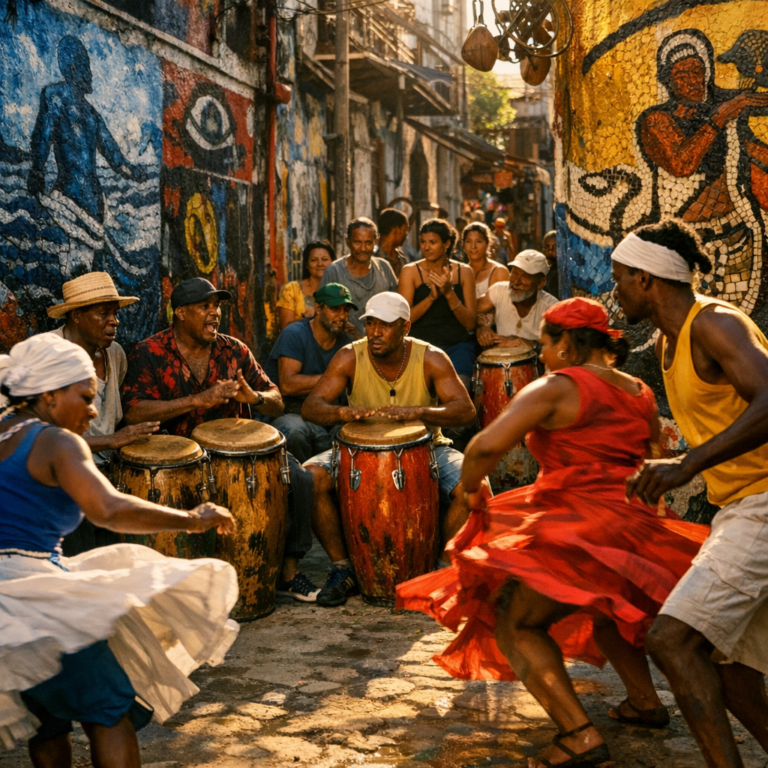
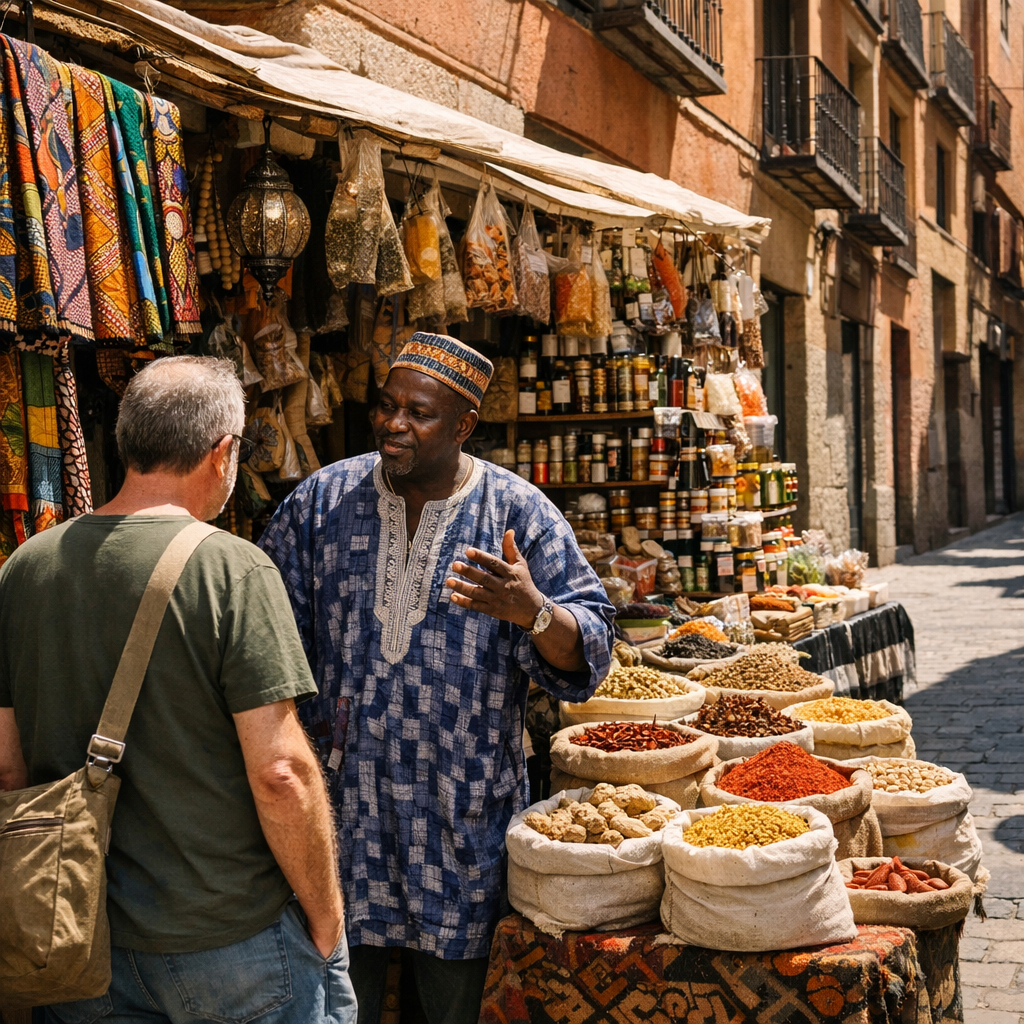
Walk down Calle de Lavapiés or Calle Ave María and the texture of the neighborhood is unmistakable — West African fabric shops, halal butchers, Senegalese hair braiding salons, Bangladeshi grocery stores, and Chinese wholesalers exist alongside centuries-old Spanish tapas bars and modern art galleries. It is loud, dense, occasionally a little rough around the edges, and completely unlike the postcard version of Madrid most first-time visitors expect.
The Senegalese community is the most visible West African presence in the neighborhood, and Senegalese street vendors — known locally and sometimes controversially as "manteros" for the blankets (mantas) they once used to display goods — have been a recognizable, if politically fraught, part of central Madrid's streetscape for years, particularly around Puerta del Sol and Plaza Mayor. Their presence has also been the subject of real tension: informal street vending is illegal in Spain, and there have been documented incidents of police crackdowns and, in at least one widely reported case, the death of a Senegalese vendor during a 2018 police operation, which sparked protests across Madrid's African community. We raise this not to alarm travelers but because it's part of an honest picture of the community's history in the city — this is a population that has organized, protested, and asserted its presence in Spanish civic life, not just a backdrop for tourism.
Lavapiés is also politically and culturally significant in its own right, independent of its African diaspora communities — it has a long reputation as a hub of anti-Francoist sentiment historically, and today as a center of street art, alternative theater, independent bookstores, and left-leaning activism. The annual La Paloma festival in early August fills the neighborhood's streets with verbenas (traditional street parties), and the area's street art scene, concentrated especially around Calle de la Fe and Plaza de Lavapiés, is considered among the best in the city.
What to Do and See
Plaza de Lavapiés — The neighborhood's social heart, ringed by cafes and the Teatro Valle-Inclán. Good for people-watching and orienting yourself before exploring the surrounding streets.
Calle Ave María and Calle Argumosa — The commercial spine of the diaspora community: West African fabric and grocery shops, Senegalese-run businesses, and a genuinely international strip of small restaurants.
Mercado de San Fernando — A restored municipal market that mixes traditional Spanish food stalls with newer, multicultural vendors, reflecting the neighborhood's blended identity.
Tabacalera de Lavapiés — A former state tobacco factory turned self-managed social and cultural center, hosting free exhibitions, workshops, and community events with an activist, anti-establishment bent typical of the neighborhood.
Street art walk — Muralistas Ferroviarios and other clusters of large-scale street murals near Calle de la Fe and Calle del Sombrerete document decades of political and social commentary painted directly onto the neighborhood's building facades.
Where to Eat
Senegalese and West African restaurants — Small, family-run spots around Calle Ave María and the surrounding blocks serve thieboudienne (Senegal's national fish-and-rice dish), yassa chicken, and mafé (peanut stew). These places are modest, cash-friendly, and some of the most authentic West African cooking in continental Spain.
Cocido madrileño — Madrid's iconic chickpea, meat, and vegetable stew, traditionally served in courses. Worth having at least once at a classic, old-school Madrid restaurant to understand the city's own culinary identity alongside its diaspora food scene.
Tapas crawl — Patatas bravas, jamón ibérico, croquetas, and tortilla española at the traditional bars scattered throughout Lavapiés and neighboring La Latina, best done standing at the bar, moving between two or three spots over an evening.
Mercado de San Fernando food stalls — A good one-stop option to sample both traditional Spanish small plates and international offerings from the neighborhood's diaspora-run vendors in a single visit.
Practical Planning: Getting There and Around
Madrid-Barajas Adolfo Suárez Airport (MAD) is one of the best-connected hubs in Europe, with direct flights from New York (JFK), Miami, Washington DC (IAD), Atlanta, and other major US gateway cities on Iberia, American Airlines, Delta, and United — typically 7.5 to 8.5 hours from the US East Coast. Madrid's metro system is extensive, clean, and inexpensive, with the Lavapiés station on Line 3 dropping you directly into the neighborhood. The city overall is highly walkable, and a 10-trip Metrobus pass covers both metro and bus travel at a significant discount over single tickets.
Entry Requirements for US Travelers
As of this writing, US citizens can enter Spain visa-free for tourism or business for up to 90 days within any 180-day period, under the standard Schengen Area rules that apply across most of the EU. Your passport should be valid for at least three months beyond your planned departure date, and having a return ticket and proof of sufficient funds on hand is good practice even though it's rarely checked. One thing to verify closer to your travel date: the EU's ETIAS pre-travel authorization system (a low-cost online registration, not a visa) has been repeatedly delayed and, as of mid-2026, its enforcement start date has continued to shift — check the official ETIAS website and the US State Department's Spain page before you fly, since requirements can change with little notice.
Best Time to Visit
Madrid's climate is continental — hot, dry summers and cold winters. Late spring (April through June) and early fall (September and October) offer the most comfortable temperatures for walking neighborhoods like Lavapiés for hours at a time. July and August bring intense heat (often 95°F-plus) and see many locals leave the city, though tourist-facing businesses stay open. Winter is mild by US East Coast standards but can be gray and damp.
Budget Guide
Budget: $80-120/day — hostel or budget guesthouse, market and casual diaspora restaurant meals, metro transport, free museum days and street art walks.
Mid-range: $150-250/day — boutique hotel, sit-down restaurant meals, paid museum entries, occasional taxis.
Luxury: $350-600+/day — five-star hotel in Centro or Salamanca, fine dining, private guided tours.
Where to Stay
Boutique/Mid-Range: Several well-reviewed boutique hotels and aparthotels sit directly in or bordering Lavapiés and the adjacent La Latina and Centro districts, putting you within walking distance of both the diaspora neighborhood and Madrid's major sights like the Prado and Retiro Park.
Budget: Hostels and guesthouses throughout Lavapiés and neighboring Embajadores offer some of the most affordable rates in central Madrid, reflecting the neighborhood's still-working-class character even as parts of it gentrify.
Luxury: Madrid's grand hotels are concentrated around Gran Vía, Sol, and Salamanca, a short metro ride or taxi from Lavapiés.
🏨 Book Madrid Hotels → ✈️ Find Madrid Flights →BTN Insider Tips
Go with curiosity, not a checklist. Lavapiés rewards slow wandering — a fabric shop, a Senegalese restaurant, a mural, a market stall — more than a rigid list of "top sights."
Learn a little Wolof or Spanish greeting, not just Spanish. Many shop owners in the neighborhood are Senegalese and will appreciate the acknowledgment that Lavapiés isn't monolithically Spanish.
Visit Tabacalera when something's on. Its program of free exhibitions and events changes often — check ahead so you don't just see a closed gate.
Be a respectful, cash-carrying customer at informal vendors. Street vending is a livelihood, and a contested one; treat vendors with the same courtesy you'd extend to any small business owner.
Pair this trip with wider research. Because Afro-Spanish community history is genuinely under-documented in English, consider supplementing this guide with Spanish-language sources or INE demographic data if you want to go deeper before you travel.
Is Madrid Safe for Black Travelers?
Madrid is generally rated a very safe major European capital, with low violent crime and a well-developed tourist infrastructure. That said, Spain — like much of Europe — has documented instances of racial profiling and discrimination affecting Black and North African residents and visitors, including in policing of informal street vendors described above. Most Black travelers report positive experiences in Madrid day to day, particularly in diverse, welcoming neighborhoods like Lavapiés, but it's worth going in with realistic expectations rather than assuming Spain is free of the racial dynamics found elsewhere in Europe.
Mark Your Calendar
- Early August — La Paloma festival, Lavapiés's biggest traditional street celebration
- October 12 — Fiesta Nacional de España (Spain's national day), also historically Equatorial Guinea's independence day from Spain (1968)
- Year-round — Rotating exhibitions and cultural programming at Tabacalera de Lavapiés
Book Your Madrid Trip
Madrid won't hand you its Afro-Spanish story on a plaque or a museum wall — you have to walk Lavapiés's streets, eat at its diaspora-run restaurants, and sit with a history that connects a small West African country's Spanish colonial past to a very real, very present community in the Spanish capital. It's a quieter kind of diaspora travel than Accra or Dakar, but it's real, and it's rarely covered in English. Go see it for yourself.
✈️ Book Your Madrid Trip Now →*Affiliate links — BTN may earn a commission at no extra cost to you.