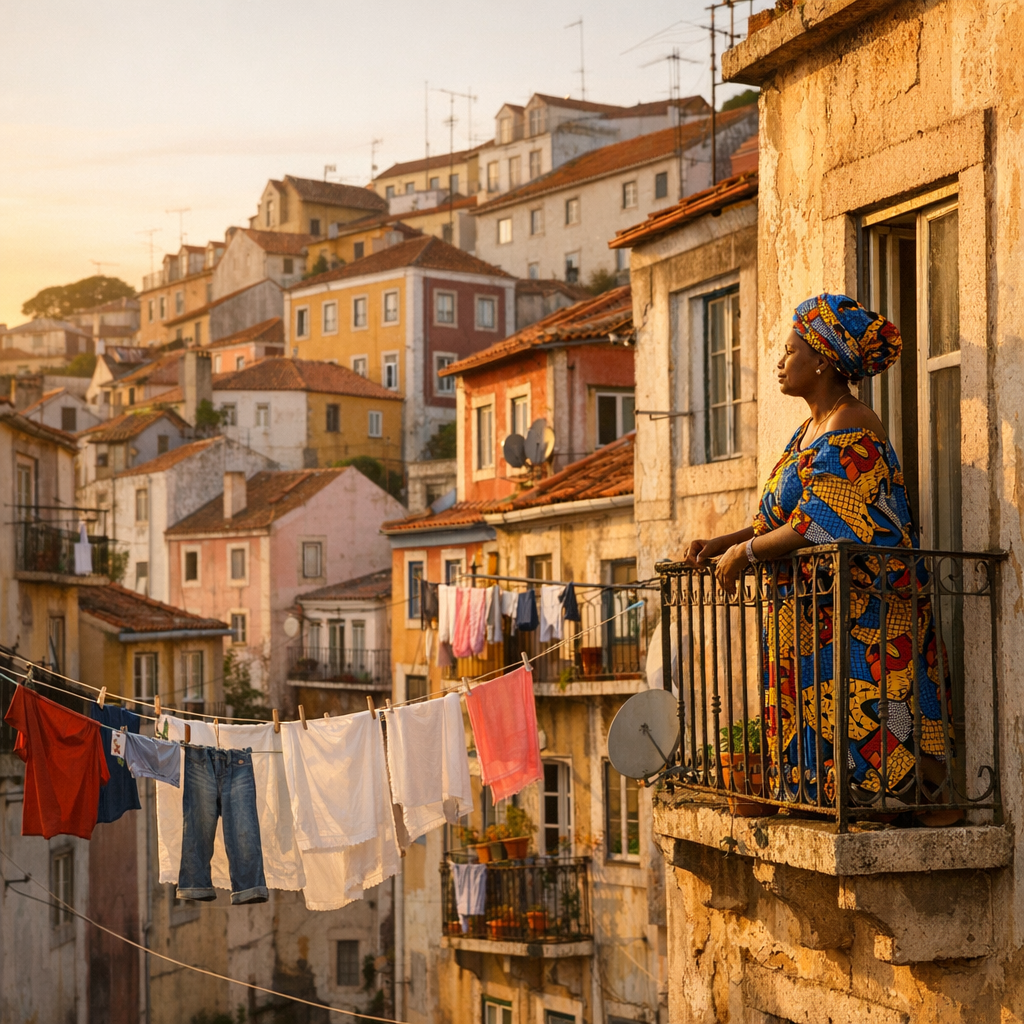
Lisbon's African Soul Wasn't Built Yesterday
Lisbon has quietly become one of the top relocation spots in Europe for Black American expats. The story usually gets told the same way: cheap rent, mild winters, a slower pace, an escape hatch from American racial exhaustion. That story isn't false. But it skips a chapter that matters — the African soul of this city wasn't built by relocating Americans in the last five years. It was built by Cape Verdean immigrants who arrived by the thousands starting in the 1970s, settled the hillsides the rest of Lisbon didn't want, and created a culture that predates the current wave of digital nomads by half a century.
This piece is about that older, deeper story — Cova da Moura and the Cape Verdean community that shaped it, the historical markers Lisbon quietly installed in 2024 acknowledging its role in the transatlantic slave trade, the slave market ruins three hours south in Lagos, and an honest look at what relocating here actually means for Black Americans, gentrification and racism included.
Cova da Moura: The Neighborhood Lisbon Tried to Erase
Cova da Moura sits just outside Lisbon proper, in the municipality of Amadora, separated from the city center by a highway and a stretch of forest park — a short physical distance that functions like a much longer social one. The neighborhood was settled beginning in 1974, when decolonization sent waves of retornados and, more significantly, Cape Verdean labor migrants toward Lisbon in search of factory and construction work during a severe housing shortage. With nowhere sanctioned to go, they built. Cova da Moura rose as an informal settlement — self-constructed homes on occupied land, without title deeds, without full recognition from the state that still, in large part, defines it today.
More than two-thirds of Cova da Moura's roughly 7,000 residents are Cape Verdean or of Cape Verdean descent. The neighborhood has never had it easy — in 2001, Lisbon-area officials floated a plan to demolish as much as 80% of the district; sustained local resistance stopped it. Drug activity and heavy-handed policing have long been part of daily life, and as recently as October 2024 the anti-racism organization SOS Racismo publicly condemned Portugal's PSP police force after a death in Cova da Moura during a police operation — one entry in what advocates describe as a long, largely unaddressed pattern of police violence in Lisbon's Black peripheral neighborhoods.
And yet Cova da Moura is also one of the most culturally alive square kilometers in Portugal. Kriolu (Cape Verdean Creole) is the first language on the street even where Portuguese dominates official life. Older residents keep morna — the melancholic, Portuguese-fado-adjacent genre made globally famous by Cesária Évora — alive in community gatherings, while younger generations have built funana and batuku (batuque), the percussive, call-and-response music and dance tradition Cape Verdean women brought with them and passed down largely outside of institutional spaces. Batuku in particular functions as oral history — women's voices narrating migration, labor, and survival over polyrhythmic drumming on rolled cloth. The annual Kola San Jon festival, celebrated in Cova da Moura since 1992, brings this heritage into the street with processions, drumming, and Cape Verdean flags.
Moinho da Juventude, founded in 1978 by Lieve Meersschaert and Eduardo Pontes, is the neighborhood's anchor institution — running daycare, a library, youth programs, and a free recording studio that has incubated Cova da Moura's rap and hip-hop scene, itself a vehicle for young Cape Verdean-Portuguese artists to speak directly about police violence, systemic racism, and identity. Visiting Cova da Moura independently as a tourist is not recommended; go with a local guide or a community-run tour (ask through Moinho da Juventude or Lisbon diaspora social groups), buy directly from Cape Verdean-owned restaurants and shops, and treat the neighborhood as a living community rather than a photo backdrop.
2024: Lisbon Finally Puts Up the Markers
For centuries, Portugal's role as one of the earliest and largest transatlantic slave-trading nations went almost entirely unmarked in its own capital. That changed, partially, in January 2024, when the city of Lisbon — in partnership with Batoto Yetu, a Cape Verdean-Portuguese cultural association — installed more than 20 historical markers across the city acknowledging Portugal's role in the slave trade. The centerpiece location is Terreiro do Paço, the grand riverside square where enslaved Africans were historically disembarked and sold; additional markers appear at Rossio Square, long a gathering point for Lisbon's Black community, and a new bust honoring Pai Paulino, a formerly enslaved man who became a defender of Black rights in 19th-century Lisbon.
The project had been ready since 2020 but was delayed repeatedly by funding gaps and changes in city leadership before finally launching. José Lino Neves of Batoto Yetu, who led the effort, put it simply: "More than erased, history was silenced." Between the 15th and 19th centuries, Portugal forcibly transported an estimated six million or more Africans, primarily to Brazil — a foundational chapter of both Portuguese and Brazilian history that, advocates note, still receives minimal treatment in Portuguese schools. City officials have floated further steps, including a formal memorial to enslaved victims and a proposed African history museum, though neither exists yet as of this writing.
Walk the markers with intention. They are small, easy to miss, and deliberately unglamorous — which is itself part of the point after centuries of silence. Pair them with the Museu do Aljube (Resistance and Freedom Museum), which houses material on Portugal's African independence movements, for a fuller picture of how colonialism echoes into the country's 20th-century political history.
A Day Trip to Europe's First Slave Market
For travelers who want to go further into this history, the Mercado de Escravos in Lagos, in the Algarve region about three hours south of Lisbon by car or train-plus-bus, sits on the site of Europe's first known slave market. In 1444, an expedition led by Lançarote de Freitas returned to Lagos with 235 enslaved Africans — the first recorded sale of enslaved Africans on European soil. The market operated at this location from 1444 until 1512, when a royal decree redirected the slave trade north to Lisbon. The current building dates to 1691, built over the earlier structure. Since 2016 it has functioned as a small, sobering museum — recognized in 2018 as an International Centre for Living Memory of Human Dignity — using tablet-guided virtual tours to walk visitors through this history as part of UNESCO's Slave Route project. It is not a large site, and it does not need to be; give it an hour, and give yourself time afterward.
The Expat Question: Honest, Not Utopian
Here is the piece other coverage often skips. Black American expats who move to Lisbon consistently describe real relief: lower cost of living, walkable neighborhoods, a slower pace, and — repeatedly cited — freedom from the specific, grinding vigilance of daily life as a Black person in the United States. Women in particular describe being able to wear natural hair without workplace friction, sleeping better, and finally having the mental space to write, build businesses, or simply exist without performing constant self-monitoring. None of that is manufactured; it shows up again and again in first-person accounts.
But Portugal is not a racism-free zone, and presenting it that way does a disservice to travelers making real decisions. Portugal's own reckoning with anti-Black violence is recent and unresolved. In 1995, Cape Verdean immigrant Alcindo Monteiro was murdered by a group of xenophobic Portuguese nationalists in Bairro Alto — a killing that shocked the country and triggered some of Portugal's first major anti-racism mobilizations. In 2020, actor Bruno Candé, who was Black, was shot and killed by a white neighbor with a documented history of racist and colonial-nostalgic rhetoric. And Cova da Moura's relationship with Portuguese policing remains openly contentious, with human rights and anti-racism groups continuing to document incidents into 2024. Separately, Portugal's 1981 Nationality Law has historically made it difficult for Portuguese-born people of African descent to claim citizenship, creating pockets of de facto statelessness that scholars have compared to Jim Crow-era exclusion.
Gentrification adds another layer. As Lisbon's popularity with remote workers and international buyers has driven up rents citywide, pressure has crept toward the city's periphery, and long-standing Cape Verdean residents — the community that built Lisbon's African cultural infrastructure in the first place — increasingly worry about being priced out or displaced from neighborhoods like Cova da Moura even as that same culture becomes more visible and marketable to outsiders, including diaspora tourists. If you relocate to or spend extended time in Lisbon, the most respectful posture is to know this history, support Cape Verdean-owned businesses and institutions directly, and resist treating the neighborhood as a curiosity rather than a community with its own long, unresolved fight for recognition.
Where to Eat and Listen
Cachupa is the dish to know — a slow-cooked stew of hominy corn, beans, and whatever meat or fish is available, considered Cape Verde's national dish and served across Cape Verdean-owned restaurants in Mouraria, Intendente, and Cova da Moura itself. Look for grilled fish prepared Cape Verdean style, and don't skip a glass of grogue (sugarcane spirit) or ponche if it's offered. For music, seek out small bars and community events in Intendente and Mouraria where morna and batuku are performed live rather than staged for tourists — ask locally, since the best nights are rarely advertised in English. Cesária Évora's recordings are the essential entry point to morna before you arrive; once there, batuku heard live, performed by Cape Verdean women, is a different and more visceral experience entirely.
Getting There, Visa Rules, and Planning Your Trip
US citizens can currently enter Portugal visa-free for up to 90 days within any 180-day period under standard Schengen Area rules — no visa or advance authorization is required as of this writing. The EU's long-anticipated ETIAS pre-travel authorization system, which will eventually require US travelers to complete a short online application and pay a small fee before entering the Schengen zone, has been delayed repeatedly and is not expected to become mandatory before spring 2027 at the earliest. Nothing changes for travelers in the meantime beyond a valid passport with at least three months' validity remaining past your planned departure date. Anyone considering a longer-term move — as opposed to a visit — will need to pursue Portugal's separate residency visa process, which is a different and considerably more involved undertaking than tourist entry.
Lisbon Humberto Delgado Airport (LIS) connects directly to New York, Newark, Boston, Miami, and Toronto, with flight times from the US East Coast around seven hours — among the shortest transatlantic hops to any European capital. Budget travelers can expect to spend roughly $80–120 per day covering a rented apartment or hostel, market and local-restaurant meals, and public transit; mid-range travel with boutique hotels and regular restaurant dining runs $150–250 per day.
BTN Verdict
Lisbon deserves its reputation as one of Europe's most livable, most affordable, and most genuinely warm capital cities for Black travelers and expats — that part of the story is real and worth taking seriously. But the city's African identity has a specific origin, a specific community, and a specific set of unresolved struggles that predate and will outlast the current relocation wave. Visit Cova da Moura with a guide and real respect. Walk the 2024 markers at Terreiro do Paço slowly. Make the trip to Lagos if you can. Eat cachupa made by Cape Verdean hands. And hold both truths at once: Lisbon can be a genuine relief from American racism, and Portugal still has its own reckoning to finish.
✈️ Book Your Lisbon Trip Now →*Affiliate links — BTN may earn a commission at no extra cost to you.