Before Sunrise, Bay Street Belongs to the Ancestors
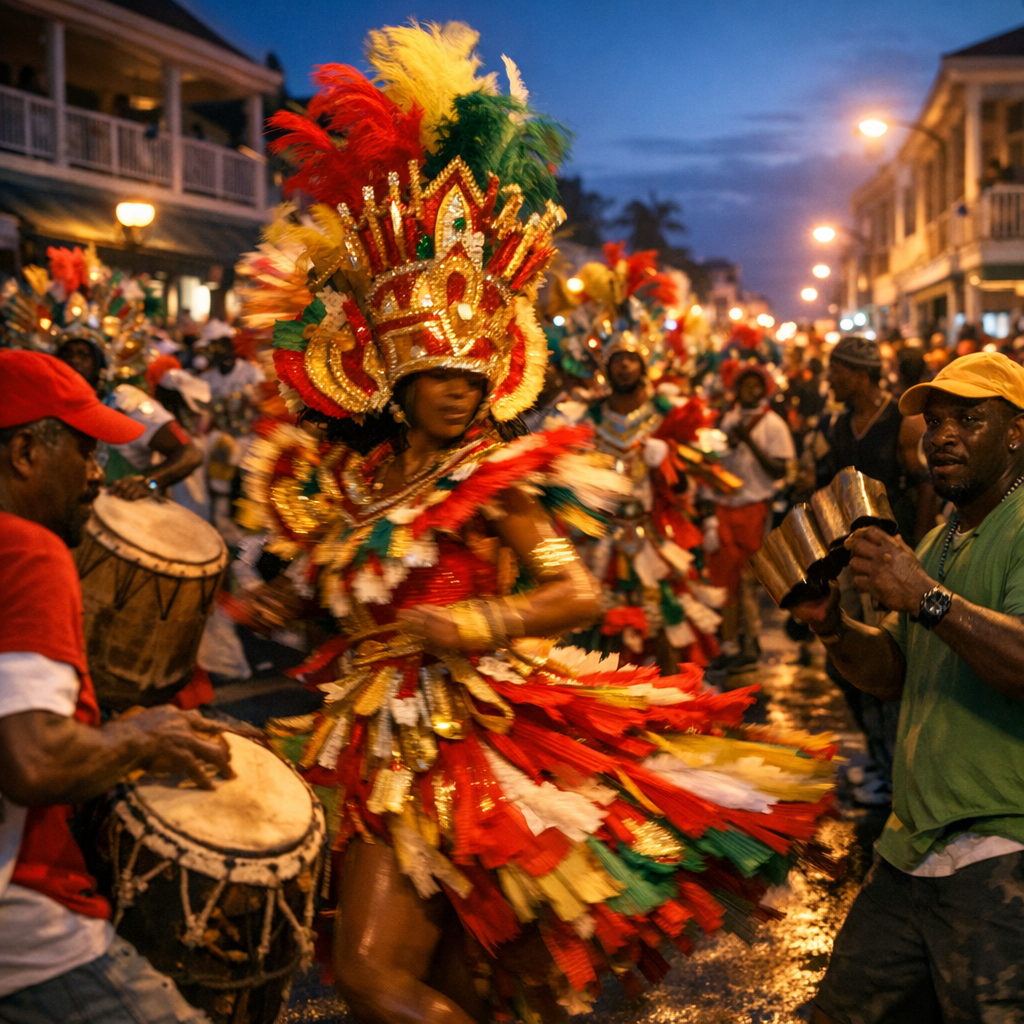
There is a specific kind of cold that settles over Nassau in the deepest hours of December 26th — the kind that makes you grateful for the rum cake vendor on the corner and the stranger next to you sharing their blanket. And then, somewhere down Bay Street, you hear it before you see it: goatskin drums, cowbells, brass horns, and thousands of voices building into a single roar. A wall of color rounds the corner — fifteen-foot-tall costumes built from crepe paper and cardboard, dyed in blazing red, gold, and green, moving in perfect choreographed rhythm. This is Junkanoo. This is Nassau's oldest, loudest, and most defiant celebration of Black identity, and it happens twice a year, in the dead of night, whether the world is watching or not.
For diaspora travelers who want more than a beach chair and a rum punch, Junkanoo is the reason to book a Bahamas trip around Christmas instead of any other week of the year.
The Origin Story: A Holiday Carved Out of Bondage
Junkanoo did not start as a party for tourists. It started as one of the only windows of freedom enslaved Bahamians were given all year. Under British colonial slavery, enslaved people were granted a few days off around Christmas — and they used that narrow opening to do what the plantation system tried to strip from them: gather, make music, mask themselves, and celebrate identity rooted in West Africa. Historians trace the tradition's roots to West African peoples, possibly the Ahanta, Igbo, or Yoruba, whose masking and processional traditions crossed the Atlantic in memory even as freedom did not.
The earliest costumes were built from whatever was on hand — sponges, newspaper, and scraps — a resourcefulness that is still honored today in the crepe-paper-and-cardboard construction techniques Junkanoo artists use, even though modern costumes are far more elaborate. What began as sanctioned holiday release quickly became something more pointed: after emancipation in 1834, Junkanoo evolved into street processions that let Black Bahamians physically take up space on avenues that had been the domain of the colonial elite. By the early 1900s, colonial authorities grew suspicious of the crowds, the noise, and the unmistakable assertion of collective Black power in the streets. When the government tried to ban street parading between 1942 and 1947, Junkanooers marched anyway. That refusal to be silenced is the throughline of the holiday's nickname among historians as an "uprising turned parade" — a celebration born from resistance that never stopped being about resistance, even as it grew into the biggest cultural event in the country.
That history is exactly why Junkanoo matters so much to diaspora travelers. This isn't a festival staged for cruise ship excursions (though cruise passengers do come). It's a living, unbroken thread connecting enslaved ancestors' stolen Christmas mornings to a 21st-century Bahamas that still fills Bay Street with tens of thousands of people at 2 a.m. to watch their own culture parade past.
What Actually Happens: The Boxing Day and New Year's Parades
Junkanoo isn't a single event — it's two massive parades, each with its own energy:
Boxing Day (December 26th) is the bigger of the two, often described as the more competitive and more crowded parade. It kicks off in the deep pre-dawn hours — reporting varies by source, with official Bahamas tourism materials describing a start "in the wee hours after midnight" and Nassau's cruise port listing a roughly 2 a.m. to 8 a.m. window — and it winds down Bay Street through downtown Nassau toward Rawson Square as the sun comes up.
New Year's Day (January 1st) follows the same format about a week later, giving groups a second shot at the top prizes and giving visitors who missed Boxing Day a second chance to catch the spectacle.
Both parades follow the same essential structure: organized "groups" (some with hundreds of members) spend the better part of a year designing a themed presentation — music, choreography, and costumes built around a single concept. Costumes are constructed from crepe paper, cardboard, and feathers, some towering up to 15 feet, and are almost always destroyed after a single use, which is part of what makes the whole spectacle feel so urgent and alive. The soundtrack is built from goatskin drums, cowbells, brass horns, and whistles — the same instrumentation, refined over generations, that gave Junkanoo its signature clattering, driving rhythm. Judges score groups on music, costume, and choreography, and Nassau's parades are widely regarded as the largest and most competitive in the country, with prize money and bragging rights on the line.
A practical note on timing: exact start times, road closures, and permit details can shift from year to year based on decisions from the Ministry of Youth, Sports and Culture and Nassau's city government — so treat any specific start time as a planning estimate, not gospel, and confirm final logistics closer to your travel dates via the official Bahamas tourism site.
How to Actually Watch It: Standing Room vs. Grandstand Seats
You have two ways to experience Junkanoo on Bay Street:
Free standing viewing along the street is exactly what it sounds like — arrive early, claim a spot along the barricades, and stand for several hours as the parade passes. It's free, it's electric, and it's also a long night on your feet in a dense crowd.
Grandstand and bleacher seating is the move for anyone who wants to actually enjoy the hours of standing around beforehand. Reserved bleacher and balcony seats along the route give you an elevated view, guaranteed sightlines, and a place to sit down between bursts of drumming. If you're traveling with family, older relatives, or just don't want to fight for curb space at 1 a.m., grandstand tickets are worth booking well ahead — they sell out as the holiday approaches, exactly like the flights and hotel rooms around them.
Either way: dress in layers (Nassau nights get genuinely cool even though the days are warm), wear shoes you can stand in for hours, and bring water, cash, and a phone battery pack. This is an all-night event that runs until sunrise — treat it like the marathon it is.
Why Book Early: The Backlog Warning Is Real
Here's the part that trips up a lot of first-time Junkanoo travelers: Boxing Day and New Year's are already the single busiest holiday travel window of the year across the entire Caribbean, and Nassau gets a second surge on top of that from Junkanoo itself. Flights fill up, hotel rates spike, and grandstand tickets move fast. If you're serious about being on Bay Street this December 26th or January 1st, the smart window to lock in flights, hotel packages, and any grandstand or parade-viewing tickets is October through November — not "sometime before Christmas." Waiting until December is how you end up watching secondhand video on Instagram instead of standing on Bay Street yourself.
🏨 Book Nassau Holiday Packages →Where to Stay
Steps from the parade route: Graycliff Hotel, a historic downtown property just off Bay Street, puts you within easy walking distance of the action — ideal if you don't want a long trek home at 6 a.m. after a full night on your feet.
Full resort experience: Baha Mar on Cable Beach is Nassau's marquee luxury resort complex, with its own holiday programming, casino, beach, and dining scene if you want a home base that's an event in itself between parade nights.
Budget and mid-range: Cable Beach and downtown Nassau both offer mid-range hotel options a short ride from Bay Street — book early, since holiday-week rates climb fast as December approaches.
Beyond the Parade: What Else to Do in Nassau
Educulture Bahamas Junkanoo Museum — If you're arriving before the holidays, or just want context before the parade, this Bay Street-area museum and resource center walks through Junkanoo's costumes, history, and craft year-round, run by people deeply embedded in the culture.
Arawak Cay Fish Fry — A cluster of casual, colorful restaurants known locally as "the Fish Fry," where you'll find impromptu drumming and Junkanoo-adjacent energy even outside of festival season, alongside some of the best casual Bahamian seafood in Nassau.
Must-try foods: conch fritters (fried, spiced conch — the unofficial national bite), cracked conch, conch salad served ceviche-style, and souse, a tangy, peppery Bahamian stew traditionally eaten as a hearty breakfast — which, notably, is exactly what a lot of Bahamians reach for after an all-night Junkanoo parade.
Entry Logistics for US Travelers
The Bahamas is one of the easiest Caribbean entries for US citizens: no visa is required for tourist stays. You do need a passport valid for at least six months beyond your entry date, and it's worth double-checking current entry requirements with the Bahamas Department of Immigration and US Customs and Border Protection before you fly, since exact stay-length allowances and entry forms can be updated. For a diaspora traveler used to visa paperwork for other international trips, the Bahamas' visa-free entry is one more reason it's such a low-friction, high-reward holiday pick.
Why Junkanoo Belongs on Every Diaspora Traveler's List
It's easy to think of the Bahamas as a beach-and-resort destination and stop there — turquoise water, all-inclusive buffets, a few days of sun. Junkanoo is the corrective. It's proof that the same islands selling you a beach chair are also home to a centuries-old act of cultural defiance that Black Bahamians have refused to let die, through colonial bans, through hurricanes, through every reason the world gave them to stop. Standing on Bay Street at 3 a.m., wrapped in a blanket, watching costumes built by hand over months move past in perfect rhythm to drums that trace back to West Africa — that's not a tourist activity. That's diaspora travel doing exactly what it's supposed to do: connecting you to a story bigger than your itinerary.
Book the flights, book the grandstand seats, and go stand in the cold on Bay Street. It's worth losing the sleep.
✈️ Find Nassau Flights →BTN Insider Tips
Book grandstand seats and holiday-week hotel rooms in October or November. Both the flights and the best viewing tickets sell out well before December.
Confirm exact parade start times closer to your trip. City permits and official start windows have shifted in past years — check the official Bahamas tourism site as your dates approach rather than relying on last year's schedule.
Dress warm, wear comfortable shoes, and prepare for an all-nighter. The parade runs from the pre-dawn hours through sunrise.
Visit the Educulture Junkanoo Museum if you're in town before the holidays to understand the craft and history behind what you're about to watch.
Bring cash for street vendors, snacks, and small souvenirs along the route.
✈️ Book Your Nassau Junkanoo Trip Now →*Affiliate links — BTN may earn a commission at no extra cost to you.