A Fortress Built on the Fear of Losing Freedom
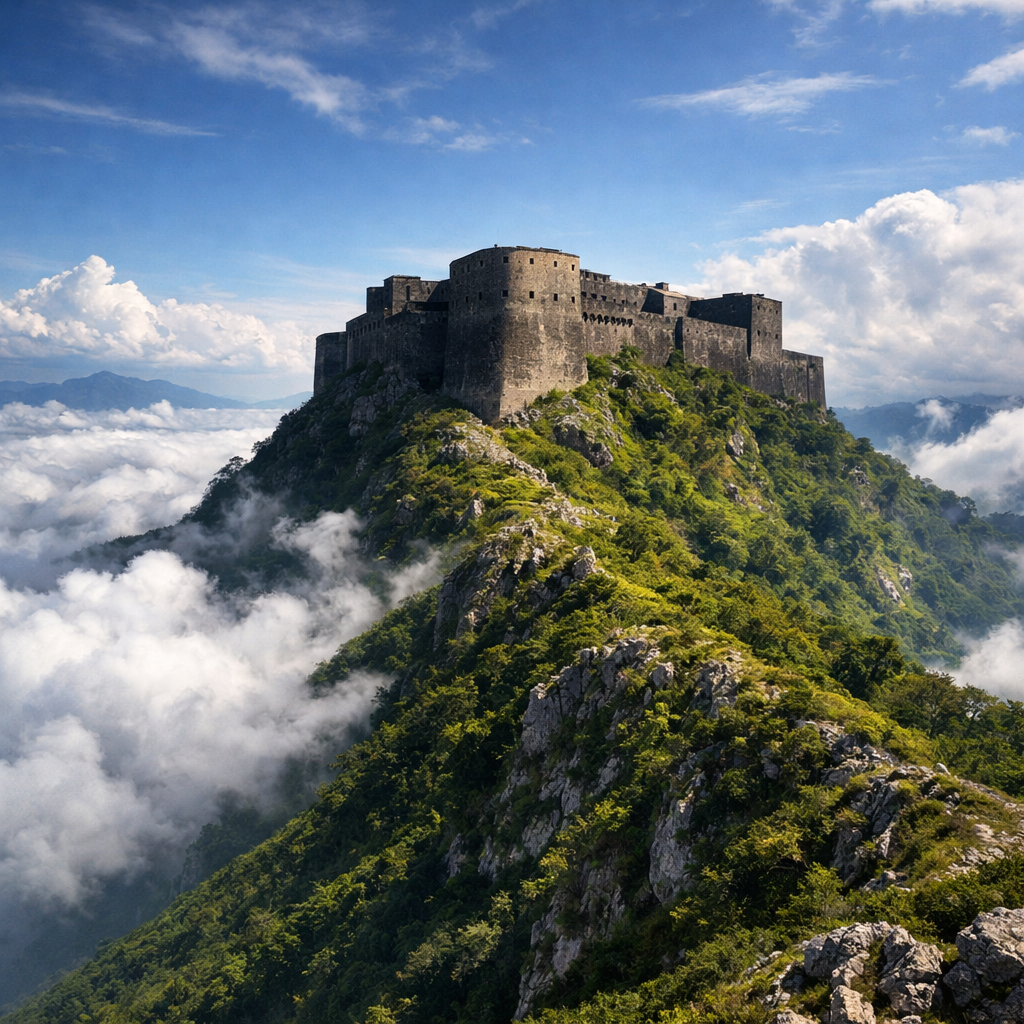
High in the mountains of northern Haiti, roughly 15 miles inland from the port city of Cap-Haïtien, a colossal stone fortress rises out of a jungle-covered peak. From certain angles, the Citadelle Laferrière looks less like a building than like something the mountain itself grew — a dark, angular outcrop of rock and will, 3,000 feet above sea level, staring out toward the sea it was built to defend against. To understand why it exists at all, you have to understand what had just happened in Haiti, and what the people who built it were terrified of losing.
On January 1, 1804, Haiti declared its independence from France, becoming the first nation in the modern world founded by a successful revolt of enslaved people. It remains the only nation in history born of a slave revolution that succeeded in permanently overthrowing both slavery and colonial rule. For twelve years, the formerly enslaved population of Saint-Domingue — the wealthiest colony in the world, built entirely on forced Black labor and brutal sugar production — had fought French, Spanish, and British forces sent to reclaim it. They won. Napoleon Bonaparte, who had tried and failed to restore slavery on the island, lost tens of thousands of French troops to the revolution and to disease. Haiti's founders had every reason to believe France would try again.
That fear — not paranoia, but recent, lived memory — is the reason the Citadelle Laferrière exists. Within a year of independence, Haiti's leadership began planning a network of fortifications capable of making any future French invasion impossibly costly. The Citadelle, positioned to command the approach to the Plaine du Nord and the northern coast, became the crown jewel of that defense plan. It was a fortress built by a free Black nation that trusted no one to guarantee its freedom but itself.
The Man Who Built It: Henri Christophe
The Citadelle was the vision of Henri Christophe, one of the most consequential and complicated figures to emerge from the Haitian Revolution. Christophe was born around 1767, likely in the British Caribbean, and was brought to Saint-Domingue in bondage as a young man. He rose through the ranks of the revolutionary armies, eventually serving as a commander under Toussaint Louverture — the revolution's most famous general and strategist, who transformed a slave uprising into a disciplined fighting force capable of defeating European empires. Christophe later fought alongside Jean-Jacques Dessalines, the general who declared Haitian independence and became the nation's first ruler after Louverture was captured and died in French custody in 1803.
When Dessalines was assassinated in 1806, Haiti fractured. Christophe eventually established a separate state in the north, and in 1811 he crowned himself King Henry I, ruling the Kingdom of Haiti while Alexandre Pétion governed a republic in the south. Whatever one makes of Christophe's monarchy — modeled in part on European royal courts, complete with a nobility he created from former slaves and revolutionary officers — his defining obsession was making sure Haiti could never be re-enslaved. The Citadelle was the physical expression of that obsession, built not for comfort or ceremony but for one purpose: to make Haiti unconquerable.
Building the Impossible
Construction began around 1805 and continued for roughly fifteen years, finishing near 1820. The numbers involved are staggering by any standard, let alone for a nation less than two decades removed from slavery and with no European colonial machinery to draw on. Tens of thousands of laborers — many of them former slaves — cut, hauled, and hoisted stone up a mountain with no roads capable of supporting the load. Estimates of the human cost of construction run as high as 20,000 lives lost to accidents, exhaustion, and the sheer brutality of the undertaking.
What they built defies easy description. The Citadelle's walls rise up to 130 feet (roughly 40 meters) in places, enclosing a complex that covers about 10,000 square meters atop the mountain known as Bonnet à l'Évêque. At its peak, the fortress was stocked with roughly 365 cannons — many of them captured from French, British, and Spanish forces during the revolutionary wars — along with vast stores of cannonballs and gunpowder magazines cut directly into the rock. It was designed to garrison thousands of soldiers and to hold out under siege indefinitely, with cisterns, storerooms, and even quarters intended for the royal family in the event of invasion.
The French invasion Christophe feared never came. Napoleon's attention was consumed by wars in Europe, and no serious attempt was ever made to retake Haiti by force after 1804. In that sense, the Citadelle never fired a cannon in the defense it was built for. But its purpose was never purely tactical — it was a declaration, carved in stone on a mountaintop, that the people who built it would never again be property. That the Citadelle stands empty of the war it prepared for does not diminish what it represents. If anything, it sharpens it: this is what free people built when they trusted nothing but their own hands to keep them free.
A UNESCO World Heritage Site
In 1982, UNESCO inscribed the Citadelle as part of the World Heritage Site officially listed as the "National History Park – Citadel, Sans Souci, Ramiers," recognizing it alongside two companion sites nearby: Sans-Souci Palace, Henri Christophe's opulent royal residence in the town of Milot, and the Ramiers fortifications, a smaller defensive complex built as part of the same military network. Together, the three sites form one of the most significant clusters of early 19th-century architecture in the Americas — and the only UNESCO World Heritage Site anywhere in the world commemorating the establishment of a nation through the successful abolition of slavery.
UNESCO's inscription recognizes the Citadelle as a masterpiece of construction, engineering, and military architecture, built almost entirely by the formerly enslaved themselves rather than by colonial administrators or European engineers. It stands today as a national emblem of Haiti — depicted on currency, stamps, and government seals — and as one of the most powerful physical monuments to Black liberation anywhere on earth. Nowhere else can you stand inside a fortress that a nation of formerly enslaved people built, by their own hands and on their own terms, specifically to guarantee that no one would ever enslave them again.
Current Travel Reality
This history deserves to be known, even though Black Travel Now cannot currently recommend a trip to see it in person. As of our most recent check in July 2026, the U.S. State Department maintains a Level 4: Do Not Travel advisory for all of Haiti — its highest advisory level, citing crime, kidnapping, terrorism, civil unrest, and limited healthcare access nationwide. The advisory notes that kidnapping is widespread, that armed groups (some formally designated as terrorist organizations by the U.S. government) operate with significant reach, and that the risk of being caught in crossfire or targeted for ransom is real and ongoing. U.S. commercial flights are not currently operating to or from Port-au-Prince due to FAA restrictions, and the U.S. government ordered non-emergency personnel and their families to leave the country in July 2023 — restrictions that remain largely in effect for embassy staff today.
It's worth being precise here: Cap-Haïtien and the Citadelle sit in the north, geographically distant from Port-au-Prince, where much of the gang violence driving the advisory is concentrated. But the Level 4 advisory currently covers the entire country without regional exception, and Black Travel Now is not in a position to imply that distance from the capital equates to safety. We have not found reporting that would responsibly support that framing, and we won't speculate where lives are at stake. Until the U.S. government and independent, on-the-ground reporting indicate real, verifiable change, this is not a trip we can advise anyone to plan — no itinerary, no logistics, no "how to get there" guide follows this article, and it won't until the advisory picture changes materially.
What we can do is make sure this history isn't forgotten in the meantime. The Citadelle Laferrière is, arguably, the single most important physical monument to Black liberation anywhere in the world, and it deserves a place in how the diaspora understands its own story — alongside Cape Coast Castle, alongside Goree Island, alongside every site where the machinery of slavery and the fight against it left permanent marks on the land. Haiti's revolution terrified every slaveholding power on earth precisely because it proved the system could be beaten. The Citadelle is what the people who beat it built next.
Why This Place Still Matters
Haiti's story is too often told only through the lens of its present crises, stripped of the fact that this is the nation that did what no other nation has ever done: overthrow slavery itself, by force, from the ground up, and hold the line against the world's most powerful empire to make it stick. The Citadelle is the physical proof of that achievement — 130-foot walls, hundreds of cannons, a mountaintop fortress built by free hands that had, until only a few years earlier, been in chains.
We'll keep watching the advisory. When conditions change and travel can be responsibly recommended again, Black Travel Now will be first in line to help the diaspora plan that pilgrimage. Until then, this history is worth knowing, worth teaching, and worth carrying with you — even from a distance.