The Only African Nation That Was Never Truly Colonized
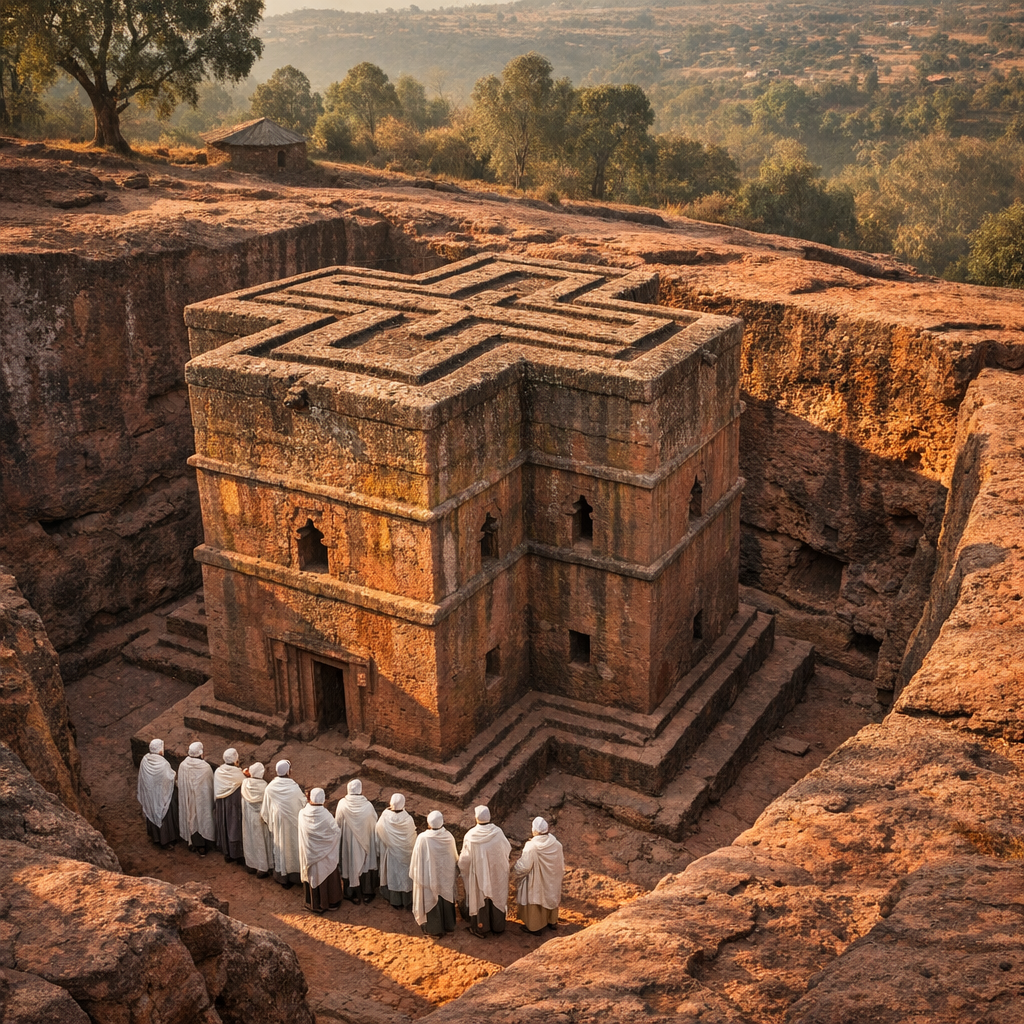
There is a moment that hits every Black traveler differently in Ethiopia. Maybe it's watching the sun rise over Lalibela's rock-hewn churches, carved downward into the earth eight centuries ago by African hands, for African faith, with no European engineer or colonial architect anywhere in the story. Maybe it's standing in Addis Ababa's Africa Hall, where the Organisation of African Unity was born. Maybe it's simply realizing that the calendar on your phone is wrong here — that it is actually seven years earlier, that the months have different names, that an entire civilization built its own timeline and never asked permission.
Ethiopia is the one story in Black heritage travel that isn't about survival after conquest. Alongside Liberia, it is the only African nation that was never fully colonized — Italy occupied the country from 1936 to 1941, but Ethiopian resistance fighters (the Arbegnoch, or "patriots") never stopped fighting, and Emperor Haile Selassie returned to the throne with British and Ethiopian forces in 1941. For a continent whose modern borders were almost entirely drawn by European powers, Ethiopia's unbroken sovereignty made it a beacon. It is why the flag of Ethiopia's red, gold, and green became the Pan-African color palette adopted by liberation movements across the continent and the diaspora. It is why Marcus Garvey, W.E.B. Du Bois, and generations of Pan-Africanists looked to Addis Ababa as proof that Black self-governance was not a hypothetical.
Lalibela: Eleven Churches Carved From a Single Mountain
Nothing prepares you for Lalibela. In the 12th and 13th centuries, under King Lalibela, Ethiopian builders carved eleven churches downward out of solid volcanic rock — not built up from a foundation, but excavated from the top down out of one continuous mass of stone, then hollowed out and chiseled into windows, doors, columns, and vaulted ceilings. The king's ambition, according to tradition, was to build a "New Jerusalem" for Ethiopian Christians after Muslim conquests made pilgrimage to the Holy Land too dangerous. Biete Medhani Alem, one of the eleven, is believed to be the largest monolithic church on Earth.
UNESCO inscribed the Rock-Hewn Churches of Lalibela as a World Heritage Site, and it remains a living place of worship, not a museum. Barefoot priests in white and gold robes still chant the liturgy inside chambers lit only by oil lamps and shafts of morning light. Pilgrims in white shammas still climb the trenches and tunnels connecting the churches on their knees. You are not visiting a ruin. You are visiting a congregation that has been in continuous use for roughly 800 years.
The churches reach peak intensity during two festivals on the Ethiopian Orthodox calendar: Genna (Ethiopian Christmas, January 7), and Timkat (Epiphany, January 19–20), which UNESCO separately recognized in 2019 as Intangible Cultural Heritage of Humanity. During Timkat, priests process replicas of the Ark of the Covenant — the Tabot — through the streets under embroidered umbrellas, crowds sing and dance until dawn, and thousands gather at pools and rivers to renew their baptismal vows. If your travel dates can flex to January, this is the single best window to experience Lalibela.
Shashamane and the Rastafari Homeland
Roughly 150 miles south of Addis Ababa sits Shashamane, a modest farming town that holds an outsized place in the spiritual geography of the African diaspora. In 1948, Emperor Haile Selassie granted 500 acres of land here to the Ethiopian World Federation — an organization founded in Harlem to support Ethiopia during the Italian occupation — as a home for Black people from the Americas and Caribbean who wished to return to Africa.
When Rastafari adherents in Jamaica, who revere Haile Selassie as a central figure of their faith, learned of the grant, many understood it as confirmation of a long-held belief that Ethiopia was the promised land of return. The first settlers arrived in 1955; by the 1960s the repatriate community had grown past 2,000. History has not been simple since — Ethiopia's 1974 revolution and Selassie's death brought land confiscations and hard years, and the community today numbers only in the hundreds. But Shashamane remains an active, living Rastafari settlement, with elders, community institutions, and a culture — including its distinctly vegetarian Ital cuisine — that visitors can respectfully encounter. This is not a museum exhibit or a relic; it is a living religious community, and travelers should approach it with the same humility and respect they would bring to any active house of worship.
Addis Ababa: The Diplomatic Capital of Africa
Addis Ababa is Ethiopia's political and spiritual anchor — home to the African Union headquarters, earning it the nickname "the diplomatic capital of Africa." Start at the National Museum of Ethiopia, where the 3.2-million-year-old fossil "Lucy" (Australopithecus afarensis) and her fellow hominid Selam rewrote our understanding of human origins — a powerful reminder that human life itself began on this continent. From there, visit Holy Trinity Cathedral, the resting place of Emperor Haile Selassie and Empress Menen, built to commemorate Ethiopia's victory over Italian occupation — British suffragette and Pan-African ally Sylvia Pankhurst is buried in its churchyard. Climb Entoto Hill for panoramic views over the city, and lose an afternoon in Mercato, one of the largest open-air markets in Africa.
Where to Eat
Injera with Doro Wat — Ethiopia's national dish: spongy fermented flatbread served alongside a slow-simmered, deeply spiced chicken stew. Eaten with your hands, torn injera used to scoop every bite. Kitfo — minced beef seasoned with mitmita spice and clarified butter, served rare or lightly cooked. Shiro — a hearty chickpea stew that anchors Ethiopia's extensive fasting-day vegetarian tradition, tied directly to the Orthodox Church's fasting calendar. And do not skip the Ethiopian coffee ceremony — Ethiopia is the birthplace of coffee, and the ceremony, with beans roasted, ground, and brewed tableside over incense, is a ritual of hospitality unto itself.
Where to Stay
Addis Ababa: The Sheraton Addis remains the city's grand-dame five-star, with sprawling gardens and a genuine sense of occasion. Hyatt Regency Addis Ababa and the Radisson Blu offer excellent mid-range comfort near Bole. Lalibela: Mezena Aynishet Guest House and Sora Lodge offer well-located, comfortable rooms with direct views of the church complex; Tukul Village Hotel gives a traditional round-house architectural experience without sacrificing modern comfort.
🏨 Book Ethiopia Hotels →Getting There
Ethiopian Airlines — Africa's largest carrier and a Star Alliance member — makes Ethiopia one of the most accessible East African destinations from the US. The airline flies direct from Washington-Dulles (IAD), a route it has anchored as its flagship US gateway for years, and from Newark (EWR), giving New York-area travelers a direct line to Bole International Airport (ADD) in Addis Ababa without a European or Middle Eastern connection. Flight time runs roughly 12-13 hours nonstop. From Addis Ababa, Ethiopian Airlines' extensive domestic network gets you to Lalibela (LLI) in about 90 minutes — flying is strongly preferred over the long overland route through mountainous terrain.
✈️ Find Ethiopia Flights →Visa Requirements
US citizens must obtain an Ethiopian e-Visa before departure — Ethiopia does not offer visa-on-arrival for Americans. Apply through the official government portal at evisa.gov.et; a standard 30-day single-entry tourist e-Visa has historically run around $52 USD, though fees can change, so confirm the current price directly on the official site before booking. Processing typically takes a few business days — apply at least two weeks ahead of travel, and avoid third-party sites that charge inflated service fees for the same application.
Best Time to Visit
Ethiopia's highlands (Lalibela and Addis Ababa both sit above 6,000 feet) stay mild year-round, with the dry season running roughly October through March — the most comfortable window for travel and sightseeing. If your trip can align with early-to-mid January, you'll catch both Genna (January 7) and Timkat (January 19–20), the two most spectacular religious festivals in the country, both centered on Lalibela and other historic churches. Expect cool mornings and nights at altitude even in the dry season — pack layers.
Budget Guide
Budget: $50-80/day — guesthouses, local injera-and-stew meals, shared domestic flights booked in advance.
Mid-range: $100-180/day — comfortable hotels, private guides in Lalibela, a few upscale meals in Addis Ababa.
Luxury: $250+/day — five-star properties, private guided touring, premium domestic flight timing.
BTN Insider Tips
Hire a licensed guide in Lalibela. The church complex is a working religious site with narrow rock tunnels and trenches — a guide keeps you safe and helps you understand what you're seeing.
Dress modestly and remove your shoes. You'll be asked to remove footwear before entering churches; long sleeves and covered legs are expected, especially for women.
Approach Shashamane with reverence. This is a living religious community, not a tourist attraction — ask before photographing people, and consider going with a guide connected to the community.
Learn a few Amharic phrases. "Selam" (hello/peace) and "Ameseginalehu" (thank you) go a long way with Ethiopians, who take enormous pride in their language and culture.
Budget extra time for altitude. Both Addis Ababa (7,700 ft) and Lalibela (8,500 ft) sit at serious elevation — take it easy your first day or two.
Is Ethiopia Safe for Black Travelers?
Ethiopia is generally welcoming and safe for Black travelers in the main tourist circuit of Addis Ababa and Lalibela, with warm hospitality and low rates of tourist-targeted crime. As with any large country, conditions can vary by region — some areas have experienced periods of civil unrest in recent years, so check current US State Department advisories for the specific regions on your itinerary before booking, and stick to well-established tourist routes and reputable local guides. Solo Black travelers, including women, generally report feeling a strong sense of welcome and cultural affinity throughout the main circuit.
Mark Your Calendar
- January 7 — Genna (Ethiopian Christmas), celebrated with dawn liturgies across Lalibela and the country's Orthodox churches
- January 19-20 — Timkat (Epiphany), Lalibela and Gondar's most spectacular religious processions
- September (Ethiopian New Year) — Enkutatash, marking the Ethiopian calendar's new year with yellow Meskel daisies in bloom
- September 27 — Meskel, the Finding of the True Cross, celebrated with massive bonfires nationwide
Book Your Ethiopia Trip
Ethiopia doesn't ask you to reckon with what was taken. It asks you to witness what was never lost — an unbroken civilization, an ancient faith, and a spiritual homeland that diaspora pilgrims have been journeying toward for generations.
✈️ Book Your Ethiopia Trip Now →*Affiliate links — BTN may earn a commission at no extra cost to you.