The Town That Governed Itself Before America Would Let It Vote
Ten miles north of downtown Orlando, tucked between Winter Park and the sprawl of Central Florida's theme-park corridor, sits a town of fewer than 2,500 people that quietly rewrote what was possible for Black America. On August 15, 1887, Eatonville, Florida officially incorporated as a self-governing municipality — run entirely by and for its Black residents, with its own Black mayor, Black town council, and Black-owned land — at a time when most of the Jim Crow South wouldn't let a Black man cast a ballot, let alone hold office.
Eatonville is often called "the oldest incorporated Black town in America," and the story is almost that simple — but not quite, and the nuance matters. Brooklyn, Illinois, just across the Mississippi River from St. Louis, was actually incorporated first, in 1873, founded by formerly enslaved and fugitive people led in part by a woman named Priscilla "Mother" Baltimore. What makes Eatonville extraordinary isn't a technicality of dates — it's that it stands among the very first and most enduring self-governing Black municipalities in the United States, and it is almost certainly the most culturally influential one, because Eatonville raised Zora Neale Hurston.
How Eatonville Came to Be
After Emancipation, formerly enslaved people migrated into Central Florida looking for land and autonomy. A white landowner from Utica, New York, named Lewis Lawrence began subdividing and selling parcels to Black settlers starting in 1881, working alongside Black community leaders including Joseph E. Clark, who became the town's first mayor. By 1887, the community had enough residents, enough self-sufficiency, and enough resolve to formally incorporate — giving Black Americans, for the first time in that part of Florida, full control over their own local government, schools, churches, and civic life.
That kind of self-determination was not just rare in 1887 — it was radical. Across the South, Reconstruction was collapsing, Black Codes and violent intimidation were stripping away political power town by town, and the promise of Black self-governance was being crushed almost everywhere it had briefly flickered. Eatonville held on. It has never stopped being run by its own residents, making it one of the longest continuously self-governed Black communities in the country.
Zora Neale Hurston's Hometown
Eatonville's other claim to fame is inseparable from the first: this is the town that raised Zora Neale Hurston, one of the most important American writers of the 20th century and a central figure of the Harlem Renaissance. Hurston moved to Eatonville as a small child in the 1890s and grew up immersed in a town where Black authority, Black storytelling, and Black joy were simply the water she swam in — no white gaze, no deference required.
That upbringing shaped everything she wrote. Eatonville appears, thinly disguised or by name, throughout Hurston's fiction and folklore collections, most famously as the setting of Their Eyes Were Watching God (1937), her masterwork about a Black woman's journey to self-possession and voice. Hurston also drew on Eatonville's oral traditions, porch-front storytelling, and community rhythms in Mules and Men, her landmark 1935 folklore collection. For Hurston, Eatonville wasn't just a hometown — it was proof of concept that Black communities could be whole, self-governing, and fully human on their own terms, and she spent her career making sure the rest of the world knew it.
Where to Feel Her Legacy Today
Zora Neale Hurston National Museum of Fine Arts — Founded in 1990 in the heart of Eatonville, this small but mighty museum showcases work by artists of the African diaspora and anchors the town's ongoing arts programming. It's an essential first stop for understanding both Hurston's legacy and the broader creative culture Eatonville continues to nurture.
The Hurston Branch Library — Renamed in Hurston's honor in January 2004, Eatonville's public library holds her books, archival material, and community programming celebrating her work. It's a fitting tribute in a town that still runs its own institutions.
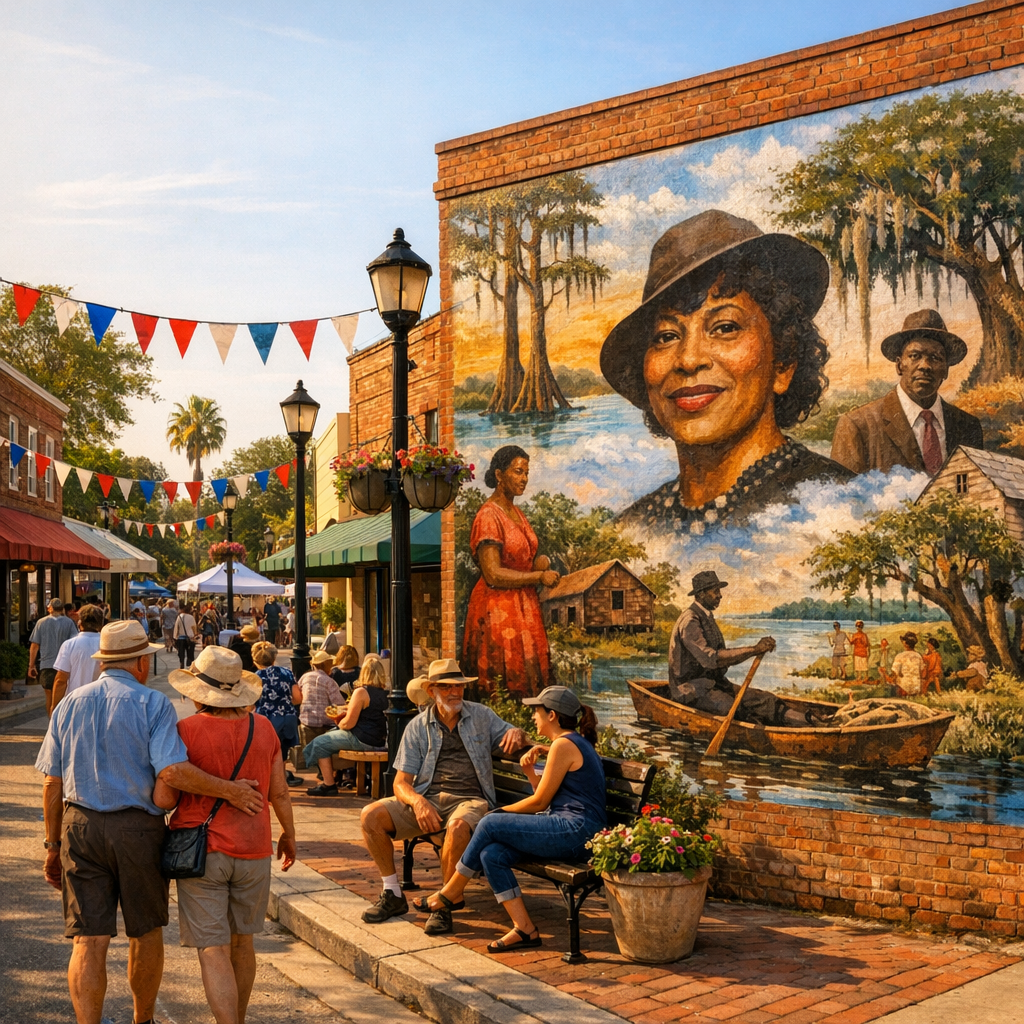
Historic Downtown Eatonville — Walk East Kennedy Boulevard and you're walking the same streets Hurston wrote about. Murals, historical markers, and small storefronts trace the town's founding families and its literary history — a compact, walkable pilgrimage for anyone who loves her work.
The ZORA! Festival of the Arts and Humanities
Every winter, Eatonville hosts the ZORA! Festival of the Arts and Humanities, a multi-day, multidisciplinary celebration established in 1990 alongside the museum. The festival blends public talks, museum exhibitions, theatrical productions, arts education programming, and a lively outdoor Festival of the Arts featuring vendors, live music, and food throughout Eatonville and Orange County. It draws visitors from across the country who come specifically to celebrate Hurston's legacy and the town's ongoing story of Black self-determination.
Festival dates shift slightly year to year and are typically announced several months out on the festival's official site — always plan around late January, historically the festival's home on the calendar, and confirm exact dates before booking travel.
Pairing Eatonville With Orlando
Eatonville isn't a standalone resort destination — it's a profound half-day or full-day cultural detour that pairs naturally with a broader Central Florida trip. Most visitors base themselves in Orlando or Winter Park and treat Eatonville as an essential add-on alongside theme parks, Winter Park's museums and lakeside charm, or a Central Florida road trip. Given the proximity, there's no reason a family or group heading to Orlando's attractions can't carve out an afternoon for one of the most historically significant towns in the country.
Getting There & Getting Around
Fly into Orlando International Airport (MCO), roughly 20-25 minutes from Eatonville by car or rideshare. A vehicle is the easiest way to explore — Eatonville's downtown is small and walkable once you arrive, but you'll want your own transportation to move between Eatonville, Winter Park, and Orlando proper.
✈️ Find Flights to Orlando →Where to Stay
Eatonville itself has limited lodging, so most travelers stay in nearby Winter Park or Orlando and drive in. Winter Park offers charming boutique hotels and easy access to both Eatonville and Orlando's attractions. Downtown Orlando and the areas near MCO offer the widest range of hotel options at every budget, from major chains to boutique properties, all within a short drive of Eatonville.
🏨 Book Orlando-Area Hotels →Best Time to Visit
Central Florida's mild, dry winter (October through April) is the most comfortable season for walking Eatonville's historic downtown, and it also coincides with the annual ZORA! Festival, historically held in late January — the single best reason to time a visit around a specific date. Summers are hot, humid, and prone to afternoon thunderstorms, though the town's indoor sites, like the museum and library, remain fully accessible year-round.
Budget Guide
Budget: $80-120/day — chain hotel in Orlando/Winter Park, quick-service meals, free or low-cost admission to Eatonville's historic sites and museum.
Mid-range: $150-250/day — boutique hotel, sit-down dining in Winter Park or Orlando, festival tickets during ZORA! season.
Luxury: $300+/day — upscale Orlando resort stay combined with a private guided history and literary tour of Eatonville.
BTN Insider Tips
Read Their Eyes Were Watching God before you go. Walking Eatonville's streets after reading Hurston's novel transforms the visit from a history lesson into something much more personal.
Time your trip around ZORA! if you can. The festival is Eatonville at its most vibrant, and it's when the town's arts community, food vendors, and storytelling traditions are most visible.
Don't skip the museum for the murals. Eatonville's outdoor art and historical markers are wonderful, but the Zora Neale Hurston National Museum of Fine Arts is where the town's full story — founding, self-governance, and Hurston's legacy — comes together.
Get the "oldest" claim right when you talk about it. Eatonville is one of the first and most historically significant self-governing Black towns in America — but Brooklyn, Illinois (incorporated 1873) holds the technical distinction of being the oldest. Both stories deserve to be told accurately and both deserve to be visited.
Is Eatonville Safe for Black Travelers?
Eatonville is an overwhelmingly safe, welcoming, small American town, and it remains proudly Black-governed to this day. Standard U.S. travel precautions apply and nothing more — this is one of the most historically significant and hospitable stops on any Black heritage itinerary in the country.
Mark Your Calendar
- August 15 — Anniversary of Eatonville's 1887 incorporation
- January (dates vary) — ZORA! Festival of the Arts and Humanities, Eatonville's flagship annual celebration
- Year-round — Zora Neale Hurston National Museum of Fine Arts exhibitions and programming
Book Your Central Florida Trip
Eatonville proves that Black self-determination in America didn't wait for permission — it built its own town, elected its own mayor, and raised one of the greatest writers this country has ever produced. Add it to your next Orlando itinerary and give it the afternoon it deserves.
✈️ Book Your Orlando/Eatonville Trip Now →*Affiliate links — BTN may earn a commission at no extra cost to you.