A Postcard City With a Difficult Truth Beneath the Paint
Willemstad photographs like a dream. Pastel row houses in candy pink, mustard yellow, and seafoam green line the harbor at Sint Anna Bay, gabled Dutch rooftops catch the Caribbean light, and the Queen Emma pontoon bridge swings open to let sailboats pass into the inner harbor. It is one of the most photographed streetscapes in the Caribbean, and Instagram will tell you it's simply pretty.
What Instagram won't tell you is why those buildings look the way they do, or who built the wealth that paid for them. A few blocks from that waterfront postcard, inside a restored colonial warehouse complex in the Otrobanda district, sits the Kurá Hulanda Museum — a museum built directly on the ground where enslaved Africans were once landed, held, and sold. It is one of the most direct, unflinching, and necessary slave-trade museums in the Caribbean, and it is the reason Curaçao belongs on any serious Black travel itinerary, not just as a beach stop, but as a place of reckoning.
What Is the Kurá Hulanda Museum?
Kurá Hulanda — Papiamentu for "Dutch Courtyard" — opened in April 1999 inside a cluster of restored 18th- and 19th-century buildings on Willemstad's western quayside, in the historic Otrobanda neighborhood directly across the bay from Punda. The site was chosen deliberately: this stretch of waterfront is where slave ships once anchored to deliver captive Africans, who were held here before being marched to the nearby slave market and sold, either into bondage on Curaçao or transshipped onward to plantations across the Spanish Main and the wider Caribbean.
The museum was founded by Dutch entrepreneur Jacob Gelt Dekker, who was invited by the Curaçao government to redevelop the derelict western quayside in the 1990s. Rather than build something purely commercial, Dekker restored fifteen historic buildings — roughly 16,000 square feet of gallery space — and filled them with one of the most extensive collections of West African, transatlantic slave-trade, and Caribbean heritage artifacts anywhere in the region. Dekker passed away in 2019; ownership and hotel operations around the museum have changed hands since (a management group took over daily operations in 2021), but the museum itself has remained open and intact throughout.
The Dutch Slave Trade in Curaçao
To understand why this museum exists here, you have to understand what Curaçao was to the Dutch West India Company (WIC). Unlike Barbados or Jamaica, Curaçao was never primarily a plantation island — its dry, arid climate wasn't suited to sugar at scale. Instead, from the mid-1600s onward, the Dutch turned Curaçao into one of the single largest slave-trading depots in the Western Hemisphere.
Willemstad's deep, protected harbor made it the ideal transshipment hub: enslaved Africans were brought across the Atlantic in Dutch ships, warehoused on Curaçao, and then redistributed by smaller vessels to Spanish colonial ports throughout the Caribbean and along the South American coast — ports where Dutch traders themselves were often legally barred from direct commerce. Historians estimate that hundreds of thousands of enslaved Africans passed through Curaçao's harbor over the roughly two centuries the trade operated here. The wealth generated by that traffic financed the very gabled merchant houses that make Willemstad's waterfront so photogenic today. The city's prosperity and its atrocity share the same foundation.
Slavery in the Dutch Caribbean was not abolished until 1863 — nearly three decades after the British Empire and roughly the same era as the United States — and even then, formerly enslaved people were subjected to a mandatory ten-year "state supervision" period before full freedom. Curaçao's 1795 slave revolt, led by Tula, remains one of the most significant uprisings in Caribbean history and is commemorated across the island; Tula is now a national hero.
Walking Through Kura Hulanda — What You'll See
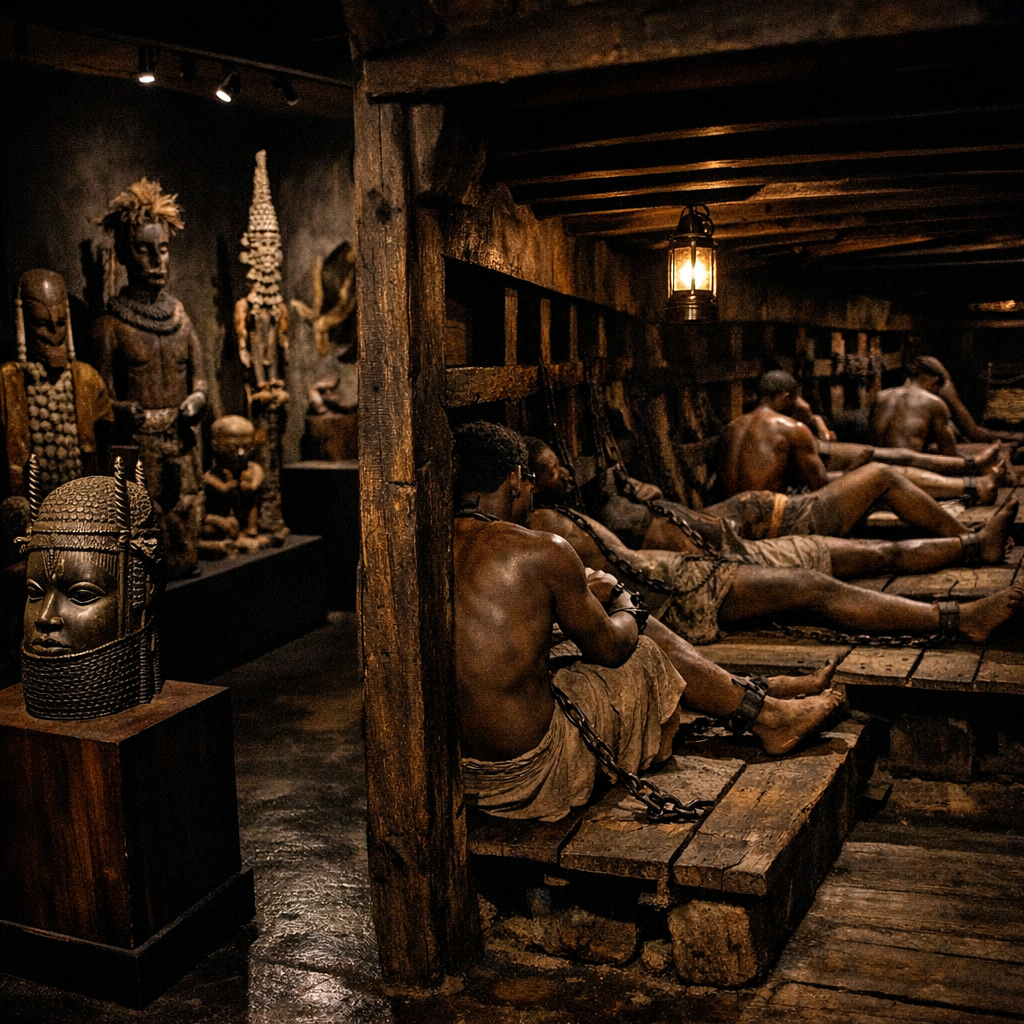
The museum's exhibits are organized to walk visitors through the full arc of the trade: West African kingdoms and their art, religion, and craftsmanship before European contact; the mechanics of capture and the Middle Passage, including a sobering replica of a slave ship's cargo hold that visitors can walk into; and the aftermath — the plantation economies, resistance movements, and the cultural retentions that West Africans carried into the Americas and the Caribbean despite everything done to erase them.
Galleries include Mesopotamian and ancient civilization artifacts (part of the museum's broader anthropological scope), a hall dedicated to the transatlantic slave trade specifically, and rotating exhibits on Caribbean and Curaçaoan cultural history. The museum complex also includes an Antillean architecture exhibit and, notably, sits adjacent to a memorial recognizing the site's history. Plan for at least two hours to move through it properly — this is not a museum to rush.
A Content Note for Ancestry & Homegoing Travelers
If you are planning this stop as part of a homegoing, roots, or ancestry-focused itinerary — particularly if you're pairing Curaçao with West Africa or other Caribbean slave-trade sites — please read this before you go. The slave ship hold replica and the trade-route exhibits at Kurá Hulanda are graphic and deliberately unflinching by design. Several BTN readers have described needing to step outside partway through, and that is a completely normal response, not a failure of preparation.
- Go with people you trust, or go prepared to be alone with it. Some travelers want a companion for this; others need to process it in silence. Know which one you are before you walk in.
- Don't schedule anything demanding right after. Give yourself the rest of the day, or at least a few unhurried hours, before your next activity.
- It is okay to not finish the museum in one visit. Staff are accustomed to visitors needing air or a break — take it.
- Consider journaling or voice-recording your reactions afterward. Many diaspora travelers find this is where the real processing happens, days or weeks later.
This museum does the work that Willemstad's beautiful waterfront does not do on its own — it names names, it shows numbers, and it refuses to let the prettiness of the architecture stand in for the truth of how it was paid for. That is exactly why it belongs on your itinerary.
Willemstad's UNESCO World Heritage Old Town
Willemstad's historic inner city and harbor entrance were inscribed as a UNESCO World Heritage Site in 1997, covering roughly 86 hectares across four historic quarters — Punda, Otrobanda, Scharloo, and Pietermaai — separated by Sint Anna Bay and the Waaigat inlet. The designation recognizes the city's remarkably intact Dutch colonial architecture, blended with Spanish, Portuguese, and local Caribbean influences, and its role as a major, continuously active hub of Atlantic trade (the slave trade very much included) since the Dutch West India Company seized the island from Spain in 1634.
Punda, the oldest quarter, is home to Handelskade — the row of gabled merchant houses along the water that appears on every Curaçao postcard — and to the Snoa, or Mikvé Israel-Emanuel Synagogue, built in 1674 by Sephardic Jewish settlers and recognized as the oldest continuously operating synagogue in the Americas. Otrobanda, across the swinging Queen Emma pontoon bridge, is where Kurá Hulanda sits, alongside Scharloo's ornate 19th-century merchant mansions and the increasingly trendy, mural-covered streets of Pietermaai. Walking all four districts in a day gives you the full, complicated picture: colonial wealth, immigrant history, resistance, and reinvention, all within a few square miles.
Beyond the Museum — Curaçao Today
Curaçao sits outside the main Atlantic hurricane belt, which makes it one of the only true year-round Caribbean destinations — a rare practical advantage if you're trying to build a trip around a specific date, like a family reunion or a homegoing anniversary, without worrying about storm season. Beyond Willemstad, the island is known for exceptional shore diving and snorkeling (the reef starts just steps from the shore in many spots), the beaches of the west coast, and a food scene that blends Dutch, Latin American, and West African-rooted Caribbean influences.
Practical Planning — Getting There & Entry Requirements
Curaçao International Airport (Hato, airport code CUR) has direct flights from several US gateway cities, including Miami, Atlanta, Newark, and Charlotte on carriers like American Airlines, Delta, and United, along with connections via Amsterdam on KLM given Curaçao's status as a constituent country of the Kingdom of the Netherlands. Flight time from the US East Coast runs roughly 3.5 to 4.5 hours direct.
US citizens need only a valid passport (valid for the duration of your stay) — no visa is required for tourist stays, and US citizens can generally remain up to six months per calendar year for tourism purposes. You'll complete a digital Embarkation/Disembarkation (ED) card before arrival and should carry proof of onward travel. The official language mix is Dutch, Papiamentu, and English — English is widely spoken in tourist areas, so navigation is easy. As of July 2025, Curaçao's currency is the Caribbean guilder, which replaced the long-standing Netherlands Antillean guilder; US dollars are widely accepted in Willemstad regardless.
Rent a car if your budget allows it — it's the easiest way to reach beaches and dive sites beyond Willemstad, though taxis (metered or flat-rate) and organized tours cover the historic center and museum district well. In an emergency, dial 911.
🏨 Book Willemstad Hotels →Best Time to Visit & Budget Guide
Because Curaçao sits outside the hurricane belt, it's genuinely a year-round destination — the driest, sunniest stretch runs January through September, with a brief wetter season October through December that rarely disrupts travel plans significantly. Temperatures hover in the mid-80s°F year-round with steady trade-wind breezes.
Budget: $90–140/day — guesthouse or apartment stay, local snack bars (pastechi, karko), public transport and walking, museum and historic-site entry fees.
Mid-range: $150–280/day — boutique hotel in Pietermaai or Otrobanda, rental car, restaurant dining, a dive or snorkel excursion.
Luxury: $300–500+/day — waterfront resort, private tours, fine dining, premium dive charters.
✈️ Find Flights to Curaçao →BTN Insider Tips
Confirm current museum hours and ticket prices directly before you go. Kurá Hulanda's hours and admission fees have shifted since a change in on-site management — check the museum's official channels or your hotel concierge the day before your visit rather than relying on older listings.
Pair the museum with the Otrobanda walking district. The neighborhood around Kurá Hulanda is packed with murals, local eateries, and independent galleries — give yourself time to walk it before or after.
Cross the Queen Emma pontoon bridge on foot at least once. It physically swings open for ship traffic — a small, memorable piece of Willemstad's working-harbor identity.
Visit the Kura Hulanda galleries in the morning when the museum is quieter, giving you space to move through the heavier exhibits without crowds.
Dress and behave as you would at any solemn historic site. This is not a photo-op stop — treat the ship-hold replica and trade-route exhibits with the same respect you'd bring to Cape Coast or Elmina.
Book Your Curaçao Trip
Willemstad will hand you a beautiful skyline and a hard history in the same afternoon. Both are true, and both are worth your time.
✈️ Book Your Curaçao Trip Now →*Affiliate links — BTN may earn a commission at no extra cost to you.