Cuba Isn't a Beach Vacation. It's Homework, Then a Trip.
No other island in the Caribbean carries the weight, rhythm, and complexity of Cuba. This is the birthplace of rumba, the home of Santería, and the resting ground of one of the most consequential Afro-descended military leaders in world history. It is also, for US citizens, the single most legally complicated destination on this entire site.
Let's say this plainly up front: you cannot legally travel to Cuba as a tourist if you are a US citizen or permanent resident. That has been true, in one form or another, since the 1960s trade embargo, and it remains true in 2026. But "you can't go as a tourist" is not the same thing as "you can't go." Tens of thousands of Americans travel to Cuba legally every year — they just do it under a specific legal framework administered by the US Treasury Department's Office of Foreign Assets Control (OFAC), and the framework has real requirements attached to it.
This article is travel journalism, not legal advice. US sanctions policy toward Cuba has changed multiple times in the last decade and is changing again right now. Before you book anything, verify the current rules directly at OFAC's Cuba Sanctions page and the State Department's Cuba country page, and strongly consider booking through a licensed Cuba tour operator who handles compliance for a living.
The Legal Framework: 12 Categories, No Tourism
Under the Cuban Assets Control Regulations (31 CFR Part 515), a US person cannot travel to Cuba for pure tourism. Every trip must instead fall under one of OFAC's authorized travel categories, or be covered by a specific OFAC license. The general-license categories have remained structurally consistent for years and typically include:
- Family visits
- Official business of the US government, foreign governments, and certain intergovernmental organizations
- Journalistic activity
- Professional research and professional meetings
- Educational activities
- Religious activities
- Public performances, clinics, workshops, athletic and other competitions, and exhibitions
- Support for the Cuban people
- Humanitarian projects
- Activities of private foundations or research or educational institutes
- Exportation, importation, or transmission of information or informational materials
- Certain authorized export transactions
There is no permission slip and no application for most of these — you self-certify at the time you book your flight and lodging, and airlines and licensed operators will ask you to select a category. But self-certification is not the same as a rubber stamp: OFAC has civil and criminal enforcement authority, US persons subject to these rules must keep records substantiating their trip (receipts, itineraries, a log of activities) for five years, and misrepresenting your category is a real compliance risk, not a technicality.
Support for the Cuban People: The Route Most Independent Travelers Use
For travelers who aren't visiting family, attending a conference, or on official government business, "support for the Cuban people" is the category that has made independent Havana travel possible for the last several years. In practice, it requires a full-time schedule of activities that engages with and directly benefits ordinary Cubans and Cuba's private sector — not a beach chair and a mojito.
That generally means staying at privately run casas particulares (Cuban bed-and-breakfasts) rather than large state-owned hotels, eating at privately owned paladares rather than state-run restaurants, hiring independent local guides, buying from private artists and vendors, and steering clear of businesses on OFAC's Cuba Restricted List — entities tied to the Cuban military, intelligence, and security services (GAESA-linked hotel chains being the most common example travelers need to watch for). Your itinerary is meant to be a real, documentable schedule of person-to-person engagement, not a loophole with a hammock in it.
2026 Update: Why Enforcement Matters More Right Now
US-Cuba policy is not static. Cuba was redesignated a State Sponsor of Terrorism in January 2025, and the current administration has pursued a broader "maximum pressure" posture through 2025 and into 2026, including tightened sanctions and a mid-2026 directive calling for stricter enforcement of travel rules. None of this eliminates the 12 authorized categories, but it raises the stakes of getting your paperwork right — and it's exactly why a licensed, US-based Cuba tour operator earns its fee. Re-verify the rules before you book, not from this article months later.
Afro-Cuban Culture: The Deepest Rhythm in the Diaspora
Here's why Black travelers keep doing the legal homework anyway: Cuba's Afro-diasporic culture is arguably the richest and most intact in the hemisphere. More than a third of Cubans identify as Black or mixed-race, and the imprint of the roughly 800,000 enslaved Africans — overwhelmingly Yoruba, Kongo, and Carabalí peoples — brought to the island runs through nearly everything that makes Cuban culture recognizable worldwide: rumba, son, the conga drum, and Santería (Regla de Ocha), the Yoruba-derived faith that syncretizes the orishas — Yemayá, Changó, Ochún, Elegguá — with Catholic saints. Santería isn't folklore behind glass here; it's a living religious practice with active houses, initiations, and ceremonies across Havana.
Callejón de Hamel: Havana's Living Santería Canvas
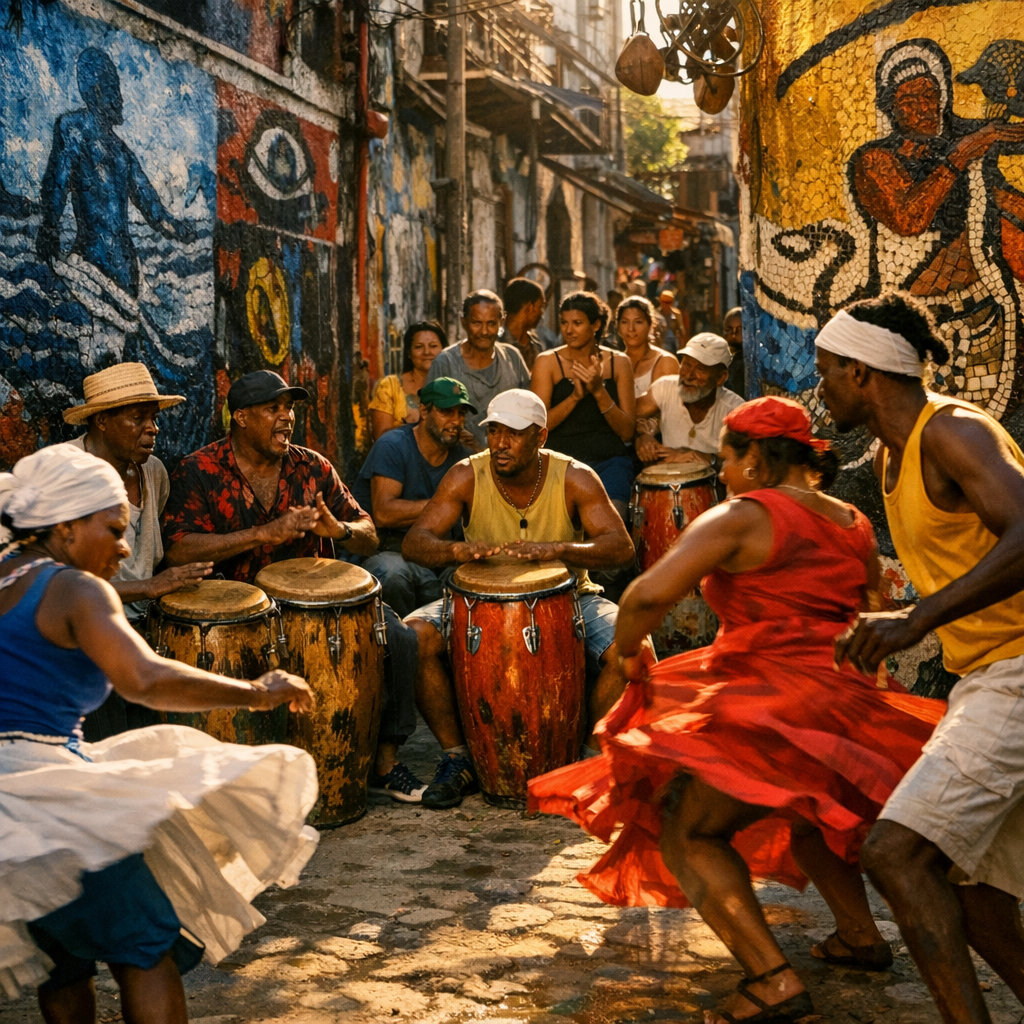
The single best place to encounter this culture in one afternoon is Callejón de Hamel, a narrow alley in the Cayo Hueso section of Centro Habana. Starting in 1990, self-taught artist Salvador González Escalona transformed what had been a rundown backstreet into a two-block-long, floor-to-roofline collage of murals, mosaics, and sculptures built from repurposed bathtubs, pipes, and machine parts — all rendered in a surrealist style saturated with Santería iconography and orisha symbolism.
The alley comes alive every Sunday afternoon, when rumba musicians and dancers turn Callejón de Hamel into an open-air performance space — congas, call-and-response vocals, and Afro-Cuban dance in front of a crowd of Habaneros and travelers standing shoulder to shoulder. It's touristed, yes, but it's also genuinely community-rooted, and it remains one of the most direct, joyful entry points into Afro-Cuban spiritual and musical culture anywhere on the island.
Antonio Maceo: The Bronze Titan of Afro-Cuban Independence
Cuba's Afro-diasporic story isn't only cultural — it's foundational to the country's political existence. Antonio Maceo Grajales (1845–1896), born in Oriente Province to Mariana Grajales, a woman of Afro-Cuban and Dominican descent, became the most celebrated general of Cuba's wars of independence against Spain. Known as "the Bronze Titan" for surviving more than 25 battle wounds across roughly 500 engagements, Maceo commanded the legendary Invasion of the West — a 1,000-mile, 96-day campaign as second-in-command under General Máximo Gómez that broke Spanish control of western Cuba.
Maceo died in battle near Havana in December 1896; his remains rest at the Monumento El Cacahual just outside the city, and monuments to him stand throughout Havana and Santiago de Cuba. For Black travelers, Maceo's story is a reminder that Afro-descended people didn't just survive Cuban history — an Afro-Cuban general helped author the country's independence.
Money, Cards, and Insurance: The Practical Realities
US debit and credit cards do not work in Cuba — the US financial embargo blocks the card networks from processing on the island, regardless of your travel category. Bring enough cash (US dollars or euros) for your entire trip, or a pre-loaded travel card from a non-US bank. Exchange money at authorized CADECA offices, banks, or hotels rather than on the street, and note that amounts over roughly $5,000 must be declared to Cuban customs.
Travel and medical insurance is mandatory for all visitors to Cuba, not optional. Many international flight tickets bundle roughly 30 days of basic medical coverage (often through Asistur), but confirm this with your airline and consider supplemental travel insurance, especially if your trip runs longer or you want broader coverage than the minimum.
Entry Requirements
Your US passport must be valid for at least six months beyond your arrival date and have two blank pages available for entry and exit stamps. In addition to your OFAC travel category, Cuba requires a separate Cuban tourist card (visa) for entry, typically purchased through your airline or a licensed travel provider — this is a Cuban entry requirement distinct from, and in addition to, your US OFAC category.
Where to Eat and Stay, the Compliant Way
Because "support for the Cuban people" is built around patronizing Cuba's private sector, your lodging and dining choices double as compliance documentation. Book a casa particular in Habana Vieja, Centro Habana, or Vedado rather than a large state-run hotel chain, and eat at family-run paladares. Try ropa vieja (shredded braised beef), congrí (rice and black beans), tostones, and ajiaco, Cuba's hearty root-vegetable stew — nearly all of it available at the same privately owned kitchens your travel category is meant to support.
Getting There and Getting Around
US carriers including American, JetBlue, and Southwest fly to Havana's José Martí International Airport (HAV) from Miami, Tampa, and a handful of other gateway cities, with flight times of roughly 1–2.5 hours. Every traveler self-certifies an OFAC category when booking. Once in Havana, ride-share apps don't operate — get around by state taxi (Cubataxi), a private licensed driver arranged through your casa particular host, or on foot through the compact, walkable streets of Habana Vieja.
BTN Insider Tips
- Use a licensed Cuba tour operator if this is your first trip. Reputable operators build your "support for the Cuban people" itinerary, handle logistics, and keep you off the Restricted List without you having to track it yourself.
- Keep everything. Receipts, itineraries, and a simple daily log of activities — five years is the recordkeeping window, and it costs you nothing to be over-prepared.
- Bring more cash than you think you need, plus a backup stash, since there's no ATM safety net for US cards.
- Time your trip for Sunday to catch the rumba at Callejón de Hamel at its most alive.
- Re-check the current rules within a week of booking. This is genuinely one of the fastest-moving policy areas in US travel law.
The Bottom Line
Cuba rewards travelers who do the work — legally and culturally. The Afro-Cuban story here, from the drum circles of Callejón de Hamel to the legacy of Antonio Maceo, is as deep as anything in the diaspora. But this is not a spontaneous-booking destination for US citizens. Confirm your OFAC category, book with a licensed operator or build a genuine support-for-the-Cuban-people itinerary yourself, bring cash, get insured, and keep your records. Do the homework, and Havana gives you one of the richest cultural experiences in the hemisphere.
✈️ Search Flights & Travel Insurance for Cuba →*Affiliate links — BTN may earn a commission at no extra cost to you. This article is for general travel information only and is not legal advice; verify current OFAC and Cuban entry requirements directly with OFAC or a licensed Cuba travel attorney/tour operator before booking.