The Costa Rica the Brochures Don't Show You
Every Costa Rica ad looks the same: a zip-line canopy tour over a cloud forest, a Blue Zone smoothie bowl, a surfer paddling out at sunset in Guanacaste. It's a beautiful country and none of that is false advertising. But drive four hours east from San José, past the volcanoes and the coffee farms, and Costa Rica changes completely. The signs start switching between Spanish and English. The music coming out of open-air bars is calypso and reggae, not mariachi. The plates arriving at the table are rondón and rice and beans cooked in coconut milk, not gallo pinto and casado. You have entered Limón Province — and you are standing in one of the most significant, least-marketed Black diaspora destinations in the Western Hemisphere.
Puerto Viejo de Talamanca and Cahuita, the two anchor towns of Costa Rica's southern Caribbean coast, were built by Afro-Caribbean hands. Their descendants are still here, still speaking their own English creole, still playing the calypso their grandparents brought with them — and almost nobody outside of Costa Rica knows the story.
How Jamaica Built the Costa Rican Caribbean
The story starts in the 1870s, when the Costa Rican government contracted American railroad magnate Minor Keith to build a rail line connecting the Central Valley to the Atlantic coast so the country's coffee crop could reach export ships faster. The jungle, heat, and tropical disease made the project brutal, and Costa Rica's own highland workforce would not do it. Keith turned to Jamaica, then still a British colony, and recruited thousands of Jamaican laborers to lay the track through Limón's swamps and rainforest.
Many of the original railroad workers died of malaria and yellow fever. The ones who survived stayed. When the railroad was finished, Keith pivoted to bananas — the crop that would become the foundation of the United Fruit Company — and the same Jamaican and West Indian communities who built the tracks became the labor force of the banana plantations that lined them, an economic relationship that continued to draw West Indian migrants to Limón well into the early 1900s.
For most of the 20th century, this population lived a genuinely separate existence from the rest of Costa Rica. Afro-Caribbean Limonenses were denied full citizenship rights and were legally barred from settling in the Central Valley under a 1934 banana-company labor law, effectively locking the Black population into Limón Province for generations. It wasn't until the 1949 constitution, following the Costa Rican Civil War, that Afro-Costa Ricans of Jamaican descent were formally granted citizenship. That history of exclusion is precisely why Limón developed, and preserved, a culture so distinct from the rest of the country: it had to build its own world, because for decades it wasn't fully allowed into anyone else's.
Limonese Creole: A Living Language, Not a Relic
Walk into a soda (small local restaurant) in Puerto Viejo or Cahuita and you'll hear it immediately — an English-based creole locals call Mekatelyu (from "make I tell you"), sometimes referred to as Limonese Creole English. It descends directly from Jamaican Patois, carried over by the original railroad and banana workers, and it has survived more than a century alongside Spanish, the country's only official language.
Limonese Creole isn't a museum artifact performed for tourists — it's the language grandparents use with grandchildren, the language of church services and back-porch conversation, the language calypso lyrics are written in. Costa Rica's Ministry of Public Education has in recent years supported bilingual Spanish-Creole education programs in Limón schools specifically to keep the language alive for younger generations, an official acknowledgment of how central it is to Afro-Costa Rican identity.
Walter Ferguson and the Sound of Costa Rican Calypso
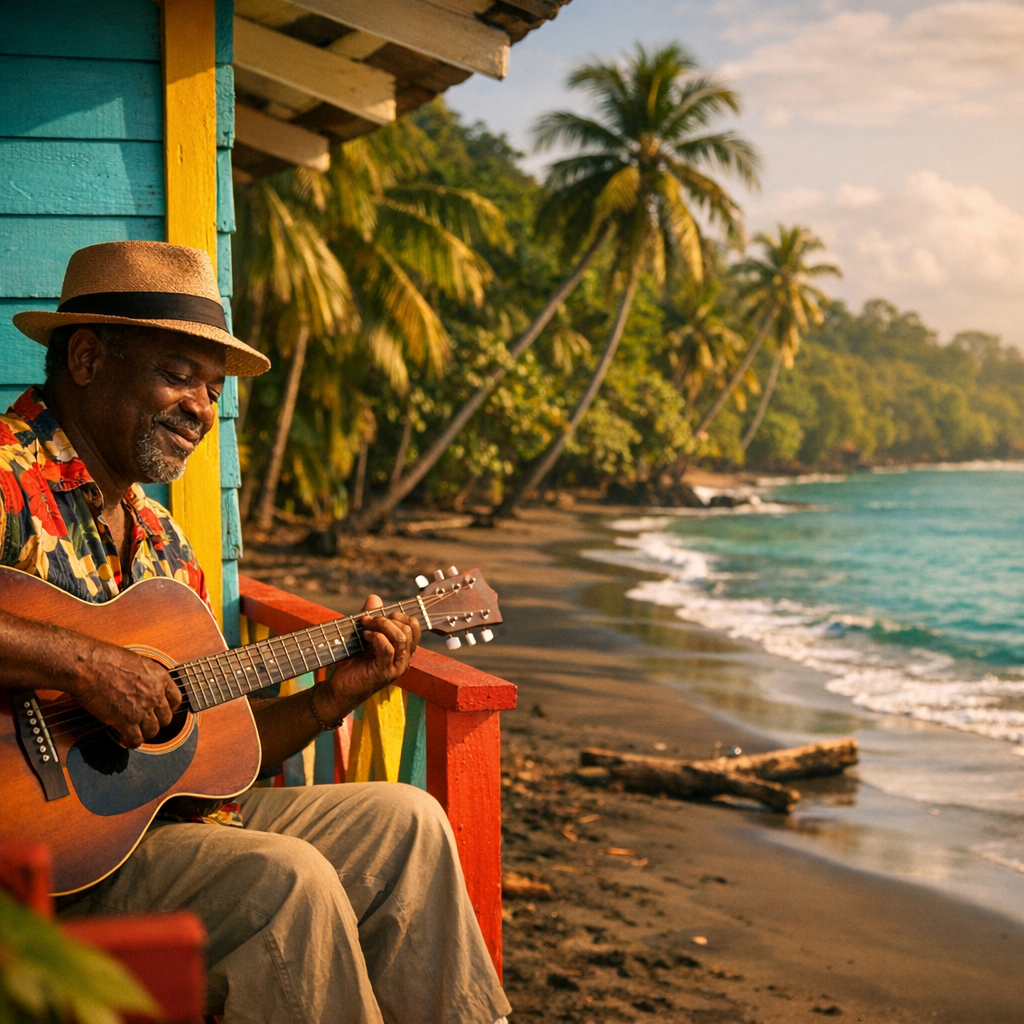
If Limón has a patron saint of music, it's Walter "Gavitt" Ferguson. Born in 1919 in Guabito, just across the border in Panama, Ferguson's family moved to Cahuita when he was a toddler, and he lived there for essentially the rest of his long life. Over more than seven decades he wrote roughly 200 calypso songs in Limonese Creole — wry, plainspoken narratives about fishing, farming, love, gossip, and daily life in a small Caribbean town, sung over acoustic guitar in a style directly descended from Trinidadian and Jamaican calypso traditions brought over by his community's ancestors.
Ferguson became known as the patriarch — the "king" — of Costa Rican calypso, and late in his life the country began formally recognizing what he'd built: Costa Rica established the Festival Internacional de Calypso Walter Ferguson in his honor in 2013, and in 2017 he received the country's Patrimonio Cultural Inmaterial "Emilia Prieto Tugores" award for intangible cultural heritage. Ferguson passed away in 2019, just short of his 100th birthday, but calypso is still very much alive in Cahuita — you'll find it on porches, in the annual calypso festival that bears his name, and in the guitars of the musicians who grew up learning his songs by ear.
Puerto Viejo vs. Cahuita: Which One Is Your Trip?
Puerto Viejo de Talamanca is the livelier, more built-up of the two — a compact beach town with a strong surf culture (Salsa Brava is one of the most respected reef breaks in Central America), a dense strip of restaurants, reggae bars, and guesthouses, and a diverse population that mixes Afro-Caribbean Limonenses, Bribri and Cabécar Indigenous communities, and a well-established international expat and backpacker scene. From Puerto Viejo, a single coastal road strings together the beaches of Playa Cocles, Playa Chiquita, and Punta Uva before ending at Manzanillo, gateway to the Gandoca-Manzanillo Wildlife Refuge.
Cahuita, twenty minutes up the coast, is quieter, smaller, and slower — the town where Walter Ferguson lived and where Afro-Caribbean culture feels least diluted by tourism infrastructure. Cahuita National Park, right at the edge of town, protects a stretch of coral reef, black-sand and white-sand beach, and rainforest trail where sloths, howler monkeys, and coatis are a near-guarantee, and the park operates on a "donation only" entrance fee for its main Kelly Creek entrance — a rarity in Costa Rican eco-tourism. If Puerto Viejo is the party, Cahuita is the porch.
Most travelers base in one and day-trip to the other; the two towns are close enough that you genuinely don't have to choose.
The Festival: Limón's Caribbean Carnival
Limón city, the provincial capital about an hour and a half up the coast from Cahuita, hosts Costa Rica's biggest and most under-the-radar Black culture celebration every October: Carnaval de Limón (also referred to in English as the Limón Carnival). It traces back to 1949, credited to Limón schoolteacher Alfred Henry King, who wanted to bring a Trinidad-and-Jamaica-style carnival tradition to the province. The celebration has historically been timed around October 12 — long known in Costa Rica as Día de la Raza or Columbus Day and now officially observed as Día de las Culturas (Day of Cultures) — and runs for roughly a week with parades, comparsas, elaborate costumes, calypso, soca, and reggae on outdoor stages, and food vendors selling rondón and patí late into the night.
A note on the name: this festival has been referred to under a few different labels over the decades — Carnaval de Limón, Limón Carnival, and simply "los Carnavales" — and exact week-by-week programming is set locally and can shift from year to year. Confirm the current year's official dates and branding directly with the Limón municipality or Costa Rica's tourism board (ICT) close to your travel dates rather than relying on any single older source. It's also worth knowing that Costa Rica separately observes Día de la Persona Negra y la Cultura Afrocostarricense (Afro-Costa Rican Culture Day) every August 31 — a national commemoration, distinct from the October carnival, that's also marked with events in Limón, including the "Grand Gala" cultural parade celebrating Afro-Costa Rican identity.
Where to Stay
Puerto Viejo: Small boutique hotels and beach cabinas dominate — expect jungle-and-ocean settings over big resort towers. Playa Cocles and Punta Uva have the area's most polished boutique properties; downtown Puerto Viejo has the cheapest hostels and guesthouses, walkable to nightlife.
Cahuita: Smaller and more low-key — beachfront cabinas and family-run guesthouses along Playa Negra and around the town center, most walkable to Cahuita National Park's entrance.
🏨 Book Puerto Viejo & Cahuita Stays →Getting There & Getting Around
Fly into San José's Juan Santamaría International Airport (SJO) — there's no commercial airport on the southern Caribbean coast. From San José, direct buses (the Caribe/MEPE line) run roughly 4 to 4.5 hours to Cahuita and Puerto Viejo, or you can drive/shuttle in about 3.5 hours via Guápiles and Limón city. Once you're there, rent a bike (the local default), grab a taxi, or use shared shuttle vans to move between beaches — a rental car is worth it if you want to explore independently or push further south to Manzanillo.
✈️ Find Flights to San José →Best Time to Visit
Counterintuitively, the Caribbean coast's driest stretch runs opposite the rest of Costa Rica's — September and October tend to be the sunniest, calmest window here (exactly when the rest of the country is in peak green-season rain), which also happens to line up with Carnaval de Limón. A secondary drier pocket runs February through March. Rain is possible almost any month on this coast, so pack for it regardless of when you go.
Budget Guide
Budget: $60-90/day — hostel or basic cabina, soda meals ($5-8), bike rental, free beaches and park trails.
Mid-range: $120-200/day — boutique cabina or small hotel, restaurant dining, a guided Cahuita National Park or wildlife tour.
Luxury: $250-400+/day — high-end jungle or beachfront villa, private tours, fine dining in Puerto Viejo's better restaurants.
Entry Requirements for US Citizens
US citizens do not need a visa to enter Costa Rica for tourism. A valid passport (with at least one blank page) and proof of onward or return travel are required at entry. Costa Rican immigration officers determine the exact length of stay granted at the border — historically around 90 days — and current regulations allow visa-exempt "Group One" visitors, including US citizens, up to a 180-day maximum stay per visit at the officer's discretion, with extensions available. Always confirm current entry requirements with the Costa Rican consulate or your airline before you travel, since rules can change.
Is It Safe?
Puerto Viejo and Cahuita are generally safe, laid-back beach towns and are visited by large numbers of international travelers every year without incident. As in any tourist area, petty theft (unattended bags and valuables on the beach, rental cars) is the main risk, not violent crime — use standard precautions, don't leave belongings unattended, and take official or hotel-arranged transport at night. Solo travelers, families, and Black travelers alike consistently report feeling welcome and comfortable in both towns, which isn't surprising in a place where Afro-Caribbean culture isn't a novelty — it's the culture.
BTN Insider Tips
Rent a bike on day one. Both towns are flat, compact, and built for it — it's the fastest way to get around and the best way to feel like a local.
Try rondón at a family-run soda, not a tourist restaurant. Ask around for whoever's grandmother is making it that week — the coconut seafood stew varies house to house and the best versions aren't on Google.
Learn a greeting in Mekatelyu. Locals notice — and appreciate — visitors who recognize that Creole is a real language here, not a novelty accent.
Time your trip around Carnaval de Limón if you want the biggest cultural payoff, but confirm that year's specific dates locally rather than assuming October 12 every year.
Don't skip Cahuita National Park's Kelly Creek entrance. The donation-based fee and easy trail make it one of the most accessible wildlife walks in the country.
Mark Your Calendar
- August 31 — Día de la Persona Negra y la Cultura Afrocostarricense (Afro-Costa Rican Culture Day), commemorated nationally with events in Limón
- October (around October 12, dates vary by year) — Carnaval de Limón, Costa Rica's biggest Afro-Caribbean carnival celebration
- Year-round — Live calypso most weekends in Cahuita and Puerto Viejo bars, carrying on the tradition Walter Ferguson built
Book Your Trip
Costa Rica sold the world on zip-lines and eco-lodges. It rarely mentions that its Caribbean coast is Jamaican in its bones — a place where the English creole your great-grandmother might recognize is still spoken on the porch, where calypso still plays live on a Friday night, and where the culture was built, brick by brick and track by track, by West Indian hands. Puerto Viejo and Cahuita are two of the most quietly significant Afro-diaspora destinations in Latin America, and almost nobody markets them that way. Now you know.
✈️ Book Your Costa Rica Caribbean Trip Now →*Affiliate links — BTN may earn a commission at no extra cost to you.