An Hour From the Resorts, a Nation Was Born Free
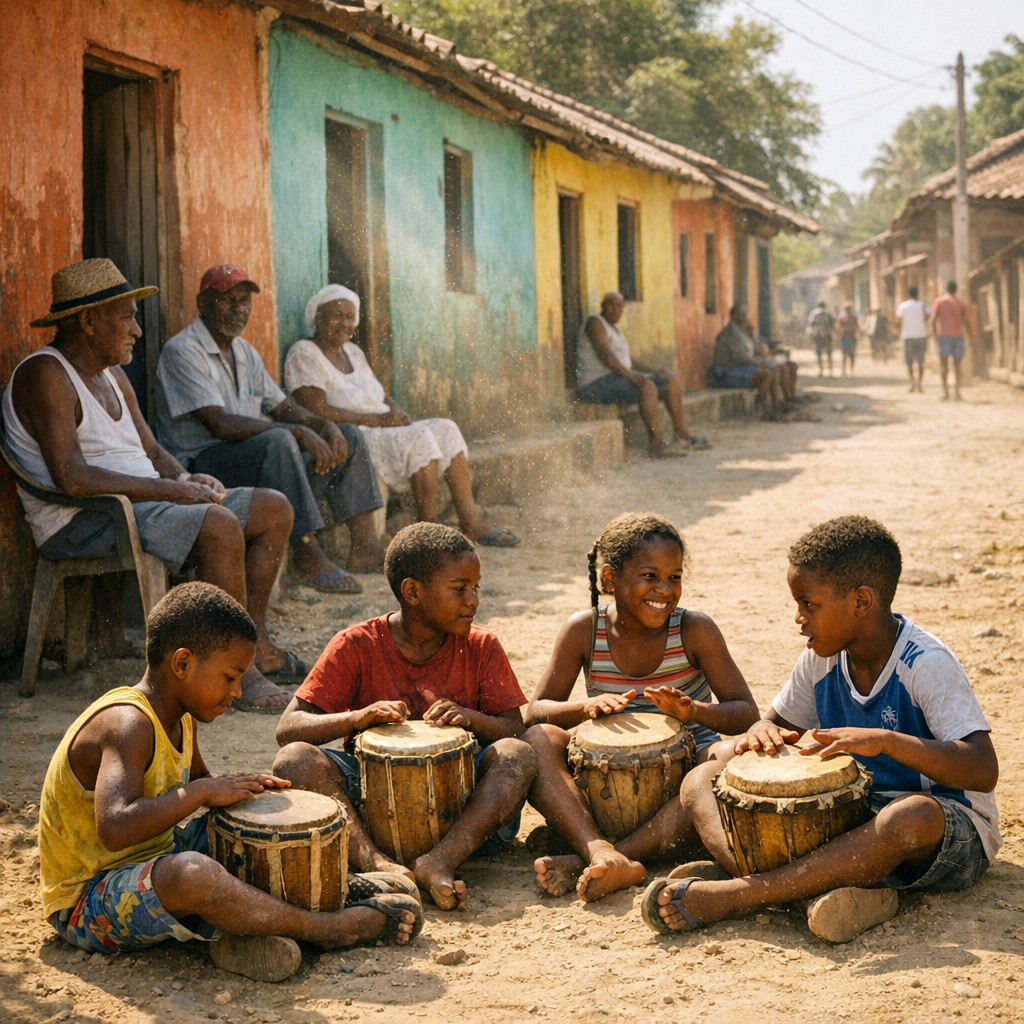
Drive an hour southeast out of Cartagena, past the last beach clubs and the last billboards for all-inclusive resorts, and the landscape changes. The Caribbean coastline gives way to the green foothills of the Montes de María, and the highway narrows into a dusty road lined with mango trees. At the end of that road is a town of brightly painted single-story houses, porches full of elders trading stories in the shade, and children drumming rhythms that are, quite literally, older than the United States of America.
This is San Basilio de Palenque. And its story is not a footnote to Cartagena's history — it is one of the most important chapters in the entire history of the African diaspora in the Americas.
While Cartagena's walled city was being built by enslaved hands to protect Spanish gold, a small number of those enslaved people were doing something almost unthinkable: escaping into the surrounding hills, organizing themselves into armed and fortified communities called palenques, and refusing to go back. San Basilio de Palenque is the last of those communities still standing, still speaking its own language, and still governing itself according to traditions its founders carried out of West and Central Africa more than four centuries ago.
Benkos Biohó and the Cimarrón Resistance
The man at the center of Palenque's origin story is Benkos Biohó, a leader believed to have been born in the Guinea-Bissau region of West Africa and brought to Cartagena de Indias in chains around 1596. He was sold more than once before escaping bondage — first when a transport vessel wrecked on the Magdalena River, and again, decisively, in 1599, when he fled into the marshy, forested terrain southeast of Cartagena.
What Biohó built next was not a hideout but an insurgency. He organized escaped Africans — known as cimarrones, or maroons — into a disciplined force that dominated the Montes de María region, raided Spanish supply lines, and ran an intelligence network guiding other enslaved people to freedom. Spanish accounts of the era describe him leading hundreds of armed cimarrones and being recognized, even by his enemies, as a king; colonial records call him the "king of Arcabuco."
By 1605, Biohó's resistance had become powerful enough that Cartagena's governor, Gerónimo de Suazo y Casasola, negotiated a peace agreement recognizing the autonomy of his community. That peace held, tenuously, until 1619, when Spanish authorities violated it and captured him. On March 16, 1621, Benkos Biohó was executed in Cartagena — hanged and quartered in the city's main square as a warning to any enslaved person who might follow his example.
It didn't work. His example is the reason this town exists today.
From One Man's Resistance to a Century-Long Fight for Freedom
Here is the part of the story that deserves care rather than shorthand: Benkos Biohó did not live to see his community's freedom formally recognized — he was executed nearly a century before that happened. What he left behind was more durable than a single victory: a fortified, self-governing settlement in the Montes de María that his community, and generations of cimarrones after him, defended for decades against repeated Spanish campaigns to retake it.
That settlement, first called Palenque de San Miguel Arcángel, finally forced the Spanish crown to formally recognize its freedom by royal decree in 1713, renaming it San Basilio Magno — the name it carries, shortened, today. That decree makes San Basilio de Palenque the first town in the Americas whose freedom was formally recognized by a European crown, roughly 150 years before emancipation in the United States and more than a century before Colombia's own independence from Spain.
It is a freedom won not in a single moment by a single hero, but through generations of cimarrones who refused, again and again, to be recaptured. Benkos Biohó lit the fire. His descendants and successors kept it burning until the Spanish crown had no choice but to acknowledge what the Palenqueros had already made true on the ground: they were free.
A Living Language: Palenquero
Walk through San Basilio de Palenque today and you will hear something you cannot hear anywhere else on Earth: Palenquero, the only Spanish-based creole language in South America. It is not a dialect and not broken Spanish — it is its own grammatical system, built from a Spanish vocabulary base fused with the grammar and structure of Kikongo and other Bantu languages carried from Central Africa. To an outside Spanish speaker, spoken Palenquero is largely unintelligible without study.
The language nearly disappeared in the 20th century as Spanish-language schooling pushed it out of public life, and by the early 2000s fewer than half of the town's residents still spoke it fluently. What has followed is a genuine cultural revival: Palenquero is now taught in the town's schools, documented in community-produced dictionaries, and treated as a source of collective pride rather than stigma. Hearing it spoken between neighbors on a front porch is one of the most quietly extraordinary experiences a diaspora traveler can have anywhere in the Americas.
UNESCO Recognition and a Culture Kept Whole
In 2005, UNESCO proclaimed the "Cultural Space of Palenque de San Basilio" a Masterpiece of the Oral and Intangible Heritage of Humanity — a designation reserved for cultural practices of exceptional and fragile global significance. The recognition covers the whole living system: the Palenquero language, the kuagros (the community's age-based cooperative work and social organizations, a direct echo of West and Central African social structures), and the lumbalú, a funerary ritual of drumming, song, and collective mourning with clearly traceable Bantu roots.
This is not a museum culture, performed for visitors and then set aside. Kuagros still organize labor and mutual aid in the town today. Lumbalú is still practiced when a member of the community dies. The drumming you'll hear in the street is not a show — it is how Palenque has always talked to itself.
Music, Boxing, and Palenque's Larger-Than-Life Sons
For a town of roughly 3,500 people, Palenque's cultural output is wildly disproportionate to its size. Antonio Cervantes, known as "Kid Pambelé," became a two-time world boxing champion and one of Colombia's most celebrated athletes; brothers Ricardo and Prudencio Cardona followed him into world championship boxing from the same small streets. Musician Rafael Cassiani Cassiani helped carry Palenque's drumming traditions onto the world stage through the group Sexteto Tabalá, one of the most important traditional Afro-Colombian music ensembles in the country. Actor Evaristo Márquez, discovered in Palenque, starred opposite Marlon Brando in the 1969 film Burn! Every one of these stories traces back to the same small plaza.
Every October, the town hosts its Festival de Tambores y Expresiones Culturales (Drums and Cultural Expressions Festival), a full showcase of Palenque's percussion traditions, dance, and oral history that draws visitors and researchers from across the world.
Must-Try Food
- Mote de queso — a hearty stew of catfish, yuca, and local cheese, one of the signature dishes of the Caribbean coast's interior communities.
- Coastal seafood rice — coconut-based rice preparations shared with the broader Caribbean coast but cooked here with distinct local seasoning.
- Smoked catfish in coconut cream sauce — a slow, smoky preparation typical of Montes de María river communities.
- Dulces de coco — coconut sweets sold by Palenqueras, the iconic fruit-basket vendors whose ancestral home is this town. (Palenque's own cookbook, Kumina ri Palenge pa tó paraje, won a Gourmand World Cookbook Award in 2014.)
How This Is Different From Our Cartagena Guide
BTN's Cartagena, Colombia guide covers the walled city, Getsemaní, the beaches, and the broader Afro-Colombian food and nightlife scene — and it mentions Palenque briefly as an essential day-trip highlight. This guide is the deep version of that mention. If Cartagena is where you'll eat, sleep, and dance, Palenque is where you go to sit with the history that makes Cartagena's Afro-Colombian identity possible in the first place. Read the Cartagena guide for your base of operations. Read this one to understand the town that came before, and alongside, the resort city an hour up the road.
Visiting Palenque: Practical Info and Community Etiquette
Almost every visitor sees Palenque as a guided day trip from Cartagena, and that is the right way to do it. This is a living community, not a heritage theme park, and the way you show up matters.
- Go with a guide, ideally one from the community. Several Cartagena-based tour operators run small-group day trips with local Palenquero guides; the history and language come across completely differently from someone whose family lived it.
- Ask before photographing people. Palenque is not a photo backdrop. A smile, a greeting, and a question go a long way.
- Spend money in the community. Buy food, crafts, and drinks locally — tourism revenue is one of the town's few consistent economic engines.
- Learn a Palenquero greeting before you go. It costs nothing and is noticed every time.
Getting There
Fly into Cartagena's Rafael Núñez International Airport (CTG), which has direct flights from Miami, Fort Lauderdale, New York, and Toronto, among other cities. From Cartagena, Palenque is roughly 50 kilometers (about an hour) southeast in the Montes de María foothills, reachable by organized tour, hired driver, or public bus toward San Jacinto/Mahates. There is no reason to attempt this without local arrangement — book a day tour out of Cartagena and let a Palenquero guide take you the rest of the way.
✈️ Find Flights to Cartagena →Visa Requirements for US Citizens
US citizens do not need a visa to visit Colombia for tourism. On arrival, you'll receive a tourist entry permit valid for up to 90 days, which can typically be extended once for a combined stay of up to 180 days within a single calendar year. You'll need a US passport valid for at least six months beyond your entry date and proof of onward or return travel. A day trip to Palenque requires no separate paperwork beyond your standard Colombia entry.
Best Time to Visit
Palenque shares Cartagena's coastal Caribbean climate: December through April is the dry season, with the most reliable weather for a day trip. The rainy season (May through November) brings afternoon showers that are usually brief, though unpaved sections of the road can turn muddy after heavy rain. If your trip lines up with October, plan around the Festival de Tambores for the fullest possible experience of Palenque's living culture.
Budget Guide
Day-trip cost: $40–90 per person — guided small-group tours from Cartagena, including transport, a local guide, and lunch, typically fall in this range. Private guides and customized visits run higher.
Where you'll actually spend the night: Cartagena. Most travelers base themselves there (see BTN's Cartagena guide for lodging) and visit Palenque as a single, focused day trip rather than an overnight stay, though some community-run guesthouses do exist for travelers who want more time in the town itself.
BTN Insider Tips
Don't treat this as a quick photo stop. Budget a half to a full day — the value of Palenque is in the conversations, not a drive-through.
Buy from the Palenqueras directly, in Cartagena and in Palenque itself. The fruit-basket vendors you'll see in the old city are ambassadors of this exact town and its history.
Bring cash in small denominations; community vendors and guides generally can't process cards.
Approach the history with weight. This is the site of one of the only successful, sustained wars for freedom won by enslaved Africans anywhere in the hemisphere. Treat it accordingly.
Is Palenque Safe for Black Travelers?
San Basilio de Palenque is considered very safe for visitors, including solo Black travelers, and its residents are generally warm and welcoming to diaspora visitors who arrive with genuine respect and curiosity. As with any rural day trip in Colombia, travel with a reputable tour operator, avoid arriving after dark, and keep valuables minimal and low-profile. The greater practical risk on this trip is logistical (unpaved roads, midday heat) rather than personal safety.
Mark Your Calendar
- October — Festival de Tambores y Expresiones Culturales (Drums and Cultural Expressions Festival), Palenque's signature celebration of its music and oral traditions.
- March 16 — Commemorations of Benkos Biohó's 1621 execution are held in Cartagena and the surrounding region, honoring his legacy as a founding father of Black freedom in the Americas.
- Year-round — Day tours run regularly from Cartagena; weekday visits tend to be quieter and more personal than weekend group tours.
Book Your Trip
San Basilio de Palenque is an hour from Cartagena's resorts and a world away from its tourist strip — a living town built by people who decided freedom wasn't something to wait for. Pair it with a Cartagena stay, bring your full attention, and go.
✈️ Book Your Cartagena & Palenque Trip →*Affiliate links — BTN may earn a commission at no extra cost to you.