The Instagram Shot Skips the Story
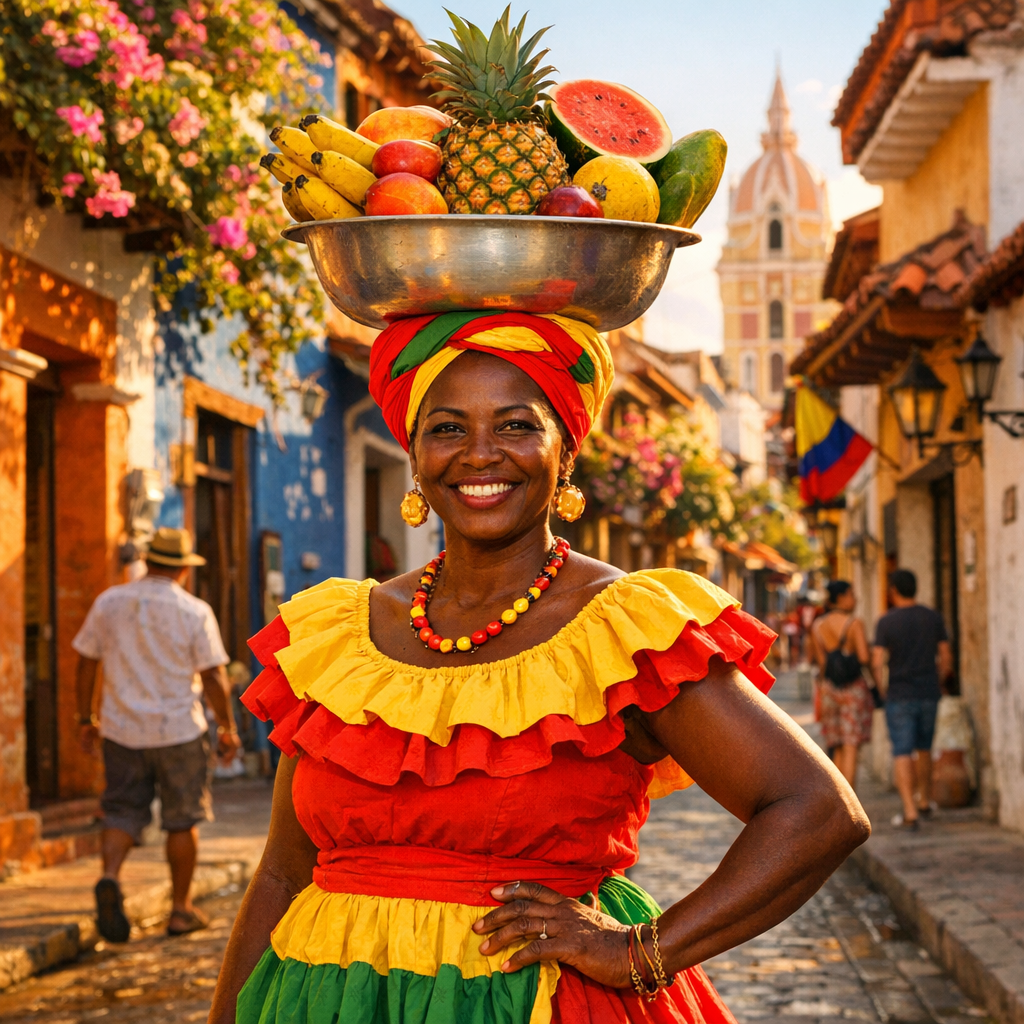
Everyone's Cartagena photo looks the same: a pastel balcony dripping in bougainvillea, a Palenquera in a canary-yellow dress balancing a bowl of mango and papaya on her head, a horse-drawn carriage clattering over cobblestones inside the Walled City. It's a beautiful shot. It is also, on its own, an incomplete one — because the culture that photograph is borrowing from was built entirely outside those walls, by people the walls were built to keep out.
This guide stays close to the ground in the two places where that culture actually lives: Getsemaní, the neighborhood that grew up on the wrong side of Cartagena's fortifications, and the Palenqueras themselves, the fruit vendors whose vivid dress has become the city's unofficial logo. Both deserve more than a photo caption.
Getsemaní: Built Outside the Walls, Now at the Center of the City
When Spanish engineers designed Cartagena's defenses in the 1600s, the walled peninsula housed the colonial elite, the churches, the government buildings, and the garrisons. Getsemaní, sitting just outside those fortifications on its own small island, was where the city's dockworkers, artisans, market vendors, and enslaved and free Afro-Colombian laborers actually lived. It was a working neighborhood in the truest sense — the labor that kept Cartagena running, housed a few hundred meters from the wealth it produced but never fully inside it.
For most of the 20th century, Getsemaní stayed exactly that: a dense, low-income, overwhelmingly Afro-Caribbean neighborhood that tourism ignored, and that by the 1980s and '90s had a reputation for street crime serious enough that guidebooks told visitors to stay inside the Walled City after dark. That reputation, and the neglect behind it, is precisely what let Getsemaní keep its own culture intact while the old city polished itself into a UNESCO showpiece.
The turnaround came from the neighborhood itself. Community-led mural projects transformed block after block into open-air galleries — portraits of local elders, Afro-Colombian folklore figures, political statements, abstract color work — to the point that Getsemaní is now sometimes called Cartagena's "Ciudad Mural." Plaza de la Trinidad, the neighborhood's historic heart, went from a quiet local gathering spot to the liveliest public square in the city after dark, with street food vendors, impromptu champeta and salsa dancing, and a crowd that's still majority Cartagenero rather than tourist on any given weeknight. Hostels, boutique hotels, and some of the city's best restaurants have since moved in. What hasn't moved out is the neighborhood's Afro-Caribbean identity — it's just louder and more visible now than it's been in generations.
The Palenqueras: Cartagena's Most Photographed, Least Understood Symbol
The women in the vivid dresses — often yellow, red, and green, the same palette Colombia's Caribbean coast wears everywhere from flags to fruit stands — are Palenqueras, and they are not a tourism invention. Traditionally, Palenqueras trace their ancestry to San Basilio de Palenque, a town about an hour southeast of Cartagena founded by self-liberated Africans in the early 1600s and formally recognized as free by the Spanish crown in 1713 — the first town in the Americas to win that recognition. Selling fruit and sweets in Cartagena's streets, a trade Palenquera women have carried on for generations, is a direct economic and cultural extension of that town into the city.
BTN covered San Basilio de Palenque's full history — Benkos Biohó's resistance, the Palenquero creole language, the UNESCO-recognized living culture — in a dedicated deep-dive guide to Palenque itself. That guide is the one to read if you want to understand where the Palenqueras come from and are considering the day trip out to see it firsthand. This guide's job is narrower and more immediate: what it means to encounter that same heritage inside Cartagena, on foot, without a tour van.
A few things worth knowing when you do: buying fruit or sweets from a Palenquera is a real, direct economic transaction with a living community, not a photo prop transaction. If you want a photograph, ask first and expect to pay a small fee for it — a longstanding and fair practice, given how often Palenqueras are photographed without payment or consent. A little Spanish and a genuine "buenas" goes a long way toward turning a two-second interaction into an actual conversation.
Cartagena's Slave-Trade History and the Palace of the Inquisition
The colorful walls exist because Cartagena de Indias was, for roughly two centuries, one of the most important ports in the Spanish transatlantic slave trade in the Americas. Under the asiento system, the Spanish crown licensed other European trading companies to bring enslaved Africans into its colonies, and Cartagena's harbor — the best natural port on South America's Caribbean coast — became a primary entry point, with an enslaved-persons market historically centered around what is now the Plaza de los Coches, just inside the old city walls. Much of the Walled City's fortifications and the massive Castillo San Felipe de Barajas fortress were themselves built using enslaved African labor.
The same city that ran that market also housed a tribunal of the Spanish Inquisition, and its seat — the Palace of the Inquisition, a grand colonial building fronting the Plaza de Bolívar inside the Walled City — is now a museum. It's best known for its collection of colonial-era religious and judicial artifacts, including instruments used in Inquisition-era trials. It's an uncomfortable, necessary stop: the Inquisition and the machinery of slavery operated in the same city, often reinforcing the same colonial hierarchy, and Cartagena's museums and historians are increasingly connecting those threads explicitly rather than treating them as separate exhibits. Visiting the Palace of the Inquisition alongside Getsemaní and a conversation with a Palenquera gives you a fuller, harder-edged version of Cartagena's history than the postcard version ever will.
How This Guide Is Different From BTN's Other Cartagena Coverage
BTN's general Cartagena guide is your resource for hotels, flights, beaches, restaurants across the whole city, and overall trip logistics — read that one first to plan where you'll sleep and eat. BTN's San Basilio de Palenque guide is the deep heritage day trip, an hour outside the city, for travelers who want the full history of the Palenqueras' ancestral home. This guide sits between them: it's entirely city-based and requires no day trip, and it exists specifically to give Getsemaní and the Palenqueras themselves the dedicated, unhurried attention a single paragraph in a broader city guide can't provide. Read this one for the neighborhood walk and the history that made it; use the other two guides for your base of operations and your day-trip planning.
What to Do: A Getsemaní Afternoon and Evening
- Walk the murals with a local guide. Several Getsemaní-based walking tours, often led by neighborhood residents or Afro-Colombian artists, explain the meaning behind specific murals rather than just photographing them. This is the single best way to understand the neighborhood's identity.
- Spend an evening at Plaza de la Trinidad. Arrive around sunset and stay past dark. Street food, live and recorded champeta, and a crowd that's genuinely local make this one of the best free experiences in the city.
- Buy directly from Palenqueras on Calle del Guerrero and around the Torre del Reloj. Bring small bills, ask before photographing, and try the dulces de coco alongside the fresh fruit.
- Catch live Afro-Colombian music. Getsemaní has a growing cluster of small venues built around champeta, salsa, and Caribbean coastal rhythms — ask your guesthouse for the current lineup, as venues rotate.
- Cross into the Walled City for the Palace of the Inquisition. It's a short walk from Getsemaní across the Puente Román and worth pairing with Las Bovedas and Plaza de los Coches for the fuller historical arc.
Must-Try Food in Getsemaní
- Carimañolas — fried yuca dumplings stuffed with meat, sold from doorways and street corners throughout the neighborhood.
- Arepas de huevo — fried corn arepas with an egg cooked inside, a Caribbean coast breakfast staple.
- Empanadas and patacones — ubiquitous, cheap, and best bought from whichever stand has the longest local line.
- Dulces de coco and fresh tropical fruit — sold by Palenqueras throughout the neighborhood; this is the most direct, everyday way to support Palenquera vendors.
- Arroz con coco — coconut rice served alongside fried fish at Getsemaní's sit-down restaurants, a coastal Colombian staple with African culinary roots.
Getting There and Around
Fly into Rafael Núñez International Airport (CTG), which has direct flights from Miami, Fort Lauderdale, New York, and Toronto. Getsemaní sits immediately next to the Walled City, connected by the Puente Román footbridge, and is entirely walkable on its own. Uber and official taxis are the safest way to reach Getsemaní from the airport or from beach areas farther out; within the neighborhood itself, everything worth seeing is within a 15-minute walk.
✈️ Find Flights to Cartagena →Visa Requirements for US Citizens
US citizens do not need a visa to enter Colombia for tourism. On arrival you'll receive an entry stamp valid for up to 90 days, extendable in most cases for a combined stay of up to 180 days within a calendar year. You'll need a passport valid through your planned stay and proof of onward travel. No separate paperwork is required for time spent in Getsemaní versus anywhere else in Cartagena.
Best Time to Visit and Budget
Getsemaní shares Cartagena's climate: December through April is the dry season and the most comfortable time to spend long stretches walking the neighborhood outdoors. May through November brings brief afternoon showers and noticeably fewer tourists. Budget guesthouses and hostels in Getsemaní run $30–80/night, generally cheaper than equivalent boutique stays inside the Walled City, with street food meals costing $2–5. See BTN's general Cartagena guide for a full citywide budget breakdown across all lodging tiers.
BTN Insider Tips
Stay in Getsemaní instead of the Walled City if you can. You'll pay less, eat better, and be steps from the neighborhood's nightlife rather than a taxi ride away from it.
Ask before you shoot. Whether it's a mural artist's work, a Palenquera's portrait, or a stranger on Plaza de la Trinidad, a quick ask and a small tip or purchase go further than a candid photo ever will.
Go at night, not just during the day. Getsemaní's energy is fundamentally an evening thing — the murals photograph fine at noon, but the neighborhood itself comes alive after sunset.
Pair this trip with the Palenque day trip. Seeing the Palenqueras in Cartagena and then visiting San Basilio de Palenque itself, even just once, changes how you see the fruit vendors for the rest of your trip.
Is Getsemaní Safe for Black Travelers?
Getsemaní today is one of the more heavily visited and generally safe neighborhoods in Cartagena, a significant change from its reputation a generation ago, though standard urban caution still applies: stick to well-lit, populated streets after midnight, use Uber over unmarked taxis for longer trips, and keep valuables minimal. Black travelers, including women traveling solo, generally report feeling welcomed and unremarkable here — a reflection of the neighborhood's own Afro-Caribbean identity. Persistent (but rarely dangerous) approaches from vendors and touts are common; a calm, repeated "no, gracias" works.
Book Your Trip
Getsemaní and the Palenqueras are not a footnote to Cartagena's beauty — they're a big part of where it comes from. Spend real time here, spend money directly with the people who built this culture, and pair it with BTN's full Cartagena guide and the San Basilio de Palenque day trip for the complete picture.
✈️ Book Your Cartagena Trip →*Affiliate links — BTN may earn a commission at no extra cost to you.