A Neighborhood Built From Memory
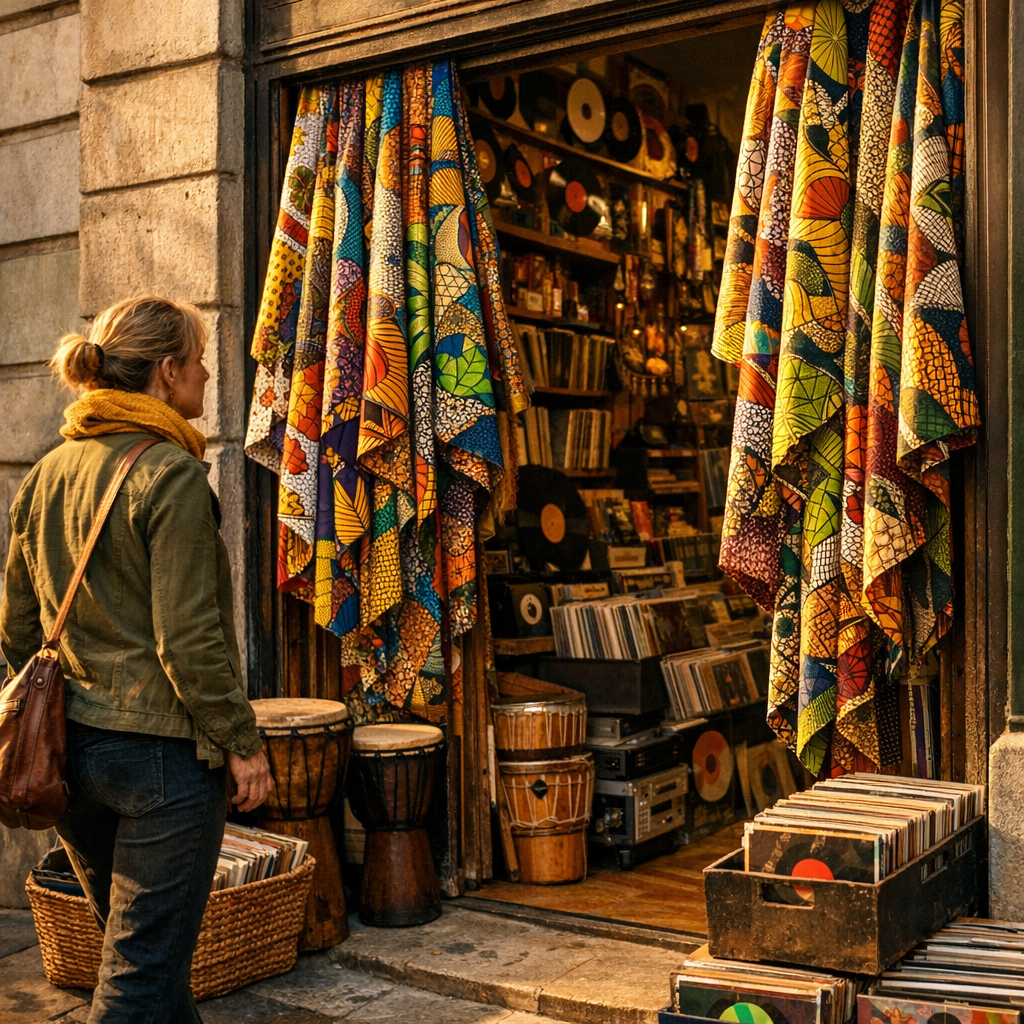
Walk ten minutes south from the glass towers of the European Parliament in Brussels and the city changes completely. The EU flags disappear. The air smells like fried plantain and palm oil. Congolese rumba spills out of record shop doorways. Women get their hair braided in salons with hand-painted signs, fabric shops overflow with wax-print textiles in every color, and restaurant menus are written in French with dishes that have nothing to do with Belgian waffles or moules-frites.
This is Matonge — a few blocks of Ixelles, centered on the Porte de Namur, that Brussels' Congolese community built into a living piece of Kinshasa. It is one of the most culturally significant Black neighborhoods in Europe, and understanding why it exists at all means reckoning with one of the most violent chapters of European colonialism.
Belgium's Congo: The History Behind the Name
In 1885, at the Berlin Conference where European powers carved up Africa among themselves, King Leopold II of Belgium secured personal ownership of a territory roughly 76 times the size of Belgium itself. He called it the Congo Free State — and framed it publicly as a humanitarian and civilizing project. It was neither free nor a state. It was Leopold's private property, run for his personal profit, and it became the site of one of the most documented atrocities of the colonial era.
To extract ivory and, later, rubber at maximum volume, Leopold's administration imposed forced-labor quotas on Congolese communities, enforced by a colonial militia called the Force Publique. Villages that failed to meet rubber quotas faced mutilation, hostage-taking, and massacre; soldiers were required to present severed hands as proof they had not "wasted" bullets, and baskets of severed human hands became, grimly, an emblem of the regime. Population estimates from the period are contested and imprecise — a 1919 Belgian government commission suggested the population had been cut roughly in half, and historians' estimates of deaths from violence, disease, and starvation during this era range from roughly 1 million to as many as 10 million people. Whatever the precise number, it represents a catastrophe on an almost unimaginable scale, inflicted for profit.
Exposure came through the work of journalists, missionaries, and reformers — most notably the British diplomat Roger Casement, whose 1904 report documented the abuses in detail, and campaigner E.D. Morel, who led the Congo Reform Association. International outrage grew loud enough that Leopold could no longer defend his personal rule. In November 1908, the Belgian Parliament annexed the territory from its own king, converting it into an official state colony: the Belgian Congo. This is the origin point of the 1908-1960 dates you'll see attached to this history — the period after Leopold's personal, unregulated brutality gave way to a more bureaucratic, but still exploitative, colonial administration.
Belgian Congo continued to extract labor, minerals, and agricultural exports — copper, diamonds, uranium, cotton, coffee — while imposing racial segregation, curfews for Congolese residents, and sharp limits on education and advancement for the colonized population. Reforms in the 1950s expanded schooling and healthcare, but political power remained entirely in Belgian hands. Congolese-led political movements, including Patrice Lumumba's Mouvement National Congolais, pushed for independence through the late 1950s, and after unrest in Leopoldville (now Kinshasa) in January 1959, Belgium abruptly agreed to decolonize. The Republic of the Congo became independent on June 30, 1960, with Lumumba as its first prime minister. Independence did not bring peace — the Congo Crisis followed almost immediately, and Lumumba was assassinated in January 1961, a rupture whose consequences shaped Congolese and Central African politics for decades.
That history — the Congo Free State's atrocities, the Belgian Congo's colonial rule, and a hard-won independence — is the reason there is a Congolese diaspora in Brussels at all. Matonge exists because Belgium colonized the Congo, and because Congolese people, students first and then whole families, made new lives in the capital of the country that had once ruled theirs.
How Matonge Got Its Name
The neighborhood's story in Brussels starts in the late 1950s, when the Maison Africaine (Maisaf), a residence for African — largely Congolese — university students, opened near the Porte de Namur. It gave Congolese students a foothold in Ixelles years before Congo's independence. After 1960, as Congolese migrants, diplomats, and eventually refugees settled in Brussels in greater numbers, they gravitated to these same few streets and gradually built a commercial and social hub that mirrored home.
They named it after Matongé, the bustling market district of the Kalamu commune in Kinshasa — a direct, deliberate echo of a neighborhood back home, recreated street by street in a European capital. Today, more than 45 nationalities live and work in Matonge, including sizable communities from Rwanda, Burundi, Cameroon, Mali, and Senegal, but its Congolese identity remains its cultural anchor.
Matonge Today: A Living Piece of Kinshasa in Europe
Matonge is compact — centered on the Chaussée de Wavre and radiating out from the Porte de Namur — and it rewards slow, on-foot exploration. The Galerie d'Ixelles and the Galerie de la Porte de Namur, two covered shopping arcades, are the commercial heart of the neighborhood: dozens of small businesses packed close together selling African fashion, cosmetics, phone accessories, and imported goods.
- Fabric shops stacked floor to ceiling with wax-print and Congolese textiles, many custom-tailored on-site.
- Hair-braiding salons lining nearly every block, some open well into the evening.
- Record shops specializing in Congolese rumba, soukous, and contemporary Congolese hip-hop and gospel.
- Congolese restaurants and snack bars, from sit-down spots to quick counters selling fried plantain and grilled fish.
- Hair and beauty product stores catering specifically to Black and mixed-textured hair, some of the first and most established of their kind in Belgium.
Where to Eat
Poulet à la moambe — Congo's national dish, chicken stewed in a rich palm-nut sauce, usually served with rice and a side of saka saka (pounded cassava leaves). It's the dish to order on your first visit to any Matonge restaurant.
Fufu — a starchy dough made from cassava or plantain, meant to be torn by hand and used to scoop up stews. It's a staple across Central Africa and widely available in Matonge's restaurants.
Makayabu — dried and grilled or fried fish, often salted cod, served with plantains and pili-pili sauce for heat.
Mikate — small, dense Congolese doughnuts, sold fresh from street vendors and snack counters; an easy, cheap way to sample the neighborhood while walking.
Primus and Skol — Congolese and regional beers on tap or in bottles at most Matonge restaurants and bars, often the social centerpiece of an evening out.
Where to Stay
Matonge sits in Ixelles, one of Brussels' most walkable and centrally located communes, within easy reach of the European Quarter, the Grand Place, and the city's museum district.
Luxury: Hotels near Avenue Louise and the European Quarter offer five-star service within a short walk or tram ride of Matonge, ideal for travelers who want proximity without staying directly in the neighborhood's busiest commercial blocks.
Mid-Range: Ixelles and nearby Saint-Gilles have a strong selection of boutique and business hotels in the $120-200/night range, many within a 10-15 minute walk of Porte de Namur.
Budget: Hostels and budget guesthouses around Brussels-South (Midi) station and Saint-Gilles offer clean, well-located rooms from roughly $60-100/night, with easy tram access into Matonge and the city center.
🏨 Book Brussels Hotels →Getting There
Brussels Airport (BRU) has direct flights from New York (JFK), Washington DC (IAD), Newark, and Atlanta via Delta, United, and Brussels Airlines, along with strong connections to Kinshasa, Kigali, Lagos, and other African hubs — a reminder of how tightly linked Brussels remains to Central Africa. From the US East Coast, nonstop flights run around 8 hours. From the airport, Matonge is roughly 15-20 minutes by taxi or a short train-plus-tram combination into the city center.
✈️ Find Brussels Flights →Getting Around
Brussels' metro, tram, and bus network (STIB/MIVB) connects directly to Matonge at the Porte de Namur stop, and the neighborhood itself is entirely walkable — most of it can be explored on foot in a single afternoon. Uber and licensed taxis operate throughout the city for trips further afield.
Best Time to Visit
Brussels is mildest and most pleasant from April through June and again from September through October, with temperatures in the 60s-70s°F and fewer crowds than peak summer. Winters are cold and gray, though the city's Christmas markets add their own appeal. Matonge is a year-round destination — its restaurants, shops, and salons operate regardless of season — but outdoor festival season (roughly May through September) is the liveliest time to experience the neighborhood's community events.
Budget Guide
Budget: $100-150/day — hostel or budget guesthouse, Matonge restaurant meals ($8-15 each), public transit, free walking exploration of the neighborhood.
Mid-range: $180-280/day — boutique hotel, mix of Congolese and Belgian dining, museum entries, day trips.
Luxury: $350-500+/day — five-star property, private guided tours, fine dining across the city.
Visa & Entry Requirements for US Citizens
US citizens can currently enter Belgium visa-free for tourism or business for up to 90 days within any 180-day period, under the Schengen Area's standard rules. Your passport must be valid for at least three months beyond your planned departure from the Schengen Area and have at least two blank pages. Be prepared to show proof of onward travel and sufficient funds at the border. Entry rules can change, so confirm current requirements with the US State Department's Belgium travel page before you fly.
BTN Insider Tips
Visit on a weekend afternoon. Matonge is at its liveliest on Saturdays, when shops are fully open and the neighborhood's social rhythm is easiest to feel.
Approach the colonial history seriously. Brussels has a small but growing number of museums and memorials addressing this history honestly, including revised exhibits at the AfricaMuseum in Tervuren, just outside the city — worth a half-day visit to pair with your time in Matonge.
Bring cash for smaller shops and food stalls, though most restaurants and larger stores accept cards.
Learn a few words of Lingala or Congolese French — even a simple greeting is warmly received by shop owners and restaurant staff.
Combine it with the rest of Brussels. Matonge is a 15-20 minute walk from the Grand Place, making it easy to pair with the city's more typical tourist circuit.
Is Matonge Safe for Black Travelers?
Matonge is a busy, welcoming commercial neighborhood and generally safe to walk during the day and early evening, with the ordinary big-city precautions of watching your belongings in crowded arcades and being aware of your surroundings at night. Black travelers, and especially members of the African and Caribbean diaspora, frequently describe Matonge as a place where they feel immediately at home — a rare experience in much of Western Europe. As with any dense urban commercial district, exercise standard caution late at night and keep valuables secure in crowded shopping arcades.
Mark Your Calendar
- Matongé en Couleurs — an annual street festival (running since 2001) celebrating Congolese and African culture through music, food, and fashion, typically held in the summer.
- June 30 — Congolese Independence Day, marked by community gatherings and events within the Congolese diaspora in Brussels.
- Year-round — Congolese live music nights at Matonge's bars and restaurants, especially rumba and soukous performances on weekends.
Book Your Brussels Trip
Matonge is a short walk from the EU's corridors of power and a world away from the postcard image of Brussels — a neighborhood built by history's hardest chapter and sustained by the community that survived it. Go for the food, the fabric, and the music, and leave with an understanding of Belgium's colonial past that most travelers never get.
✈️ Book Your Brussels Trip Now →*Affiliate links — BTN may earn a commission at no extra cost to you.